

You might think the biggest hurdle in 2026 is the 7.2% minimum wage increase across Vietnam, but the real challenge is finding a factory that truly understands your technical specs. I’ve seen too many brands get burned by communication gaps or factories that simply can’t source specialized performance fabrics like Nuyarn. If you’re looking for vietnam custom garment manufacturing, you need more than just a vendor. You need a partner that handles the new EU Digital Product Passport requirements and the standard MFN tariff rates that returned after the February 20, 2026, U.S. Supreme Court ruling.
I know how exhausting it is to manage a fragmented supply chain where quality fluctuates with every shipment. I’ll show you exactly how to find a reliable partner that handles everything from tech packs to bulk delivery. I’m going to break down the shift toward high-value products, the impact of the EVFTA fabric-forward rules, and my personal blueprint for securing a one-stop solution. This guide ensures your brand stays competitive as Vietnam’s textile industry targets $50 billion in export revenue this year.
Key Takeaways
- I’ll explain why I’m seeing a major shift toward Vietnam and how choosing between OEM and ODM models defines your brand’s operational success in 2026.
- You’ll learn my exact workflow for refining tech packs and why I insist on a perfect “Golden Sample” before bulk production begins.
- I’ll show you how we use laser cutting and bonding to master vietnam custom garment manufacturing, providing the technical precision required for high-end activewear.
- I’ll share my strategy for sourcing recycled polyesters and natural fibers to help your supply chain comply with the latest EU environmental regulations.
- I’ll provide the specific questions every brand needs to ask to secure a reliable, long-term partnership instead of a simple vendor relationship.
Why I believe Vietnam is the sweet spot for custom garment manufacturing in 2026
I’ve noticed a massive shift in how brands approach production lately. My clients aren’t just looking for the lowest labor costs; they’re looking for stability and technical maturity. While China was the default for decades, the move toward Vietnam has accelerated in early 2026. This isn’t just a temporary trend. It’s a strategic pivot driven by the sophistication I see every day in Vietnam’s manufacturing sector. When I talk about vietnam custom garment manufacturing, I’m referring to a highly developed ecosystem that can handle everything from high-street fashion to elite performance gear.
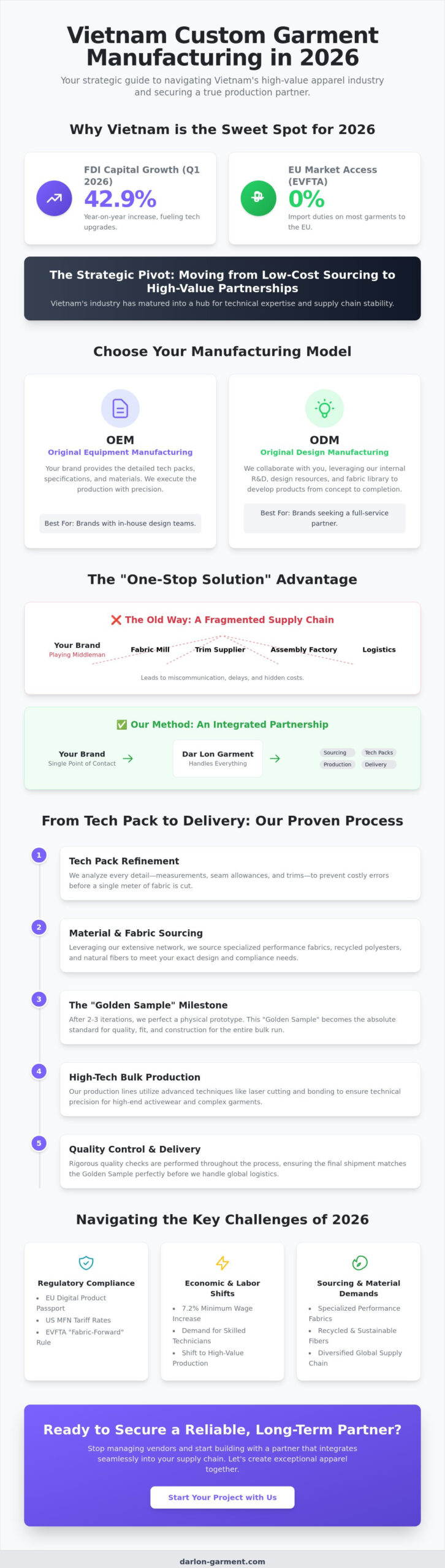
I often have to clarify what “custom manufacturing” means for my partners. In our factories, we work through two main models: OEM and ODM. OEM, or Original Equipment Manufacturing, is where you provide the tech packs and I handle the physical production. ODM, or Original Design Manufacturing, is more collaborative. I use my factory’s internal resources to help you develop products from scratch. Both paths now benefit from the 42.9% year-on-year increase in FDI we saw in the first quarter of 2026. This influx of capital has allowed me to upgrade our lines with the latest tech, making 2026 the year of “Smart Sourcing.” It’s no longer just about the bottom dollar; it’s about how fast I can get your product to market and how agile we can be when trends shift.
In Ho Chi Minh City, I see a unique blend of skilled craftsmanship and massive industrial capacity. We’ve moved beyond basic assembly. My team combines decades of sewing experience with high-volume efficiency. This balance is rare. It allows me to maintain the quality of a boutique workshop while meeting the demands of global retail chains. We’re currently on track to help the national industry hit its $50 billion export target for 2026, and you can feel that momentum on every factory floor.
The ‘One-Stop’ advantage I offer my partners
Managing a supply chain is an absolute headache. I’ve seen brands struggle because they’re trying to coordinate five different vendors for a single jacket. I prefer a different way. I handle everything from the initial fabric sourcing to the final logistics. This one-stop approach eliminates the hidden costs of time-zone delays and miscommunications that usually plague overseas production. When you have me as your single point of contact, nothing gets lost in translation. I make sure your vision stays intact from the first stitch to the final shipping container, saving you the stress of playing middleman between your own suppliers.
Vietnam’s evolving role in the global supply chain
Vietnam’s role in the world has changed. We’re no longer just a “backup” to other hubs; we’re the primary choice for high-end activewear. Thanks to the EVFTA, most of our garment categories now enjoy 0% import duties to the EU. To get that, I make sure we strictly follow the “fabric-forward” rule of origin. This makes the “Made in Vietnam” label a premium, cost-effective asset for your brand. Our local expertise in technical sportswear has surpassed our regional neighbors, and my perspective is that we’ve become the gold standard for performance brands that value precision over everything else.
My step-by-step process: From your tech pack to bulk delivery
I’ve learned that the secret to success in vietnam custom garment manufacturing is a rigid process that allows for creative flexibility. I start with your vision, but I don’t just take a sketch and run with it. I spend significant time helping you refine your tech packs for production readiness. If your measurements or stitch callouts are off by even a few millimeters, it cascades through the entire run. My goal is to catch those errors while they’re still on paper, not after I’ve cut thousands of meters of fabric.
Refining the tech pack: The foundation of everything
I see the same mistakes repeatedly. Missing seam allowances or vague trim specifications can cost you thousands in wasted materials. I view the tech pack as our “contract of quality.” It’s the primary document I use to hold my production team accountable. You can see more details about How Garments Are Made: A Behind-the-Scenes Look at My Production Process to understand why this documentation is the backbone of our partnership.
Once the specs are locked, I source the soul of the garment. I find the exact yarns and trims your design demands. According to the 2026 outlook for Vietnam’s garment industry, manufacturers are facing increased pressure to diversify material sources due to shifting global demand. I’ve built a network that lets me find niche performance fabrics without the long lead times others face, ensuring your production stays on schedule.
Sampling and the ‘Golden Sample’ milestone
We usually go through two or three iterations before we hit the mark. The physical prototype is where I solve the engineering challenges of your design. I use these samples to test material durability and fit before the bulk run starts. Once we have the “Golden Sample” perfect, I insist on it being the absolute reference point for the mass production line. This sample is what my QC team uses to verify every single piece that comes off the line.
During mass production, I manage the assembly line to ensure every piece is identical, regardless of the order size. My quality assurance team performs checks at every station, looking for deviations in tension or alignment. This is the only way to maintain a high standard in vietnam custom garment manufacturing. Once the final QC is complete, I handle the global logistics. I get your products from my factory to your warehouse, handling the customs documentation so you don’t have to. If you’re ready to see this process in action, feel free to discuss your project with me.
Mastering the technical side: Laser cutting, bonding, and performance fabrics
I believe the real difference between a standard factory and a high-tier partner lies in the machinery on the floor. While manual scissors are fine for basic silhouettes, they can’t provide the precision required for modern technical apparel. I’ve invested heavily in laser cutting because it eliminates human error and ensures every panel is identical. This technical edge is what defines high-end vietnam custom garment manufacturing today. It’s not just about speed. It’s about the consistency that allows your brand to scale without quality dips. When I’m dealing with complex patterns for high-performance activewear, the margin for error is non-existent.
Bonding is another area where I’ve focused my efforts. The art of creating seamless, high-performance apparel requires specialized adhesive technology and heat presses. I use these techniques to build garments that last longer and feel better against the skin. For activewear brands, this is a non-negotiable requirement in 2026. It removes the friction caused by traditional seams, providing the sleek look and functional durability that premium customers expect. I see this as a critical step in moving away from mass production toward high-value, specialized goods.
Handling specialized fabrics like Nuyarn performance wool or high-stretch elastane is a distinct challenge. These materials react differently to heat and tension. If your manufacturer doesn’t understand the molecular structure of these textiles, you’ll end up with puckering or loss of elasticity. I make sure my team is trained on specific tension settings for every fabric type. You can read more about my approach in this guide to Elastane Fabric: A Manufacturer’s Guide to Mastering Stretch in 2026.
The machinery that makes me a ‘silent backbone’ for brands
I find that the best results come from a balance of automatic sewing machines and skilled manual oversight. My automatic units handle the long, repetitive seams with perfect tension, while my experienced operators manage the complex assembly points. Supported by the 42.9% year-on-year increase in FDI we saw in early 2026, I’ve been able to bring in more advanced bonding units and automated cutters. This hybrid approach reduces waste and improves the overall sustainability of your production, which is essential for meeting the new EU environmental standards.
Specialized products: Sportswear, Activewear, and Swimwear
Manufacturing swimwear and gym-wear presents specific hurdles, particularly with chlorine resistance and moisture-wicking properties. I’ve spent years mastering the construction of seamless garments that hold their shape even after intense use. My experience with these technical categories is a game-changer for brands looking to enter the premium fitness space. If you’re currently vetting partners for your next collection, I’ve put together a quick tip on Choosing the Right Fitness Wear Manufacturer: My 2026 Insider Guide. It’s vital to choose a partner that has the physical infrastructure to back up their claims.
Sourcing and sustainability: How I build your supply chain in Vietnam
I’ve built a global sourcing network that allows me to find the best textiles and trims for your specific budget without compromising on durability. Sourcing is the foundation of vietnam custom garment manufacturing, and I don’t limit myself to what’s available locally. I frequently coordinate the import of specialized yarns from Japan or technical trims from Europe to ensure the final product meets your exact specifications. My role is to act as your eyes and ears on the ground, verifying the quality of every roll of fabric before it ever touches my sewing machines. If the hand-feel or the stretch recovery isn’t perfect, I send it back to the supplier immediately.
In 2026, the conversation around sustainability has shifted from a marketing “nice-to-have” to a regulatory requirement. With the EU’s Carbon Border Adjustment Mechanism (CBAM) taking full effect on January 1, 2026, I’ve had to adapt my operations to provide full transparency on greenhouse gas emissions. I’m also helping my partners navigate the new Digital Product Passport (DPP) requirements, which demand lifecycle traceability for every garment. It’s no longer enough to just say a product is green; I provide the data to prove it. This commitment to transparency is how I build long-term trust with the brands I support.
The shift toward natural and recycled materials
I’m seeing a massive pivot toward organic cotton and recycled polyesters this year. My clients are increasingly asking for materials that reduce their environmental footprint while maintaining the high-performance standards of modern activewear. I focus on balancing that “eco-friendly” promise with the technical needs of the garment. For example, I often blend recycled synthetics with natural fibers to ensure a shirt remains moisture-wicking and durable. You can read more of my thoughts on this in The Manufacturer’s Guide to Natural Fibers.
Managing the logistics of a global supply chain
Navigating the complexities of international trade is part of the “one-stop” service I provide. Since the Vietnamese government issued Decision 12/2026/TT-BCT on April 28, 2026, the process for issuing Certificates of Origin has been streamlined. I use these new regulations to make it easier for you to comply with FTA requirements, such as the “fabric-forward” rule in the EVFTA. I also work closely with you on lead times, helping you plan your collection launches months in advance to avoid the seasonal bottlenecks that can delay production. If you’re ready to simplify your procurement, let’s discuss your sourcing strategy today.
Finding the right partner: Why I focus on long-term cooperation
I’ve always believed that the best results come from a partnership, not just a transaction. In the world of vietnam custom garment manufacturing, it’s easy to find someone to sew a shirt. It’s much harder to find someone who cares about your brand’s growth as much as you do. I don’t want to be just another vendor on your spreadsheet. I want to be the technical backbone that allows you to focus on marketing and design while I handle the industrial heavy lifting. This long-term focus is why I prioritize transparency from day one. I’m honest about what we can achieve and where the technical limits lie, ensuring we never over-promise and under-deliver.
Before you sign any contract, I think you should ask the tough questions. Ask about my factory’s policy on sub-contracting. Many middleman companies will take your order and farm it out to smaller, unvetted workshops, which is where quality usually dies. I don’t do that. I also suggest you ask me about my internal QC failure rates. I’m proud of my “Quality First” approach because it’s the only way I’ve stayed in business as the industry evolves. I treat every production run, whether it’s for a boutique startup or a global retailer, with the same level of institutional discipline and technical mastery I’ve described in the previous sections.
Vetting your manufacturer: My insider tips
I always encourage my partners to visit the floor. If you can’t fly to Ho Chi Minh City, I’ll take you on a detailed video tour. You should look for clean workstations, organized material storage, and evidence of a disciplined workflow. Certifications like WRAP and SA8000 aren’t just pieces of paper to me; they’re proof that I operate at global export standards. These credentials protect your brand’s reputation as much as mine. For a deeper look at what to verify during your search, check out my detailed guide on Choosing a Sportswear Factory in Vietnam.
Scaling with Dar Lon Garment: From small runs to global volume
I’ve built my production lines to be incredibly flexible. I know that most brands start small, perhaps with 500 pieces to test a new market or a specific technical fabric. I support that growth because I want to be there when you’re ready to scale to 50,000 pieces. My facility handles the transition from small-batch craftsmanship to high-volume industrial output without a hitch. We build the infrastructure so you don’t have to worry about outgrowing your manufacturer as you hit your 2026 targets. Let’s build something great together; I’m ready to turn your vision into a finished product that stands out on the global stage.
Future-proofing your brand in Vietnam’s new manufacturing era
I’ve walked you through how the local landscape has shifted from basic assembly to high-tech precision. We’ve talked about why navigating the 2026 wage increases and the new EU Digital Product Passport regulations requires a partner who understands more than just sewing. Picking a factory that integrates advanced laser-cutting with a “one-stop” service model isn’t just a luxury; it’s the only way to stay competitive as Vietnam targets $50 billion in textile exports this year. Successful vietnam custom garment manufacturing in 2026 is about technical maturity and supply chain agility.
Since I established Dar Lon Garment in 2019, I’ve focused on providing the high-tech infrastructure brands need to scale. My facility is equipped with automatic sewing technology and bonding units specifically designed for performance activewear. I’m ready to help you navigate these complexities through my comprehensive OEM/ODM solutions. If you’re looking for a partner that prioritizes quality and long-term stability, let’s start the conversation. Get a custom manufacturing quote for your next collection and let’s turn your technical specs into a finished product that stands out on the global stage. I’m excited to see what we can build together.
Frequently Asked Questions
Is it better to use a custom manufacturer in Vietnam or China in 2026?
Vietnam is the better choice for 2026 due to the significant trade advantages now in place. The U.S. Supreme Court ruling on February 20, 2026, removed the 20% reciprocal tariff on Vietnamese goods. When you combine that with the 0% duties to the EU under the EVFTA, Vietnam offers a financial edge that China simply cannot match. I see brands making the move to secure standard MFN rates for their collections.
What is the typical minimum order quantity (MOQ) for custom garment manufacturing in Vietnam?
My typical minimum order quantity starts at 500 pieces per style. This volume is necessary to calibrate our automatic sewing machines and laser cutters effectively. It ensures that the cost per unit remains competitive while allowing me to maintain the high technical standards I’ve set for my facility. Some smaller runs are possible for specialized performance fabrics, but 500 is the standard baseline for most projects.
How long does the sampling and production process usually take?
You should plan for a total lead time of 10 to 15 weeks. The sampling phase usually takes 2 to 3 weeks to get the Golden Sample right. Once you approve that, bulk production typically requires another 8 to 12 weeks. I use the streamlined Certificate of Origin process from Decision 12/2026/TT-BCT, which became effective May 1, 2026, to keep the final export phase moving as quickly as possible.
Can you help me source sustainable fabrics for my activewear line?
I definitely help with sourcing because sustainable materials are now a requirement for the EU market. I source recycled polyesters and natural fibers that comply with the 2026 Digital Product Passport regulations. I verify every supplier through my network to ensure the fabrics meet both your performance needs and the strict greenhouse gas emission standards required by the CBAM carbon tax starting January 1, 2026.
Do I need to provide a complete tech pack to start production?
I prefer a complete tech pack because it acts as our blueprint, but I can help if you’re still in the design phase. If your specs aren’t ready, I offer ODM services where I use my internal team to refine your vision into production-ready documents. Having a solid tech pack is the only way I can guarantee the “Quality First” promise I make to every partner I work with.
How do you ensure quality control during mass production?
I ensure quality by implementing a station-by-station inspection protocol. My QC team checks every garment against the approved Golden Sample at multiple stages of the assembly line. This methodical approach is a staple of vietnam custom garment manufacturing at my facility. I don’t wait until the end of the run to find mistakes; we catch and fix them in real-time to maintain consistency.
What are the shipping and logistics options from Vietnam to the US or Europe?
You have two main options: sea freight for bulk orders and air freight for samples. Most of my shipments to the US and Europe go via sea, taking roughly 30 to 45 days. Since the 42.9% increase in FDI in the first quarter of 2026, our port infrastructure has improved significantly. This helps me manage your logistics and customs documentation with much higher efficiency than in previous years.
Can you handle complex technical features like laser-cut pockets and bonded seams?
I handle these complex features using my in-house laser-cutting and bonding machinery. These technical details are essential for modern activewear and swimwear, and I’ve invested in the tech to ensure they’re executed with zero errors. Manual cutting can’t reach the precision I provide with these machines. It’s a core reason why I’m a preferred partner for vietnam custom garment manufacturing.