

Most designers believe they’re creating fashion, but in 2026, we’re actually engineering high-precision technical tools for the human body. You’ve likely felt the frustration of an activewear product development cycle that results in a sample that looks perfect in a sketch but fails the first squat test. It’s discouraging when a vision gets lost in translation, especially when fabric costs now account for 40% to 60% of your total unit investment. I know how it feels to worry if a factory can actually handle the technical rigor your brand demands.
I’m going to walk you through the technical journey from concept to high-performance reality from my perspective on the factory floor. I’ll show you how I navigate complex sourcing, sub-5μm laser cutting precision, and the new EU Digital Product Passport requirements that add roughly $0.05 to $0.15 per garment. You’ll gain a clear roadmap from your first $300 tech pack to a successful bulk production run that meets every global export standard. We’ll start with the transition from design to technical specifications and move through the essential performance testing that ensures your gear actually works.
Key Takeaways
- I’ll show you why successful activewear product development is actually a form of engineering, where balancing seam strength and four-way stretch is more critical than the initial sketch.
- Learn how to construct a “bulletproof” tech pack that serves as our definitive contract on the factory floor to prevent fit and performance failures.
- Discover my iterative prototyping process, including why I recommend using “Proto 1” samples to test fit before you commit to expensive custom-dyed fabrics.
- I’ll explain how I use advanced bonding and sub-5μm laser cutting to achieve the “gold standard” seamless finishes that 2026 consumers demand.
- Understand the logistical advantages of manufacturing in Vietnam and how my one-stop service manages the transition from your first prototype to bulk global export.
Why Activewear Product Development is More Engineering Than Fashion
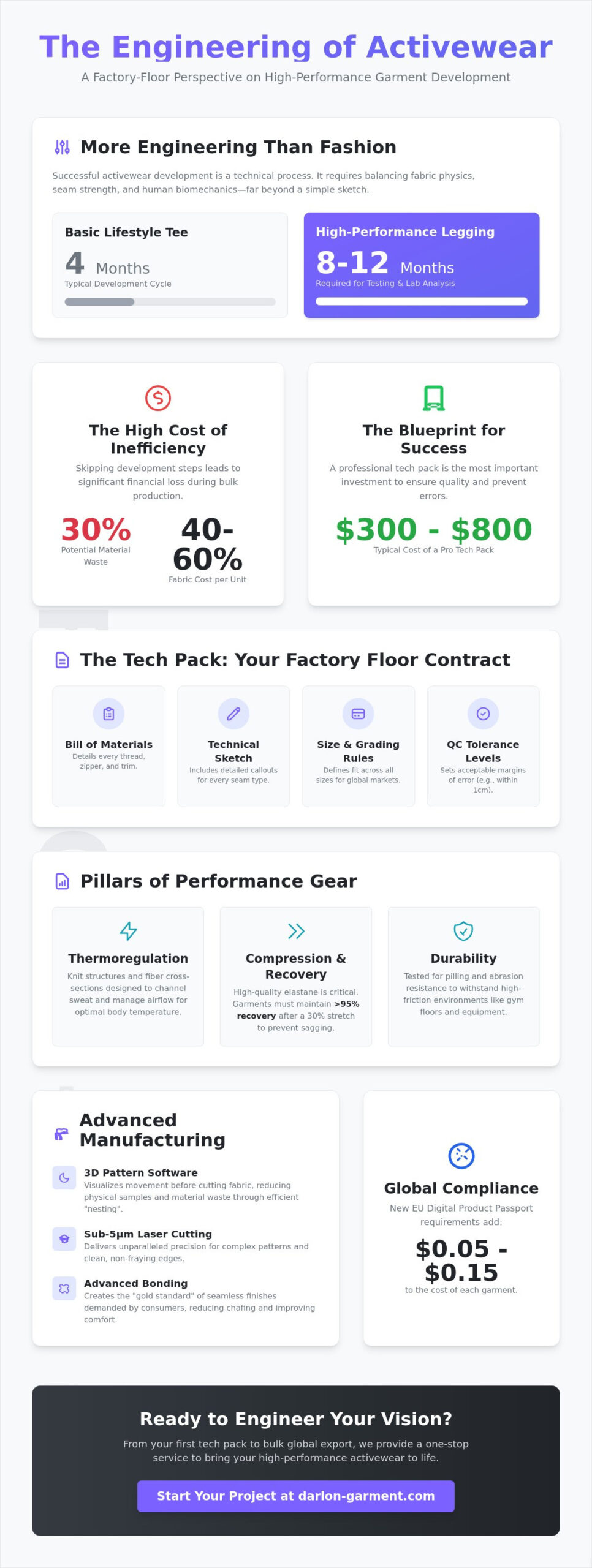
I’ve spent decades on the factory floor, and I’ve seen too many brands treat activewear like it’s just standard streetwear with more spandex. That’s a mistake that leads to expensive returns and failed launches. To me, activewear product development is a rigorous engineering process. We aren’t just choosing colors or silhouettes; we’re balancing four-way stretch, moisture management, and seam strength to create a garment that survives 500 wash cycles and intense physical strain. While a basic lifestyle tee might take four months to develop, a high-performance compression legging often requires eight to twelve months. This is due to the extensive wear-testing and lab analysis required to meet 2026 performance standards.
I see my role as your technical consultant rather than just a service provider. When I look at a design, I run it through a mental “manufacturability” test. I often have to tell designers that their specific seam placement won’t survive a squat test or that their chosen mesh will tear under high tension. This is because we’re working with advances in clothing technology that require a deep understanding of textile physics. If the pattern doesn’t account for the specific modulus of the fabric, the garment will fail in the field. My job is to bridge the gap between your creative vision and the mechanical realities of the human body in motion.
The Four Pillars of Performance Gear
- Thermoregulation: We develop fabrics with specific knit structures that channel sweat away from the skin. It’s about managing airflow and evaporation rates through technical fiber cross-sections.
- Compression and Recovery: This is where elastane quality is the make-or-break factor. If the recovery rate is less than 95% after a 30% stretch, your leggings will sag after only a few wears.
- Durability: We develop gear for high-friction environments. This means testing for pilling and abrasion resistance against rough surfaces like gym floors or heavy equipment.
The Cost of Skipping Development
Skipping steps in the tech pack phase is a financial disaster. I’ve seen brands lose 30% of their materials to waste during bulk production because they didn’t perfect the marker making or pattern grading early on. Since fabric accounts for 40% to 60% of your total unit cost as of May 2026, those mistakes hurt your bottom line immediately. Poor pattern grading is particularly dangerous; if you don’t calculate the stretch-to-fit ratio correctly for every size, your larger sizes won’t provide the compression they promise. Investing in the development phase is the only way to ensure your bulk production is efficient, consistent, and profitable.
Building Your Blueprint: The Tech Pack and Pattern Phase
In my facility, the tech pack isn’t just a document; it’s the only “contract” that matters once the machines start running. When my production team begins a run, they don’t look at your marketing mood board or a loosely defined sketch. They look at the technical specifications you’ve provided. A professional, mid-range tech pack in 2026 typically costs between $300 and $800, and it’s the most important insurance policy you can buy for your brand. If a detail isn’t in that document, it won’t be on the finished garment. This level of precision is non-negotiable for successful activewear product development.
I follow a strict four-step process to finalize this blueprint before we touch a single meter of fabric. First, we finalize the Bill of Materials (BOM). This includes every thread, zipper, and specialized trim. Second, I require a technical sketch with detailed callouts for every seam type. Third, we develop the size chart and grading rules. A medium in the US market is often a large in Asian markets, so we define these rules early to avoid inventory headaches. Finally, we set the tolerance levels for quality control. This defines the acceptable margin of error, usually within 1cm, for critical measurement points.
The Anatomy of a Professional Tech Pack
A high-performance tech pack must specify construction details that go beyond simple aesthetics. I need to know if you want flatlock seams for chafe-free comfort, overlock seams for durability, or bonded seams for a sleek, modern finish. We also include labeling and packaging specs, which are often forgotten until the last minute. You can see how garments are made in my facility to understand how these documents guide our specialized machinery through every stage of assembly.
Pattern Making for Performance
I now use 3D pattern software to visualize how a garment moves before we ever cut fabric. This technology allows me to reduce the number of physical samples needed, which saves you time and money. It also helps with the art of “nesting” patterns. By strategically placing pattern pieces on the fabric roll, I can significantly reduce waste. Given that fabric accounts for up to 60% of your unit cost, efficient nesting is a primary driver of your profit margins. If you need help refining these technical details, I’m always available for consulting on your next collection to ensure your patterns are production-ready.
This technical foundation is what separates a professional activewear product development cycle from a hobby project. Once the blueprint is solid, we move into the iterative heart of the process: sourcing the specialized textiles that will bring your vision to life.
Fabric Sourcing and Prototyping: The Iterative Heart of the Process
Once the technical blueprint is set, we move into the most critical phase of activewear product development: securing the materials. I’ve spent years building a global network of mills because I know that your garment is only as good as the yarn it’s knitted from. In 2026, fabric isn’t just a component; it represents 40% to 60% of your total unit cost. I handle the heavy lifting of sourcing specialized textiles that meet both performance standards and the newer EU Ecodesign requirements. It’s a complex dance of lead times and technical specs, and it’s where most projects either succeed or stall.
I always tell my clients that fabric development is usually the longest part of the journey. A custom-dyed, high-performance knit can take 45 to 60 days just to reach my cutting table. Because of this, I strongly recommend a “Proto 1” phase. Instead of waiting for your custom materials, I use available “deadstock” fabric with a similar weight and stretch modulus to create your first physical sample. This allows us to test the pattern and fit immediately while the mills are still processing your primary order. To understand the technical nuances of the most common activewear material, you can read my elastane fabric guide for a deep dive into mastering stretch.
Polyamide vs. Polyester: Making the Choice
I often guide brands through the Polyamide versus Polyester debate based on their specific end-use. I suggest Polyamide (Nylon) when you’re aiming for a premium, buttery-soft hand feel that’s perfect for yoga or low-impact activities. It’s more expensive but offers superior “cool-touch” properties. On the other hand, Polyester remains the king of durability and sublimation printing. If your designs involve bold graphics or need to withstand the high-friction environment of cross-training, Polyester is the more resilient choice.
The Prototype Feedback Loop
The “Fit Sample” is our first real-world check. I use this to ensure the garment moves with the athlete rather than fighting against them. We look for “grinning” at the seams and ensure the compression hits the right muscle groups. I also encourage my clients to conduct a “Wear Test.” Don’t just look at the sample on a mannequin; I want you to actually work out in it. If a waistband rolls down during a run or a seam chafes during a HIIT session, we need to know now. This iterative loop is the only way to ensure your activewear product development results in a high-performance reality that consumers will trust.
Advanced Construction: Laser Cutting, Bonding, and Beyond
By 2026, the market has moved beyond basic flatlock stitching. I consider seamless and bonded garments to be the “gold standard” for high-end collections because they offer a level of comfort that traditional sewing simply cannot match. This is a critical stage in activewear product development where the right machinery makes or breaks the final product. If your factory lacks these specific technical capabilities, your brand will struggle to compete with established performance giants. I’ve invested heavily in these technologies because I know they are no longer “extras”; they are requirements for professional-grade gear.
I use high-end laser cutting systems that achieve sub-5μm accuracy. This level of precision allows me to create intricate ventilation patterns and “mapped” breathability zones without the risk of fraying. Because laser cutting is a non-contact process, it cauterizes the edges of synthetic fabrics instantly. This creates a clean, sharp finish that remains durable even after intense physical use. It allows for design details that were physically impossible to execute with traditional die-cutting or manual shears just a few years ago.
Then there’s the science of bonding. I use heat-activated adhesives and specialized pressure equipment to join fabric panels, eliminating bulky seams entirely. This creates a “second-skin” feel that is essential for high-performance compression gear. It’s why choosing the right fitness wear manufacturer with advanced technical infrastructure is your most important vetting criteria. If you want to see how these technologies can elevate your next collection, contact me to discuss your technical requirements.
Nuyarn and Performance Wool
I’ve been working extensively with Nuyarn technology to create ultra-light, strong wool apparel. Unlike traditional merino that is twisted into a rope-like structure, Nuyarn keeps the fibers loftier and more resilient. This results in a fabric that is significantly stronger and dries much faster than standard wool. This high-tech wool is disrupting the traditional synthetic activewear market because it offers natural thermoregulation while maintaining the mechanical durability of a polyester blend. It’s a game-changer for brands looking to offer premium, natural-fiber alternatives in their activewear product development cycle.
Testing for Real-World Performance
I don’t just rely on visual inspections; I put every developed garment through rigorous lab testing. We perform pilling tests and colorfastness checks to ensure the gear looks new even after 50 or more industrial wash cycles. We also conduct “burst strength” testing, which is vital for bonded seams. This ensures that the adhesive bond won’t fail under the extreme tension of a heavy lift or a long-distance run. My goal is to ensure that your concept survives the transition from the design studio to the high-pressure environment of a professional gym.
Navigating the Jump to Bulk Production in Vietnam
I’ve watched the global supply chain shift significantly over the last few years, and I’m convinced that Vietnam is the premier destination for technical apparel in 2026. This isn’t just about labor costs; it’s about a sophisticated infrastructure that supports complex activewear product development. On April 3, 2026, the Vietnamese government approved Resolution No. 82/NQ-CP, a new Law on Key Industries designed to prioritize high-value manufacturing like the bonded and seamless garments I produce. With U.S. tariffs on Vietnamese apparel now stabilized at standard MFN rates of 10% to 20% as of February 2026, the economic landscape for international brands has never been more predictable.
My “One-Stop Service” model is designed to eliminate the friction that usually occurs when moving from a design studio to a factory floor. I handle everything from the initial material sourcing to the final global logistics. This approach prevents the “quality fade” that often plagues brands when they move from a perfect sample to a bulk run of five thousand units. By keeping the entire process under one roof, I ensure that the technical specifications we perfected in the prototyping phase are executed with absolute consistency during bulk production. For a deeper look at why this region is so critical, read my sportswear factory Vietnam guide.
Managing MOQs and Production Runs
I work closely with brands to balance their minimum order quantities (MOQs) with production efficiency. I understand that for a “lean startup” launched with an initial investment of $2,000 to $5,000, managing inventory risk is just as important as the stitch quality. Shipping from my facility near Ho Chi Minh City provides a massive logistical advantage. We have direct access to major shipping lanes, which reduces transit times to key markets in Europe and North America. This allows you to stay agile and restock top-selling items without the long delays common in other manufacturing hubs.
The Final Quality Gate
My “Quality First” philosophy is anchored in a rigorous final inspection process. Before any goods leave my dock, they undergo a final AQL (Acceptable Quality Level) inspection to ensure they meet international export standards. We also finalize the Digital Product Passport (DPP) data required for the EU market, which now adds a verified cost of $0.05 to $0.15 per garment. When you receive your final shipping documents, you’ll have full transparency on everything from fabric origin to performance test results. This methodical approach ensures that your activewear product development journey ends with a product that’s ready to dominate the global market.
Engineering Your Brand’s Future in 2026
Success in this industry requires moving past the design board and into the technical specifics of fiber physics and mechanical stress. We’ve explored how a rigorous activewear product development cycle ensures your gear survives the high-pressure environments of the modern athlete. I’ve shown you why high-tech wool like Nuyarn and precision laser cutting are no longer optional extras if you want to compete on a global scale. It’s about building a product that performs as well as it looks.
Since I established Dar Lon Garment in 2019, I’ve prioritized global export standards and invested in the automatic sewing technology needed to support high-performance brands. My team and I are ready to act as your technical backbone, helping you navigate the complexities of sourcing and bulk production with a one-stop service model. Ready to start your activewear journey? Let’s talk about your project today. I look forward to seeing your technical concepts come to life on the world stage.
Frequently Asked Questions
What is the typical timeline for activewear product development?
A full cycle for high-performance gear usually takes eight to twelve months from the initial sketch to bulk delivery. This allows for the necessary rounds of prototyping and the long lead times required for technical fabrics. If we use available stock materials for your first fit samples, I can often accelerate the early stages of the process significantly.
How much does it cost to create an activewear sample?
Sample costs depend on the technical complexity of your garment and the specific machinery required for construction. While a professional tech pack is a separate investment, the physical sample is typically billed at a higher unit rate than bulk production. This covers the labor involved in specialized machine setup for features like bonding or laser cutting, which require precise calibration for small runs.
Can I develop my own custom fabric with a manufacturer?
You can absolutely develop proprietary fabrics through my network of specialized global mills. This is a core part of activewear product development for brands that want a unique hand-feel or specific compression levels. Keep in mind that custom textile development usually requires meeting higher minimum order quantities and adds a few months to your overall production schedule.
What is the difference between OEM and ODM in activewear?
OEM means I manufacture garments based on the specific technical designs and tech packs you provide. In contrast, my ODM services allow you to choose from my existing library of high-performance patterns, which you can then customize with your own branding. This is often a faster and more cost-effective route for brands that don’t want to invest in the heavy engineering phase of a brand-new design.
Do I need to have a tech pack ready before contacting you?
It’s helpful if you have a tech pack ready, but I can also help you build one from your initial sketches. Think of the tech pack as the definitive manual for my production team; if a detail isn’t in there, it won’t be on the finished garment. If you’re still in the concept phase, I can act as a technical consultant to ensure your designs are manufacturable before you invest in patterns.
How do I protect my designs during the development phase?
I protect your intellectual property through formal Non-Disclosure Agreements (NDAs) and strict internal production controls. My facility is designed to be the silent backbone for your brand; we ensure that your technical innovations and aesthetic designs remain confidential from the first sketch to the final export. I’ve built Dar Lon Garment on long-term B2B partnerships where trust and technical reliability are the foundation of every production run.