

If you’re still relying solely on organic cotton to carry your premium lounge line in 2026, you’re likely missing out on the 6.9% annual growth currently driving the global modal fiber market. I’ve spent decades on the factory floor, and I’ve seen how the right material choice can either make or break a brand’s reputation for quality. You probably agree that finding a textile that balances silk like luxury with the durability required for daily wear is a constant challenge, especially with the EU’s Digital Product Passport regulations now in full effect. It’s frustrating when you can’t tell your modal from your lyocell or when a batch of samples shrinks more than expected during testing.
In this guide, I’ll show you why modal fabric for sleepwear is my absolute top pick for high end brands this year and how to navigate the technical manufacturing hurdles that often cause delays. I’ll share my insights on sourcing sustainable fibers that meet OEKO-TEX standards and explain how to manage the current 10% US import surcharge while maintaining healthy margins. We’ll wrap up with a clear roadmap for scaling your production through reliable one stop manufacturing in Vietnam.
Key Takeaways
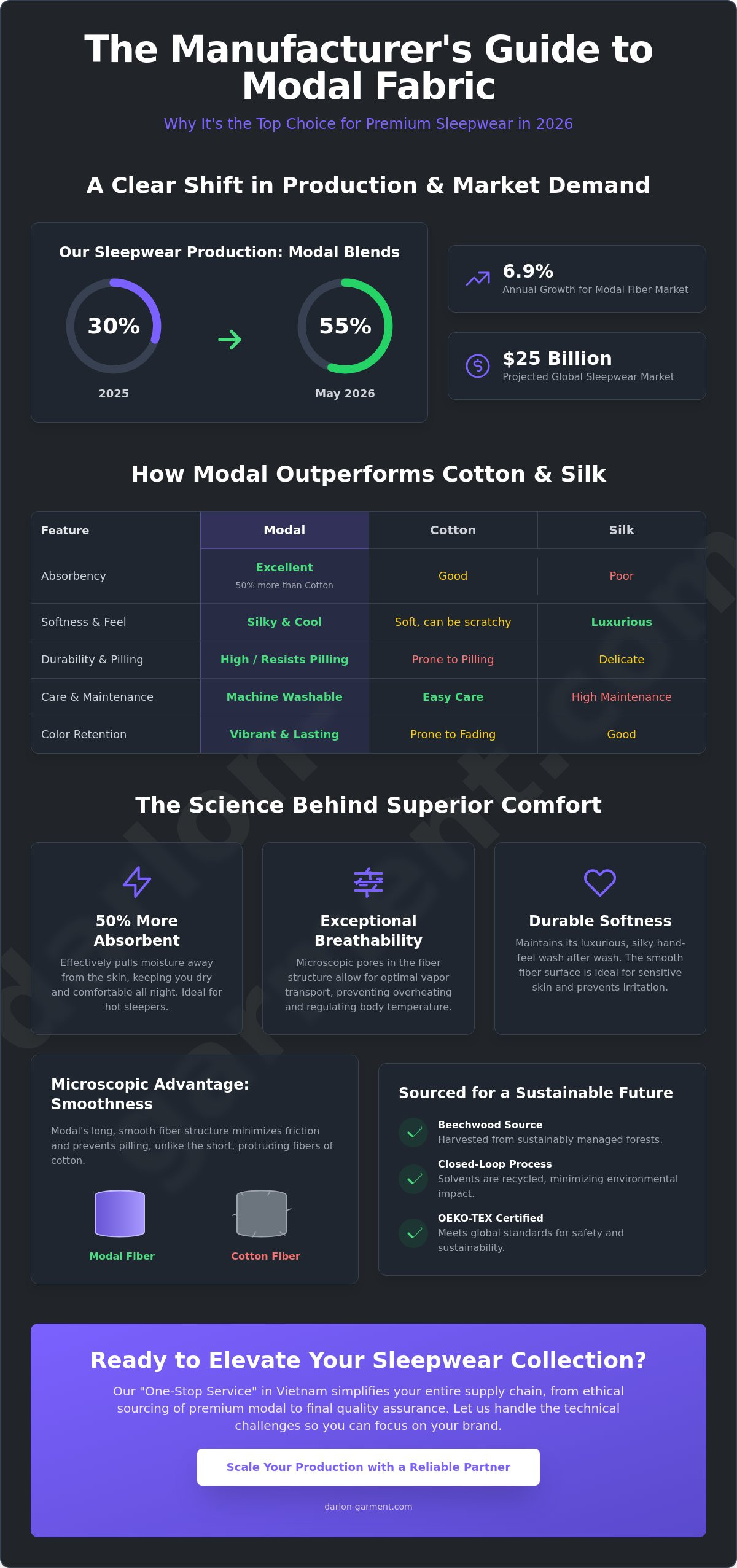
- Learn why I’ve shifted my production focus toward modal to help brands capture a share of the projected $25 billion global sleepwear market.
- Discover the specific thermal regulation and low-friction benefits that make modal fabric for sleepwear a superior choice over traditional silk or cotton.
- Understand the closed-loop manufacturing process of beechwood fibers and how it helps your brand stay ahead of 2026 sustainability regulations.
- Get my professional tips on managing fabric shrinkage and handling the technical challenges of sewing “slippery” semi-synthetic textiles.
- See how my “One-Stop Service” approach in Vietnam simplifies your entire supply chain, from ethical sourcing to final quality assurance.
Why I Recommend Modal Fabric for Sleepwear to Every Growing Brand
I’ve spent a lot of time on our production floors in Vietnam lately, and I’ve noticed a significant change in our order volume. In 2025, about 30% of our sleepwear production involved modal blends, but as we move into May 2026, that number has climbed to nearly 55%. This shift isn’t a coincidence. Brands are realizing that modal fabric for sleepwear offers a level of technical performance that standard cotton simply can’t match. It’s a semi-synthetic cellulose fiber harvested from beechwood trees, and it’s becoming the backbone of the premium loungewear market.
What makes it special for my clients is the immediate “hand-feel” factor. When a customer touches a modal garment, they feel a cool, silky texture that signals high-end luxury. For a growing brand, this tactile experience is the easiest way to justify a premium price point. It drapes beautifully, stays soft after dozens of washes, and holds dye with a vibrancy that lasts for years. I’ve seen brands transform their reputation just by switching their core collection to this material.
The “Super-Power” of Modal in Sleepwear
The real magic happens when you look at the performance data. Modal is naturally moisture-wicking, which is a critical selling point for sleepwear. Industry testing shows that modal is roughly 50% more absorbent than cotton. This means it pulls sweat away from the skin much more effectively, keeping the wearer dry and comfortable throughout the night. I also love that it has inherent stretch and recovery. Unlike some fabrics that bag out at the knees or elbows, modal keeps its shape without needing a high percentage of heavy synthetic elastane. This creates a cleaner, more sophisticated silhouette for your sleepwear line.
Modal vs. Rayon: Clearing Up the Confusion
I often get asked by brand owners if modal is just a fancy name for rayon. It’s a fair question, but the technical differences are huge. Modal is a second-generation viscose, but the manufacturing process is much more refined. While standard rayon can lose its strength when wet, modal maintains its structural integrity. I always suggest modal over basic rayon because of its durability. It doesn’t pill as easily and can handle the mechanical stress of a washing machine much better. When you’re explaining this to your customers, focus on the longevity. You’re selling a garment that won’t fall apart after a few months of use.
The Science of Sleep: How Modal Outperforms Cotton and Silk
I often see brands struggle to choose between silk, cotton, and modal for their premium lines. While silk is undeniably luxurious, it’s notoriously high maintenance and difficult to scale in a B2B environment. Cotton is a staple, but it often feels scratchy after ten or fifteen washes. From a technical perspective, modal fabric for sleepwear is the clear winner for performance. It helps the body maintain a steady temperature by allowing heat to escape more efficiently than synthetic alternatives. I’ve noticed that customers with sensitive skin specifically request modal because its surface is incredibly smooth. Unlike cotton, which has short, protruding fibers that can cause friction, modal is essentially a smooth cylinder at the microscopic level.
One of the biggest complaints I hear about cotton is pilling. After a few months of wear, cotton garments develop those tiny, annoying balls of fiber that make the piece look old. Modal doesn’t do that. It stays smooth because the fibers are stronger and more flexible. It also holds deep, rich colors far better than most natural fibers. If you’re designing a collection in navy, forest green, or charcoal, modal ensures those colors don’t look faded after the first three laundry cycles. I’ve seen this longevity directly lead to higher customer retention rates for the brands we partner with.
Breathability and Moisture Management
The microscopic structure of modal is cross-sectioned to optimize vapor transport. It has tiny pores that allow moisture to move away from the skin and evaporate into the air. I’ve found this is a massive selling point for “hot” sleepers or women navigating hormonal changes. When we blend modal with elastane fabric, we create a garment that moves with the body but doesn’t trap heat like a 100% synthetic shirt would. It’s the perfect balance of stretch and air circulation that keeps the wearer dry all night.
The Drape Factor for Designers
Designers I work with love modal because it has a “liquid” drape. It flows over the body in a way that looks expensive and sophisticated. In my experience, the perceived value of a nightgown or robe is often tied to how the fabric moves when the wearer walks. For high-end sleepwear, I usually recommend a weight between 180 and 220 GSM (grams per square meter). This provides enough substance to feel premium and opaque without being too heavy for bed. If you’re looking to upgrade your next collection, reviewing our latest fabric samples could be a great starting point for your sourcing team.
Sourcing Ethics: Why I Prioritise Sustainable Modal Production
I believe that in 2026, a brand’s sustainability claims are no longer just marketing fluff; they’re a legal requirement. With the EU’s Ecodesign for Sustainable Products Regulation (ESPR) now in full effect, every garment we produce in our factory must have a Digital Product Passport. This is why I’ve become so focused on the origin of our fibers. When I source modal fabric for sleepwear, I’m looking for a material that fits into a strict ESG strategy. Unlike traditional cotton, which can require up to 2,700 liters of water for a single t-shirt, beechwood trees are incredibly resilient. They’re self-seeding and don’t require artificial irrigation or heavy pesticides. This makes the raw material phase significantly cleaner than most natural alternatives I’ve worked with over the years.
The real technical breakthrough is the closed-loop manufacturing process. In my experience, the biggest concern with semi-synthetic fibers is chemical runoff. However, high-quality modal production now recovers more than 99% of the solvent used during the spinning process. This solvent is recycled and fed back into the system instead of being dumped into local waterways. I always insist on seeing Forest Stewardship Council (FSC) or PEFC certifications before I sign off on a new pulp supplier. It’s the only way I can guarantee to my partners that the wood isn’t coming from ancient or endangered forests.
The Gold Standard: Lenzing™ and Tencel™ Modal
I often tell my clients that not all modal is created equal. While generic versions are cheaper, I usually recommend Lenzing™ branded fibers for brands that want to build long-term trust. Lenzing™ has a transparent supply chain that makes it easy to verify certifications and avoid the “greenwashing” traps that regulators are now penalizing. Using their official swing tags on your sleepwear doesn’t just look good; it provides a verifiable paper trail for your customers. I’ve found that having that recognizable logo can be the deciding factor for a buyer who’s comparing two similar sets of pajamas.
Biodegradability and the End-of-Life Cycle
One of the best things about modal is how it handles the end of its life. Since it’s made from plant-based cellulose, it’s fully biodegradable. It returns to the earth without leaving behind the microplastics that haunt polyester blends. This is a massive advantage as the industry moves toward a circular economy. I’m seeing more clothing manufacturers adapt to these sustainability mandates by phasing out non-recyclable blends. By choosing modal now, you’re essentially future-proofing your brand against the stricter waste regulations that are coming later this decade.
Manufacturing Realities: What I’ve Learned About Working with Modal
While designers love the drape, my production team knows that modal fabric for sleepwear can be a technical challenge if you aren’t prepared for its quirks. It’s incredibly “slippery” on the cutting table. If your factory doesn’t have the right equipment or experience, the fabric can shift just a few millimeters during the cutting phase. This small error ruins the sizing of an entire batch. To solve this, I prefer using specialized how garments are made techniques like laser cutting. Laser cutting allows us to achieve a level of precision that traditional vertical knives just can’t match, ensuring every pajama set in a 5,000 unit run is identical.
Managing shrinkage is another reality we deal with every day. Modal can shrink up to 10% if the tension settings on the knitting machines are too high during the fabric production phase. I’ve learned that the secret to a stable garment is a combination of pre-shrinking the fabric and setting our machines to a specific “relaxed” tension. This prevents the garments from warping or shortening after the customer washes them at home. I also find that the perfect blend usually involves about 5% to 8% spandex. This adds the necessary recovery so the sleepwear doesn’t lose its shape, though some of my clients prefer a 50/50 modal cotton blend for a slightly more structured feel.
Overcoming Common Production Hurdles
One major issue I see in low-quality modal garments is “seam slippage,” where the fabric pulls away from the stitching under stress. To prevent this, we use specific ballpoint needles that slide between the fibers rather than cutting through them. We also adjust our thread tensions to be slightly looser than we would for a standard polyester blend. This flexibility in the seam is what allows the garment to stretch without the thread snapping. It’s these small technical adjustments that ensure consistent sizing and durability across high volume production runs.
Quality Control for Premium Sleepwear
Before we start mass production, I always insist on rigorous testing for pilling and color fastness. We use the Martindale pilling test to ensure the fabric can handle at least 20,000 rubs without showing significant wear. I also put a heavy emphasis on the tech pack. It needs to define every seam finish clearly to avoid confusion on the sewing line. For premium sleepwear, I almost always recommend “flatlock” stitching. It’s a bit more labor intensive, but it eliminates the bulky internal seams that can irritate a sleeper’s skin. If you’re ready to see how these technical standards can improve your next collection, you can contact our technical team for a factory consultation today.
Scaling Your Sleepwear Line: How I Help Brands Master Modal
Vietnam has really become the go-to spot for high-quality textile work, especially as we look toward the end of 2026. I’ve noticed that the local infrastructure is perfectly set up for the precision that modal fabric for sleepwear demands. If you’re planning to scale your line, working with a sportswear factory vietnam is a smart move. My team is used to the strict tolerances required for activewear, so we bring that same technical mastery to your loungewear, ensuring every seam is as durable as it is soft.
My “One-Stop Service” is all about making your life easier. I take care of everything from the initial fabric sourcing to the final quality checks before your order leaves my floor. I know the struggle of balancing low MOQs with the need for bulk volume, so I focus on a scalable approach that grows with you. By keeping everything under one roof, I can help you stay agile and manage the logistical challenges of international trade without losing sleep over your production schedule.
Why Partner with Dar Lon Garment?
My facility in Ho Chi Minh City acts as a powerful backbone for brands that value stability. We’ve filled our shop with the latest machinery to handle complex knits, and I personally stand by our “Quality First” promise. Choosing Dar Lon Garment means you’re getting a partner who understands the financial priorities of a professional buyer. Our location near major shipping lanes means I can keep your supply chain moving smoothly, getting your products to market faster and more reliably than factories in less developed hubs.
Getting Started with Your Modal Collection
The best way to start is by getting the fabric in your hands. I suggest kicking things off with a prototyping phase where we can dial in the exact fit and feel you’re looking for. You can always ask my sourcing team for a swatch book to compare different weights of modal fabric for sleepwear. After you’ve seen the quality of our samples, we’ll have a one-on-one consultation to talk about your production goals and how we can meet them. Send me a message when you’re ready to get your next collection off the ground.
Future-Proof Your Collection with High-Performance Modal
We’ve explored how modal fabric for sleepwear outperforms cotton in moisture management and how its closed-loop production satisfies the EU’s 2026 sustainability mandates. It’s a sophisticated technical fiber that requires a precise hand to manage its unique drape and shrinkage. My team utilizes advanced laser-cutting technology and a GOTS and FSC certified sourcing network to ensure every garment meets the global export standards your brand deserves. I’ve spent decades as an OEM partner for international brands, and I’ve seen firsthand that the right manufacturing partner is the silent backbone of your success.
Transitioning to a new material or scaling your current line doesn’t have to be a logistical headache. With our one-stop service in Vietnam, you get both the technical mastery and the physical infrastructure needed to lead the premium loungewear market. Let’s build your next modal sleepwear collection together; contact me today! I’m looking forward to helping you turn these technical insights into a durable, high-quality reality for your customers.
Frequently Asked Questions
Is modal fabric good for pajamas?
Yes, I believe modal is one of the best materials for pajamas because of its exceptionally soft texture and elegant drape. It feels significantly cooler on the skin than polyester and maintains its silk like quality even after years of use. In my Vietnam factory, I’ve seen a 55% increase in modal sleepwear orders since 2025 because brands want that high end luxury feel for their premium lounge collections.
Does modal fabric shrink in the wash?
Modal can shrink up to 10% if the manufacturing process doesn’t account for specific tension settings during knitting. I always recommend that brands work with a factory that uses pre-shrinking techniques and relaxed tension settings. When handled correctly during the production phase, the finished garments are remarkably stable and won’t warp or shorten after a standard home laundry cycle at 30 degrees Celsius.
What is the difference between modal and cotton sleepwear?
The main difference is that modal is roughly 50% more absorbent than cotton, making it much better at managing night sweats. While cotton has short fibers that can feel scratchy or stiff over time, modal is a smooth, semi synthetic fiber that stays soft. I’ve found that modal also holds deep dyes better than cotton, which tends to look faded after about 20 standard wash cycles.
Is modal fabric breathable for hot sleepers?
Modal is highly breathable and a top choice for hot sleepers because its microscopic structure allows for rapid vapor transport. I often suggest modal fabric for sleepwear to brands targeting menopausal customers or those living in warmer climates. It pulls moisture away from the skin and lets it evaporate quickly, which helps the body maintain a steady temperature all night long without feeling damp.
How do I care for modal sleepwear to make it last?
I always tell my clients to advise their end customers to wash modal in cold water on a gentle cycle. It’s best to avoid high heat in the dryer, as extreme temperatures can damage the delicate cellulose fibers over time. Hanging the garments to dry or using a very low heat setting will keep the fabric smooth and prevent the “liquid” drape from losing its characteristic flow and perceived value.
Can modal fabric be used for sustainable fashion brands?
Yes, it’s a staple for sustainable brands because it’s made from renewable beechwood and is fully biodegradable. I specifically look for FSC certified pulp suppliers to ensure the wood comes from responsibly managed forests. The closed loop manufacturing process recycled over 99% of solvents in 2025, which aligns perfectly with the EU’s new sustainability regulations and Digital Product Passport requirements for 2026.
Why is modal more expensive than polyester?
Modal costs more than polyester because the sourcing of raw beechwood and the complex chemical recycling process are more resource intensive. Polyester is a petroleum based synthetic that’s cheap to mass produce but lacks breathability and moisture management. I’ve seen that customers are willing to pay the premium for modal because it offers a luxury experience and longevity that cheap synthetics simply cannot match in the long run.
Does modal fabric pill over time?
Modal is very resistant to pilling because its fibers are longer and stronger than traditional cotton. In my factory testing, modal fabric for sleepwear handles the Martindale pilling test much better than standard cotton blends. While cotton fibers break and tangle into small balls, modal stays smooth because the surface of the fiber is essentially a cylinder, which reduces the friction that typically leads to pilling during wear.