
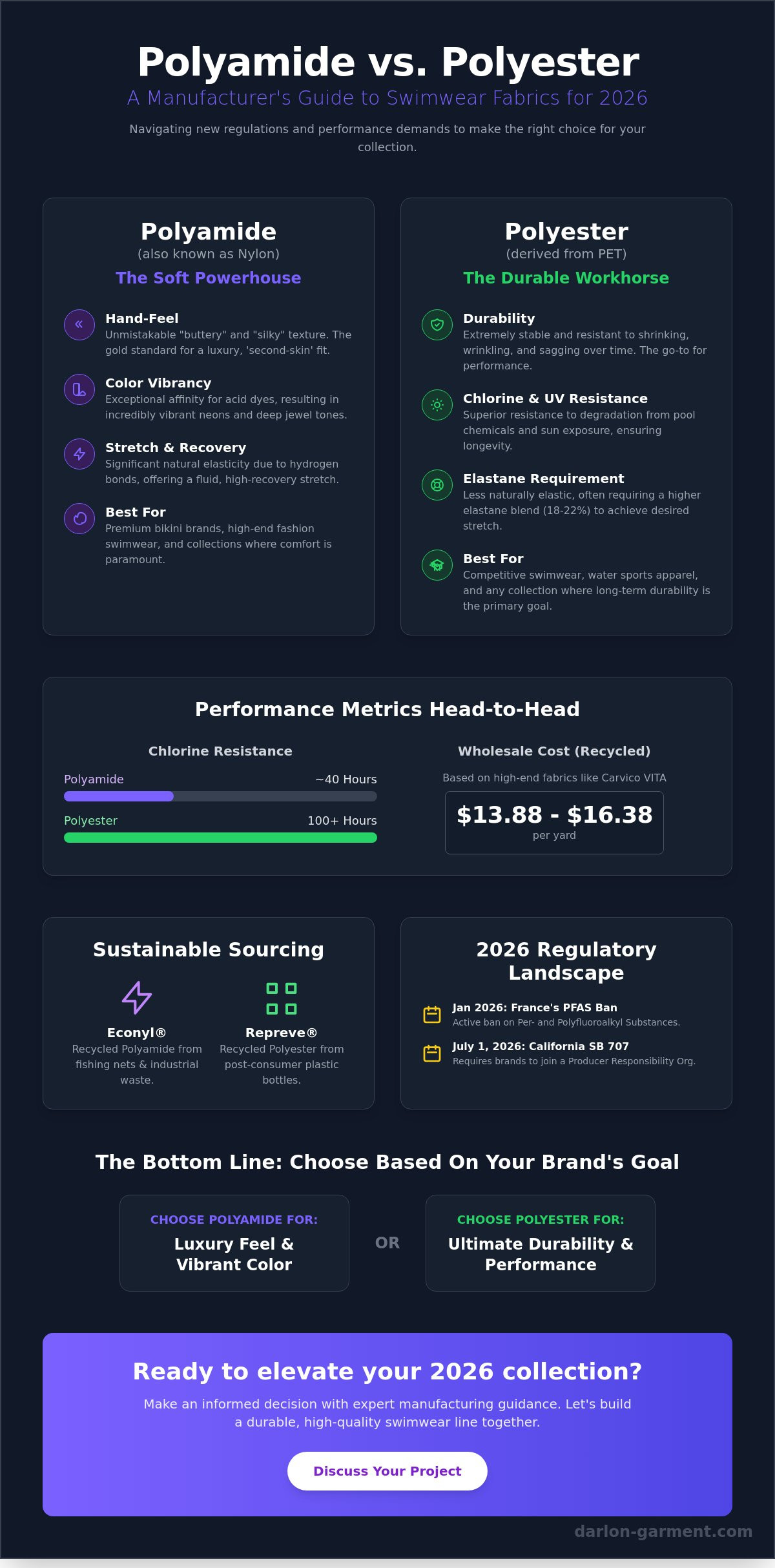
If you believe the softest hand-feel is the only metric that matters for your 2026 collection, you might be overlooking the massive technical shift happening in our industry right now. With France’s PFAS ban active since January 2026 and California’s SB 707 requiring brands to join a Producer Responsibility Organization by July 1, 2026, the stakes for material selection have never been higher. I see many designers struggle with the polyamide vs polyester for swimwear debate, often fearing that a sustainable choice means sacrificing that premium stretch. It’s a valid concern, especially when wholesale prices for high-end recycled fabrics like Carvico VITA now range between $13.88 and $16.38 per yard.
I understand the pressure of trying to build a durable brand while navigating strict new EU regulations on textile destruction and packaging waste. I’ll break down the real-world performance differences between these two fibers so you can make an informed decision for your next production run in Vietnam. We will look at chlorine resistance, color vibrancy, and the specific technical trade-offs that determine whether your pieces end up as long-term favorites or landfill fodder.
Key Takeaways
- Understand the core technical differences in the polyamide vs polyester for swimwear debate to decide if your 2026 line needs luxury softness or high-performance durability.
- Learn how to pair these fabrics with the right elastane percentage to ensure your garments maintain their shape after hundreds of hours in the water.
- Find out why I suggest specific polyester blends for brands targeting the competitive swimming market due to their superior resistance to chlorine and UV rays.
- Get a clear breakdown of sustainable sourcing options like Econyl and Repreve to help you meet new global environmental standards without losing quality.
- Discover how advanced manufacturing techniques like laser cutting and bonding can elevate the finish of both materials for a premium retail look.
What Are Polyamide and Polyester? My Simple Breakdown
I start every production meeting by clarifying the technical jargon that often confuses new brand owners. In the textile manufacturing world, Polyamide is simply the technical name for Nylon. While “Nylon” is a familiar household word, “Polyamide” is the term you’ll find on international customs forms, technical data sheets, and B2B shipping manifests. I prefer using the technical term because it reflects the precision we maintain at Dar Lon Garment. When we evaluate polyamide vs polyester for swimwear, we’re essentially choosing the chemical foundation of your entire collection. These fibers act as the DNA of your garments; they dictate how the piece feels against the skin, how it takes color, and how long it lasts before it loses its shape.
The fundamental difference between these two polymers lies in their molecular chemistry. Polyamide fibers are built with hydrogen bonds that allow for significant natural elasticity. This is why it feels so much more supple and “stretchy” than polyester. Polyester is composed of carbon rings, which makes the fiber much stiffer and more resistant to stretching. This rigidity is actually a benefit in certain contexts, as it prevents the fabric from sagging over time. In my factory, I see many premium versions of these fibers marketed under trade names like Tactel or Supplex. These are refined polyamides engineered to mimic the feel of natural cotton while retaining all the performance benefits of a synthetic. Understanding this polyamide vs polyester for swimwear distinction is the first step in ensuring your 2026 collection meets the high standards of global export markets.
Polyamide (Nylon): The Soft Powerhouse
I frequently suggest polyamide for premium bikini brands because of its unmistakable “buttery” texture. It is the gold standard for luxury hand-feel in the swimwear industry. One of its greatest strengths is its high affinity for acid dyes, which results in exceptionally vibrant colors. If your 2026 mood board features neon hues or deep, saturated jewel tones, polyamide will deliver that visual impact better than almost any other synthetic. Its natural stretch and recovery make it one of the most common swimsuit materials for high-end fashion pieces that need to move with the body without feeling restrictive or stiff.
Polyester: The Durable Workhorse
When durability is the primary goal, I steer my partners toward polyester. It is the undisputed go-to for competitive swimwear and water sports apparel. Because it is derived from polyethylene terephthalate (PET), the same material used in high-strength containers, it is incredibly stable. It resists shrinking and wrinkling far better than polyamide. In my experience, a polyester suit will maintain its structural integrity for over 100 hours of pool time, whereas a standard polyamide suit might start thinning after just 40. Modern micro-polyesters have come a long way; they can now mimic the softness of nylon while keeping their “workhorse” reputation for total chlorine resistance.
Performance Comparison: Which Fabric Wins in the Water?
I recently spent a morning in our quality control lab comparing 2026 premium samples of both materials. When you hold a piece of high-grade polyamide next to a standard polyester, the difference isn’t just technical; it’s emotional. Most customers decide to buy based on that first touch. In the polyamide vs polyester for swimwear debate, polyamide usually wins the tactile test because of its silk-like smoothness. However, performance isn’t just about the dry touch. It’s about how the garment behaves once it’s saturated with water and stretched across a moving body.
The ‘Hand-Feel’ Factor
I always recommend polyamide for brands that want to market a ‘second-skin’ fit. It has a natural suppleness that polyester sometimes lacks. That said, I’ve seen massive improvements in micro-polyester over the last two years. By 2026, the gap has narrowed significantly. Modern polyester no longer feels like the scratchy, plastic-like material of the past. It’s now possible to source polyester that mimics the softness of nylon while maintaining its superior chlorine resistance of swimwear fabrics. This is a game-changer for brands that want luxury aesthetics without the fast degradation often seen in premium nylons.
The way these fibers interact with elastane fabric is where the real engineering happens. Polyamide’s molecular structure allows it to bond more fluidly with spandex, creating a high-recovery fabric that snaps back to its original shape instantly. Polyester is less naturally elastic, so I often suggest a slightly higher percentage of elastane, usually around 18-22%, to compensate for its rigidity. This ensures the wearer feels supported rather than restricted. If you’re unsure which blend suits your target demographic, I’m always happy to discuss your specific collection requirements to find the right balance.
Moisture Management and Breathability
If your brand promise involves getting your customers from the pool to the bar as fast as possible, polyester is your winner. It’s naturally hydrophobic, meaning it repels water rather than absorbing it. In my drying tests, polyester garments typically dry 25% faster than their polyamide counterparts. Polyamide is more hydrophilic; it holds onto a small amount of moisture, which makes it feel slightly heavier when wet but provides a cooling effect as it evaporates. This wicking property is excellent for active beachwear or “dry-to-wet” transition pieces that need to stay fresh during a long day of sun exposure. I’ve noticed that polyamide suits tend to feel lighter on the body when dry, but polyester keeps the wearer more comfortable after the swim by shedding water weight almost immediately.
The Durability Battle: Chlorine, UV, and Saltwater
I always tell my partners that if their 2026 collection targets competitive swimmers or high-performance athletes, they should stick with polyester. While we’ve discussed how polyamide offers that luxury feel, it simply cannot match the rugged endurance of polyester in harsh environments. In the polyamide vs polyester for swimwear debate, durability is where the two fibers diverge most sharply. I’ve seen many beautiful nylon suits lose their elasticity after just one season of heavy use, whereas polyester pieces often look brand new even after 100 hours of pool time.
Saltwater presents another challenge for your fabric choice. While it is less aggressive than chlorine, salt crystals can get trapped between fibers and act like tiny saws, causing microscopic tears during movement. Polyamide is softer and more prone to this type of abrasion, which often leads to the “pilling” problem many brands fear. To keep polyamide looking smooth, I suggest using high-density knits with at least 20% elastane. This creates a tighter surface that resists the friction caused by sand and salt. Polyester handles these stressors with much more resilience, making it my top choice for surfing and active water sports gear.
Why Polyester is the Chlorine King
The science here is straightforward. Chlorine is a powerful oxidant that specifically attacks the hydrogen bonds in polyamide fibers. This chemical reaction causes the material to become brittle, yellow, and eventually lose its “snap.” Polyester is built with carbon rings that are far more stable; chlorine molecules literally struggle to find a way to break them down. In my factory tests, polyester maintained its structural integrity for over 200 hours in chlorinated water. Standard polyamide began to thin and sag after only 50 hours. I can apply specialized chlorine-resistant treatments to polyamide to extend its life, but these are temporary fixes compared to the inherent strength of polyester.
Colorfastness and Sun Exposure
With UPF 50+ ratings becoming a non-negotiable standard for 2026, you have to consider how UV rays affect your color palette. UV light doesn’t just damage skin; it breaks down the molecular bonds of the dyes themselves. Because polyester is naturally more UV-resistant, it keeps that bright red from turning pink by August. Polyamide relies on acid dyes that are more susceptible to fading under the intense sun of regions like Australia or California. Polyester is the superior choice for high-UV environments because its molecular structure provides a natural shield against color degradation and fiber fatigue.
Sustainability in 2026: Eco-Friendly Fabric Options
By 2026, sustainability has transitioned from a marketing “extra” to a strict legal requirement for any brand exporting to the EU or North America. With the EU’s Empowering Consumers for the Green Transition (ECGT) Directive taking full effect on September 27, 2026, generic green claims are no longer permitted. You need verified data to back up your branding. I’m seeing a massive shift toward Global Recycled Standard (GRS) certified materials in the polyamide vs polyester for swimwear debate. While I’ve previously discussed the growing interest in natural fibers for apparel, swimwear still relies on recycled synthetics to maintain the performance standards your customers expect.
Recycled Polyamide (Econyl)
Econyl, or regenerated nylon, is the premium choice for brands wanting to tell a story about ocean health. It’s produced by recovering nylon waste, such as abandoned fishing nets and industrial plastic, and chemically recycling it back into virgin-quality yarn. I often get asked if recycled polyamide feels different. In my factory, we’ve found that GRS-certified recycled nylon is indistinguishable from virgin fiber in terms of stretch and dye absorption. For a high-end brand, using a fabric like Carvico VITA, which currently wholesales for roughly $13.88 to $16.38 per yard, provides a powerful narrative that justifies a premium retail price point while meeting the highest environmental standards.
Recycled Polyester (Repreve)
Repreve is the leading brand of recycled polyester, and it’s primarily sourced from PET plastic bottles rather than old garments. If you’re looking for a cost-effective entry into sustainable fashion, this is your best option. It offers the same chlorine resistance and UV protection as virgin polyester, which I’ve noted is essential for competitive swimwear. I find that many of my partners choose Repreve because the supply chain is incredibly stable and the recycling process consumes significantly less energy than creating new petroleum-based fibers. It’s a pragmatic choice for high-volume 2026 collections that need to meet new environmental regulations without a massive increase in production costs.
We also have to address the reality of microplastic shedding. As part of the preparatory work for the Digital Product Passport (DPP) rollout, I’m helping my partners implement advanced knitting and finishing techniques that minimize fiber fragmentation. This technical mastery ensures your garments don’t just look good; they’re engineered to be as responsible as possible throughout their entire lifecycle. If you want to see how these eco-friendly options fit into your 2026 production plan, you can contact me to discuss your sustainable sourcing strategy today. Making these decisions now is the only way to stay ahead of the regulatory curve hitting the market later this year.
My Factory Verdict: Which One Should You Source?
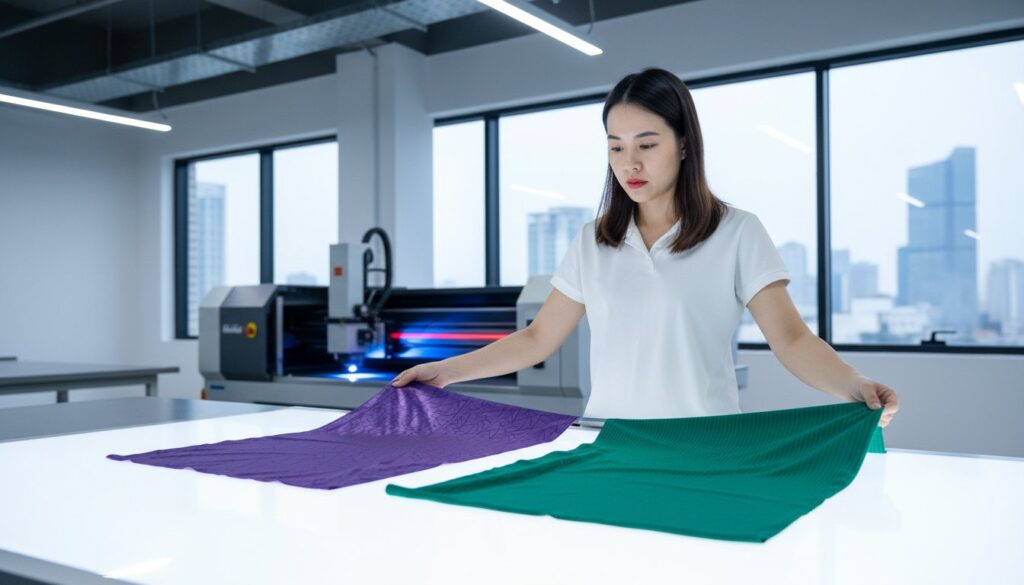
After decades on the factory floor, I can tell you that the final decision in the polyamide vs polyester for swimwear debate usually comes down to your brand’s core identity and your price-point strategy. I don’t just look at the fabric’s properties; I look at how it interacts with my machines. In 2026, the technical demands of production have changed. I’ve noticed that polyamide reacts more predictably to laser cutting because it melts at a lower temperature, creating a perfectly sealed edge that won’t fray. Polyester requires more precise heat calibration on my bonding machines to avoid a “burnt” edge, but once we dial it in, the structural integrity is unmatched. You can see how these techniques differ in my detailed look at how garments are made within our Vietnam facility.
My “One-Stop Service” promise means I handle everything from sourcing to the final stitch. I’ve found that polyester is often more efficient for high-volume runs because the fiber is more stable during high-speed automated production. Polyamide is more temperamental and requires a slower, more artisanal touch to prevent puckering at the seams. If you’re building a tech pack for 2026, you need to weigh these manufacturing nuances against your retail goals. A high-margin boutique piece justifies the slower production of polyamide, while a mass-market athletic line benefits from the efficiency of polyester.
When to Choose Polyamide
I recommend polyamide for luxury fashion brands where the “feel-first” experience is the primary selling point. It is ideal for intricate designs and “second-skin” fits that require maximum flexibility. If you’re targeting a high-margin boutique market, the premium cost of polyamide is a worthwhile investment. Just ensure you pair it with a high-quality elastane, like Lycra Xtra Life, to mitigate the fiber’s natural vulnerability to chlorine. This combination ensures your customers get the buttery softness they want with the durability they expect from a premium label.
When to Choose Polyester
Choose polyester if your brand focuses on athletic wear, competitive swimming, or high-volume retail. It is the champion of durability and price-point efficiency. To make polyester feel premium, I use specific high-gauge knitting techniques that increase the density of the fabric, giving it a heavier, more expensive drape. This is the best choice for brands that need to guarantee a long lifecycle in harsh, chlorinated environments. It’s also the most straightforward path for brands looking to scale quickly without the technical hurdles of high-stretch nylon production.
Before you finalize your next collection, use this checklist to ensure your tech pack is production-ready:
- Fiber Blend: Confirm if you need 80/20 or 82/18 ratios for your specific fit.
- Dyeing Method: Verify acid dyes for polyamide or disperse dyes for polyester to ensure colorfastness.
- Construction: Decide between seamless, bonded, or laser-cut edges based on your fabric choice.
- Compliance: Ensure your GRS or OEKO-TEX certifications are documented for 2026 export standards.
Building Your 2026 Collection with Confidence
Deciding between polyamide vs polyester for swimwear isn’t just about picking a fabric; it’s about defining your brand’s future in a competitive 2026 market. I’ve shown you how polyamide offers that unmatched luxury touch for boutique lines, while polyester provides the technical endurance required for high-performance athletic wear. Both choices now come with robust recycled options like Econyl and Repreve, allowing you to meet new global sustainability standards, such as the EU’s ECGT rules, without compromising on quality.
As a Vietnam-based OEM/ODM expert, I specialize in bringing these technical fabrics to life using laser-cutting and automated sewing precision. My facility is purpose-built for the specialized demands of performance swimwear. I’m here to ensure your collection transitions from a tech pack to a high-quality finished product that stands the test of time. Let me help you source the perfect swimwear fabric for your 2026 collection. I look forward to building a reliable partnership that helps your brand thrive in the seasons ahead.
Frequently Asked Questions
Is polyamide or polyester better for bikinis?
I recommend polyamide for fashion-forward bikinis because of its superior “buttery” softness and ability to hold vibrant neon dyes. If your brand targets leisure swimmers who value aesthetics and comfort, it’s the clear winner. However, for a competitive bikini line that faces daily chlorine exposure, polyester is the more durable choice. Most of my luxury boutique partners choose polyamide for its premium hand-feel and second-skin fit.
Does polyamide stretch out over time?
Polyamide can stretch out over time if it’s subjected to heavy chlorine exposure or poor care habits. The fiber’s molecular bonds are more susceptible to chemical degradation than polyester’s. To prevent sagging in my production runs, I use high-quality elastane blends and specific knitting tensions. This helps the garment retain its original shape for at least 50 to 100 hours of active use before any noticeable loss of elasticity occurs.
Is polyester swimwear itchy?
Modern polyester swimwear is not itchy, thanks to advancements in micro-denier yarn technology. By May 2026, the industry has perfected “soft-touch” polyesters that mimic the feel of nylon almost perfectly. I source specific circular-knit versions that provide a smooth, comfortable surface against the skin. This eliminates the scratchy reputation polyester had in the early 2000s, making it a viable option for even sensitive skin in high-performance garments.
Can I mix polyamide and polyester in one garment?
I don’t usually recommend mixing polyamide and polyester in a single fabric blend because they require different dyeing temperatures and chemical processes. Polyamide uses acid dyes, while polyester requires disperse dyes. Attempting to dye a mixed-fiber garment often leads to uneven color saturation or “frosting” effects. It’s much more efficient to choose one primary fiber and blend it with elastane to achieve the desired stretch and recovery.
Which fabric is more eco-friendly in 2026?
Both fabrics offer strong eco-friendly profiles in 2026 through Global Recycled Standard (GRS) certifications. Recycled polyamide, like Econyl, is excellent for brands focusing on ocean waste and fishing net recovery. Recycled polyester, like Repreve, is a 100% verified way to repurpose post-consumer plastic bottles. I’ve found that both options help brands comply with the EU’s Digital Product Passport requirements that are planned to begin their rollout in 2027.
Why is polyamide more expensive than polyester?
Polyamide is more expensive because the raw polymer production and the specific acid-dyeing process are more energy-intensive than polyester’s. Additionally, trade names like Carvico command a premium due to their specialized performance and sustainability certifications. When looking at polyamide vs polyester for swimwear, the price difference reflects the luxury hand-feel and the complex engineering required to make nylon salt-resistant. Polyester’s manufacturing process is generally more streamlined and cost-effective.
Does salt water damage polyester swimwear?
Salt water does not significantly damage polyester swimwear because the fiber is naturally hydrophobic and chemically stable. While salt crystals can cause minor physical abrasion if they aren’t rinsed out, they won’t break down the molecular structure of the fabric. I’ve seen polyester suits maintain their color and elasticity through an entire summer season of daily ocean use without the thinning or sagging often seen in untreated nylon garments.
How do I care for polyamide swimwear to make it last?
I advise my partners to tell their customers to rinse polyamide suits in fresh, cold water immediately after every swim. This removes chlorine and salt before they can weaken the fibers. It’s also vital to avoid direct sunlight during drying and to never use a tumble dryer. These simple steps can double the lifespan of a premium nylon garment, keeping the colors vibrant and the fit tight for multiple seasons.