

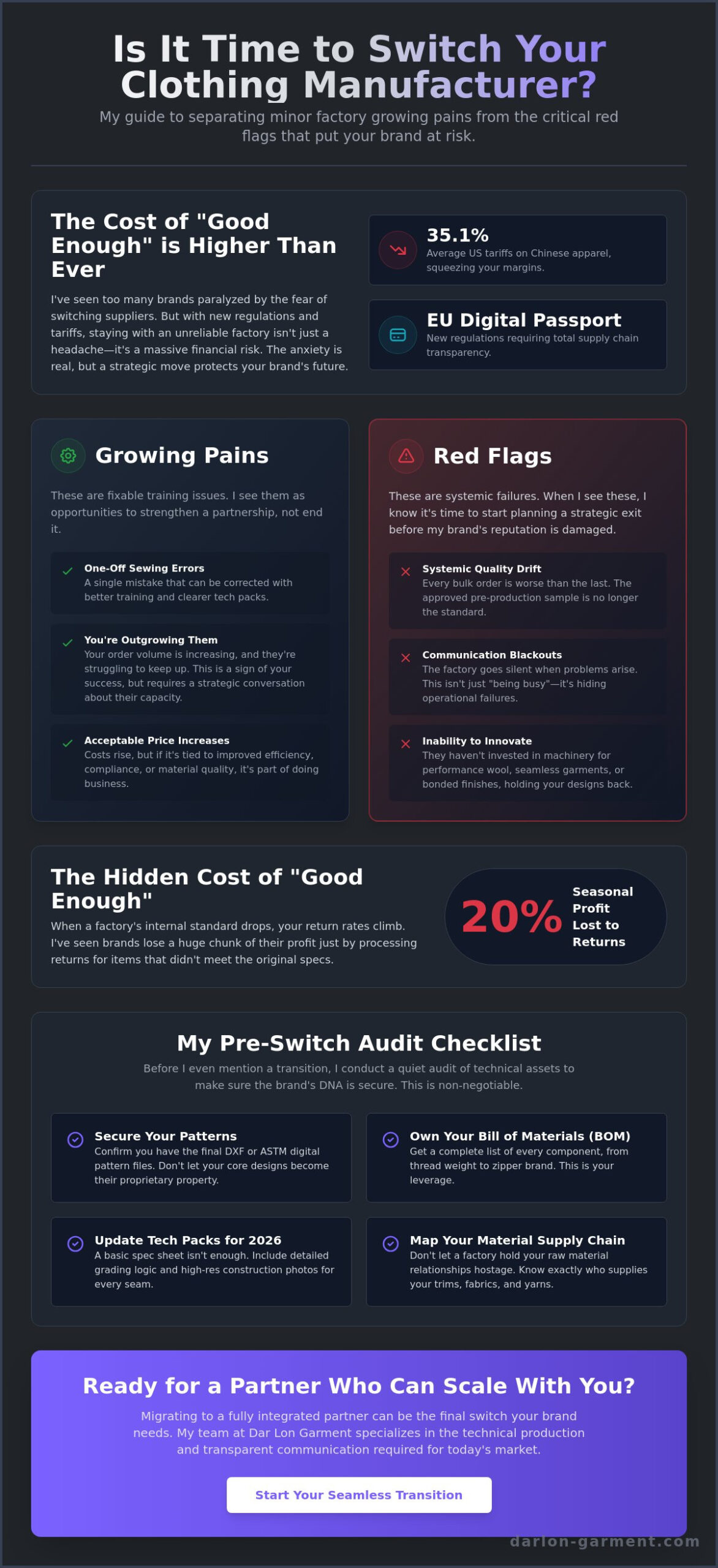
What if I told you that staying with an unreliable factory out of fear is actually the biggest risk your brand faces in 2026? I’ve seen too many founders paralyzed by the thought of missing a retail season or losing access to their proprietary patterns. With average US tariffs on Chinese apparel hitting 35.1% and new EU Digital Product Passport regulations requiring extreme transparency, the cost of “good enough” has become far too high. You need a partner who understands the technical precision of performance wool and seamless garments, not just someone who can sew a straight line.
I understand the anxiety that comes with change. You’re worried a new factory will repeat the same mistakes or that your supply chain will collapse during the move. I’m here to tell you it doesn’t have to be that way. Learning how to switch clothing manufacturers is a strategic migration of your brand’s standards, not a desperate leap of faith. I’ve developed a proven 12-week framework to help you transition to a higher-quality partner while protecting your margins and your sanity. In this guide, I’ll walk you through the technical audits, data verification, and chronological milestones needed to secure a seamless production handoff without losing a single day of sales.
Key Takeaways
- Learn to spot the difference between minor factory growing pains and the systemic quality red flags that signal it’s time to move on.
- Discover my step-by-step strategy for how to switch clothing manufacturers without losing your patterns or missing a single retail delivery.
- Secure your brand’s future by auditing your tech packs and intellectual property before you ever start the “breakup” conversation.
- Move beyond the lowest price quote to find a partner with the specialized machinery needed for high-performance activewear and seamless garments.
- Understand why migrating to a fully integrated partner like Dar Lon Garment can be the final switch your brand needs to scale effectively.
Knowing When to Walk Away: My Red Flags vs. Growing Pains
Deciding when to leave a production partner is one of the toughest calls I make. It is easy to get attached to a team that helped you launch, but in the clothing industry, staying with the wrong factory isn’t just sentimental; it’s a liability. I have learned that you must separate “growing pains” from “red flags.” A one-off sewing error is a training issue that we can fix. A systemic quality regression, where every bulk order looks worse than the last, is a clear signal to start researching how to switch clothing manufacturers before your brand reputation takes a permanent hit.
Sometimes, you simply outgrow the factory floor. If your partner specialized in small-batch runs but you are now moving thousands of units per SKU, their infrastructure might buckle under the pressure. I don’t see this as a failure on their part. It is a milestone of your brand’s success. If a factory cannot scale their output or maintain consistency at higher volumes, they become a bottleneck that stifles your growth.
In 2026, a “communication blackout” is a risk I simply won’t take. With the new EU Digital Product Passport requirements and shifting US tariffs, I need data and answers in hours, not weeks. If your factory goes silent when things get difficult, they aren’t just being “busy.” They are likely hiding operational failures. I also look at the commercial math. A price increase is acceptable if it comes with improved efficiency or better compliance data. If the costs are rising while the service remains stagnant, the value proposition has collapsed.
The Quality Drift: Why “Good Enough” is Killing Your Brand
I always tell my clients to document every defect with photos and tech pack references. If the bulk order does not match the Pre-Production Sample (PPS), that is my biggest deal-breaker. When “good enough” becomes the factory’s internal standard, your return rates will inevitably climb. These hidden costs eat your margins faster than any production delay ever could. I’ve seen brands lose 20% of their seasonal profit just by processing returns for garments that didn’t meet the original specs.
When Your Factory Can No Longer Innovate With You
The market is moving rapidly toward technical apparel. I’m seeing a massive shift where brands now require specialized Nuyarn performance wool, seamless garments, or bonded finishes. If your current partner hasn’t invested in laser cutting or automatic sewing machinery, they are holding your designs back. You aren’t just looking for a vendor; you need a strategic partner who has the physical infrastructure to build what the 2026 consumer actually wants to buy.
The Technical Audit: Securing Your Intellectual Property
I have seen too many factory breakups turn ugly because the brand didn’t realize they were caught in an “IP Trap.” Many founders assume that because they paid for samples, they automatically own the digital patterns and tech packs. However, if your current factory created those files from a sketch without a clear ownership agreement, you might discover they consider that data their proprietary property. This is a massive hurdle when you are figuring out how to switch clothing manufacturers. Before you even mention a transition to your current partner, I recommend conducting a quiet audit of your technical assets to confirm what you actually own.
Your most valuable asset during a move is a complete Bill of Materials (BOM). This document must list every single component of your garment, from the specific thread weight and fiber origin to the exact brand of zippers or buttons. If this information stays locked in your current factory’s internal system, you lose your leverage. According to the U.S. Copyright Office on fashion design, the legal landscape regarding design protection is complex; therefore, owning your master technical files is the only way to ensure your brand’s DNA remains yours. I help brands verify they have their DXF or ASTM pattern files in hand before the breakup talk ever happens.
Auditing Your Tech Packs for 2026 Standards
In 2026, a basic spec sheet isn’t enough to guarantee quality. I advise brands to update their documentation for modern, high-performance materials like elastane fabric. You must ensure your grading logic is fully documented. Don’t let sizing remain “factory knowledge” where a size Large is just an approximation. I also insist on including high-resolution construction photos for every seam and finish. If you find your current documentation is lacking, you can reach out to my team at Dar Lon Garment to see how we structure technical files for seamless transition and long-term production stability.
The Material Sourcing Handoff
You should never let a factory hold your raw material relationships hostage. I’ve seen manufacturers refuse to share supplier contact info for specific trims or elastics as a way to prevent a move. I help my clients map out their entire supply chain. This means knowing exactly who provides your zippers, labels, and performance yarns. I often handle transition sourcing by securing a small bridge stock of raw materials. This ensures your first run with a new partner maintains the exact same hand-feel and color consistency as your previous season. Continuity is the key to a risk-free migration.
Vetting Your Next Partner: My “Beyond the Price Quote” Framework
I have seen far too many brands get blinded by a low FOB price, only to realize later that a cheap quote is actually a “hidden tax” on their future quality. When you are researching how to switch clothing manufacturers, you must look past the initial dollar amount. In 2026, a factory that undercuts the market is likely cutting corners on compliance, technical labor, or raw material sourcing. I prefer to look at the total landed cost, especially since average tariffs on Chinese apparel have climbed to 35.1%. This makes the financial stability and technical capability of your partner more important than a few cents saved on a sewing line.
I believe Vietnam has emerged as the premier hub for sportswear and activewear in 2026. The technical labor force here is highly specialized in complex constructions like bonded seams and laser cutting. When I vet a new facility, I head straight for the machinery floor. If a factory is still relying entirely on manual sewing for performance garments, they won’t be able to provide the consistency your brand needs to scale. I look for automatic sewing units and precision laser-cut apparel capabilities that ensure every piece matches your tech pack exactly. This technical mastery is what separates a simple vendor from a strategic growth partner.
The 12-Point Vetting Checklist
I don’t rely on “golden samples” that were made months ago. Instead, I request “live” QC reports from their current production runs. This shows me how they handle real-time defects and quality control. I also verify that certifications like WRAP, Smeta, or GOTS are current. It is common for factories to display expired certificates, which is a major risk under the new EU Green Claims Directive. Finally, I evaluate their internal merchandising team. If they don’t have proactive, English-speaking project managers who understand technical engineering, your communication will eventually break down.
Capacity and Scalability Analysis
I always ask to see the factory’s floor space and their 3-year expansion plan. You don’t want to be the biggest client in a small shop, as you’ll have no room to grow. I also dig into their lead times during peak season versus the off-season. Understanding these cycles helps me plan my 12-week transition framework without hitting a production wall. I’ve found that choosing a sportswear factory in Vietnam requires a deep look at their specialized labor force. You need a team that is already trained in handling high-stretch elastane and performance wool to avoid the steep learning curve that ruins most manufacturer switches.
The 12-Week Transition: My Roadmap to a Seamless Migration
I’ve developed a methodical 12-week roadmap because I know that a sudden “rip-the-band-aid-off” approach is exactly how retail seasons get ruined. Once you’ve completed your technical audit and vetted your new partner’s machinery, the execution phase begins. When you’re learning how to switch clothing manufacturers, the goal is an invisible transition. Your customers shouldn’t notice a change in the hand-feel of your swimwear or the compression of your activewear; they should only notice that your quality has become more consistent. My framework relies on parallel production, ensuring you have a safety net while the new team proves its technical mastery.
Weeks 1 through 4 are what I call the “Blind Sampling” phase. I don’t just hand over a perfect tech pack and wait. I send a physical sample of a current best-seller and ask the new factory to replicate it from scratch. This tests their intuition for technical construction, especially with complex items like bonded and laser-cut apparel. If they can’t match the tension of a seam or the placement of a laser-cut vent without three rounds of corrections, they won’t survive a full production run. It is better to discover these gaps during a sample run than during a bulk order.
Weeks 5 through 8 focus on the trial order. This is where I run a small batch, usually 20% to 30% of your typical volume, alongside your current production. This overlap is your insurance policy. If the new factory hits a snag, you still have the majority of your inventory coming from your old partner. By weeks 9 through 12, we analyze the trial order’s KPIs. This is the most critical stage of how to switch clothing manufacturers, as it requires a disciplined scaling of volume to ensure the new lines can handle the increased pressure of a full-season launch.
The Power of the Trial Order
I always recommend starting with your “hero” style. Don’t give the new factory your easiest t-shirt; give them the complex Nuyarn performance wool piece or the seamless legging that defines your brand. Setting clear KPIs for this trial, like a defect rate under 1.5%, is non-negotiable. This phase isn’t just about production; it’s about training the new team on your brand’s specific DNA and finishing standards before you commit your entire fiscal year to their floor space.
Managing the “Old” Relationship During the Move
I’ve learned that you should never give notice until your trial order from the new factory is in the warehouse and inspected. This “Safe Window” strategy protects you from retaliation or priority drops at the old facility. Be professional about remaining fabric inventory. If you own the raw materials, I help coordinate a formal inventory transfer between facilities. Maintaining these ties is vital; the apparel world is small, and you may need that old partner as a backup during unforeseen global supply chain shifts. If you’re ready to start this process with a partner who values technical precision, start your production migration with Dar Lon Garment today.
Why I Built Dar Lon to Be the Last Switch Your Brand Ever Makes
I built Dar Lon because the traditional manufacturing model is fundamentally broken. Most founders researching how to switch clothing manufacturers are doing so because they’re tired of being treated like a line item in a factory’s spreadsheet. I wanted to create a partnership that provides a comprehensive service model, moving beyond simple assembly to offer a true one-stop solution. From the initial fiber sourcing of Nuyarn performance wool to the final bonded finishing, I ensure every step of the process is handled with industrial precision and technical mastery.
The way how garments are made at Dar Lon is different from a standard CMT shop. While others wait for you to provide every minor detail, my team takes a proactive stance. We’ve integrated technical engineering directly into our production lines to handle the complexities of 2026 sustainability standards, including the strict data requirements for Digital Product Passports. I personally oversee the onboarding of every brand that joins us. I know that the first 90 days are critical for establishing the trust and reliability you’ve been missing with your current partner.
Integrated OEM Solutions for Performance Brands
Our in-house development team often starts by fixing “broken” tech packs that previous factories simply couldn’t execute. If your grading logic is inconsistent or your material specs aren’t meeting the latest regulatory requirements, we resolve those technical hurdles before the first needle drops. We leverage a global sourcing network to find the exact performance fabrics your brand needs for high-end activewear and swimwear. I’ve found that choosing the right fitness wear manufacturer is less about finding the lowest price and more about finding a partner who can protect your margins through manufacturing efficiency.
Your Next Steps: A Personal Invitation
If you’re ready to stop worrying about your supply chain and start focusing on your brand’s growth, I invite you to book a production audit with me. To make our first call productive, please have your current tech packs and a list of your top three production pain points ready. I’ll give you a grounded, evidence-based assessment of how we can stabilize your output and improve your quality. Your brand deserves a partner that values technical mastery and long-term cooperation as much as you do. Let’s make this the last time you ever have to ask yourself how to switch clothing manufacturers.
Secure Your Brand’s Future with a Strategic Production Migration
Transitioning your supply chain is a significant undertaking, but it is often the only way to protect your brand from the rising costs and regulatory complexities of 2026. I’ve shown you that success depends on identifying systemic red flags early and securing your technical IP before you ever start the conversation. By following my 12-week roadmap, you can move away from unreliable partners without risking your seasonal sales or inventory stability. Understanding how to switch clothing manufacturers is about more than just finding a lower price; it is about finding a disciplined partner that offers technical mastery and high-volume OEM/ODM capacity.
Since 2019, I’ve built Dar Lon to handle the most demanding requirements in the industry. We specialize in complex constructions like Nuyarn performance wool, seamless garments, and bonded apparel, all produced in our 2026-ready facilities in Vietnam. I’m ready to help you move past the stress of factory mismanagement and into a more efficient, reliable future. Let me audit your current production and help you plan your switch to Dar Lon. Your brand has worked too hard to be held back by production failures. Let’s build something better together.
Frequently Asked Questions
How long does it realistically take to switch clothing manufacturers?
I recommend planning for a 12-week transition period to ensure your supply chain remains stable. This timeline allows for four weeks of technical audits and sampling, followed by a four-week trial order phase, and a final month for scaling. Attempting to rush this process often results in defective bulk or missed delivery windows for your next retail season.
Will I lose my patterns if I leave my current factory?
You will only lose your patterns if you don’t secure ownership of the master DXF or ASTM files before the transition. I’ve seen many brands discover too late that their factory considers digital patterns to be proprietary property. I advise auditing your technical assets and ensuring you have full legal ownership of your tech packs before you mention a move to your current partner.
What is a trial order, and why is it mandatory when switching?
A trial order is a limited production run, usually 20% to 30% of your standard volume, that tests a factory’s intuition and technical precision. It is mandatory because “golden samples” don’t reflect the reality of a high-speed production line. I use trial orders to verify a factory’s ability to handle complex constructions like seamless garments or bonded seams under real-world pressure.
How do I tell my current manufacturer I am moving production?
I suggest keeping the conversation strictly professional and waiting until your first trial order with the new partner is safely in your warehouse. This “Safe Window” protects you from potential retaliation or priority drops. Frame the move as a strategic shift in your business model rather than a critique of their service to maintain professional ties for future backup needs.
Is it more expensive to manufacture in Vietnam than in China in 2026?
While factory quotes vary, the total landed cost is often lower in Vietnam due to current trade policies. With US tariffs on Chinese apparel reaching 35.1% in 2026, the duty burden makes China significantly more expensive for many brands. I’ve found that Vietnam’s specialized labor force offers better fiscal value for high-performance activewear and technical sportswear.
What documentation do I need to provide to a new factory?
You must provide a comprehensive technical package that includes a Bill of Materials, high-resolution construction photos, and documented grading logic. When you’re researching how to switch clothing manufacturers, you’ll also need to prepare traceability data. This includes fiber origin and chemical compliance reports required for the 2026 EU Digital Product Passport regulations.
Can I move my fabric inventory from one factory to another?
Yes, you can move your raw materials if you own the inventory and have a clear logistics plan in place. I coordinate formal inventory transfers by performing a physical count and quality check before the fabric leaves the old facility. This prevents disputes over missing yardage and ensures material continuity for your first production run with the new partner.
How do I vet a factory if I cannot visit them in person?
I rely on “live” video walkthroughs of the machinery floor and requests for real-time QC reports from their current production lines. You should verify that their certifications, such as GOTS or WRAP, are current and not expired. A factory’s ability to provide transparent, evidence-based data via an English-speaking merchandising team is the best indicator of their reliability from a distance.