

What if the biggest threat to your brand’s growth isn’t a lack of demand, but the technical infrastructure of your own supply chain? I’ve watched many founders hesitate to take the leap because they fear that scaling apparel production means compromising on the technical precision of their sportswear or losing that specific feel their customers love. It’s a valid concern, especially when you’re moving from a local studio to a high-capacity facility in Vietnam while trying to keep your soul intact.
I understand the anxiety of managing communication across borders and the stress of keeping unit costs predictable. You’re likely also weighing the impact of 2026 requirements, such as the EU Digital Product Passport, which adds around $0.05 to $0.15 per garment for traceability data. I’ll show you how to transition from small batches to mass production without losing the quality that defines your brand. I’ll provide a roadmap for finding a reliable manufacturing partner, mastering technical construction in activewear, and ensuring your brand identity remains consistent as your volume grows.
Key Takeaways
- Learn why the “100-unit mindset” often fails during growth and how I shift my focus toward system-driven excellence to maintain your brand’s standards.
- Discover how I utilize advanced machinery like laser cutting and automatic sewing to provide more reliability and precision than even the most skilled hand-sewer.
- I’ll reveal the specific “Sweet Spot” in Vietnam where scaling apparel production leads to significant unit cost reductions while keeping your quality intact.
- Get my 4-step framework for a seamless transition, including how to audit your tech pack so your designs are ready for a high-capacity factory environment.
- Understand the long-term benefits of a “one-stop shop” ODM or OEM partnership and how I can serve as the silent, powerful backbone for your brand’s expansion.
Why scaling apparel production feels like a leap of faith (and how I bridge that gap)
Scaling a brand is often described as a leap of faith, but I prefer to think of it as a calculated transition in engineering. When I talk about scaling apparel production, I’m not just talking about ordering more fabric. It’s the move from artisan-level oversight, where you personally inspect every stitch, to a state of system-driven excellence. In my experience, this transition is where many brands either find their footing or lose their identity. I define scaling as the moment your brand stops relying on individual effort and starts relying on repeatable, industrial processes.
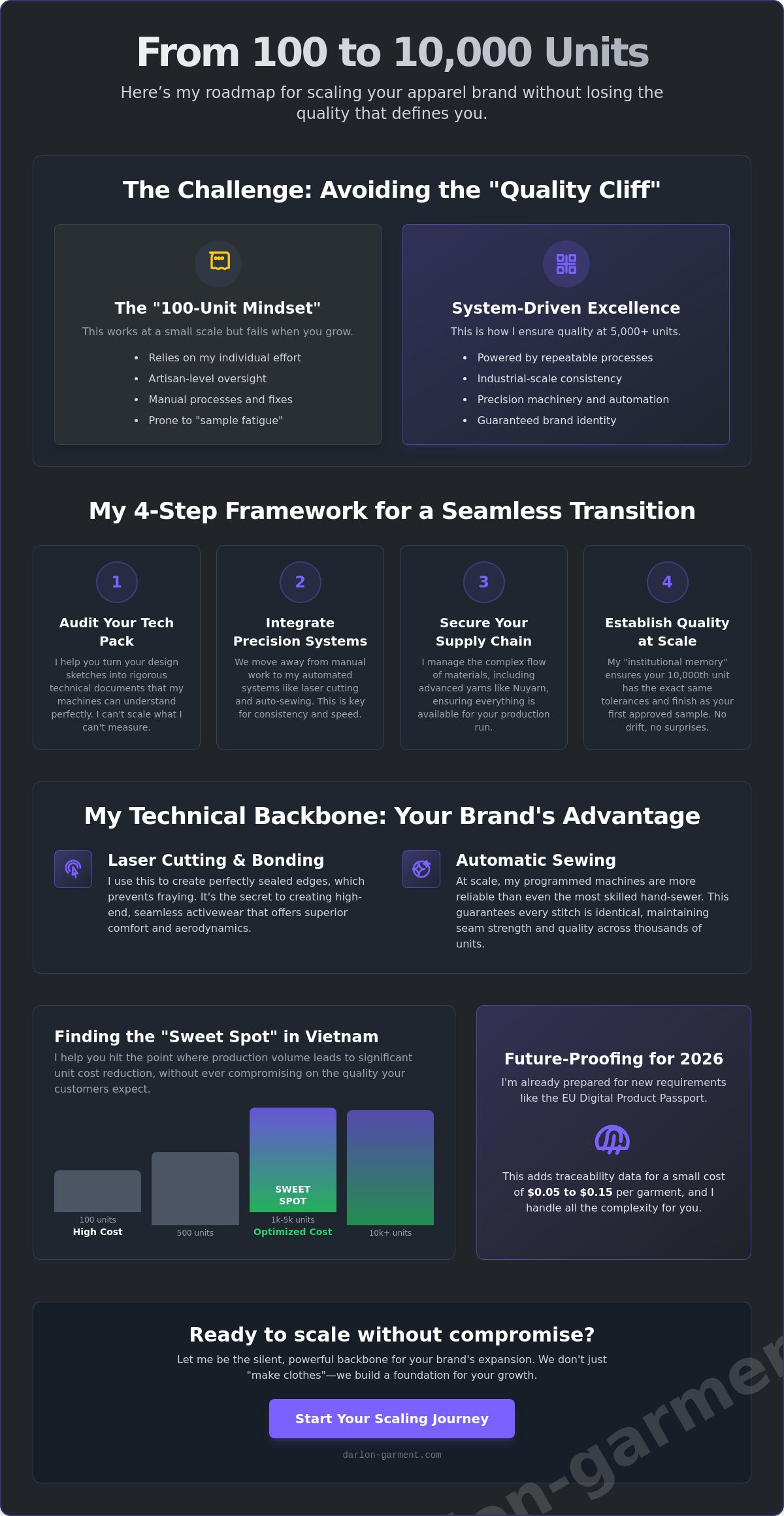
I often see founders hit a wall because they try to apply a “100-unit mindset” to a 5,000-unit order. At a small scale, you can catch errors on the fly or fix a minor seam issue yourself. When you hit 5,000 units, those small oversights become systemic failures that can bankrupt a business. Chasing volume without the right infrastructure is a common pitfall. I’ve seen brands focus so much on the “vibe” of their marketing that they forget to check if their manufacturer can actually replicate a bonded seam 5,000 times without a 10% failure rate. This is why I view my role as more than just a vendor; I see a sportswear factory in Vietnam as the silent, technical backbone of your business.
To achieve true mass production, we have to move away from the creative chaos of a design studio and toward the cold, hard metrics of industrial manufacturing. It’s about building a partnership where my facility’s capacity matches your brand’s ambition.
The “Quality Cliff”: Why things go wrong at 1,000 units
Manual processes that work for a handful of samples simply fail when speed increases. I’ve seen brands suffer from “sample fatigue,” where the first ten units look perfect, but the next nine hundred start to drift in sizing or finish. This happens because the production line isn’t stabilized. Your tech pack is your only real insurance policy here. It needs to be a rigorous technical document, not just a sketch. I can’t scale what I can’t measure, and I won’t let your quality drop just because your volume went up.
The mental shift: From designer to production manager
As you grow, you need to start thinking about tolerances and specifications. It’s no longer just about how a garment feels; it’s about whether the seam strength meets a specific requirement or if the moisture-wicking properties of your activewear remain consistent across different dye lots. You have to trust me to handle the heavy lifting of the supply chain. In 2026, lead times are heavily influenced by global logistics and material availability. Setting realistic expectations for these timelines early is vital for your cash flow. We don’t just “make clothes”; we manage a complex industrial flow that requires discipline from both of us.
The technical backbone: How I prepare my factory for your growth
I’ve spent years on the factory floor, and I can tell you that successful scaling apparel production isn’t about hiring more people. It’s about installing better systems. When you move from hundreds of units to thousands, the physical reality of manufacturing changes. I don’t just oversee a workforce; I manage a technical ecosystem designed for repeatability. To ensure your brand’s growth is sustainable, I focus on integrating precision machinery that performs exactly the same way on Monday morning as it does on Friday afternoon.
I rely heavily on automatic sewing and laser cutting because precision machinery is actually more reliable than the most skilled hand-sewer at scale. Even the best tailor has “off days,” but a programmed machine does not. This level of consistency is vital as more brands are rebalancing their global sourcing footprint to favor stability and technical mastery. I maintain what I call “institutional memory” for every client. This means the settings, tolerances, and material handling protocols for your 10,000th unit are identical to your first, ensuring your brand identity never wavers as you grow.
Laser cutting and bonding: The secret to high-end activewear
Traditional seams often fail when you push for high volumes and high intensity. In my facility, I use laser cutting to ensure edges are perfectly sealed, which prevents fraying before the garment is even assembled. This changes the fundamental way how garments are made in my production lines. By introducing laser precision and bonding, I can create seamless garments that offer better aerodynamics and comfort. This technology allows your brand to offer high-end activewear and swimwear that stands out in a crowded 2026 market.
Nuyarn and advanced yarn tech: Scaling performance
I often recommend Nuyarn performance wool apparel for brands looking to differentiate themselves while they scale. Sourcing specialized yarns at high volumes is a technical challenge, but it’s one I’ve optimized to prevent supply chain bottlenecks. Performance wool offers incredible longevity and technical benefits, such as natural elasticity and moisture management, which don’t degrade over time. By using these specialized textiles, I help you build a product line that justifies a premium price point even as your production volume increases. If you want to see how these materials fit into a larger strategy, I suggest reviewing my guide on technical garment construction.
Small batches vs. mass production: Navigating MOQs and costs in Vietnam
I often see brands struggling to find the balance between risk and reward when they decide to grow. In a world in flux, knowing when to pull the trigger on a larger order is a critical business decision. Successfully scaling apparel production requires identifying the “Sweet Spot.” This is the volume where your fixed costs, like tech pack development and machine setup, are absorbed by enough units to make your retail price competitive without bloating your inventory. I’ve found that for most technical activewear, this shift happens when you move past the initial sampling phase into consistent bulk runs.
I always remind my partners that hidden costs can eat your margins if you aren’t careful. Beyond the cost of labor and fabric, you have to account for fabric wastage, trim sourcing, and the evolving logistics of 2026. For instance, disruptions in the Red Sea have recently pushed container shipping costs up by as much as $5,000 per container. I help you navigate these variables by choosing sea freight where possible, which typically ranges from $0.50 to $1.50 per unit, compared to the much higher rates of air freight. Choosing a fitness wear manufacturer in Vietnam provides a strategic advantage because of our proximity to major shipping lanes and a robust local supply chain.
Understanding the MOQ: It’s not a random number
I get asked about Minimum Order Quantities (MOQs) more than almost anything else. It’s important to understand that my MOQs aren’t arbitrary; they’re often dictated by the fabric mills. If you’re sourcing a specialized elastane fabric with specific compression or moisture-wicking properties, the mill requires a minimum dye lot. I work with brands to bridge this gap by suggesting shared fabric bases across different styles or colors. This allows us to meet mill minimums while giving you the variety your collection needs.
The Vietnam Advantage in 2026
Vietnam is currently the third-largest apparel exporter globally, and for good reason. My location offers a unique balance of technical expertise and cost efficiency that neighboring countries often lack. We benefit from extensive trade agreements, such as the EVFTA, which keeps duties for EU imports between 0% and 12%. Even with average garment worker wages around $300 per month, I focus on high-value products like seamless and bonded apparel. This ensures that while we aren’t the “cheapest” on paper, the value you receive in technical precision and duty savings makes us the most fiscal choice for long-term growth.
My 4-step framework for a seamless scale-up
I’ve developed a 4-step framework to remove the guesswork from scaling apparel production. This isn’t a theoretical model; it’s the physical checklist I use to move brands from small batches to thousands of units without a drop in quality. I focus on building a foundation where every variable is controlled before the first meter of fabric is cut.
Step 1 is always auditing your tech pack. I can’t scale what I can’t measure. If your documentation is vague, your production will be too. I look for specific tolerances and construction methods that can be replicated at high speed. For complex technical garments, a professional tech pack can cost upwards of $1,000, but it’s a necessary investment to avoid systemic errors. Step 2 involves prototyping for mass production. I don’t just look at the aesthetic; I look at how the garment moves through the line. Step 3 is stress-testing your fabric sourcing. I need to know if your mill can scale from 500 meters to 5,000 meters without a drop in quality or a six-month lead time. Finally, Step 4 is the implementation of my 4-stage Quality Control protocol.
Prototyping for the assembly line
Your first sample might look great, but it often needs changes for bulk efficiency. I use physical samples to train my line supervisors so they understand the exact tension required for a seamless knit or the precise heat setting for a bonded pocket. Wear testing is non-negotiable before you hit the 5,000-unit mark. I need to know how that sportswear performs after twenty washes before we commit to a massive run. This process ensures that the technical precision of your activewear remains high even as the volume increases.
The 4-Stage QC Protocol
Quality isn’t something I check at the end; it’s something I build into the industrial flow. My process starts with fabric inspection, followed by in-line QC where we catch errors at the sewing station. We then move to end-of-line QC and a final audit before packing. I’ve found that natural fibers require a different QC approach than synthetics because of their inherent variability in shrinkage. You can monitor this entire process through the digital data required for the 2026 EU Digital Product Passport, giving you total transparency from halfway across the world. If you’re ready to apply this level of precision to your brand, you can view my full range of production services to see how we can grow together.
Partnering for the long haul: Why Dar Lon Garment is your scaling backbone
I believe that the most successful brands don’t just find a vendor; they find a partner. My philosophy on ODM and OEM partnerships is rooted in the idea that we grow together. When you are scaling apparel production, you need a factory that acts as your silent, powerful backbone. I’ve built Dar Lon Garment to be exactly that. I handle the technical complexities of the supply chain so you can focus on your brand’s vision and market expansion. It’s about moving away from short-term transactions toward a disciplined, long-term cooperation.
My “one-stop shop” model is designed to provide stability in an unpredictable market. I manage everything from the initial sourcing of specialized materials like Nuyarn performance wool to the final delivery of your bulk orders. By centralizing these processes, I can keep your unit costs predictable and your quality consistent. I help you stay agile, even as you get bigger. This means you can adjust your volumes or refine your technical specifications without the friction usually found in fragmented supply chains. My goal is to ensure that your transition to mass production is as seamless as the garments we produce.
Sustainable scaling: Growth without the guilt
Growth shouldn’t come at the expense of your brand’s reputation or the planet. I’ve invested in waste reduction technology and energy-efficient machinery to ensure my facility meets the strict 2026 sustainability standards. Ethical manufacturing is a requirement for scaling apparel production in today’s market. I handle all the necessary compliance for major global markets, including the US, EU, and Australia. This includes managing the data integration for the EU Digital Product Passport, ensuring your products are ready for international regulatory standards. I take pride in providing a manufacturing environment that is both technically advanced and ethically sound.
Ready to grow? Let’s talk shop
If you’re ready to take the next step, I invite you to share your tech packs with me for a preliminary audit. In our first consultation, I’ll take a professional look at your current designs and construction methods to see how they can be optimized for my assembly lines. We’ll discuss your growth targets and how my physical infrastructure can support your trajectory. I’ll provide a clear, results-oriented narrative on how we can reach your goals together. Your brand is safe in my hands because I value the technical mastery and reliability that a professional buyer expects. Let’s start building your brand’s future today.
Build Your Brand’s Future with Industrial Precision
Success in 2026 depends on how well you can bridge the gap between a creative vision and industrial reality. We’ve explored how scaling apparel production requires moving away from artisan-level oversight toward a more disciplined, system-driven approach. By integrating advanced laser-cutting technology and specializing in high-performance materials like Nuyarn wool, I help you maintain technical precision as your volume increases. Vietnam continues to offer a unique advantage, providing the infrastructure and trade benefits needed to stay competitive in a global market.
My one-stop OEM/ODM solutions are built to serve as your brand’s technical backbone. I handle the complexities of sourcing and quality control so you can focus on what you do best. It’s time to move past the fear of losing your brand’s identity and embrace the stability of a professional partnership. Ready to scale? Let me take a look at your tech pack today. I’m excited to see what we can build together as your brand reaches its full potential.
Frequently Asked Questions
What is the typical MOQ for scaling apparel production in Vietnam?
I usually set MOQs based on the fabric mill’s specific requirements. For technical activewear or swimwear, you should expect minimums of 500 to 1,000 units per color. While some factories offer lower quantities, scaling apparel production effectively requires these volumes to reach the “Sweet Spot” where unit costs become competitive and fabric mills agree to custom dye lots.
How do I ensure my quality stays consistent when moving to a larger factory?
I rely on a 4-stage Quality Control protocol to maintain standards at high volumes. This includes raw material inspection, in-line checks at the sewing stations, end-of-line reviews, and a final audit before shipping. By moving from manual oversight to system-driven checks, I ensure that the 5,000th unit is identical to the first sample you approved.
Can I scale production if I only have a basic design and no tech pack?
I don’t recommend scaling without a professional tech pack. A basic design is fine for a local tailor, but a high-capacity factory needs a technical blueprint to ensure precision. I can’t scale what I can’t measure. If you don’t have one, I suggest investing in a professional tech pack to avoid costly errors during the bulk run.
How long does the lead time change when moving from 500 to 5,000 units?
Bulk orders don’t simply take ten times longer. While a 500-unit run might take 30 to 45 days, a 5,000-unit order usually requires 60 to 90 days. Most of that extra time is spent on fabric procurement and machine setup. Once the line is running, the actual sewing time is incredibly efficient due to our automated processes.
What advanced technologies should I look for in a scaling partner?
I suggest looking for facilities that utilize laser cutting, bonding, and seamless knitting technology. These tools are essential for high-end activewear and swimwear because they provide a level of precision that manual sewing can’t match. Automation reduces human error and ensures that complex technical features, like moisture-wicking seams, remain consistent across every unit.
How do you handle fabric sourcing for large-scale performance wear runs?
I coordinate directly with specialized mills to ensure dye lot consistency across large volumes. For performance wear, I often source technical yarns like Nuyarn wool or recycled nylon. Since Vietnam imports nearly 100% of its fibers, I manage the logistics of these imports to prevent delays and ensure the material meets your specific technical requirements.
What are the main cost drivers when scaling from small batch to bulk?
Fabric and logistics are your primary costs. Beyond the raw materials, you’ll need to factor in shipping; sea freight typically ranges from $0.50 to $1.50 per unit. You also need to account for new 2026 regulations like the EU Digital Product Passport, which adds a small fee per garment for traceability data and digital twins during scaling apparel production.
Do I need to visit the factory in Vietnam to manage a large production run?
I don’t believe an in-person visit is strictly necessary if you have a transparent partner. With modern digital reporting and the traceability required by 2026 standards, you can monitor your production from anywhere. I provide regular updates and data-driven insights, though I always welcome partners who want to see our industrial scale and craftsmanship firsthand.