

If you’re still choosing a manufacturing partner based solely on the lowest labor cost, you’re likely setting your brand up for a technical failure. I’ve seen too many designers search for the best activewear factories in vietnam only to be burned by facilities that can’t execute a clean laser-cut edge or a durable flatlock seam. I know how exhausting it is to manage communication gaps and fabric sourcing hurdles while trying to maintain your brand’s quality standards.
I want to help you find a reliable partner that acts as a silent, powerful backbone for your business. In this guide, I’ll show you how to identify top-tier manufacturers by using my technical evaluation framework. We’ll move beyond basic cut-and-sew to focus on specialized capabilities like Nuyarn performance wool and seamless garment construction. I’ll also walk you through the logistics of the 2026 market, including the impact of the EVFTA and rising ocean freight rates, so you have a clear path from your first prototype to a successful bulk production.
Key Takeaways
- Learn how Vietnam’s shift toward high-tech manufacturing and trade benefits like the EVFTA can help you optimize your global production budget.
- Discover my 5-step framework to identify the best activewear factories in vietnam by focusing on technical machinery audits and material sourcing networks.
- Understand why specialized equipment, like automatic sewing machines, is the true differentiator for brands that need consistent, high-tension seams.
- Get insights into managing the 2026 supply chain, from the rise of natural fibers to handling increased ocean freight and insurance costs.
- See how a technical OEM partner can bridge the gap between your complex designs and the bulk production of seamless or bonded apparel.
Why Vietnam is the Global Hub for Activewear in 2026
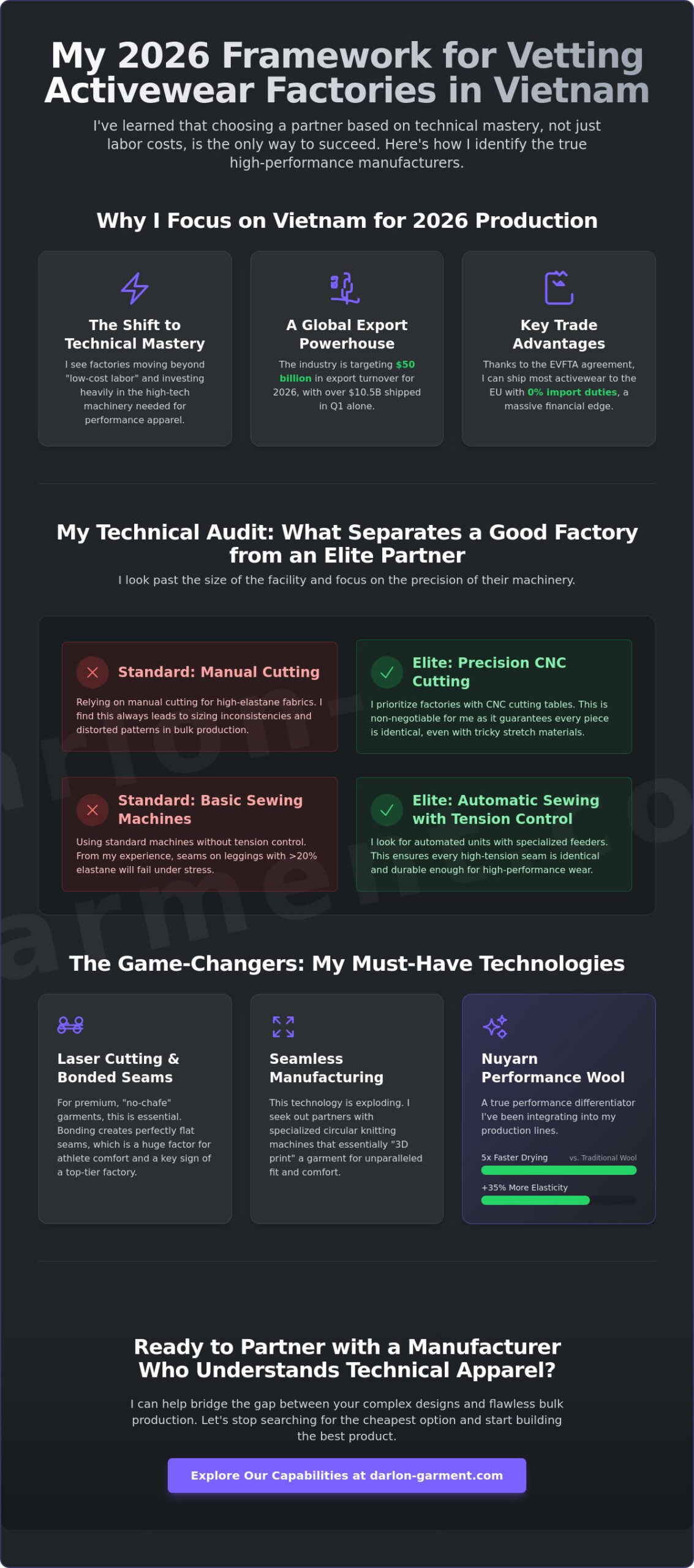
I’ve spent years on factory floors across Southeast Asia, and the transformation I’m seeing in 2026 is staggering. Vietnam isn’t just a backup plan anymore; it’s the primary destination for performance apparel. The industry has moved far beyond simple “low-cost labor.” While the new regional minimum wage for 2026 has increased to 5,310,000 VND in Region I, the value isn’t in the hourly rate. It’s in the technical mastery. The best activewear factories in vietnam have pivoted toward high-tech manufacturing, investing in the specialized machinery required for bonded seams and laser-cut finishes.
The rapid development of Vietnam’s manufacturing sector has been fueled by massive investments in infrastructure and automation. This shift is reflected in the numbers. Vietnam’s textile and garment industry is targeting an export turnover of $50 billion in 2026. In the first quarter of 2026 alone, exports reached over $10.54 billion. I see this growth every day. Brands are moving their most complex designs here because they know the technical expertise exists to handle high-performance fibers like Nuyarn wool and seamless knits.
Trade agreements are the other half of the story. Under the EVFTA, import duties on most activewear categories for the EU are now at 0%. This gives my partners a massive financial edge. Even with the standard U.S. apparel duties ranging from 0% to 32%, the “China Plus One” strategy remains dominant. I’m seeing a huge influx of brands diversifying their sourcing to mitigate risk, and Vietnam is the clear winner due to its stable business environment and proximity to major Asian fabric mills.
The Regional Powerhouses: Where the Best Factories Live
I chose to base my operations in Southern Vietnam because of the logistical advantages. The clusters around Ho Chi Minh City and Binh Duong are built for speed. While Northern factories often focus on heavier outerwear, the South specializes in the stretch and recovery fabrics essential for activewear. Infrastructure improvements in 2026, including expanded port capacities, mean I can get finished garments onto ships faster than ever, even with the 20-day transit extensions currently affecting some maritime lanes.
Regulatory Advantages and Trade Benefits
The “Made in Vietnam” label has become a mark of quality in the fitness industry. It tells your customers that the garment was produced in a facility that meets strict international standards. In 2026, sustainability is no longer optional. I’m seeing factories implement “digital product passports” to provide material traceability. This transparency is crucial for brands selling in the EU and US, where ethical sourcing is a top priority. We’ve moved past the era of opaque supply chains; today, it’s about verified data and technical precision.
Technical Capabilities: What Separates “Good” from “Best”
I’ve walked through hundreds of facilities, and I can tell you that the best activewear factories in vietnam aren’t defined by their size, but by their machinery. In performance apparel, the machine is the true differentiator. If a factory is still relying on manual cutting for high-elastane fabrics, you’re going to see sizing inconsistencies across your bulk production. When I’m identifying the best activewear factories in vietnam, I look for precision CNC cutting tables that can handle the shifting nature of stretch materials without distorting the pattern.
Consistent high-tension seams are another non-negotiable. I prioritize factories that utilize automatic sewing machines. These units ensure that every stitch is identical, which is vital when you’re hitting Vietnam’s 2026 garment export targets by producing millions of technical units. When I evaluate a new partner, I check how they manage fabrics with 20% or higher elastane content. If they don’t have specialized tension-control feeders, those leggings will likely fail at the seams under stress. You can’t just pull these fabrics through a standard machine and expect a professional result.
Laser Cutting and Bonded Seams
The engineering behind “no-chafe” garments is fascinating. I’ve found that laser cutting is the only way to achieve the perfect, sealed edges required for premium yoga wear. By using bonding technology instead of traditional stitching, we can create garments that are essentially flat. This is a massive factor in fitness wear manufacturer success because it significantly improves athlete comfort. If you want to see how this looks in practice, you can explore our technical production capabilities to see the difference between standard and bonded finishes.
Seamless Manufacturing and Nuyarn Performance Wool
Seamless technology has exploded in 2026. It requires highly specialized circular knitting machines that essentially “print” the garment in 3D. I’ve also been integrating Nuyarn performance wool into my production lines. Unlike traditional ring-spun wool, Nuyarn drafts wool fibers around a high-performance core. This creates a fabric that is 5x faster drying and 35% more elastic. It’s a game-changer for durability. When I compare Nuyarn to traditional methods in a factory setting, the difference in tensile strength is immediate. You can’t fake this kind of performance; you either have the tech or you don’t.
My 5-Step Framework for Evaluating an Activewear Factory
I don’t just choose a partner because they have a clean showroom or a professional website. To find the best activewear factories in vietnam, I use a rigorous evaluation framework that looks at the actual mechanics of production. I’ve learned that a factory’s true value is hidden in its workflow and its ability to solve technical problems before they reach the shipping container. Here is the five-step process I use to vet every facility I work with.
- Step 1: Technical Capability Audit. I start by comparing their machinery list against your specific tech pack. If you need seamless garments, I verify they have the circular knitting machines on-site rather than outsourcing the work.
- Step 2: Material Sourcing Network. Since approximately 70% of raw materials in the Vietnamese garment sector are imported, I check their supply chain. They must have established routes to source high-quality elastane fabric that meets international stretch and recovery standards.
- Step 3: Prototyping Speed. I measure how quickly they can turn a digital sketch into a physical sample. A reliable factory should provide an initial prototype within 10 to 14 days.
- Step 4: Quality Control (QC) Protocols. I look for a four-stage inspection process. This includes raw fabric testing, in-line inspections, end-of-line checks, and a final random audit before packing.
- Step 5: Ethical and Environmental Compliance. In 2026, I only partner with factories that hold updated certifications like WRAP, BSCI, or the Global Recycled Standard (GRS).
The Importance of the Tech Pack
I always tell my clients that a premium garment starts with a perfect tech pack. If your documentation is vague, even the best activewear factories in vietnam will struggle to give you an accurate quote. I need to see a detailed Bill of Materials (BOM), specific grade rules, and clear seam construction notes. Common mistakes, like omitting the exact GSM of a fabric or failing to specify thread types, often lead to weeks of avoidable production delays.
Sampling: The Critical Testing Ground
Sampling is where I see a factory’s “soul.” It isn’t just about making one piece look right; it’s about testing the stretch and recovery of the material under real-world conditions. I offer iterative prototyping because the first sample is rarely the final one. We use this stage to refine the fit and ensure the technical seams I mentioned earlier actually perform during high-intensity movement. If a sample fails my stress test, we don’t move to bulk production until the engineering is corrected.
Sourcing and Logistics: The Backbone of Production
I’ve found that the real work begins long before the first stitch is sewn. In 2026, the best activewear factories in vietnam aren’t just assembly lines; they’re supply chain managers. Since about 70% of our raw materials are imported, I have to manage the flow from raw yarn to finished garment with extreme precision. Lately, I’m seeing a significant shift toward natural fibers in the activewear market, as brands look for high-performance alternatives to synthetics. Whether it’s sourcing these natural blends or specialized recycled nylons, my role is to ensure the material matches your performance requirements exactly.
When you’re comparing quotes, you’ll likely see two models: CMT (Cut, Make, Trim) and FOB (Free On Board). I usually recommend the FOB model for international partners. It means I handle the entire process, including material sourcing and local transport to the port. This is especially important right now. Geopolitical tensions have pushed ocean freight rates and marine insurance up by about 10% in early 2026. Shipping transit times have also been extended by up to 20 days. By managing the logistics from my end, I can better navigate these bottlenecks and prevent your launch from being derailed by a missing shipment of zippers or a container delay at the port.
Advanced Material Sourcing
I don’t leave material quality to chance. For eco-conscious brands, I source certified recycled polyesters and sustainable nylons. But it isn’t just about the fabric. I personally verify the quality of every trim, zipper, and accessory. Before bulk production begins, we run rigorous material tests for colorfastness and shrinkage. If a fabric shrinks more than 3% after a wash test, we recalibrate the patterns. This level of detail is what separates the best activewear factories in vietnam from those that simply follow a tech pack without questioning the inputs.
Navigating Vietnam Customs and Shipping
Getting your goods out of the country requires a deep understanding of local infrastructure. Most of my activewear exports move through Cat Lai in the south or Hai Phong in the north. In 2026, documentation requirements have become more stringent, particularly regarding material traceability for digital product passports. This is why a “one-stop” manufacturing partner is so valuable. I handle the customs paperwork and coordinate with carriers so you don’t have to. If you’re ready to simplify your supply chain, you can partner with us for a complete manufacturing solution today.
Partnering with Dar Lon Garment: Your Technical OEM Solution
I founded Dar Lon Garment because I saw a recurring problem in the international apparel industry. Many brands had incredible designs but couldn’t find a manufacturer capable of executing the complex technical details. I wanted to create one of the best activewear factories in vietnam by focusing on the intersection of engineering and performance apparel. My goal wasn’t just to build another production line. I wanted to provide a silent, powerful backbone for international labels that require stability and technical mastery.
My “One-Stop” philosophy is the core of our operation. We manage the entire lifecycle of your product, from initial development to global delivery. This means you don’t have to coordinate between a fabric mill, a sewing factory, and a logistics provider. I’ve integrated these steps to ensure that the technical integrity of your activewear or swimwear remains intact from the first prototype to the final bulk shipment. When searching for the best activewear factories in vietnam, brands often prioritize scale, but I believe the true value lies in the marriage of high-tech production and direct, expert communication.
Our Specialized Production Lines
I’ve designed our facility to handle the most demanding technical requirements. Whether you’re looking for high-compression leggings or want to understand how garments are made in our specialized swimwear division, we have the machinery to back it up. Our lines are equipped with the laser-cutting and automatic sewing tech I discussed earlier. This allows us to maintain the institutional permanence and quality control that professional buyers expect. We don’t just sew; we engineer garments for maximum performance.
We also have dedicated sections for Nuyarn performance wool and seamless garments. These aren’t just “add-on” services. They’re core competencies supported by specialized knitting machines and technicians who understand the material science of stretch and recovery. I offer customized OEM solutions that can be tailored to your specific volume needs. This ensures that our partnership can scale as your brand grows, providing a reliable foundation for your sportswear, sleepwear, or activewear collections.
Start Your Production Journey with Me
If you’re ready to move away from the communication gaps of offshore manufacturing, the first step is simple. I invite you to submit your tech pack for a preliminary technical review. I’ll personally look at your documentation to ensure our machinery is the right match for your designs. After that, we’ll schedule a consultation call to discuss your production metrics and timeline. This structured approach prevents confusion and sets a clear path for our cooperation.
My promise to you is rooted in professionalism and precision. I value long-term cooperation over short-term gains, and I’m committed to providing a transparent, results-oriented experience. When you partner with Dar Lon Garment, you’re not just hiring a vendor. You’re gaining a disciplined partner with the physical infrastructure and operational history to ensure your success in 2026 and beyond. I look forward to helping you bring your high-performance apparel to the global market.
Building a Resilient Activewear Brand in 2026 and Beyond
I’ve shown you why the search for the best activewear factories in vietnam must focus on technical infrastructure rather than just labor costs. Success in 2026 depends on navigating trade benefits like the EVFTA while managing the rising logistics costs we discussed earlier. By using my five-step framework, you can audit potential partners to ensure they have the machinery and material networks required for high-performance apparel. I’ve built Dar Lon Garment to be the technical partner I always wanted to see in this industry.
From our Advanced Laser-Cutting Technology to our role as a Specialized Nuyarn Performance Wool Partner, we offer Comprehensive OEM/ODM Services that take the guesswork out of production. I’m ready to help you bridge the gap between your design vision and a finished product that performs in the real world. It’s time to stop worrying about communication gaps and start focusing on scaling your brand with a partner you can trust.
Let’s discuss your next activewear collection—contact me today!
Frequently Asked Questions
Why is Vietnam considered the best place for activewear manufacturing in 2026?
Vietnam offers a unique combination of technical expertise and 0% import duties to the EU under the EVFTA. I’ve seen the industry pivot from basic assembly to high-tech manufacturing, making it a reliable hub for performance gear. The workforce is highly skilled in handling complex construction like seamless and bonded garments that require specialized machinery.
What is the typical Minimum Order Quantity (MOQ) for activewear factories in Vietnam?
Typical MOQs for the best activewear factories in vietnam usually range from 500 to 1,000 pieces per style. While some large scale facilities require higher volumes, technical partners can often accommodate smaller, high value runs for premium labels. It’s always best to discuss your specific volume needs during our initial consultation call to see what is possible.
Can Vietnamese factories handle sustainable and eco-friendly activewear fabrics?
Yes, many facilities now specialize in sustainable materials like recycled polyester and organic cotton. I’ve seen a massive shift toward “digital product passports” that provide full material traceability for international markets. We regularly source GRS certified fabrics to meet the growing demand for ethically produced sportswear and activewear.
How long does the sampling process take for a new activewear design?
The sampling process generally takes between 10 and 14 days once I have your finalized tech pack. This timeline allows us to source the correct fabric and test the technical seams for durability. If your design involves complex elements like laser-cut bonding or Nuyarn wool, we might add a few days to ensure the prototype is perfect.
What is the difference between CMT and FOB manufacturing in Vietnam?
In the CMT model, you provide the fabric and I handle the cutting and sewing. FOB is a more comprehensive service where I source all raw materials, manage the entire production process, and handle local logistics to the port. I generally suggest the FOB model for international brands because it simplifies the supply chain and reduces the risk of material delays.
What certifications should I look for in a Vietnam activewear factory?
I recommend looking for social compliance certifications like WRAP, BSCI, or SA8000 to ensure ethical labor practices. For material safety and sustainability, OEKO-TEX Standard 100 and the Global Recycled Standard are the industry benchmarks. These certifications prove that a factory meets the rigorous requirements of the global 2026 activewear market.
How do I protect my intellectual property when manufacturing in Vietnam?
Protecting your IP starts with choosing a reputable partner who values long term cooperation over short term gains. I suggest using clear NNN agreements (non-disclosure, non-circumvention, and non-competition) that are enforceable under local law. Working with a professional OEM like Dar Lon Garment ensures your designs are handled with institutional discipline and confidentiality.
Can I visit the Dar Lon Garment factory in person?
I absolutely welcome brand partners to visit my facility in person. Seeing our laser-cutting machines and automatic sewing lines in action is the best way to understand our technical capabilities. It also allows us to build the trust necessary for a successful long term partnership. Please contact me to schedule a tour of our production floor.