

What if the biggest threat to your 2026 collection isn’t a lack of demand, but the 14 days of transit time currently added by Red Sea rerouting? I’ve seen too many brands lose their seasonal momentum because they treated apparel manufacturing lead times as a static number rather than a variable they could control. It’s a common trap, especially when you’re managing complex technical builds like bonded performance wear or Nuyarn wool pieces from halfway across the world.
I know how exhausting it is to deal with vague timelines and the looming fear of inventory stockouts just as your peak season hits. With the EU ban on destroying unsold goods taking effect on July 19, 2026, getting your volume right and your timing perfect has never been more critical. I’m pulling back the curtain on how I manage production schedules here in Vietnam so you can stop guessing and start delivering your activewear and swimwear collections on a predictable clock.
In this guide, I’ll provide a roadmap to reduce production delays by addressing the fact that fabric sourcing accounts for up to 55% of first-order hold-ups. You’ll learn exactly how to navigate the four key phases of production to ensure a faster response to market trends without sacrificing the technical mastery your brand requires.
Key Takeaways
- I’ll show you why I treat lead time as your brand’s most vital cash flow metric and how to calculate the full window from the first order to your warehouse door.
- You’ll learn why sourcing is often the biggest bottleneck and how to better manage apparel manufacturing lead times by anticipating raw material delays before they happen.
- I’ll explain my approach to tech packs and samples, which helps you avoid the constant back-and-forth that often kills a production schedule.
- Discover my top five strategies for accelerating your 2026 production, such as simplifying your material strategy across your entire swimwear or sportswear line.
- I’ll share how the factory floor experience of Dar Lon Garment in Vietnam helps navigate today’s logistics challenges and keep your delivery dates predictable.
What are Apparel Manufacturing Lead Times? My View from the Factory Floor
When you ask me about apparel manufacturing lead times, I don’t just look at how fast my sewing lines move. To me, lead time is the total “order-to-door” window. It starts the second we finalize your tech pack and ends when the boxes arrive at your warehouse. I’ve seen brands fail because they only tracked “Production Lead Time” (the actual sewing part) and ignored the “Total Supply Chain Lead Time,” which includes sourcing raw materials and ocean freight. If you want a deeper dive into the technical definitions, What are Apparel Manufacturing Lead Times? from a global supply chain perspective can help set the foundation.
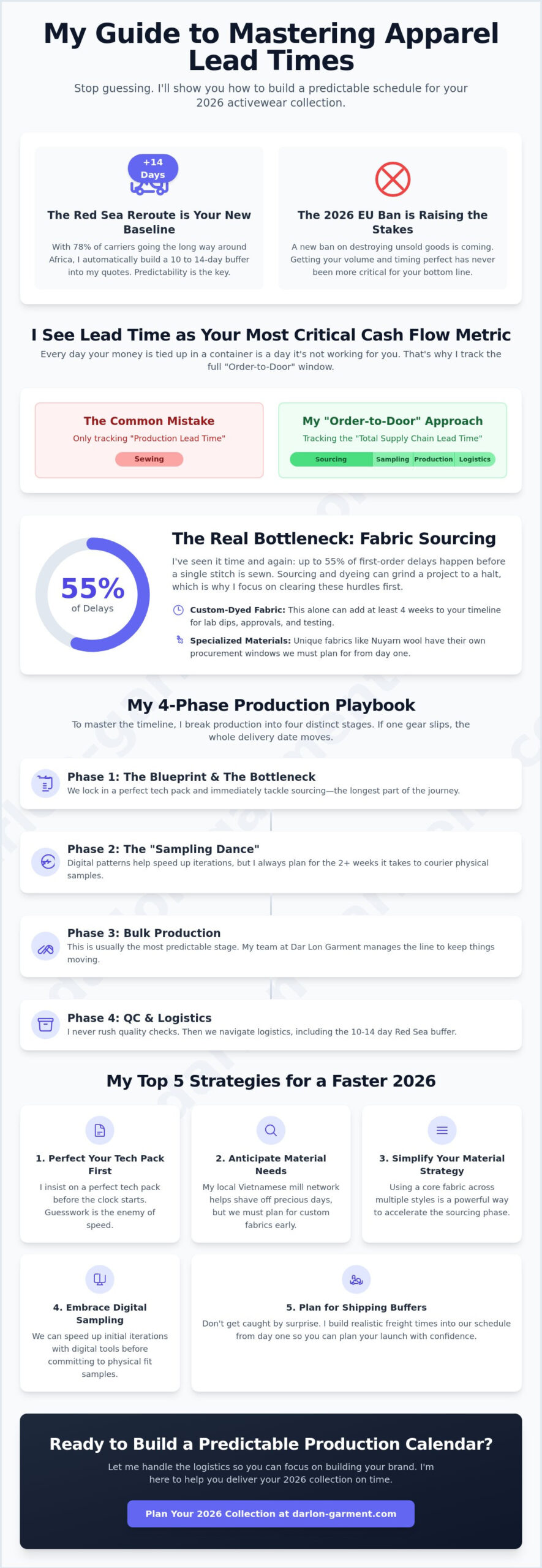
I consider lead time the most critical metric for your brand’s cash flow. Every day your capital is tied up in raw yarn or finished sportswear sitting in a container is a day that money isn’t working for you. In 2026, the baseline for speed has shifted. With 78% of major carriers still rerouting around the Cape of Good Hope to avoid the Red Sea, we’re dealing with an automatic 10 to 14 day delay for shipments to Europe. That’s why I always build a “buffer zone” into my initial quotes. I’d rather give you a realistic date you can plan around than an “optimistic” one that leaves your shelves empty during peak demand.
The Order-to-Delivery Lifecycle
I break my production down into three distinct stages. Phase 1 is the administrative kickoff. This is where we finalize tech packs and lab dips for your activewear or swimwear. Phase 2 is the physical transformation. We take raw materials and turn them into finished, high-quality garments like Nuyarn wool pieces or seamless leggings. Finally, Phase 3 covers quality control and the long journey to your door. I’ve found that fabric sourcing and dyeing account for 45% to 55% of delays in first orders, so I focus heavily on clearing those hurdles early in the cycle.
Why Reliable Timelines Build Stronger Brands
Reliable schedules are about more than just convenience; they’re about your bottom line. When I hit my dates, you avoid the massive expense of emergency air freight. With ocean freight from Asia to North Europe sitting around $2,907 per FEU as of April 2026, keeping your goods on the water is essential for maintaining your margins. Transparency is my priority here. I’ve learned that a brand can survive a long lead time if they know it’s coming, but they can’t survive a surprise delay that ruins a seasonal launch. Consistent delivery windows lead to better retail sell-through because your marketing and inventory stay perfectly synced.
The Anatomy of a Lead Time: Where the Days Actually Go
I’ve often noticed that brands treat their production calendar like a single, unbreakable block of time. In my experience on the factory floor, that’s a mistake. To truly master apparel manufacturing lead times, you have to see the individual gears turning inside the machine. If one gear slips, the whole delivery date moves. I don’t just look at the finished product; I look at the interlocking phases that get us there.
The Sourcing Bottleneck
Sourcing raw materials is almost always the “long pole” in my tent. If you’re looking for a specific elastane fabric with a custom-dyed Pantone, you can expect that to add at least 4 weeks to your timeline. Custom developments require lab dips, strike-offs, and shrinkage testing before we even think about cutting. I try to mitigate this by leveraging my local Vietnamese mill network, which helps me shave off precious days compared to importing from overseas. Specialized materials like Nuyarn also have a unique procurement window that we have to account for right at the start of our planning.
Sampling and Pre-Production Approval
The “sampling dance” is another area where time often disappears. I insist on a perfect tech pack before I even start the clock because guesswork is the enemy of speed. Many brands forget about the “hidden” time lost to courier deliveries. Sending fit samples back and forth across the ocean can eat up two weeks easily. To fight this, I use digital pattern making to speed up our internal iterations, though nothing replaces the final physical fit check for high-performance activewear.
Once we hit bulk production, the machines are finally running at full capacity. This is usually the most predictable part of the process, but it’s still affected by Factors That Kill Your Timeline, such as sudden shifts in local labor availability or seasonal energy quotas. Even when we’re in a rush, I never compromise on the final Quality Assurance phase. A rushed inspection leads to defects reaching your warehouse, and returns are the ultimate lead time killer for your brand’s reputation.
If you’re feeling overwhelmed by these moving parts, it helps to have a partner who manages the technical minutiae for you. You can see how I structure my production lines to keep these phases in perfect sync and your collections on schedule.
Factors That Kill Your Timeline: My Advice on Avoiding Delays
I’ve spent years on the factory floor here in Vietnam, and I can tell you that the most perfectly planned apparel manufacturing lead times can fall apart in a single afternoon. It isn’t usually a massive catastrophe that ruins a schedule; it’s a series of small, preventable errors. When we talk about getting your collection to market, we’re talking about a chain of approvals where one weak link stops the entire machine. I’ve seen brands lose their entire seasonal momentum because they overlooked a single detail in the pre-production phase.
The number one reason I have to stop a production line isn’t a machine failure; it’s an incomplete tech pack. If my team has to guess at a measurement or a seam construction, we stop. Guesswork leads to defects, and I won’t risk your quality. Similarly, late approvals of lab dips or fit samples are a major bottleneck. If your team takes two weeks to sign off on a color, the production slot I reserved for your activewear is gone. I have to move to the next client in the queue, and your “two-week delay” can easily turn into a six-week wait for a new opening on the floor.
I also warn every partner about the “Tet Effect.” In Vietnam, the Lunar New Year is a total shutdown. It isn’t just a holiday; it’s a period where the entire supply chain, from fabric mills to shipping ports, stops for weeks. If you haven’t placed your order by early December, you’re likely to get caught in the post-holiday backlog. This is the ultimate timeline killer because it’s completely outside our control once it begins.
Technical and Design Complexity
Some garments are naturally more demanding of our time. For example, bonded and laser-cut apparel requires precise calibration of ultrasonic welding machines. If the settings aren’t perfect, the seams won’t hold under the stress of high-performance use. Seamless garment production carries similar risks; the programming for circular knitting machines is a specialized task that can’t be rushed. When you add intricate trims or custom hardware to a 5,000-unit run of sportswear, you’re adding more sub-suppliers to the mix. A three-day delay from a zipper manufacturer can hold up your entire shipment.
External and Logistical Factors
Even when the factory is running perfectly, external factors can shift your delivery window. Port congestion and shipping lane volatility in Southeast Asia remain constant challenges. I spend a significant amount of my day managing sub-suppliers for labels, hangtags, and packaging. I’ve found that it’s often the smallest components that cause the biggest headaches. If the raw fabric doesn’t show up at the mill on time, my sewing lines sit idle. That’s why I value transparency over “optimistic” dates. I’d rather tell you the truth about a delay now than have you find out when your warehouse is empty.
How to Shorten Lead Times: 5 Strategies I Use for My Clients
I’ve spent a lot of time explaining what goes wrong, so let’s talk about what goes right. Shortening apparel manufacturing lead times isn’t about cutting corners; it’s about removing the friction that slows us down. I’ve developed five core strategies that I use with my long-term partners to keep their 2026 collections moving through my facility at peak velocity.
- Standardize your fabric base: I always suggest using the same base material across multiple styles. If you use one consistent fabric for five different activewear leggings, we only have to source and test one material instead of five.
- Invest in high-quality tech packs: Precision is the foundation of speed. When I receive a tech pack that leaves zero room for “guesswork,” my floor managers can set up the lines immediately without waiting for clarifications.
- Use “Greige” fabric programs: I keep un-dyed, pre-knitted fabric in stock for many clients. This allows us to move straight to the dyeing phase, which can shave weeks off a custom production run.
- Forecast your needs early: I need a 6-month outlook to manage my capacity effectively. When you provide a forecast, I can reserve your line space and pre-book raw materials before the seasonal rush starts.
- Leverage advanced technology: I use industrial laser cutting machines to increase speed. These machines are significantly faster and more accurate than manual cutting, ensuring that the assembly phase starts with perfectly uniform panels.
The Power of Material Planning
I often recommend that my clients start their designs with natural fibers that are locally available in Vietnam. By building a “core” fabric library of materials we already know and trust, we can reduce the sourcing phase to almost zero. I also encourage bulk fabric commitments; when I have the fabric sitting in my warehouse, your production slot is protected from the volatility of the global textile market.
Operational Efficiency in Vietnam
On my factory floor, I rely on automatic sewing machines to ensure a consistent and fast output for every order of sleepwear or swimwear. My “One-Stop” service model is another major time-saver because it eliminates the need for third-party finishers. We handle everything from the initial bonding to the final packing under one roof. I truly believe choosing the right fitness wear manufacturer in 2026 is less about the lowest price and more about the technical stack they use to protect your timeline. If you want to see how these systems can work for your brand, you can partner with a manufacturer who prioritizes speed and technical precision.
Partnering with Dar Lon Garment: Why My Lead Times are Built for 2026
I founded Dar Lon Garment in 2019, right as the global trade environment began its shift into the complex “new normal” we navigate today. Since then, I’ve focused on building a facility in Vietnam that doesn’t just sew garments but actively manages the volatility of the modern supply chain. I know that for your brand, apparel manufacturing lead times aren’t just dates on a calendar; they’re the foundation of your seasonal cash flow. I treat your launch date as my own personal deadline because I’ve learned that a manufacturer is only as good as the reliability of their delivery.
Inside our Vietnam facility, you’ll see a unique blend of high-end technology and seasoned craftsmanship. We’ve invested heavily in physical infrastructure to ensure that we aren’t slowed down by the technical hurdles that stop smaller shops. By controlling the process from the initial tech pack review to the final container loading, I can offer a level of stability that’s rare in international trade. I don’t believe in over-promising; I believe in providing a disciplined, results-oriented backbone for your 2026 production needs through Dar Lon Garment.
Our High-Capacity Capabilities
My team manages bulk sportswear and activewear orders with industrial-scale precision. We use advanced laser-cutting machinery to ensure every panel is perfectly uniform, which is essential for the high-performance assembly of our bonded and laser-cut apparel. We also operate specialized lines for seamless garments and Nuyarn performance wool, ensuring that technical complexity doesn’t translate into delays. Whether we’re producing a run of technical swimwear or soft sleepwear, we apply a “Total Quality Control” approach. This means we catch potential issues during the initial line setup, preventing the time-wasting reworks that often kill a production schedule.
Ready to Speed Up Your Supply Chain?
If you’re tired of vague timelines and the constant fear of inventory stockouts, I’m ready to help you build a more predictable schedule. To give you a realistic quote on apparel manufacturing lead times, I’ll need a finalized tech pack and a rough forecast of your order volume. This information allows me to check raw material availability with my mill partners and reserve the necessary line space in my facility well in advance of your launch.
When we partner together, you won’t have to deal with “optimistic” dates that I can’t hit. You’ll get clear, direct communication and a roadmap that accounts for the realities of 2026 logistics. My final promise is a commitment to transparency from the first tech pack to the final delivery. Let’s start a conversation and get your collections to market on the timeline your business deserves.
Mastering Your 2026 Production Calendar
I’ve shared these insights because I want you to see that apparel manufacturing lead times aren’t just obstacles; they’re metrics you can optimize with the right partner. By focusing on material standardization and investing in high-quality tech packs, you can strip away the friction that usually leads to missed launch dates. My goal is to move your brand from reactive guessing to proactive planning so you can hit every seasonal window with confidence.
At my facility in Vietnam, I’ve combined a strategic global location with advanced laser-cutting and automatic sewing technology to keep your collections on schedule. I specialize in high-performance activewear and sportswear, ensuring that technical complexity never comes at the cost of your delivery window. We have the infrastructure and the expertise to make your 2026 production cycle the most efficient one yet.
Let’s discuss your production timeline and get your brand moving. I’m ready to help you build a reliable supply chain that responds as fast as the market moves. I look forward to seeing your next collection on the shelves right when your customers need it.
Common Questions About Production Timelines
What is the average lead time for a sportswear factory in Vietnam?
Average lead times for a sportswear factory in Vietnam typically range from 10 to 16 weeks for a first order. This window includes the sampling phase, fabric procurement, and bulk sewing. Reorders are often 30% to 50% faster because the development work is already complete. I find that the complexity of the garment, such as bonded seams or laser cutting, can push this closer to the 16-week mark.
Does the order quantity (MOQ) significantly affect the lead time?
Yes, order quantity impacts your schedule because smaller runs often have to wait for a gap between larger production blocks. While the actual sewing time for 500 units is shorter than for 5,000, the machine setup time remains the same. I advise clients that very small MOQs can sometimes face longer apparel manufacturing lead times because I have to coordinate them with existing fabric dyeing schedules at the mill.
How can I reduce the time spent in the sampling phase?
You can reduce sampling time by providing a high-quality tech pack and using digital pattern iterations before we cut the first physical sample. Much of the delay in this phase comes from shipping fit samples back and forth. I suggest consolidating your feedback into one clear document to avoid multiple rounds of minor adjustments that keep the sample room tied up for weeks at a time.
Can I pay a “rush fee” to get my order finished faster?
Whether you can pay a fee to accelerate an order depends on the factory’s current capacity and the availability of raw materials. I recommend checking with your production manager early if you anticipate needing an accelerated timeline. While some facilities might prioritize an order for a surcharge, it’s never a substitute for proper planning, especially when global shipping lanes are currently facing significant congestion.
Why do custom-dyed fabrics take so much longer to source?
Custom-dyed fabrics require a sequential approval process that includes lab dips and strike-offs, which adds at least 4 weeks to the procurement window. Unlike stock fabrics that are ready to ship, custom colors must be dyed to match your specific Pantone, then tested for colorfastness and shrinkage. I’ve found that fabric sourcing is the primary reason for delays in over 50% of all first-time orders.
How does the Tet holiday impact my production schedule?
The Tet holiday causes a total shutdown that can impact your production schedule by 4 to 6 weeks. It isn’t just the factory closing; the entire logistics network and every sub-supplier in Vietnam stop as well. I tell my partners to place their orders by early December to ensure their goods are finished and on a ship before the holiday begins to avoid the post-holiday backlog.
Is lead time calculated from the deposit date or the tech pack approval?
I calculate lead time starting from the day the tech pack is finalized and the deposit is received. We can’t book line space or order raw materials until both of these milestones are met. Any delay in the administrative kickoff effectively pushes the final delivery date back, even if the sewing machines haven’t started running yet. Clear communication at this stage is vital for your apparel manufacturing lead times.
What is the difference between FOB and CMT lead times?
FOB lead times are longer because the factory is responsible for sourcing all materials, whereas CMT lead times only cover the sewing phase. In a CMT model, you provide the fabric, so the factory’s clock starts as soon as the materials arrive at my door. However, I find that FOB is often more efficient because I can manage the mill relationships directly to prevent the timeline from slipping due to third-party errors.