

What if your “green” label actually leads to a legal fine by the end of this year? With the EU’s Empowering Consumers for the Green Transition Directive taking effect on September 27, 2026, the era of vague claims in eco friendly apparel manufacturing is officially over. I know how frustrating it is to deal with suppliers who talk about sustainability but can’t back it up with data, or whose material costs make your margins disappear. Vetting an overseas factory from thousands of miles away often feels like a gamble you can’t afford to lose.
I’m here to change that by showing you exactly how to handle the technical complexities of sustainable production without the fluff. I’ll walk you through the specifics of sourcing fabrics like Nuyarn performance wool, managing the costs of GOTS 8.0 certifications, and why our industrial infrastructure in Vietnam is the backbone you need for ethical, high-scale garment production. From seamless activewear to bonded technical pieces, I’ll give you a transparent look at how we build reliable, compliant supply chains for 2026 and beyond.
Key Takeaways
- Learn why I prioritize product durability over marketing labels to help your brand transition from fast fashion to a truly circular model.
- I’ll explain my preference for technical fabrics like Nuyarn and recycled synthetics when building high-performance activewear that lasts.
- Discover my no-nonsense approach to vetting eco friendly apparel manufacturing through rigorous factory audits instead of just collecting paperwork.
- See how I integrate digital pattern making and laser cutting to significantly reduce material waste during the production process.
- Understand the roadmap I use to help partners scale efficiently from initial prototyping to consistent, high-capacity bulk manufacturing.
What Does Eco-Friendly Apparel Manufacturing Actually Mean in 2026?
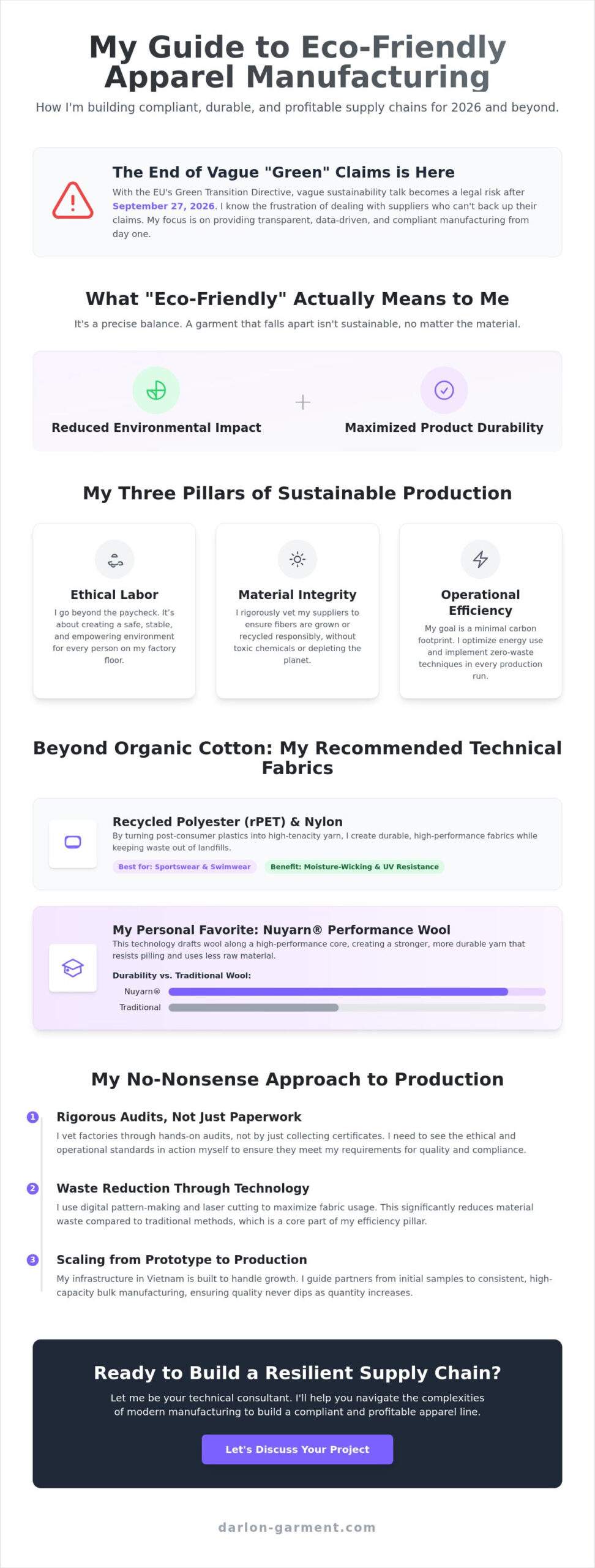
In my experience, “eco-friendly” is often used as a vague marketing buzzword, but in 2026, it has become a strict technical requirement. I define eco friendly apparel manufacturing as the precise balance between reducing environmental impact and maximizing product durability. If a garment falls apart after three washes, it isn’t sustainable, regardless of the fabric’s origin. I’ve moved my daily operations toward a sustainable fashion model that prioritizes circularity over the traditional “take-make-waste” cycle. This means I design for longevity and recyclability from the very first stitch. Transparency isn’t just a nice-to-have feature anymore; it’s the most important service I provide. I believe my role as a manufacturer has shifted from being a simple vendor to acting as a technical consultant. I help you navigate the complexities of new regulations, like the EU’s ban on destroying unsold goods, to ensure your brand remains compliant and profitable.
The Three Pillars of Sustainable Production
- Ethical labor: I look beyond the basic paycheck. True sustainability involves the long-term well-being of the factory community, ensuring a safe, stable, and empowering environment for every technician on the floor.
- Material integrity: I focus on sourcing that doesn’t deplete the planet. This involves rigorous vetting of suppliers to ensure fibers are grown or recycled without toxic chemical runoff.
- Operational efficiency: I work to reduce the carbon footprint of the facility itself. By optimizing energy use and implementing zero-waste cutting techniques, I minimize the environmental cost of every production run.
Why I Am Seeing a Global Shift Toward Vietnam
There is a clear reason why so many international brands are looking at clothing manufacturers in Vietnam right now. The local industry has undergone a massive evolution, moving far beyond basic assembly. I’ve watched a quality revolution happen here, where “Made in Vietnam” now represents high-tier technical mastery. Our local infrastructure has been upgraded to support faster, greener logistics that help minimize transport emissions. I see this as a disciplined approach to eco friendly apparel manufacturing that combines industrial scale with a deep commitment to international standards. When you partner with a factory here, you aren’t just buying capacity; you’re tapping into a sophisticated supply chain that values long-term stability and technical precision.
Beyond Organic Cotton: Technical Sustainable Fabrics I Recommend
Organic cotton is a great starting point for many brands, but for high-performance activewear or swimwear, it often falls short of the technical requirements I demand in my factory. In the world of eco friendly apparel manufacturing, I frequently guide my partners toward advanced technical fabrics that offer better durability and performance. While cotton is biodegradable, it doesn’t always withstand the intense friction of a gym workout or the constant exposure to chlorine in a pool. To truly reduce the environmental impact of the fashion industry, we have to produce garments that don’t need to be replaced every few months. I’ve found that technical sustainability is just as much about longevity as it is about the raw material source. If a product lasts twice as long, its environmental footprint is effectively halved.
Recycled Polyester and Nylon Blends
Recycled polyester, or rPET, is a staple in my production lines for high-compression leggings and sportswear. By turning post-consumer plastic bottles into high-tenacity yarn, we keep waste out of landfills while maintaining the moisture-wicking properties athletes need. For swimwear, I almost always recommend recycled nylon. It offers superior resistance to oils and UV light compared to virgin alternatives. When I work with these blends, I pay close attention to the knitting process to ensure the fabric retains its stretch and recovery over hundreds of wear cycles. It’s a technical challenge that requires precision machinery, but the result is a professional-grade garment that supports a circular economy. If you’re looking for specific fabrications for your next collection, you can browse our technical material options to see what we currently have in stock.
Nuyarn Performance Wool: A Personal Favorite
Nuyarn is a technology that has completely changed how I view wool in the activewear space. Unlike traditional ring-spun wool, Nuyarn drafts wool fibers along a high-performance core. This creates a yarn that is significantly stronger and has much more natural stretch. From a sustainability perspective, Nuyarn is a clear winner because it resists pilling and maintains its shape much longer than standard wool. This longevity is a core part of eco friendly apparel manufacturing. I recommend this for premium brands that want the thermal benefits of wool without the typical durability issues. It’s a high-performance choice that actually uses less raw material to achieve a far better result for the end user.
Tencel, Lyocell, and Modal for Sleepwear
For sleepwear and lifestyle pieces, I often suggest Tencel or Modal. These fibers are produced through a closed-loop process where almost 100% of the solvents used are recycled and reused. They provide a silky, luxurious feel that rivals traditional silk but with a much lower environmental cost. However, I always remind my clients that a small percentage of elastane fabric is still necessary to ensure the fit remains consistent after multiple washes. I also take a careful look at how I evaluate natural fibers for durability before they ever hit the production line. Sourcing responsibly doesn’t have to be prohibitively expensive; it’s about choosing the right technical solution for the specific garment type you’re building.
Navigating Certifications: How I Vet My Own Supply Chain
I’ve seen many brands get burned by greenwashing. They buy a fabric they believe is sustainable, only to find out the factory isn’t certified or the supply chain is a mess. In my approach to eco friendly apparel manufacturing, a certificate is just a starting point. It’s the actual audit that matters. I’ve learned that you can’t rely on a PDF sent over email; you have to understand the operational reality behind the logo. When I vet my own supply chain, I look for a history of compliance and a willingness to show me the raw data. This is how I address the Key challenges on environmental impact that the global industry faces, from chemical management to energy consumption.
The biggest objection I hear from new partners is simple: “How do I know you’re actually being ethical?” It’s a fair question. I answer it by providing full transparency into my material sourcing and labor practices. I don’t just act as a middleman. I manage the logistics to ensure material purity, preventing the cross-contamination of conventional and organic fibers in my facility. For me, being ethical isn’t a marketing strategy. It’s a fundamental part of maintaining a stable, high-capacity production line that can meet the strict 2026 regulations coming out of the EU and North America.
The Gold Standards: GOTS and OEKO-TEX
I focus on GOTS and OEKO-TEX because they provide a clear framework for both environmental and human safety. GOTS 8.0, which launched in March 2026, is particularly important because it now includes mandatory due diligence and circularity provisions. I make sure my facility stays compliant with these evolving international standards through regular internal checks. It’s also vital to distinguish between factory-level and garment-level certification. Just because a factory is certified doesn’t mean every garment they produce is. I work with you to ensure your specific brand marketing is backed by the correct level of documentation.
Supply Chain Transparency in Vietnam
Transparency doesn’t stop at the fabric mill. In my Vietnam operations, I source trims, buttons, and zippers only from certified partners who meet my technical requirements. I place a heavy emphasis on Tier 2 and Tier 3 supplier vetting. This means I’m looking at where the fabric is knitted and even where the raw fiber is produced. I always encourage my brand partners to visit my factory in person. There is no better way to build trust than seeing the machinery, meeting the team, and witnessing the eco friendly apparel manufacturing process firsthand. It’s about building a partnership based on physical evidence, not just digital promises.
The Production Process: How I Reduce Waste in My Factory
I’ve spent years on factory floors, and I can tell you that the biggest enemy of sustainability isn’t just the material; it’s the physical waste generated during the production cycle. In my approach to eco friendly apparel manufacturing, I focus on technical efficiency at every single station. It starts with digital pattern making. By using advanced nesting software, I can calculate the exact fabric yield before a single inch of fabric is cut. This significantly reduces leftover scrap, which is a major financial and environmental drain for high-volume orders.
Next, I use laser cutting for all my technical apparel. Traditional die-cutting or manual shears often lead to fraying and human error, but lasers provide a sealed edge and near-perfect precision. This is a critical part of how garments are made in my facility. I’ve also swapped out older, energy-hungry machinery for energy-efficient sewing units. These modern machines only draw power when the needle is actually moving, which cuts our facility’s electricity consumption by a measurable margin.
For dyeing and finishing, I implement water-saving techniques like low-liquor ratio machines. These systems reduce water consumption by up to 50% compared to traditional methods while ensuring the chemical runoff is properly treated. Finally, I help brands move away from the traditional plastic culture. I offer minimalist, plastic-free packaging solutions that protect the garment during shipping without cluttering the planet with unnecessary waste.
Laser Cutting and Automatic Sewing
I invested in these automated machines for my Vietnam facility because they provide a speed advantage that manual labor simply can’t match. Automated precision reduces material scrap by up to 15% in complex designs, especially for multi-panel sportswear. It’s about stability and predictability. When the machine handles the repetitive, high-precision tasks, human error is virtually eliminated. This level of technical mastery is what allows me to scale eco friendly apparel manufacturing for global partners who need consistent quality across thousands of units.
Seamless and Bonded Technology
If you want a truly durable product, you have to look at the construction methods. By using seamless and bonded technology, I can eliminate bulky seams and unnecessary thread usage. This reduces material usage and creates a product that lasts much longer under stress. For brands focused on fitness wear, bonding is a game-changer. It provides a sleek, second-skin feel that doesn’t chafe or fail during high-intensity training. If you’re ready to see how these machines can improve your next collection, you can contact me for a virtual factory tour today.
Partnering with Me: Scaling Your Sustainable Brand
Scaling a sustainable brand is often where the most ambitious “eco” dreams hit a practical wall. I’ve seen many founders struggle because they treat their factory like a simple vendor rather than a strategic partner. In my view, eco friendly apparel manufacturing only works at scale when we build a long-term relationship based on technical trust. I don’t focus on one-off orders. They’re inefficient for my facility and rarely result in the level of quality a growing brand needs. Instead, I look for partners who want to grow their volume over several years, allowing us to optimize every part of the production line for their specific requirements.
I help you balance your environmental goals with the hard realities of running a business. It’s about making smart choices that don’t compromise your margins. For example, we might start with a specific recycled nylon for your swimwear line that meets your price point today while planning for a transition to even more advanced circular materials as your volume increases. My final advice for brands entering the market in 2026 is simple: focus on the technical foundation first. Marketing claims mean nothing if the product doesn’t perform or the factory can’t deliver on time. If you don’t have a reliable production backbone, you don’t have a brand.
From Tech Pack to Mass Production
The transition from a prototype to bulk manufacturing is a high-stakes phase. I always emphasize the importance of getting the tech pack right the first time. A precise tech pack is your best defense against production waste. I manage the prototyping phase with a lean mindset, using my sample room in Vietnam to refine the fit and construction before we move to the high-capacity lines. When you scale your volume here, you’re tapping into an infrastructure designed for consistency. We don’t just “make” clothes; we engineer a repeatable process that ensures the ten-thousandth unit is identical to the first approved sample.
The Dar Lon Commitment
I take a personal interest in every project that enters my facility. My commitment to you is rooted in a disciplined approach to quality control and ethical standards. We can work together to innovate on new designs, whether that’s exploring new applications for Nuyarn performance wool or perfecting a seamless activewear set. I want to be the silent, powerful backbone of your brand, handling the logistical and technical heavy lifting so you can focus on your community. If you’re ready to discuss how we can scale your eco friendly apparel manufacturing in a responsible, efficient way, I’d love to hear from you. Let’s start a conversation about your next collection today.
Building Your Sustainable Future in 2026
I’ve shown you that eco friendly apparel manufacturing is about more than just picking a fiber; it’s about engineering a product that lasts and a process that minimizes waste. By focusing on technical mastery, like the laser-cutting technology I’ve utilized since establishing Dar Lon in 2019, you can ensure your brand meets the high standards of tomorrow’s market. We’ve discussed why technical durability matters more than marketing labels and how specialized materials like Nuyarn performance wool can set your brand apart. The right partnership makes all the difference when moving from a concept to a high-capacity production line. I’m ready to help you navigate these complexities through my comprehensive OEM and ODM services based right here in Vietnam. Let’s discuss how I can bring your sustainable designs to life at Dar Lon Garment. I look forward to building a stable, high-performance future for your brand together. Let’s make your next collection a benchmark for the industry.
Frequently Asked Questions
What is the most eco-friendly fabric for activewear?
I recommend recycled polyester (rPET) or Nuyarn performance wool for activewear because they balance low environmental impact with high technical durability. While natural fibers are excellent for casual wear, activewear requires the stretch and moisture management that technical synthetics provide. Using recycled materials keeps waste out of landfills while ensuring the garment doesn’t fall apart after a few gym sessions, which is the ultimate goal of sustainability.
How can I verify if a manufacturer in Vietnam is truly ethical?
You should verify a manufacturer’s ethics by requesting recent third-party audit reports and conducting a physical site visit whenever possible. Don’t just rely on a certificate sent via email. I always encourage my partners to see the facility in person to witness the working conditions and waste management systems firsthand. This level of transparency is essential for honest eco friendly apparel manufacturing and long-term partnership trust.
Is eco-friendly apparel manufacturing more expensive than traditional methods?
Sustainable production often carries a higher upfront material cost, but it’s more cost-effective when you consider the total lifecycle and durability of the product. Organic cotton can cost between $3 and $5 per yard, which is more than conventional options. However, the increased durability and reduced waste from precision techniques like laser cutting often balance out these initial expenses over a full production run in 2026.
What certifications should I look for in a sustainable factory?
You should look for GOTS Version 8.0 and OEKO-TEX Standard 100 certifications as baseline requirements for any reputable facility. GOTS 8.0 is particularly relevant now because it includes mandatory due diligence and circularity provisions. Additionally, the Global Recycled Standard (GRS) is vital if you’re using recycled synthetics, as it tracks the material from the waste source directly to the final garment on my production line.
Can I produce small batches of eco-friendly clothing?
Small batch production is possible, but I usually manage it as part of a larger scaling strategy for growing brands. I focus on the transition from prototyping to bulk manufacturing to help partners grow their business efficiently. While small runs allow for initial testing, the technical efficiency of eco friendly apparel manufacturing is best realized when we can optimize our machinery for larger, more stable production volumes.
How does laser cutting contribute to sustainability?
Laser cutting contributes to sustainability by virtually eliminating human error and material fraying during the production process. I use this technology because it allows for much tighter nesting of patterns on the fabric roll through digital software. This precision significantly reduces the amount of scrap material that ends up as waste, ensuring we get the maximum possible yield from every yard of technical fabric.
Why is Vietnam a hub for sustainable apparel production in 2026?
Vietnam has become a global hub because of its massive investment in advanced machinery and green logistics infrastructure. The local industry has moved beyond basic assembly into high-tier technical mastery of sportswear and activewear. My facility in Vietnam allows me to provide stable, high-capacity production that meets the strict 2026 EU environmental regulations while maintaining the reliability expected by international professional buyers.
What is the difference between recycled polyester and organic cotton?
The primary difference lies in the source material and the performance characteristics of the final fabric. Recycled polyester is a technical fiber made from post-consumer waste like plastic bottles, making it ideal for moisture-wicking activewear and swimwear. Organic cotton is a natural fiber grown without synthetic pesticides. I often suggest rPET for high-performance gear and organic cotton for lifestyle or sleepwear pieces where technical stretch isn’t the priority.