

The most expensive mistake I see brands make is assuming that lower quality is the only way to protect their margins. With U.S. tariffs on Vietnamese apparel hitting 46% and shipping rates up 5.9% this year, the old methods of chasing the lowest bidder are failing. You’re likely feeling the squeeze of shrinking profit margins and high fabric waste, wondering how to reduce garment production costs without turning your brand into a discount bin staple. I’ve spent years in high-capacity manufacturing, and I’ve learned that the real savings come from technical mastery, not cutting corners.
In this guide, I’ll show you exactly how to engineer efficiency into your apparel line to lower costs while actually improving your final product. We’ll look at how I use seamless construction and bonded technology to strip unnecessary labor minutes out of the production cycle. I’ll also walk you through better fabric utilization strategies and streamlined factory communication that can slash your COGS. From optimizing Nuyarn performance wool to meeting the new EU Digital Product Passport requirements, you’ll get a clear roadmap for a leaner, more profitable 2026 season.
Key Takeaways
- I’ll show you how a solid tech pack stops the “sampling loop” that eats up your budget before production even starts.
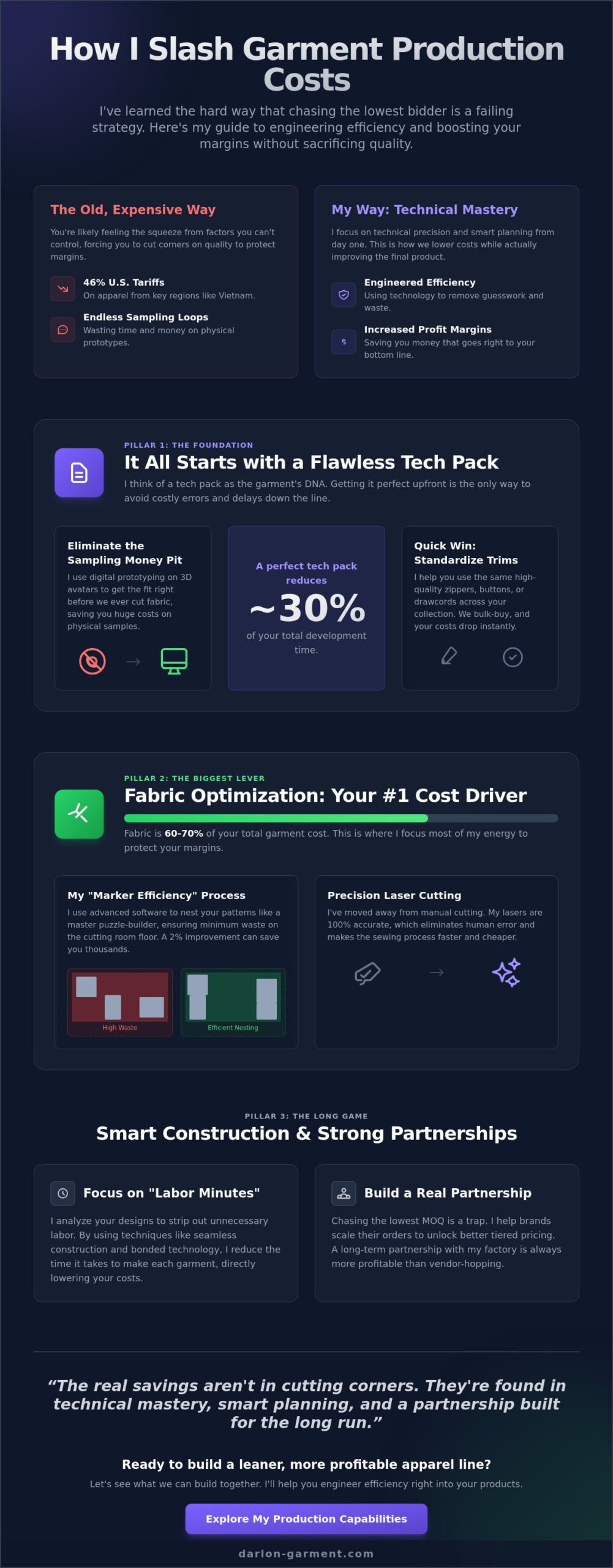
- Learn why I prioritize “marker efficiency” to squeeze every bit of value out of your fabric, which is usually 70% of your total cost.
- I’ll explain how to reduce garment production costs by looking at your designs in terms of “labor minutes” and stripping away invisible expenses.
- Find out why chasing the lowest MOQ is often a trap and how I help brands scale their orders to unlock better tiered pricing.
- See why building a long-term partnership with my factory is more profitable than constantly switching vendors to save a few cents.
The Foundation: Why I Always Start with the Tech Pack
I think of a tech pack as the blueprint for your brand’s success. It is essentially the DNA of your garment. If you send me a sketch without specific measurements or material specs, I have to guess; and in this industry, guessing is the fastest way to blow your budget. When I have a complete document from the start, we can lower the total manufacturing cost by avoiding errors that usually do not show up until the assembly line is already moving. Precision at the start is the only way to ensure the final product matches your vision.
A perfect tech pack can reduce your development time by as much as 30%. I’ve seen it happen repeatedly. By defining every stitch type and seam allowance upfront, I don’t have to stop the machines for mid-production re-tooling. This level of detail is exactly how to reduce garment production costs while maintaining the high standards your customers expect. It is about building a predictable workflow where every operator knows exactly what to do. When we eliminate ambiguity, we eliminate waste.
Eliminating the Sampling Money Pit
Every physical sample I make adds to your overhead. Shipping fabrics, paying for labor, and the logistics of international couriers quickly turn into a “sampling loop” that drains your cash. To stop this, I recommend digital prototyping. We can see how a seamless legging or a performance wool top fits on a 3D avatar before I ever touch a piece of fabric. This ensures we get the first physical sample nearly perfect. You can see the full scale of this complexity in my guide on how garments are made.
Standardizing Components Across Your Collection
One of my favorite “quick wins” for new brands is bulk-buying trims. If you use the same high-quality zippers or buttons across five different styles, your sourcing costs drop significantly. I manage the inventory for these shared components so that production never stops. Whether it is for swimwear or bonded activewear, standardizing these small details allows us to negotiate better prices with suppliers. It is a simple shift that creates immediate fiscal value for your line without changing the aesthetic of your brand.
Fabric Optimization: My Insider Secrets for Reducing Material Waste
Fabric usually accounts for 60 to 70 percent of your total garment cost. Because of this, I focus most of my energy here when looking at how to reduce garment production costs for my clients. It is the single biggest lever we can pull to protect your margins. I use a process called “Marker Efficiency” to act like a master puzzle-builder with your patterns. By nesting pieces closer together through advanced software, I ensure we leave the absolute minimum amount of waste on the cutting room floor. Even a two percent improvement in fabric utilization can save thousands of dollars on a large production run.
The width of the fabric you choose is another critical factor that many designers overlook. If your pattern pieces are 60cm wide and the fabric is 140cm, you’re paying for a lot of empty space. I always check these specs against our machinery capabilities before we order. I also warn my partners against the “cheap fabric” trap. Low-cost textiles often come with high defect rates or unpredictable shrinkage. If I have to discard 10 percent of the roll due to dyeing streaks or holes, your actual cost per unit skyrockets. Investing in quality raw materials is a fundamental part of apparel value chain optimization because it ensures the production line never stops for quality issues.
Sourcing Strategy: Choosing the Right Materials
I help my clients navigate the price gap between standard polyester and specialized blends. While elastane fabric or Nuyarn performance wool might have a higher upfront cost, they allow for higher retail margins. My extensive network in Vietnam allows me to source these high-quality textiles at local prices, bypassing many of the middleman markups. For premium activewear or sleepwear, I often suggest natural fibers to justify a luxury price point while keeping the construction efficient.
Precision Cutting with Laser Technology
I’ve moved away from traditional manual cutting wherever possible. My laser cutting machines offer a level of precision that a hand-held blade simply can’t match. This eliminates the “human error” factor that leads to mismatched seams or irregular sizing. When the cut pieces are 100 percent accurate, the sewing process becomes faster and cheaper because my team doesn’t have to fight the fabric to make it fit. If you want to see how these technical efficiencies can transform your brand, take a look at my specialized production capabilities to see what we can build together.
Construction Engineering: Simplifying Without Losing Style
I don’t look at a hoodie or a pair of leggings as just a piece of clothing. I look at them in “labor minutes.” Every seam, every pocket, and every decorative stitch represents a specific amount of time an operator spends on the production floor. If you want to know how to reduce garment production costs, you have to treat construction as an engineering task rather than just a creative one. It isn’t about making a “cheap” product. It’s about removing the complexity that doesn’t add real value for your customer or your brand’s core aesthetic.
I often help my partners identify “invisible” costs that bloat their budget without improving the final product. For example, does that activewear top really need three different types of topstitching? If it doesn’t improve the durability or the fit, it’s just adding to your bill. I am a big advocate for seamless technology for this exact reason. Seamless garments are knitted into their final shape, which removes several steps from the production line. Fewer seams mean fewer labor minutes and a lower per-unit cost. It is a win for both your margins and the comfort of the end-user.
The Impact of Seam Choice on Your Bottom Line
The type of seam you specify in your tech pack has a massive impact on your unit price. From my perspective, a flatlock seam is excellent for performance, but it requires specialized machinery and more operator time than a standard overlock seam. I often recommend bonded seams for certain high-end activewear styles. While the bonding equipment represents a high-tech investment, the process can actually reduce bulk and assembly time compared to traditional stitching. I also use automatic sewing machines for repetitive tasks like cuff attachment, which are faster and more consistent than any manual process.
Designing for Production Efficiency
I share a “Design for Manufacturing” (DFM) checklist with my clients to help them streamline their designs before we hit the floor. Sometimes, a small tweak to a sleeve curve or a collar attachment can save $0.50 per unit. When you multiply that by a 5,000-unit run, the savings are substantial. I always encourage brands to visit my sportswear factory in Vietnam. Seeing the assembly line in person helps designers understand how their choices on paper translate to real-world costs on the factory floor. It’s the best way to learn how to balance your brand’s vision with the realities of industrial production.
Logistics and Scale: How I Manage MOQs and Shipping in 2026
I often see brands celebrate finding a factory with a “Low MOQ,” but in my experience, this is usually a financial trap. When I set up my machines for a run of 100 units, the cost of calibration and threading remains the same as it would for 5,000 units. This means you’re paying a massive premium per garment just to cover that overhead. If you’re looking at how to reduce garment production costs, the real goal should be scaling from 500 to 5,000 units. This shift unlocks tiered pricing that can drop your unit cost significantly. I help my partners reach these numbers by bundling orders or using shared materials across their collections to hit higher volume brackets with fabric suppliers.
I also spend a lot of time helping clients navigate hidden logistics costs like insurance, port fees, and local trucking. These “invisible” line items can easily add 10 percent to your total bill if you aren’t careful. For my international clients, I prefer working on a DDP (Delivered Duty Paid) basis. It keeps things simple because I handle the complexity of customs and duties, ensuring there are no surprise invoices when your goods arrive at the warehouse. With FedEx and UPS implementing a 5.9 percent rate increase in 2026, every efficiency in the shipping lane counts toward your bottom line.
Strategic MOQ Planning
The “setup cost” for my specialized machinery is the primary driver of high prices for small runs. To combat this, I bundle orders for smaller brands, allowing them to benefit from the same bulk material pricing as my larger partners. It is a collaborative approach that requires transparency from the start. I believe every brand should read my guide on choosing clothing manufacturers before they begin negotiations. Understanding the factory’s perspective on volume will give you the leverage you need to secure a better deal.
Vietnam’s Trade Advantage in 2026
Sourcing from Vietnam offers a massive competitive edge right now. For example, while Chinese cotton knitwear faces a combined duty of approximately 50.5 percent when entering the U.S., my Vietnamese-made apparel benefits from much lower rates. Additionally, the EVFTA is fully phased in, allowing Vietnamese garments to enter the EU duty-free if they meet origin requirements. By using my “One-Stop” services, you eliminate the cost of multiple middle-men and take full advantage of these trade agreements. If you are ready to optimize your supply chain, contact me today to discuss your 2026 production needs and see how we can lower your total landed cost.
The Long-Term Play: Why a Partnership Beats a Transaction
I’ve seen too many brands jump from one factory to another just to save ten cents per unit. It’s a short-sighted move that usually backfires. Every time you switch vendors, you lose the “Institutional Knowledge” my team has built regarding your specific fit and fabric preferences. This lack of continuity often leads to expensive errors in the first few runs with a new factory. If you want to know how to reduce garment production costs over the long haul, you have to value stability. My team catches mistakes in your tech packs because they’ve learned your brand’s DNA over time. That reliability is worth much more than a few cents of paper savings.
I view my role as a silent backbone for your business. When we work together across multiple seasons, we develop a rhythm that naturally strips away waste. For example, my operators might remember that your specific Nuyarn wool blend requires a slightly different needle tension to avoid puckering. They make those adjustments before the first piece is even cut. This proactive approach prevents the “learning curve” costs that reset every time you chase a marginally cheaper quote elsewhere. The cheapest factory isn’t always the one with the lowest bid; it’s the one that delivers a perfect product on time, every time.
Quality Control as a Cost-Saving Tool
Quality control isn’t just a hurdle; it’s a financial safeguard. I use a 4-stage QC process to ensure that every shipment of swimwear or sleepwear meets the highest standards. I believe AQL 2.5 is the absolute minimum standard any professional buyer should accept. By catching defects at the source, I prevent the nightmare of international returns and expensive chargebacks. I provide detailed defect reporting after every run so we can continuously improve the process. It’s much cheaper to fix a seam in my factory than it is to handle a customer return in your warehouse.
Investing in Innovation Together
I’m constantly investing in the future of apparel to keep my partners ahead of the curve. Whether it’s laser cutting for precision or advanced bonding for seamless activewear, these technologies help us stay efficient. I position myself as a fitness wear manufacturer that focuses on high-performance results rather than just the lowest bid. By using sustainable, high-tech materials like Nuyarn, I help you future-proof your brand against changing regulations and consumer demands. My final word is simple: let me help you engineer your next collection for maximum profit. When we plan for the long term, we can find how to reduce garment production costs through innovation rather than sacrifice.
Future-Proofing Your Production Strategy
Success in 2026 requires moving beyond the mindset of simple transactions. I’ve shown you that the real secret to how to reduce garment production costs lies in technical precision, from the initial tech pack to the final fabric marker. By engineering your designs to minimize labor minutes and utilizing advanced technology like laser cutting or seamless construction, you can protect your margins without ever compromising on the quality your customers expect. It is about building a lean, predictable supply chain that can withstand global shifts and rising logistics fees.
I am ready to put my expertise and infrastructure to work for your brand. From specialized Nuyarn and seamless technology to advanced laser cutting and automatic sewing, I offer comprehensive one-stop OEM/ODM solutions. Let me help you optimize your production costs; get a quote from Dar Lon Garment today. I look forward to partnering with you to engineer a collection that is as profitable as it is high-performing. Let’s build something lasting together.
Frequently Asked Questions
How much does it cost to produce a sample in 2026?
Sample costs in 2026 typically range from two to five times the estimated bulk production price, plus international courier fees. I find that many brands forget to account for the shipping costs, which have risen by 4 to 8 percent this year due to international rate increases. To keep these expenses manageable, I suggest finalizing your digital prototypes before requesting a physical sew-up. This reduces the number of iterations and the total labor hours spent in the sampling room.
What is the most expensive part of garment production?
Raw materials are the most expensive component, typically accounting for 60 to 70 percent of the total cost of a garment. This is why I focus so heavily on fabric utilization and marker efficiency during the planning stage. When you are working with specialized textiles like Nuyarn performance wool or high-stretch elastane, every square centimeter of waste represents lost profit. Managing your material consumption is the most effective way to understand how to reduce garment production costs at the source.
Can I reduce costs without lowering my fabric quality?
Yes, you can lower costs by engineering the construction and optimizing the pattern rather than switching to cheaper, lower-quality materials. I often suggest removing decorative elements that don’t serve a functional purpose, such as unnecessary pockets or complex topstitching. By simplifying the labor minutes required for assembly, we can maintain the premium feel of your high-quality fabric while reducing the overall sewing time and the associated labor expense.
How do MOQs affect the final price per unit?
Minimum Order Quantities (MOQs) determine how the fixed factory setup costs are distributed across your entire production run. If I have to calibrate a seamless knitting machine for only 100 units, that setup time makes the per-unit price significantly higher. As you scale to 1,000 or 5,000 units, those fixed costs are diluted across more garments. This tiered pricing model is a fundamental part of how to reduce garment production costs as your brand grows.
Is it cheaper to manufacture in Vietnam or China right now?
Vietnam is currently the more cost-effective option for the U.S. and EU markets due to significant tariff advantages. As of January 2026, Chinese cotton knitwear faces a combined effective duty of about 50.5 percent in the U.S., while Vietnamese products benefit from lower rates and the EVFTA for European shipments. While raw labor costs in Vietnam average $2 to $3 per hour, the real savings come from avoiding the heavy trade penalties associated with Chinese origin.
How does a tech pack help reduce my production costs?
A tech pack reduces costs by serving as a precise technical blueprint that eliminates the need for expensive guesswork during assembly. When I have clear measurements, stitch types, and seam allowances from the start, I can avoid the sampling loop that often drains a brand’s budget. It prevents mid-production re-tooling and ensures that the first physical sample is as close to the final product as possible, saving both time and material waste.
What are the hidden costs of apparel manufacturing I should watch out for?
You should watch out for port fees, insurance, local trucking, and sudden tariff surcharges like the U.S. Section 122 temporary 15 percent tax. These logistics expenses are often left out of initial factory quotes but can add 10 percent or more to your landed cost. I recommend using DDP terms so that these variables are managed by the manufacturer. This gives you a transparent, all-in price that won’t fluctuate unexpectedly upon delivery.
How can I save money on shipping garments internationally?
Consolidating your shipments and utilizing ocean freight is the best way to save money on logistics in 2026. Ocean freight spot rates have dropped 70 percent from their 2024 peaks, making it much more affordable than air freight, which hovers between $3 and $9 per kg. I help my clients plan their production cycles to allow for longer transit times by sea. This shift significantly reduces the shipping burden on their total Cost of Goods Sold.