

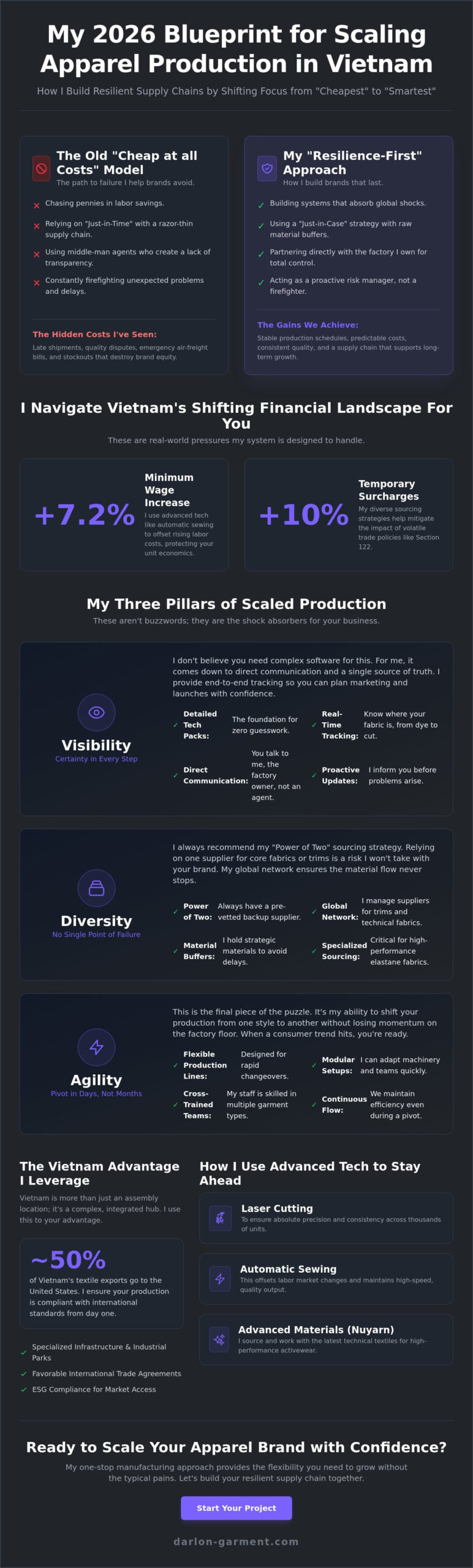
What if I told you that scaling your apparel brand in 2026 isn’t about finding the cheapest labor, but about mastering the logistics of a shifting tariff landscape? When you start scaling apparel production with a vietnam factory, you quickly realize that the old rules don’t apply anymore. I’ve seen too many brands hit a wall because they weren’t prepared for the 7.2 percent minimum wage increase that took effect this January or the temporary 10 percent surcharge under Section 122. It’s a lot to manage when you’re just trying to get your product out the door.
I know the pressure of trying to maintain quality consistency at high volumes while costs seem to climb every quarter. It’s a balancing act that can keep any founder up at night. That’s why I’ve put together this guide. I’ll share the exact strategies I use to help brands scale their production in Vietnam while maintaining total supply chain resilience. We’ll explore how to lock in a stable production schedule, lower your unit costs through smart volume planning, and use advanced tech like Nuyarn and laser cutting to stay ahead of the curve.
Key Takeaways
- Learn why I prioritize supply chain resilience over the “cheapest at all costs” model to protect your brand from sudden production stops.
- I’ll explain how scaling apparel production with a vietnam factory depends on mastering the three pillars of visibility, diversity, and agility.
- See how I use advanced manufacturing tech, like laser cutting and automatic sewing, to ensure precision and offset labor market changes.
- Understand how to use Vietnam’s specialized infrastructure and trade agreements to build a more efficient global distribution network.
- Discover how my one-stop manufacturing approach provides the flexibility you need to grow without the typical growing pains.
Why Scaling Today Requires a Shift from “Cheap” to “Resilient”
I’ve spent years on the factory floor, and if there is one thing I can tell you, it’s that the “cheapest at all costs” model is dead. I’ve seen brands fail repeatedly because they chased pennies in labor savings only to lose thousands in late shipments and quality disputes. When you are scaling apparel production with a vietnam factory, the goal shouldn’t be to find the lowest price. It should be to build a resilient system. To me, resilience is the ability to absorb global shocks, like the 7.2 percent minimum wage increase that took effect this January, without stopping your production line or sacrificing the quality your customers expect.
The global market has changed. We are seeing a massive shift from “Just-in-Time” to “Just-in-Case” inventory strategies. Relying on a razor-thin supply chain leaves you vulnerable to the volatility of current trade policies, such as the temporary 10 percent surcharge under Section 122. Instead, I advocate for holding strategic raw material buffers and diversifying where those materials come from. Understanding Vietnam’s economic landscape is vital here; the country has moved beyond simple assembly to a complex, integrated hub. One of the biggest mistakes I see is the “middle-man” model. When you use an agent who doesn’t own the machines, you lose control. That lack of transparency is the biggest point of failure for modern scaling.
The Hidden Costs of a Fragile Scaling Plan
I often talk to brand owners who are shocked by the bill for air-freighting bulk orders. This usually happens because a “cheap” factory missed a deadline, and now the brand is desperate to avoid a stockout. If you are scaling apparel production with a vietnam factory and you run out of stock, the damage to your brand equity is far worse than a slightly higher cost of goods sold. Customers won’t wait for you to fix your logistics; they will just go to a competitor.
Supply chain fragility is a hidden tax on brand growth.
The 2026 Mindset Shift: Proactive Risk Management
In 2026, you can’t just be a firefighter. You have to be a risk manager. This means looking at your production through the lens of long-term stability. Consumers now demand transparency about where their clothes are made and who made them. It isn’t just a “nice-to-have” anymore. Incorporating ESG (Environmental, Social, and Governance) standards into your growth plan isn’t just about ethics; it’s about ensuring your factory stays compliant with international trade laws. With the United States accounting for about 50 percent of Vietnam’s textile exports, staying ahead of labor and environmental regulations is a financial necessity for any brand looking to grow.
Mastering the Three Pillars of Scaled Production: Visibility, Diversity, and Agility
To build a brand that lasts, I focus on three core pillars: visibility, diversity, and agility. These aren’t just industry buzzwords. They are the physical shock absorbers that keep your business running when global markets get bumpy. When you are scaling apparel production with a vietnam factory, you need to know exactly where your materials are at every stage, from the initial yarn spinning to the final garment assembly. Vietnam has taken a strategic role in the apparel supply chain by integrating these capabilities into its industrial parks. I’ve found that when these pillars work together, you can pivot your production lines in days instead of months when consumer trends shift.
Achieving End-to-End Visibility Without the Complexity
I don’t believe you need massive, expensive software to get end-to-end visibility. It really comes down to direct communication with your sportswear factory vietnam. I use real-time production tracking to keep my partners informed, but the foundation is always the Tech Pack. A detailed Tech Pack ensures everyone is on the same page from day one. It eliminates the guessing game that often leads to costly mistakes during the scale-up phase. When I can see exactly where a batch of fabric is in the dyeing process, I can give my clients the certainty they need to plan their marketing launches.
The “Power of Two” Sourcing Strategy
I always recommend a “Power of Two” sourcing strategy. You should never rely on a single supplier for your core trims or fabrics. If one supplier hits a logistical snag, you need a pre-vetted backup ready to go. I manage a global network of suppliers to ensure our material flow never stops, even during peak seasons. This is especially vital when you are scaling apparel production with a vietnam factory and using specialized materials like elastane fabric for high-performance activewear. Having multiple sources for these technical textiles means you can scale volume without the fear of a single point of failure.
Agility is the final piece of the puzzle. It’s the ability to shift from one style to another without losing momentum on the factory floor. If you’re curious about how to set this up for your own brand, you might want to look into my strategic guide for brands to see how we structure these partnerships for long-term growth. By focusing on these three pillars, you aren’t just making more clothes; you’re building a smarter, more responsive business.
How I Use Advanced Manufacturing Tech to Protect Your Production
I’ve always believed that while digital tracking is essential for visibility, the real protection for your brand happens on the factory floor. In my experience, automation is the best defense against labor market volatility. When you are scaling apparel production with a vietnam factory, you can’t just rely on adding more people to the line. You have to invest in machines that don’t get tired and don’t make mistakes. By using laser cutting and automatic sewing machines, I ensure that precision is maintained even as we ramp up to high volumes. It’s about reducing waste and making sure every dollar you spend on fabric is utilized effectively.
I also lean heavily into tech-heavy materials like Nuyarn performance wool. These technical fabrics offer better performance for the end-user and, surprisingly, more supply stability because they are produced in highly controlled environments. I’ve also moved a lot of our volume into seamless and bonded apparel. These technologies reduce the number of production steps, which simplifies the assembly line. When there are fewer pieces to sew together, there are fewer places for things to go wrong. It makes the entire process more predictable, which is exactly what you need during a growth phase.
Automation as a Buffer Against Labor Shortages
The 7.2 percent average minimum wage increase that took effect in Vietnam this January has made human-centric production more expensive. I use automation to maintain a steady output even when the local labor market is tight. Precision laser cutting, for example, significantly improves fabric yield, which is a massive cost-saver when you’re scaling. Automated sewing reduces human error in how garments are made, ensuring that the first unit is exactly the same as the ten-thousandth. This level of consistency is what builds trust with your customers and keeps your return rates low.
Innovation in Performance Materials for Stability
Using specialized machinery also allows me to offer quicker prototyping and sampling. When you’re scaling apparel production with a vietnam factory, being able to see a sample in days rather than weeks allows you to react to the market with much more confidence. Seamless garment technology is a huge part of this. By knitting the garment in one piece, we bypass many of the traditional “cut and sew” bottlenecks. This not only speeds up the process but also creates a more durable product for your activewear or swimwear lines. It’s a technical approach that turns your manufacturing into a competitive advantage.
Vietnam as Your Strategic Scaling Hub: Infrastructure and Trade Benefits
I chose Vietnam as the base for Dar Lon Garment back in 2019 because I saw a country that was actively building an industrial backbone, not just a collection of workshops. When you’re scaling apparel production with a vietnam factory, you’re entering a market that is targeting 50 billion USD in export revenue for 2026. That doesn’t happen by accident. It’s the result of over 16 free trade agreements and a massive labor force of 2.7 million workers who have moved beyond simple assembly into high-value technical garments. Vietnam’s proximity to major shipping lanes and its efficient logistics hubs make it a natural center for global brands.
As a fitness wear manufacturer, I’ve seen how this infrastructure allows us to act as a central hub for our clients. We coordinate everything from raw material intake to final export with minimal friction. Scaling apparel production with a vietnam factory is about more than just sewing; it’s about leveraging a world-class trade network that connects you to every major market on the planet.
The Infrastructure Advantage in 2026
The infrastructure advantage in 2026 is clear. We’ve seen significant investment in ports and roads, which has helped the industry achieve over 10.6 billion USD in exports in the first quarter of 2026 alone. This represents a 3 percent year-on-year increase. Local fabric sourcing is another huge win. It cuts down lead times because we don’t have to wait for imported materials to clear customs for every bulk run. Plus, the availability of skilled labor for complex items like swimwear and activewear is unmatched in the region. We have the physical capacity to move large volumes without the bottlenecks that plague smaller manufacturing hubs.
Navigating Trade Agreements and Tariffs
Navigating trade agreements and tariffs is where I really add value for my brand partners. The EVFTA and CPTPP offer huge fiscal benefits for European and North American brands, often providing preferential market access that competitors in other countries simply can’t match. I help my clients maximize these advantages while managing current volatility, like the temporary 10 percent surcharge under Section 122 that took effect in February. Even with these temporary hurdles, Vietnam remains the most stable geopolitical choice for the next decade of growth. If you are ready to move your production to a more reliable, high-capacity base, explore how our manufacturing solutions can support your growth.
Building Your Scaling Roadmap with Dar Lon Garment
I’ve always seen my role as more than just a vendor. I offer a one-stop manufacturing partnership that handles the heavy lifting so you can focus on your brand’s vision. Some competitors suggest that software is the primary solution for growth, but software can’t physically inspect a seam or source the right technical fabric for a high-performance activewear line. When you’re scaling apparel production with a vietnam factory, you need a partner who understands the physical reality of the factory floor. My team and I provide both OEM and ODM solutions that are specifically designed with scaling flexibility in mind, allowing you to grow without the typical bottlenecks.
My personal commitment to quality control is what keeps our production lines running smoothly at high volumes. I oversee rigorous testing standards at every stage, from the moment raw materials arrive to the final quality check before shipping. This isn’t just about catching errors; it’s about protecting your brand from the next global “hiccup.” By building a buffer into our processes and maintaining high technical standards, I ensure that your growth isn’t derailed by preventable mistakes. I treat your brand’s reputation with the same respect as my own factory’s legacy.
Our One-Stop Manufacturing Model
Our model covers everything from initial product development and prototyping to full-scale bulk manufacturing. I take the lead on fabric sourcing and trim procurement because I know how much time and money that saves you in the long run. Having a partner who understands both the intricacies of design and the complexities of global logistics is a massive advantage. We don’t just make your clothes; we manage the entire lifecycle of the production run to ensure maximum efficiency. This integrated approach is what allows us to handle complex items like seamless garments and bonded apparel with total precision.
Starting Your Journey Toward Resilience
If you’re ready to grow, I recommend starting with a comprehensive supply chain audit. We’ll look at your current processes and identify where you might be vulnerable to the market shifts and tariff changes I’ve discussed throughout this guide. From there, I can help you transition your production to a more agile, tech-driven model that uses the advanced machinery we have in our facility. Scaling apparel production with a vietnam factory shouldn’t be a gamble; it should be a calculated, strategic move toward long-term stability. Let’s discuss how I can strengthen your apparel supply chain and help you reach your production targets for 2026 and beyond.
Securing Your Brand’s Growth for 2026 and Beyond
Scaling your brand in today’s market is no longer just about finding a workshop to sew your designs. It’s about building a system that can withstand the shifts we’ve discussed, from nationwide wage increases to new trade surcharges. I’ve shown you how visibility, diversity, and agility form the backbone of a modern supply chain. By embracing advanced tech like laser-cutting and working with specialized materials like Nuyarn performance wool, you move your business from a reactive state to a proactive one.
Scaling apparel production with a vietnam factory is about more than just volume; it’s about a commitment to excellence and technical mastery. At Dar Lon Garment, I use ISO-certified quality control standards and automatic sewing technology to ensure your brand maintains its reputation as it grows. While we manage the physical side of your growth, you can also discover موقع زوار to enhance your digital marketing and attract more visitors to your site. I’m ready to help you navigate these complexities and turn your manufacturing into a competitive advantage. My team and I are here to act as your powerful, silent backbone.
Partner with Dar Lon Garment to build your resilient supply chain today.
I look forward to helping you build a production roadmap that lasts.
Frequently Asked Questions
What is the first step in scaling apparel production with a Vietnam factory?
I always recommend starting with a comprehensive supply chain audit and perfecting your Tech Packs. You can’t scale what you haven’t defined. By finalizing every technical detail before the first bulk run, I ensure that the factory can replicate your designs with total precision at high volumes. This initial groundwork prevents the quality drift that often happens when brands try to grow too quickly without a solid technical foundation.
How does manufacturing in Vietnam improve my supply chain stability?
Vietnam provides a stable environment through its network of over 16 free trade agreements, including the EVFTA and CPTPP. These agreements offer preferential market access that helps shield your brand from global trade volatility. Because the country has developed an integrated textile supply chain, I can source many raw materials locally. This reduces your reliance on long-distance shipping and helps maintain a steady production flow even when global logistics are disrupted.
Can small apparel brands afford to build a resilient supply chain?
Yes, resilience isn’t just for global giants. I help smaller brands build stability by focusing on a “Power of Two” sourcing strategy for their most important materials. Instead of buying everything from one place, we split the sourcing to ensure there’s always a backup. This approach doesn’t require a massive budget. It just requires a shift in mindset from chasing the absolute lowest price to prioritizing long-term reliability and partnership.
What role does technology play in preventing production delays?
I use technology like laser cutting and automated sewing to remove the human bottlenecks that typically cause delays. These machines provide a consistent output that isn’t affected by fluctuations in the labor market. When scaling apparel production with a vietnam factory, real-time production tracking also plays a vital role. It allows me to see exactly where your order is in the process; furthermore, utilizing reliable labeling solutions from dymoonline.com.au ensures that every package is accurately identified to prevent logistical errors before they turn into late shipments.
How do I balance cost-efficiency with supply chain resilience?
The best way to balance these is by moving toward a “Just-in-Case” inventory model for your core raw materials. While holding a small buffer of fabric has a minor upfront cost, it’s far cheaper than the emergency air-freight fees you’ll pay if a shortage occurs. I’ve found that scaling apparel production with a vietnam factory is most cost-effective when we plan for these small redundancies to avoid expensive, last-minute firefighting.
What are the risks of relying on a single country for all garment sourcing?
The main risk is exposure to localized disruptions, such as the temporary 10 percent surcharge that took effect in February 2026. I mitigate this risk by diversifying where we get our raw materials. While the final assembly happens in my Vietnam facility, the fabric and trims might come from a variety of regions. This geographical diversity ensures that your entire production line doesn’t stop just because one region faces a temporary hurdle.
How does Dar Lon Garment handle sudden raw material shortages?
I maintain a pre-vetted network of secondary suppliers for all technical fabrics, including specialized items like elastane and Nuyarn performance wool. If our primary supplier hits a snag, I can pivot to a backup source within a few days. This proactive management is a standard part of my service because I know that a shortage of even a single trim can stop an entire production line.
Is sustainability linked to supply chain resilience?
Sustainability and resilience are deeply connected in 2026. Factories that follow strict ESG standards are much less likely to face regulatory fines or trade sanctions that could shut down production. I prioritize sustainable practices because they lead to better resource efficiency and ensure that your brand stays compliant with international laws. A “green” supply chain is often a more stable and predictable one for long-term growth.