

Risk mitigation in the garment industry isn’t just about a legal clause; it’s a technical discipline practiced on the factory floor every morning. While vetting clothing manufacturers in vietnam, I’ve seen how a 7.2% minimum wage increase or a 10% US import surcharge can quickly erode margins for the unprepared. I understand the stress of inconsistent fabric quality and those hidden costs that seem to surface only after you’ve paid a deposit. You deserve a partner who values technical mastery over empty promises. I’m going to show you how I manage these operational risks to keep your production schedules predictable and your quality levels at zero-defect standards. We’ll look at the specific audit protocols and regulatory shifts, like Decree 08/2022, that I use to build a resilient supply chain that protects your bottom line in 2026.
Key Takeaways
- Understand why shifting your focus from unit price to regional resilience is the only way to protect your margins against the economic volatility of 2026.
- Learn how I use high-detail tech packs as a primary insurance policy to prevent the quality failures that often plague technical activewear and sportswear production.
- Get my personal checklist for vetting clothing manufacturers in vietnam to ensure they have the physical infrastructure to meet your specific industrial requirements.
- Explore the logistical advantages of sourcing from Ho Chi Minh City and how I manage shipping timelines to keep your inventory arrivals predictable.
- Discover the benefits of a partnership-first strategy that replaces traditional purchase orders with a transparent, “Trust but Verify” collaboration model.
The Shifting Landscape of Apparel Sourcing Risks in 2026
I’ve spent years on factory floors, and I’ve seen the same mistake repeated: chasing the lowest unit price until the supply chain snaps. In 2026, that strategy isn’t just outdated; it’s a liability. When I talk to brands about vetting clothing manufacturers in vietnam, I emphasize that resilience is a technical discipline, not a contract clause. We’re seeing a massive shift as de-globalization pushes production toward stable regional hubs. Vietnam has become the silent backbone for international labels, but the risks have changed. It’s no longer enough to find a factory that can sew; you need a partner who understands the shifting tectonic plates of global trade.
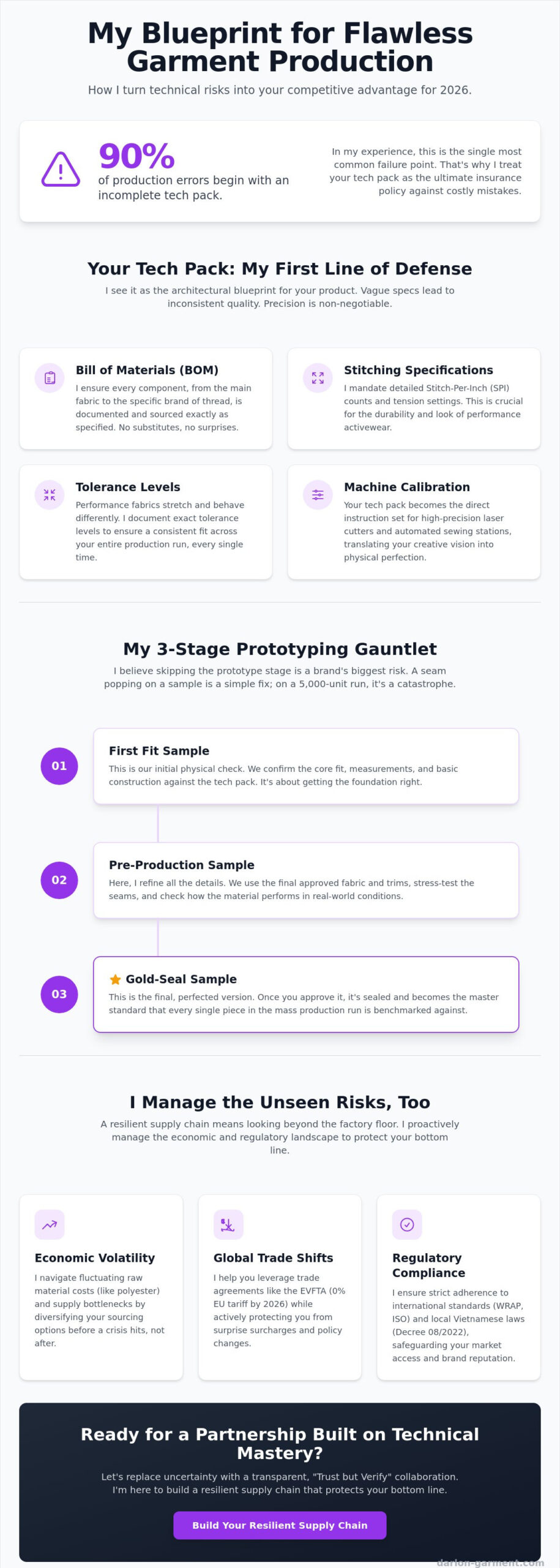
Trade policies are moving faster than ever. For instance, the temporary 10% surcharge on US imports under Section 122 has forced many of my partners to rethink their margins. Meanwhile, the EU-Vietnam Free Trade Agreement (EVFTA) has finally phased most apparel tariffs to 0% as of January 2026, provided you meet the strict yarn-forward rules. Understanding how your partner fits into the global apparel value chain is essential for maintaining market access. To me, resilience means a production line that can absorb these shocks without missing a delivery date.
Macro-Economic Volatility and Your Bottom Line
Raw material costs are no longer predictable. I’ve watched polyester prices fluctuate wildly this year, driven by energy shifts and supply bottlenecks. If your manufacturer relies on a single upstream supplier, your lead times are at risk. Geopolitical shifts in Southeast Asia also impact shipping reliability out of ports like Ho Chi Minh City. I always recommend diversifying your material sources before a disruption occurs. Waiting for a crisis to find a backup fabric mill is a recipe for empty shelves and lost revenue.
The Rise of Regulatory and Ethical Compliance Risks
Compliance is the new barrier to entry. International markets are introducing Extended Producer Responsibility (EPR) fees that penalize brands for opaque supply chains. I make it a point to maintain rigorous standards, including WRAP and ISO certifications, because they are the best defense for my clients. Cutting corners on labor standards or fire safety regulations, such as the QCVN 06:2022 standards, might save pennies today, but the legal and reputational costs in 2026 are astronomical. Vetting clothing manufacturers in vietnam must include a deep dive into their environmental permits and wastewater discharge records under Decree 08/2022.
Technical Risk: Why Your Tech Pack is Your Best Insurance Policy
In my experience, 90% of production errors start with an incomplete tech pack. It’s the single most common failure point I encounter. When you’re vetting clothing manufacturers in vietnam, you’re essentially looking for an engineering partner who can translate your creative vision into precise machine instructions. I use these documents to calibrate everything from automated sewing stations to high-precision laser cutting machines. If the specifications are vague, the machine output will be inconsistent. Guessing on measurements is the fastest way to lose your deposit; a factory cannot be held liable for a fit issue if the tech pack was missing a critical grade rule.
I view the tech pack as the backbone of the production line. For complex items like activewear and sportswear, every millimeter matters. If you’re looking for a partner who prioritizes this level of technical accuracy, you can review our manufacturing standards to see how we handle high-capacity orders. A risk-proof tech pack for performance gear must include more than just a sketch. It needs to account for the physical behavior of the fabric under tension and the specific capabilities of the machinery involved.
Critical Elements of a 2026 Tech Pack
A modern tech pack must be exhaustive. I insist on a comprehensive Bill of Materials (BOM) to ensure that every component, from the main fabric to the specific brand of thread, is matched exactly. For seamless garments, I require detailed stitching specifications, including stitch-per-inch (SPI) counts and tension settings. Performance fabrics are particularly sensitive; I always document tolerance levels for high-stretch materials. Without these defined boundaries, you’re leaving your quality assurance to the discretion of a floor manager who might not understand your brand’s specific fit requirements.
Prototyping: The Final Barrier Against Mass-Production Failure
I believe skipping the prototype stage is a brand’s biggest risk. My process for iterative sampling is non-negotiable. We move from the first fit sample to a pre-production sample, and finally, a gold-seal sample. This is where we catch the technical glitches that a computer screen can’t show. I use these prototypes to test the recovery and tensile strength of elastane fabric. If a seam pops during a stress test on a sample, it’s an easy fix. If it happens during a 5,000-unit production run, it’s a catastrophe. Prototyping allows us to verify that the theoretical specs in your tech pack actually perform in the real world.
Vetting for Resilience: Moving Beyond Basic Factory Audits
When I’m vetting clothing manufacturers in vietnam, I look for more than just a signed contract and a business license. A piece of paper doesn’t tell me if a factory can actually deliver a 10,000-unit order of technical activewear on time. I’ve seen many brands rely on third-party audits that only scratch the surface of social compliance. While those are necessary, they don’t measure technical resilience. I evaluate a manufacturer’s technical infrastructure by looking at the age of their machinery, the organization of their fabric warehouse, and the specific certifications of their floor technicians. If the physical infrastructure isn’t there, the promise of quality is just talk.
I also make a clear distinction between a buying house and a direct manufacturer like me. A buying house acts as a broker; they don’t own the machines or manage the workers directly. This adds a layer of risk and cost that most brands can’t afford in 2026. When you work with me, you’re dealing with the person responsible for the final stitch. I demonstrate this transparency through real-time production tracking. You shouldn’t have to guess where your order stands. You should be able to see your garments moving through each stage of the line with total clarity.
Evaluating Technical Mastery and Machinery
I invested heavily in laser cutting technology for my facility because it removes human error from the production process. Precision is everything in sportswear. Understanding how garments are made is the only way to judge their eventual durability and performance. If a factory hasn’t mastered specialized capabilities like bonding or the handling of Nuyarn performance wool, they aren’t equipped for the high-end market. I check for these specific technical markers to ensure my clients’ products stand out from the competition.
The Four Stages of Quality Control I Use
I don’t just wait for the end of the production run to check for defects. My system relies on a proactive, four-stage quality control model:
- Raw Material Inspection: Every roll of fabric and every trim is verified for color match and tensile strength before it’s allowed on the floor.
- Pre-production Verification: We run a small batch to check for potential bottlenecks in the sewing or bonding process.
- In-line Inspections: My technicians conduct daily checks at every station to catch errors before they become bulk problems.
- Final QC: We use strict AQL (Acceptable Quality Level) standards to ensure every piece is retail-ready before it’s packed.
This methodical approach is the only way to guarantee zero-defect quality assurance. Vetting clothing manufacturers in vietnam requires this level of granular detail if you want to protect your brand from quality failures and delays.
Supply Chain and Logistical De-risking: The Vietnam Advantage
I chose Vietnam as the base for Dar Lon Garment in 2019 because I saw a shift in the global supply chain that others were ignoring. It’s not just about labor costs anymore; it’s about the entire ecosystem of trade. When you’re vetting clothing manufacturers in vietnam, you have to look at their proximity to major ports like Ho Chi Minh City and their understanding of regional trade lanes. Managing shipping is a technical skill. I’ve seen brands fall into the “Lead Time Trap” where they focus on production speed but lose weeks because their factory doesn’t have a reliable relationship with local freight forwarders. I make sure our logistics are as disciplined as our sewing lines.
The 2026 trade environment has made Vietnam even more critical for your margins. As of January 2026, the EU-Vietnam Free Trade Agreement (EVFTA) has finally phased most apparel tariffs to 0%. This is a massive advantage, but only if your manufacturer knows how to navigate the strict “yarn-forward” rules of origin. I spend a lot of my time ensuring our fabric and trim sourcing meets these requirements so my clients don’t get hit with unexpected duties at the border. It’s this level of detail that protects your bottom line from hidden costs.
Strategic Sourcing in Southeast Asia
I’ve found that sportswear factory vietnam partnerships offer the best risk-to-reward ratio in the current market. Vietnam has captured a significant portion of the orders that shifted away from China between 2019 and 2024. My local networks allow me to manage the volatility of raw material availability. If polyester prices spike or a specific trim becomes scarce, I have the domestic connections to find alternatives without stopping the line. This position allows me to buffer my clients against the shipping and material spikes that often cripple less established operations.
Reducing Lead Times Through One-Stop Manufacturing
Fragmented sourcing is a major risk. If you use one vendor for design, another for fabric, and a third for sewing, you’re inviting communication breakdowns and delays. My one-stop OEM solutions eliminate the middle-man delay. I’ve saved clients from shipping disasters by controlling the process from the initial tech pack to the final container loading. For example, when port congestion issues arise, I can reroute shipments because I manage the logistics in-house. If you want to see how we can stabilize your production schedules, explore our integrated manufacturing services to discuss your 2026 requirements.
Building a Partnership-First Sourcing Strategy
I’ve always believed that a successful production run is built on a relationship, not just a spreadsheet. When you’re vetting clothing manufacturers in vietnam, you’re essentially looking for a partner who treats your brand’s growth as their own. I don’t see my clients as simple purchase orders; I see them as long-term collaborators. Moving from a transactional buyer to a strategic partner means moving away from the “lowest price” mindset and toward shared goals. This shift is what allows us to navigate the complexities of the 2026 market together, ensuring that your brand remains resilient regardless of global shifts.
I operate on a “Trust but Verify” model. I encourage my partners to be involved in the process because transparency is the best way to prevent misunderstandings. Whether it’s a virtual tour of the sewing floor or a deep dive into our material testing logs, I want my clients to see the technical discipline we apply every day. I also view sustainability as a critical risk hedge. By investing in energy-saving systems and wastewater permits under Decree 08/2022, I am protecting my partners from the rising costs of international environmental penalties and EPR fees. It’s a proactive approach that secures your supply chain for the next decade.
Communication: The Secret Weapon Against Sourcing Risk
I prioritize direct access to my production management team because speed of information is everything. You shouldn’t have to wait three days for an update on a shipping delay or a fabric shortage. I use quantitative data, like daily output metrics and defect rates, to keep my partners informed at every stage. My philosophy on problem-solving is simple: be proactive. If I see a potential bottleneck in the bonding process, I flag it immediately and present a solution. This level of honesty is rare, but it’s the only way to build real trust in international trade.
Choosing Your 2026 Manufacturing Backbone
A modern fitness wear manufacturer needs more than just sewing machines; they need a vision for the future. I am constantly preparing Dar Lon Garment for the next decade by upgrading our automation and refining our technical mastery of performance fabrics. Vetting clothing manufacturers in vietnam is about finding that reliable friend in the factory who will stand by you when the global market gets volatile. My commitment is to remain the silent, powerful backbone that allows your brand to scale with confidence. The best risk mitigation isn’t a contract; it’s a partner who won’t let you fail.
Securing Your Production Future in 2026
I’ve seen the apparel industry shift rapidly since I established my facility in 2019. Price used to be the only metric that mattered, but today, resilience is the real currency. By focusing on technical accuracy through high-detail tech packs and maintaining a “Trust but Verify” partnership model, you can eliminate the hidden costs and quality failures that derail so many brands. Vetting clothing manufacturers in vietnam requires a deep dive into their physical infrastructure and their ability to handle specialized processes like seamless and bonded performance wear.
I’ve invested in advanced laser-cutting technology and comprehensive one-stop OEM solutions specifically to protect my partners from the unpredictability of the modern market. Whether you’re working with Nuyarn or high-stretch activewear, my goal is to provide the technical stability you need to scale. We’ve moved beyond the era of transactional sourcing; it’s time to build a supply chain that acts as your brand’s backbone.
Partner with a factory that understands your risks-let’s talk about your next collection.
I’m ready to help you navigate these challenges and turn your 2026 production goals into a predictable, high-quality reality.
Frequently Asked Questions
What are the most common risks when sourcing apparel from Vietnam?
Unpredictable lead times and inconsistent fabric quality are the primary risks I see brands facing today. Many partners also struggle with hidden costs that only appear after a deposit is paid. These issues often stem from a lack of direct communication with the factory floor. I manage these risks by providing total transparency into our production metrics and sourcing networks.
How does a detailed tech pack reduce my financial risk?
A detailed tech pack acts as a binding technical contract that prevents costly production errors. It ensures my machines are calibrated to your exact specifications for measurements, stitching, and fabric tension. Without one, you risk receiving a bulk order that doesn’t fit your brand standards. This usually leads to a total loss of your deposit and significant retail delays.
What is the difference between CMT and FOB in terms of risk management?
FOB is generally lower risk for you because I handle the entire process from fabric sourcing to port delivery. In a CMT model, you are responsible for providing the raw materials. If your fabric supplier is late or the quality is poor, your production line stops. You still have to pay for the factory time, which can quickly destroy your margins.
How can I verify a garment factory’s ethical compliance from overseas?
You should request digital copies of current certifications like WRAP, BSCI, or SA8000 and verify them through the issuing body’s online database. I also recommend asking for recent wastewater discharge permits under Decree 08/2022. This documentation provides objective proof of a factory’s commitment to international labor and environmental standards without requiring an immediate on-site visit.
What role does machinery like laser cutting play in quality control?
Laser cutting removes the human error associated with manual fabric shears, ensuring every cut piece is identical to your digital pattern. This precision is vital when vetting clothing manufacturers in vietnam for technical sportswear or seamless garments. It allows me to maintain tight tolerance levels that manual cutting cannot achieve, leading to a zero-defect final product for your customers.
How do I handle shipping delays when sourcing from Southeast Asia?
I suggest booking your freight at least four weeks in advance and building a ten-day buffer into your retail launch schedule. Port congestion in Ho Chi Minh City can be unpredictable during peak seasons. I maintain close relationships with local logistics providers to secure container space early. Proactive planning is the only way to mitigate the common lead time trap.
Why is One-Stop Manufacturing considered a lower-risk model?
One-stop manufacturing reduces risk by centralizing design, sourcing, and sewing under a single management team. This eliminates the communication gaps that occur when you use multiple fragmented vendors. My OEM solutions provide a single point of accountability. This significantly lowers the chance of quality mismatches or logistical delays across your entire apparel collection.
What certifications should I look for in a 2026 apparel supplier?
Look for ISO 9001 for quality management and ISO 14001 for environmental systems to ensure the factory meets modern industrial standards. These certifications are essential when vetting clothing manufacturers in vietnam for long-term partnerships. They signal that the facility has the technical infrastructure and disciplined processes required to handle high-capacity international orders with consistent reliability.