

The most dangerous mistake you can make in 2026 isn’t choosing the wrong fabric; it’s assuming that a signed contract equals a transparent production floor. I know the anxiety of sending a deposit into the void and wondering if the final shipment of activewear will actually match the gold seal sample. You’re likely worried about communication gaps or the dreaded bait and switch with material quality. Learning how to trust your overseas factory shouldn’t feel like a leap of faith. It’s about moving past gut feelings and looking at the hard data instead.
I’m going to show you how to peel back the curtain on manufacturing so you can build a partnership rooted in technical proof and real-time transparency. We’ll look at why the 2026 regulatory environment, including the 10% surcharge under Section 122 and the new Law on Key Industries, makes factory verification more critical than ever. I’ll walk you through the specific metrics you need to track, from Oeko-Tex compliance to production cadence, ensuring your swimwear or performance wool orders are executed exactly as specified. This guide provides the blueprint for a disciplined, long-term partnership that values results over empty promises.
Key Takeaways
- I’ll help you shift from viewing production as a “black box” to a data-driven process by exploring how the Vietnamese apparel industry has evolved since 2019.
- Learn why I look at a factory’s investment in specialized machinery as the ultimate sign of their financial health and technical mastery.
- Discover my “Transparency as a Service” (TaaS) framework and how it shows you exactly how to trust your overseas factory through over-communication.
- See how I use the Tech Pack as a manufacturing “Constitution” to test your design vision against reality during the prototyping stage.
- Find out how to move beyond transactional vendors to find a strategic partner that can help you innovate custom activewear or seamless garments.
The Psychology of Sourcing: Why Trusting an Overseas Factory Feels Like a Leap of Faith
I’ve seen the look on a brand owner’s face when they realize they’ve just sent fifty thousand dollars to a factory they’ve never stepped foot in. It’s a gut-wrenching moment. This is the “Black Box” problem. You provide the designs, pay the deposit, and then you’re left staring at your inbox, hoping for the best. When I started working in the Vietnam garment industry in 2019, the landscape was different. Back then, it was mostly about sheer volume and basic stitching. Today, the market has shifted toward high-performance sportswear and complex technical garments like seamless activewear. Traditional vetting methods, like just checking a website or looking at a few photos, simply don’t work anymore. If you want to know how to trust your overseas factory, you have to stop relying on polite email updates and start looking at verified systems.
The High Stakes of Global Apparel Production
The financial impact of a failed production run can be fatal for a growing brand. If your swimwear arrives with bleeding dyes or your activewear has failing seams, your reputation is gone. I always tell my partners that the cheapest price is the biggest red flag. It usually suggests that the factory is sacrificing the fundamentals of quality control to win the bid. On my side of the table, I’m looking for long-term stability. I would rather turn down an order than deliver something that doesn’t meet our standards; a failed partnership costs me money and reputation too. We value disciplined, predictable growth over short-term gains from cutting corners.
Moving Past the “Middleman” Anxiety
Many brands hide behind sourcing agents because it feels safer, but this often creates a game of “telephone.” You lose visibility and pay a premium for the privilege. I’ve found that direct factory relationships are the only way to get true transparency and lower your overall landed costs. When we work together directly, I can explain exactly how garments are made in our facility. You get to see the actual machines, the fabric testing reports, and the people behind the seams. This direct line of communication is what turns a risky transaction into a reliable, powerful backbone for your business. It allows us to troubleshoot technical issues in real-time rather than waiting for an agent to relay a message across three time zones.
Beyond the Website: Identifying the Physical Markers of a Reliable Manufacturer
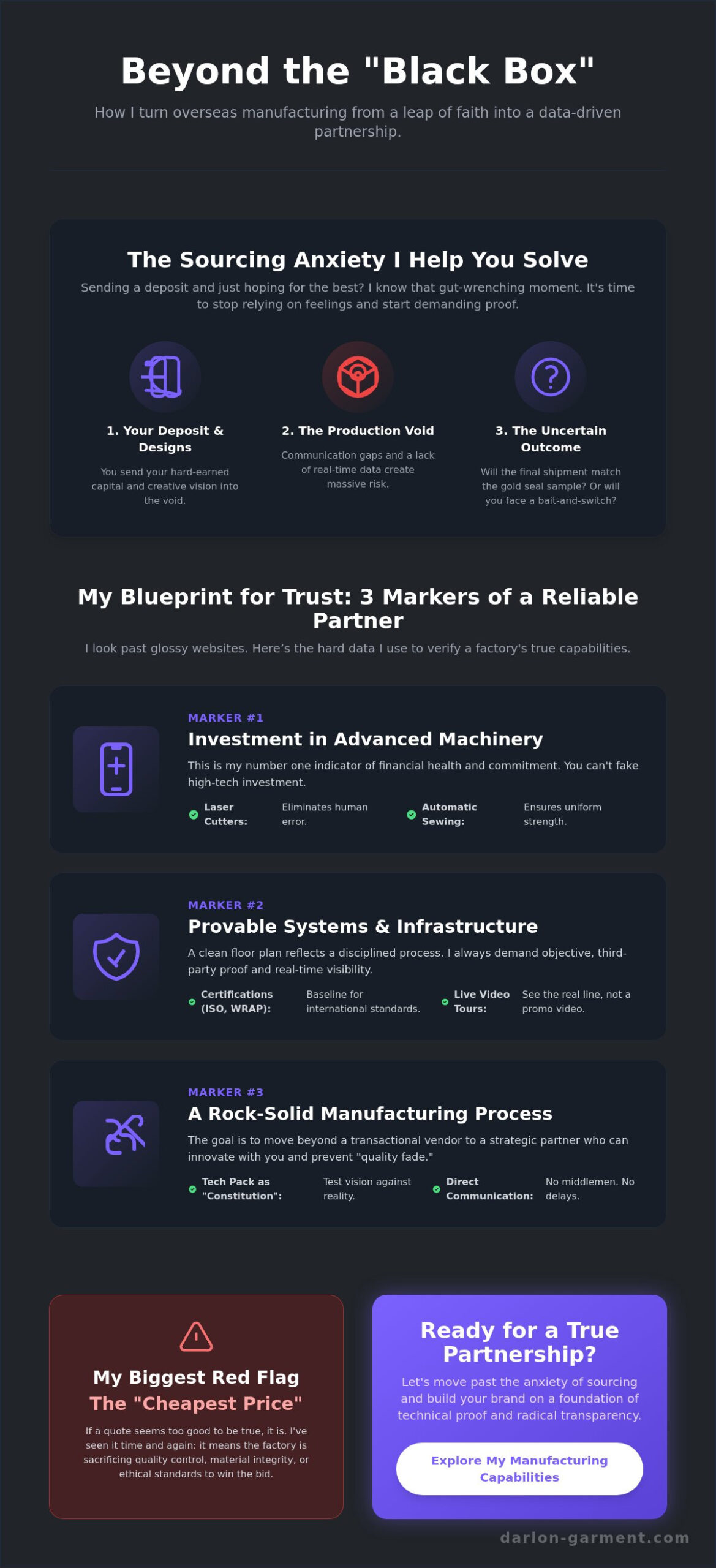
I’ve learned that a glossy website is the easiest thing to fake in this industry. When you’re trying to figure out how to trust your overseas factory, you have to look past the marketing and focus on the physical infrastructure. A factory’s investment in high-end technology is the most reliable indicator of their financial health and long-term commitment. If they’re pouring capital into laser cutters and automatic sewing machines, they aren’t planning to disappear with your deposit. They’re building a foundation for consistent, high-volume production that manual shops just can’t match.
High-performance products like Nuyarn performance wool or bonded activewear require a level of precision that manual labor simply can’t replicate. When I evaluate a facility, I look for objective third-party proof like ISO or WRAP certifications. While these are baseline requirements, they show a disciplined approach to management and international standards. For more specialized insights, I often look at U.S. government guidance on apparel sourcing to stay updated on the compliance and trade regulations that affect my international partners.
The Tech Stack: Laser Cutting and Automatic Sewing
I invested heavily in laser cutting because it’s the only way to eliminate human error when working with complex patterns. In manual cutting, a two-millimeter slip can ruin a whole batch of seamless garments. Laser technology ensures every piece is identical. Automatic sewing machines also play a huge role; they don’t get tired or lose focus. This keeps our lead times predictable and our seam strength uniform across thousands of units. It’s how we prevent “quality fade,” which is that frustrating trend where the first shipment is great but the third one falls apart because the factory started cutting corners.
Infrastructure as a Trust Signal
You can tell a lot about a factory’s management just by walking the floor. A clean, organized production line isn’t just about aesthetics; it’s about efficiency and safety. If the floor is chaotic, the quality control usually is too. I always encourage my clients to ask for a live video tour of the actual production line. Don’t settle for pre-recorded promotional videos. You want to see the in-house product development team and the prototyping area in action. If you’re looking for a partner that prioritizes this level of technical mastery, you can explore our manufacturing capabilities to see how we handle high-capacity orders. Seeing the physical reality of the workspace is the fastest way to turn anxiety into confidence.
Transparency as a Service: How Communication Bridges the 8,000-Mile Gap
I’ve found that trust isn’t a feeling; it’s a service. I call it Transparency as a Service (TaaS). In the context of Vietnamese manufacturing, this means giving you a window into our floor that makes the 8,000-mile gap disappear. Most brands struggle with how to trust your overseas factory because they only hear from the vendor when things go wrong or when an invoice is due. I believe in the opposite. I over-communicate during the fabric and trim sourcing phase because that’s where the foundation of the garment is built. If the yarn isn’t right, the final activewear or sportswear won’t be either. We provide the proof before the first stitch is even made.
You have to watch out for “Yes-Culture.” It’s a common risk where a factory says “yes” to every deadline and technical request just to secure the order. A true partner will tell you “no” when a design isn’t feasible for mass production. That’s the difference between a vendor who just wants your deposit and a partner who wants your brand to scale. If we hit a delay, I don’t hide it. I present the problem along with a solution. This honesty is the only way to build a partnership that lasts through multiple seasons and market shifts.
The Weekly Reporting Cadence
I use a strict weekly reporting cadence to keep my global clients in the loop. A professional production status report isn’t just a “we are on track” email. It includes specific data points like raw material arrival dates, cutting start times, and real-time QC pass rates. I utilize digital tools to ensure this information is updated constantly. This data-driven approach removes the guesswork from your supply chain and gives you the certainty you need to plan your marketing launches.
Building Cultural Competence
Bridging the gap between Western brand expectations and Eastern production realities requires cultural competence. I prioritize English-speaking account managers who understand the nuances of global trade. They act as translators for more than just language; they translate your vision into technical instructions our floor teams can execute. While digital updates are great, there’s no substitute for visiting a sportswear factory vietnam in person. It allows you to see the discipline of our operations firsthand and solidifies the partnership beyond a computer screen. This face-to-face interaction often uncovers innovation opportunities that a simple email thread would miss.
The Technical Handshake: Using Tech Packs and Samples to Verify Capability
I always tell my clients that if the contract is the marriage, the Tech Pack is the prenuptial agreement. It’s the ultimate “Constitution” of our manufacturing partnership. When you’re figuring out how to trust your overseas factory, you need to stop looking at samples as just pretty clothes and start seeing them as technical benchmarks. I use the prototyping phase to stress-test your vision against the reality of my production line. If a design for seamless garments or bonded apparel looks great on paper but fails in the heat-press, I’m going to tell you immediately. This technical handshake is where we verify that what you want is actually what we can build at scale.
The most important rule in my facility is the “Golden Sample” rule. We never start bulk production without two identical, signed-off versions of the final garment. You keep one, and I keep one. This prevents any “bait and switch” anxiety because we both have a physical reference for the fabric quality, trim placement, and seam strength. It’s the only way to ensure that the 5,000th unit of swimwear or activewear matches the first one I sent to your office. It turns a verbal promise into a physical reality that both parties must honor.
The Anatomy of a Trustworthy Tech Pack
A vague tech pack is a recipe for disaster. I look for a complete Bill of Materials (BOM), graded specifications for every size, and specific stitch details like SPI (stitches per inch). Without these, we end up in the “I thought you meant X” trap, which wastes time and fabric. I won’t accept a bulk order until I’m confident the documentation is airtight. It protects your investment and my production schedule. If the documentation is clear, the path to quality is too.
The 4 Stages of Quality Control (QC) Verification
Trust is verified through a methodical four-stage process. First is pre-production, where we handle fabric testing and shrinkage verification. Then comes in-line inspection; we catch errors while the garments are still on the machines. Finally, we perform a final QC using the AQL (Acceptable Quality Level) standard. This statistical method ensures the batch meets your requirements without needing to inspect every single thread. If you want to know more about vetting clothing manufacturers, you should check out my guide on the specific questions to ask before signing a deal. Ready to see how we handle precision? You can send me your tech pack for a technical review and let’s see what’s possible.
From Vendor to Partner: Scaling Your Brand with a Trusted Vietnamese Factory
I’ve spent the previous sections breaking down the technical side of production, but the real value of our partnership lies in what happens after the first shipment. The transition from a transactional vendor to a strategic partner is where your brand actually begins to scale. A vendor sews what you tell them; a partner suggests ways to optimize your supply chain or innovate your product line. When you’ve mastered how to trust your overseas factory, we can stop worrying about basic quality and start focusing on collaborative growth. This might involve developing custom activewear blends or aligning your production with the new Resolution No. 82/NQ-CP, which is shaping the future of Vietnamese manufacturing.
Long-Term Benefits of Factory Direct Relationships
Loyalty has its rewards in the manufacturing world. When you move past the trial phase, I offer priority production scheduling to my long-term partners. This is crucial because capacity at top-tier Vietnamese factories is tight, with booking lead times often extending to 18 weeks. Shared cost savings also become a reality through supply chain optimization. I help my partners navigate the “yarn-forward” rules of origin to maximize tariff benefits and advise them on the global shift toward natural fibers and high-performance materials. We work together to ensure your margins stay healthy as you grow.
Taking the First Step with Dar Lon Garment
I know that committing to a new factory feels like a major risk. That’s why I always suggest starting with a trial run. It allows you to test our communication cadence and technical accuracy without risking your entire season’s budget. During our first consultation call, I won’t just talk about MOQs or lead times. I’ll listen to your brand’s vision and show you exactly how our physical infrastructure can support it. My personal commitment to you as a factory owner is rooted in transparency and technical mastery. I don’t just want to be your supplier; I want to be the silent, powerful backbone of your success.
Securing Your Supply Chain for the Future
Building a successful apparel brand in 2026 requires more than just a good design; it demands a manufacturing backbone that you can verify with data. I’ve shown you that the path to learning how to trust your overseas factory isn’t found in a marketing brochure. It’s found on the production floor through the precision of advanced laser-cutting and automatic sewing technology. By prioritizing direct-from-manufacturer transparency and using your tech pack as a technical constitution, you eliminate the guesswork that often plagues international sourcing. We’ve moved past the era of blind faith and into an age where specialized Nuyarn and seamless production capabilities are the benchmarks for success.
I want to help you take that next step toward a disciplined, long-term partnership. If you’re ready to see our infrastructure in action and verify our processes for yourself, I invite you to Book a Virtual Factory Tour with Me Today. We’ll look at our physical facility together and discuss how we can scale your activewear or swimwear lines with absolute technical certainty. Your brand deserves a partner that values precision as much as you do. Let’s build something stable together.
Frequently Asked Questions
How do I know if an overseas factory is actually a factory and not a middleman?
I recommend requesting a live video tour of the production floor and asking for a copy of their manufacturing license. Middlemen often hesitate to show the facility in real-time or lack deep technical knowledge about specific machinery. When you see our laser-cutting machines and seamless knitting units in action, it provides physical proof that we own the infrastructure and manage the production ourselves.
What are the most common red flags when communicating with a new manufacturer?
The most dangerous red flag is “Yes-Culture,” where a factory agrees to every deadline and technical request without asking for a tech pack. If they don’t ask detailed questions about your fabric composition or seam construction, they likely don’t understand the complexity of the job. Consistent delays in communication during the quoting phase are also a sign that your brand will be a low priority during production.
Can I really protect my intellectual property (IP) when manufacturing in Vietnam?
You can protect your IP by signing a NNN (Non-use, Non-disclosure, Non-circumvention) agreement that is enforceable under Vietnamese law. While contracts are a vital foundation, the best protection is choosing a partner that values long-term cooperation over short-term gains. I prioritize these legal frameworks because they establish a professional boundary and ensure your custom sportswear designs remain exclusive to your brand.
What is the standard payment structure for a trusted overseas factory?
Most reputable manufacturers require a 30% to 50% deposit before fabric sourcing begins, with the balance due before the goods are shipped. This is a standard industry practice for high-capacity industrial orders. Understanding this fiscal rhythm is part of learning how to trust your overseas factory, as it ensures both parties are financially committed to the production milestones and the final quality standards.
How do I verify a factory’s social and environmental compliance certifications?
I suggest verifying certificates like WRAP, BSCI, or Oeko-Tex by entering the unique certificate number into the official online database of the issuing organization. Don’t simply trust a PDF scan provided in an email. I keep our certifications updated and transparent because I know professional buyers need objective, third-party proof that our facility meets international labor and environmental standards before they sign a contract.
Is it possible to manage quality control without being physically present in Vietnam?
It is entirely possible if you hire a third-party inspection agency to conduct in-line and final audits on your behalf. You should also demand a high level of digital transparency, such as receiving real-time photos of the cutting and sewing stages. I provide my clients with detailed status reports and data from the floor, which allows them to manage their supply chain with confidence from their own office.
What happens if the bulk production does not match the approved sample?
If the bulk production fails to meet the standard of the “Golden Sample,” the factory must be held accountable for rework or a credit based on your agreed terms. This is why having two identical, signed-off samples is so critical. I use these physical benchmarks to ensure my production team has an exact standard to follow, which prevents quality fade and ensures the final shipment matches your vision.
Why do some factories have such high Minimum Order Quantities (MOQs)?
High MOQs are usually dictated by the minimum requirements of fabric mills and the high cost of setting up specialized machinery for a production run. For Tier-1 factories in Vietnam, an MOQ of 3,000 units is common to maintain the efficiency of a large-scale line. While Tier-2 facilities may offer MOQs between 300 and 1,000 units, the price per unit is often higher to account for the increased overhead of smaller batches.