
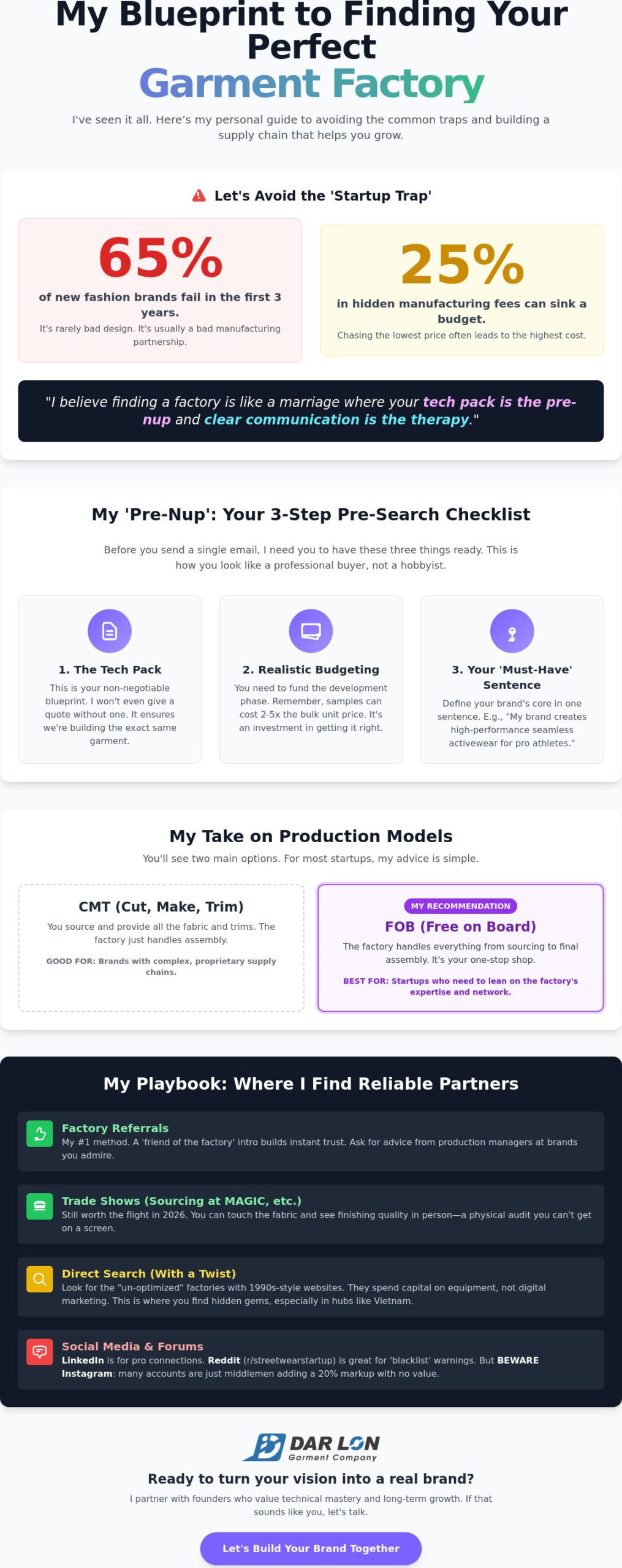
Did you know that 65% of emerging fashion brands fail within their first three years? Most of the time, it isn’t because of bad design, but because they underestimate hidden manufacturing fees by as much as 25%. I’ve seen many founders struggle with high MOQs they can’t afford or receive a box of “garbage” product that looks nothing like their original sketches. Learning how to find a clothing manufacturer for a startup is the most critical hurdle you’ll face. It’s the difference between a hobby and a scalable business. I believe finding a factory is like a marriage where your tech pack is the pre-nup and clear communication is the therapy.
I’ll walk you through the exact steps I use to identify, vet, and partner with the right garment factory to turn your startup vision into a real brand. I understand the fear of being scammed or the stress of navigating the new 10% Section 122 reciprocal tariffs. In this guide, I’ll preview the 2026 manufacturing landscape, from understanding landed costs to meeting the EU’s Digital Product Passport requirements. You’ll learn how to get a first sample that actually works and build a reliable supply chain that grows with you.
Key Takeaways
- I’ll show you why defining your specific niche, like activewear or swimwear, is the mandatory first step before you send a single email.
- Learn my personal strategy on how to find a clothing manufacturer for a startup using industry directories and the high-value power of factory referrals.
- We’ll weigh the benefits of domestic production against the technical mastery found in Vietnam, especially for performance fabrics.
- I’ll share my vetting checklist to help you spot a reliable partner and explain why you can’t afford to skip the proto-sampling phase.
- Discover how to bridge the gap from small startup batches to large-scale production using advanced tech like seamless construction and Nuyarn performance wool.
My Honest Advice on Starting Your Search: Why Your ‘Why’ Matters First
I’ve spent years on the factory floor, and if there’s one piece of advice I give every founder, it’s this: stop looking for a manufacturer until you’ve nailed down your product. It’s tempting to rush. You want to see your designs come to life. But figuring out how to find a clothing manufacturer for a startup begins with internal clarity, not an external search. If you don’t know whether you’re building a performance-driven sportswear brand or a lounge-heavy sleepwear line, you’re going to end up in the ‘Startup Trap.’ This is where founders chase the lowest per-unit price, only to realize that ‘cheap’ usually leads to poor quality, missed deadlines, and a product that sits in a warehouse because it’s unsellable. In 2026, a good partner isn’t just a vendor; they are a transparent extension of your team with the technical mastery to help you grow.
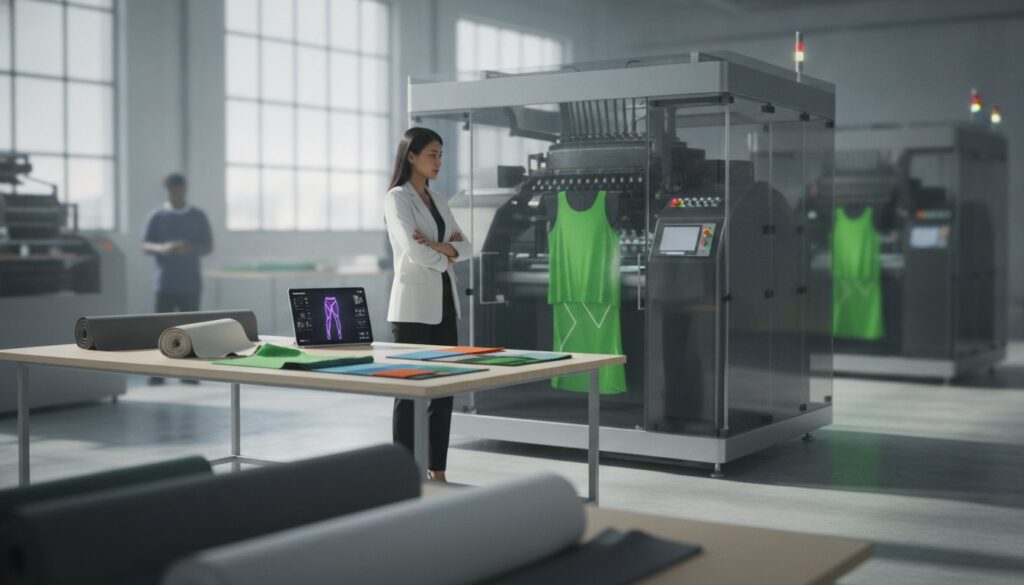
A foundational step is understanding the textile manufacturing process and how it applies to your specific niche. For example, producing technical activewear or bonded and laser-cut apparel requires specialized machinery that a standard fast-fashion factory simply doesn’t have. I focus on long-term cooperation, which means I look for brands that value technical capability over the absolute bottom dollar. A partner who understands the fiscal value of high-capacity production will always be more beneficial than one who just offers the lowest bid.
Identifying Your Production Model
You’ll likely choose between CMT (Cut, Make, Trim) and FOB (Free on Board). For most startups, I recommend FOB. It’s essentially a one-stop-shop where the factory handles everything from sourcing the fabric to final assembly. It’s less of a headache because it puts the logistical burden on the experts. Regarding MOQs, I view small orders as an investment. While high minimums are common in industrial settings, finding a partner willing to start small allows you to test the market without drowning in inventory. It’s about finding that balance between your current scale and your future potential.
The Essential ‘Pre-Search’ Checklist
Before you send your first email, you need your ‘pre-nup’ ready. I find that the most successful partnerships start with a clear, technical foundation. Use this list to prepare:
- The Tech Pack: This is your blueprint. I won’t give a quote without one because it’s the only way to ensure we’re talking about the same garment.
- Realistic Budgeting: Remember that sampling typically costs 2 to 5 times the bulk price. You need to fund the development phase before you ever see a profit.
- Your ‘Must-Have’ Sentence: Write one sentence defining your brand’s core values. For instance: ‘My brand focuses on high-performance seamless garments for professional athletes.’
Having this clarity ensures you don’t waste time with factories that don’t align with your technical requirements or production goals.
Navigating the Search: Where I Recommend Looking for Reliable Partners
Once you have your tech pack ready, the hunt begins. I’ve found that many founders get stuck in a loop on massive industry directories. While platforms like Maker’s Row or Kompass are decent starting points, they often lead to analysis paralysis because they don’t filter for technical mastery. I often suggest founders look at the SBA’s guidance on writing a business plan before they start cold-emailing. A solid plan makes you look like a professional buyer rather than a hobbyist. If you want to know how to find a clothing manufacturer for a startup that actually delivers, look for the “un-optimized” factories. These are the ones with 1990s-style websites that show photos of their actual machinery. They spend their capital on equipment, not digital marketing.
Referrals remain my favorite way to meet new partners. I love it when a brand comes to me through a ‘friend of the factory’ because it creates an immediate layer of trust. If you don’t have that network yet, trade shows are still worth the flight in 2026. Events like Sourcing at MAGIC or the large-scale expos in Ho Chi Minh City allow you to touch the fabric and see the finishing quality in person. It is a physical audit you simply cannot get through a screen. Seeing a factory’s output firsthand prevents the “garbage product” surprise that haunts so many startups.
Leveraging Social Media and Forums
LinkedIn is a powerful tool for this search. I use it to find production managers at brands I admire. Instead of asking for their factory name immediately, I ask for advice on technical specs. On the flip side, Reddit’s r/streetwearstartup is a goldmine for “blacklisted” factory warnings. It is where the real talk happens about who missed deadlines or sent poor samples. Be careful on Instagram; many accounts looking like factories are actually middle-men adding a 20% markup without adding any technical value.
The ‘Hidden Gems’ in Manufacturing Hubs
Vietnam has become the gold standard for sportswear startups today. I recommend looking into local trade associations like VITAS (Vietnam Textile and Apparel Association). They provide lists of verified members that meet international standards. The real magic happens in “clusters” where the fabric mill, the trim supplier, and the assembly line are all in the same district. This proximity reduces lead times and shipping costs significantly. If you are ready to explore this level of efficiency, you can see how we manage performance apparel production to see if our capacity aligns with your brand goals.
The Big Debate: Should You Source Locally or Head to Vietnam?
Deciding where to base your production is a crossroad every founder hits. I see many startups lean toward domestic manufacturing because they believe it’s safer or simpler. If you’re making basic cotton tees, staying local might work. But if you want to know how to find a clothing manufacturer for a startup that specializes in technical gear like activewear or swimwear, the answer often lies across the ocean. Domestic factories in the US or EU offer speed and no customs hurdles, but they often lack the specialized machinery required for modern performance fabrics. I’ve seen brands struggle with high labor costs only to receive a product that feels a generation behind in its construction.
Overseas manufacturing, particularly in Vietnam, offers a different value proposition. You get access to advanced technology like laser cutting and bonding that is hard to find elsewhere. While shipping times and the “fear of the unknown” are real concerns, the bulk costs are significantly lower, which is vital for a brand trying to scale. I believe the trade-off is worth it if your designs require technical mastery. Choosing the right region is just as important as choosing the right factory; it sets the ceiling for what your brand can technically achieve.
Why Vietnam is Winning the Sportswear Game in 2026
Vietnam is currently winning the sportswear game in 2026. The infrastructure here has undergone a massive boom, making it the primary beneficiary of the “China Plus One” strategy. Startups are moving here because they need access to high-tech processes like seamless construction and Nuyarn performance wool. For a deeper look at this, check out my guide on choosing a sportswear factory in Vietnam. It breaks down the regional clusters that make this location so efficient for new brands.
Calculating the Real Cost of Sourcing
When you’re figuring out your margins, don’t get blinded by the per-unit price. I tell my partners to focus on the “landed cost.” This includes the manufacturing price plus shipping, insurance, and the current 10% Section 122 reciprocal tariff. These extras can add 15 to 25% to your unit price. I recommend looking at this in-depth guide to finding a clothing manufacturer for a clear perspective on how these variables impact your business plan. While “Made in USA” is a great marketing hook, “High Tech in Vietnam” is usually the performance win that keeps your customers coming back for the quality of the actual garment. I help my partners balance this quality with a price point that actually leaves room for a healthy retail markup.
Vetting Your Shortlist: My Checklist for Avoiding the ‘Wrong Fit’
By now, you likely have a list of three to five potential partners. Narrowing this down is where most founders get nervous. When you are learning how to find a clothing manufacturer for a startup, the first email you receive back is actually a test of their professionalism. I always look for a response that is technical and inquisitive. If a factory simply says “yes, we can do this” without asking for your tech pack or clarifying your fabric choice, they aren’t listening. A good partner will challenge your assumptions to ensure the final product is actually manufacturable at scale.
I cannot stress this enough: never, ever skip the proto-sample phase. It is the only way to verify that a factory understands your vision. This is your chance to see if they can handle the tension of a flatlock stitch or the precision of a heat-bonded seam. If you can’t fly out to visit the facility in person, ask for a live video tour. I frequently use video calls to show my partners the production floor in real-time. It provides a level of transparency that static photos can’t match. You should also look for certifications like WRAP or ISO. These aren’t just alphabet soup; they are proof that the factory operates with institutional permanence and follows international labor and quality standards.
Questions I Hope You’ll Ask Me
I appreciate it when a founder comes prepared with tough questions. It shows me they are thinking about the long-term health of their brand. You should always ask about a factory’s capacity during peak seasons. You don’t want to be bumped from the schedule because a bigger brand suddenly doubled their order. I also encourage you to ask for specific examples of technical work. For instance, can I see a sample of your bonded and laser-cut apparel? Finally, ask how they handle quality control at each stage. A reliable factory doesn’t just check the final garment; they inspect the fabric at the source and the stitching at every station.
Spotting Red Flags Early
There are a few warning signs that should make you walk away immediately. The biggest one is a factory that agrees to everything without seeing your technical specs. These “yes men” often end up being “ghost factories” that outsource your work to a lower-tier shop they don’t even control. This ruins your quality and puts your brand reputation at risk. In the world of activewear, a lack of specialized machinery like seamless knitting machines or laser cutters is a total dealbreaker. If they don’t own the tech, they can’t guarantee the performance. If you want to see what a high-capacity facility looks like, you can view our production capabilities to benchmark your other options.
Moving from ‘Startup’ to ‘Scale’: How I Help Brands Grow
Scaling isn’t just about making more of the same thing. It’s about maintaining quality while increasing volume. I manage the transition from 100 units to 10,000 by standardizing every technical process from the very first stitch. When you’re researching how to find a clothing manufacturer for a startup, you should look for a partner who has the physical infrastructure to support that kind of growth. I’ve spent my career building that backbone. I invest in machinery like Nuyarn spinning and laser-cutting stations because they provide a level of precision that manual labor can’t match at high volumes. This tech gives my partners a competitive edge in a crowded market. Knowing how to find a clothing manufacturer for a startup that values technical mastery is the key to surviving the transition from a small label to a major player.
Sustainability is also a major factor in 2026. I’m seeing a significant shift toward natural fibers as brands look for more eco-friendly options that still offer performance. I provide a comprehensive service model that covers everything from fiber selection to final quality validation, ensuring your brand stands on a foundation of technical excellence. My final word of advice is simple: treat your manufacturer like your most important employee. If you treat us like a faceless vendor, you’ll get a generic product. If you treat us like a partner, you’ll get our best ideas and our most careful attention to your bottom line.
The Future of Your Collection
I use advanced prototyping to reduce material waste. This saves you money and speeds up your time to market. Staying ahead of fabric trends, like high-performance elastane or moisture-wicking blends, is crucial for your long-term growth. If you’re focusing on the gym or yoga market, check out my insider guide to fitness wear for specific scaling tips. I find that brands that iterate quickly based on technical fabric availability tend to capture the most market share.
Let’s Build Something Together
At Dar Lon Garment, I approach new startup partnerships with a focus on long-term cooperation. I offer specific technical support to founders who are still learning the ropes of production metrics and supply chain management. I don’t just take your order; I help you refine your designs for better industrial efficiency. This proactive attitude is backed by our extensive operational history in Vietnam. Reach out and let’s talk about your vision. I’m ready to help you turn that first sample into a globally recognized brand through disciplined production and technical mastery.
Launching Your 2026 Collection with Confidence
Building a brand is a marathon, not a sprint. Success depends on the technical foundation you lay today. We’ve discussed why your tech pack is your most valuable asset and how the right manufacturing region can dictate your product’s performance. Understanding how to find a clothing manufacturer for a startup is about looking beyond the price tag to find a partner who invests in your long-term scalability. Whether you choose to stay local or leverage the high-tech clusters in Vietnam, remember that your factory is the silent backbone of your brand’s reputation.
I’ve been specializing in high-tech sportswear since 2019, equipping my facility with advanced laser cutting and automatic sewing to meet the needs of global brands. I offer one-stop OEM solutions that take the guesswork out of the production line. If you’re looking for a partner that values technical mastery and institutional stability, I’m here to help you navigate the complexities of the 2026 market. Ready to start your production journey? Let’s talk about your brand today.
Take that first step with clarity. Your vision deserves a production partner that is as disciplined and proactive as you are. I look forward to seeing what you build.
Frequently Asked Questions
How much does it typically cost to start a small clothing line in 2026?
Industry data suggests that a professional launch of a 5-piece capsule collection typically requires between $15,000 and $50,000. This budget covers your tech packs, multiple sampling rounds, and the initial bulk production run. I always advise founders to set aside an additional 25% buffer to cover landed costs like freight, insurance, and import duties.
Can I find a manufacturer if I don’t have a tech pack yet?
It is nearly impossible to secure a reliable partner or an accurate quote without a tech pack. I view the tech pack as the mandatory blueprint for your garment. While some factories offer development services, I recommend hiring a technical designer first to ensure you own your intellectual property before you start the search.
What is the typical lead time from the first sample to final delivery?
You should plan for a total timeline of four to six months. The sampling phase usually takes four to eight weeks, depending on how many revisions your designs require. Once the final sample is approved, bulk production in a high-capacity facility typically takes 60 to 90 days, followed by transit time to your warehouse.
How do I protect my designs from being copied by the factory?
I suggest signing a NNN (Non-use, Non-disclosure, and Non-circumvention) agreement before sharing your technical files. However, the strongest protection is partnering with a factory that has a documented history of working with international brands. Reputable manufacturers value their global standing and long-term partnerships far more than any single design concept.
What is a ‘Low MOQ’ and is it actually possible for high-quality sportswear?
A “Low MOQ” usually refers to orders between 50 and 300 units per style. It is possible for technical sportswear, but you will likely need to use the factory’s stock fabrics. Custom fabric colors or specialized performance blends often require much higher minimums because the fabric mills themselves have their own production limits.
Is it better to source my own fabric or let the manufacturer do it?
I recommend the FOB (Free on Board) model where the manufacturer handles the sourcing. We have established relationships with mills and can often negotiate better pricing and lower minimums than a startup could achieve alone. This also ensures the material is technically compatible with our specialized machinery, such as seamless knitting or laser-cut bonding tools.
How do I handle shipping and customs when manufacturing in Vietnam?
I suggest hiring a licensed freight forwarder to manage the logistics from the port to your door. They will help you navigate the 10% Section 122 reciprocal tariff and ensure your documentation meets all current U.S. Customs requirements. Mastering these logistics is a vital part of learning how to find a clothing manufacturer for a startup without losing your margins to shipping errors.
What happens if the bulk production doesn’t match the final sample?
This is why the “golden sample” is so critical. Both you and the factory must sign off on an identical sample that serves as the legal standard for the bulk run. I prevent discrepancies by using quality control checkpoints at every stage of the assembly line. If a factory fails to meet the signed standard, your contract should specify the terms for rework or credits.