
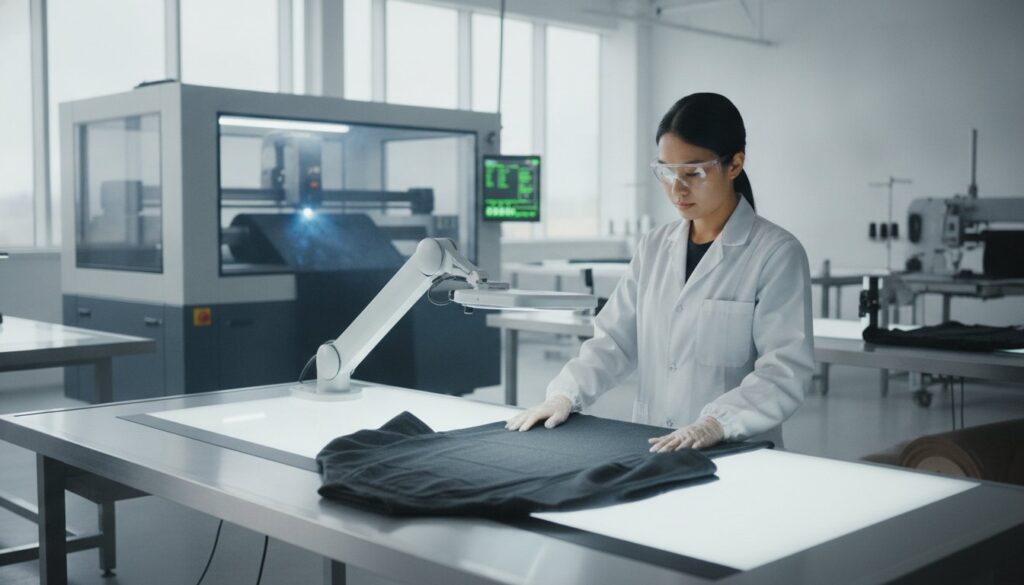
What if I told you that the biggest bottleneck in your 2026 activewear line isn’t the rising cost of raw merino, but the outdated spinning technology your factory is still using? I know how difficult it is to find a performance wool apparel manufacturer that actually understands the technical difference between a standard knit and a high-intensity base layer. Most factories treat wool like a delicate luxury fiber, but for elite sportswear, we need it to be much tougher.
You’ve likely felt the frustration of seeing a beautiful prototype lose its shape or pill after just a few heavy workouts. I’m going to show you exactly how we bridge the gap between raw merino wool and professional-grade gear using Nuyarn technology and advanced manufacturing. I’ll explain why this specific yarn outperforms traditional spinning and provide a clear, reliable path for moving your designs from a first sample to bulk production at our scaleable facilities in Vietnam. By the end of this guide, you’ll see how we maintain the natural benefits of wool while adding the durability your customers demand.
Key Takeaways
- Learn why I’m seeing a massive shift toward engineered performance wool that prioritizes moisture management and durability for high-intensity movement.
- Discover how working with a specialized performance wool apparel manufacturer allows you to leverage Nuyarn technology to eliminate the common fragility issues of traditional merino wool.
- I’ll explain my technical approach to garment construction, including how I use laser-cut edges to prevent fraying and ensure a professional finish.
- Understand the strategic advantages of manufacturing in Vietnam, from established supply chains to technical expertise in activewear production.
- Get a clear roadmap for scaling your brand, moving smoothly from the initial prototyping phase to full-scale bulk production with a reliable partner.
Why I am Seeing More Brands Pivot to Performance Wool in 2026
I have spent a lot of time on factory floors lately, and I’ve noticed a massive shift in how my clients view wool. It’s no longer just for heavy winter sweaters or base layers for skiing. In 2026, brands are coming to me looking for something much more technical. To put it simply, performance wool is merino wool that has been specifically engineered for high-intensity movement, extreme durability, and superior moisture management. It is about taking a natural fiber and making it work in environments where it used to fail.
As a performance wool apparel manufacturer, I’ve seen firsthand why my sportswear partners are ditching 100% synthetics. They are moving toward wool-rich blends because consumer demand for natural, biodegradable fibers is at an all-time high this year. People want clothes that don’t just perform well but also align with a more sustainable lifestyle. Wool offers a level of breathability that polyester simply can’t match, and that is why it’s becoming the foundation of so many new activewear collections.
The “Natural Performance” Revolution
I see brands prioritizing odor resistance and thermal regulation over the simple “dry-fit” polyester that dominated the last decade. While synthetic fabrics are cheap, they tend to trap bacteria and develop a permanent smell over time. Wool naturally resists those odors. It also helps athletes stay cool when it’s hot and warm when it’s cold. This versatility is essential for modern apparel companies focusing on circular economy goals. In my professional opinion, a hybrid blend of wool and nylon is the sweet spot for durability. It allows the garment to withstand the friction of a gym workout while keeping the soft, natural feel of the fiber.
Performance Wool vs. Traditional Merino
In my experience, traditional merino often lacks the “snap-back” or elasticity needed for high-stress items like leggings or compression gear. If you look into the history of wool production, you’ll see how the fiber has been used for centuries, but old-school spinning methods have their limits. Traditional spinning can actually hide the natural benefits of the fiber by twisting it in a way that makes it prone to pilling or breaking under tension. My role as a performance wool apparel manufacturer is to preserve those natural benefits throughout the entire production line. We have to ensure the yarn is strong enough for the sewing machines without losing the moisture-wicking properties that make wool so special in the first place.
Decoding Nuyarn: The Technology That Changed How I Think About Wool
I’ve spent years working with various technical textiles, but I am especially proud to offer Nuyarn performance wool to my partners. For a long time, the biggest headache for any performance wool apparel manufacturer was the inherent fragility of standard merino. If you made the fabric thin enough to be breathable, it often became too weak to survive the rigors of a high-intensity workout. Nuyarn solves this by fundamentally changing how the yarn is constructed at the microscopic level.
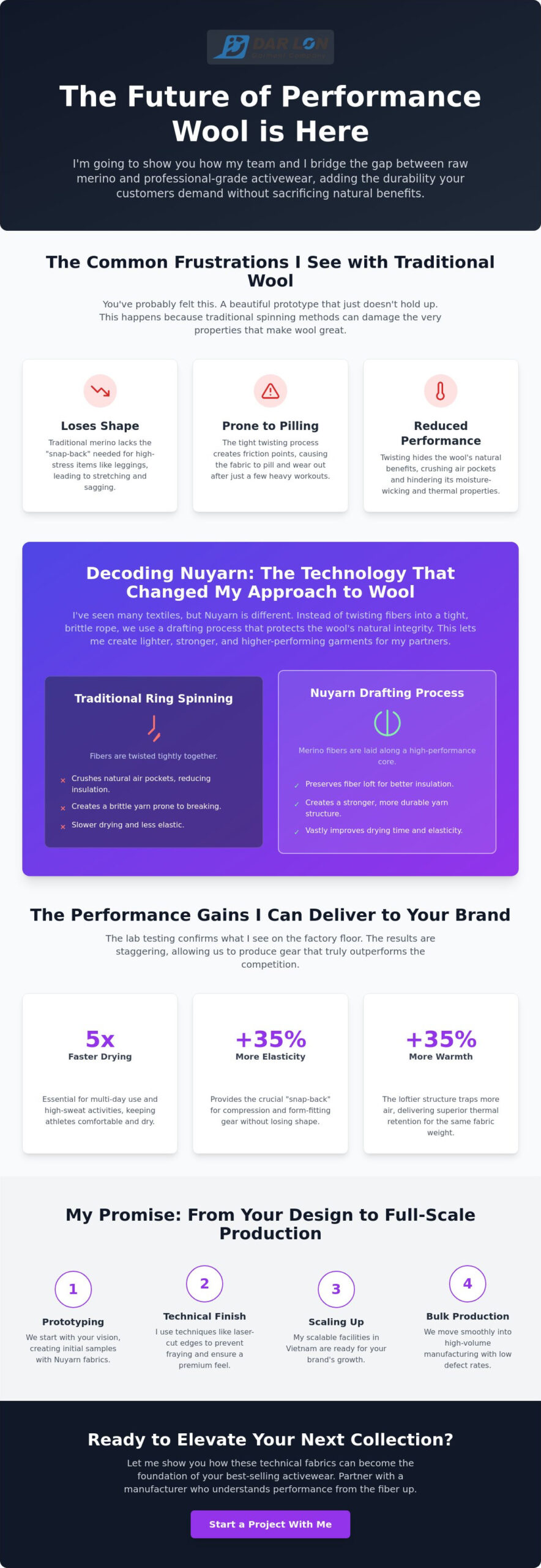
Most people are familiar with traditional ring spinning. In that process, wool fibers are twisted together into a tight, rope-like structure. While this works for casual sweaters, it actually crushes the natural air pockets in the wool and makes the yarn brittle. Nuyarn uses a drafting process instead. It lays the wool fibers along a high-performance core without twisting the life out of them. The results I see in our lab testing are staggering. Garments made this way dry 5x faster than traditional merino and offer 35% more elasticity. This technology allows me to create lighter, stronger garments that don’t lose their shape after the first few washes.
Why Nuyarn is a Game-Changer for My Factory
From a production standpoint, this yarn is a dream to work with. I can produce thinner, more breathable fabrics for activewear without the constant fear of the material tearing or puckering during the sewing process. Because the yarn isn’t under the same internal tension as twisted wool, it retains the natural loft of the fiber, which leads to much better insulation for the wearer. It’s also much easier to integrate this yarn into my automated sewing processes. This keeps our efficiency high and our defect rates low, which is exactly what my clients expect from a high-capacity facility.
- 5x faster drying: This is essential for multi-day use and high-sweat activities.
- 35% more elasticity: It provides the natural “snap-back” required for performance compression gear.
- 35% more thermal retention: The loftier structure traps more air, keeping athletes warmer in cold conditions.
Physical Properties of High-Performance Wool
Moisture-wicking in merino wool is the unique process where the fiber absorbs moisture vapor into its internal structure before it even turns into liquid sweat on the skin. When we look at the burst strength of Nuyarn fabrics, they are significantly more durable than standard wool knits of the same weight. While durability is a major benefit, thermal regulation remains the #1 reason my activewear clients choose this material. It keeps the body at a steady temperature regardless of the output level. If you are ready to see how these technical fabrics can elevate your next collection, you might want to explore how a specialized performance wool apparel manufacturer can streamline your development cycle.
Beyond the Stitch: My Technical Approach to Performance Apparel Construction
I’ve learned over the years that sourcing the best technical yarn is only the first step. As a performance wool apparel manufacturer, I know that the fabric is only half the battle. You can have the most advanced Nuyarn blend in the world, but if the construction is sloppy, the garment will fail in the field. High-performance athletes don’t just need a shirt that dries fast; they need gear that moves with them without causing irritation or falling apart at the seams. That’s why I focus so heavily on the engineering that happens after the fabric leaves the loom.
Working with technical wool requires a level of precision that standard cotton or polyester shops just can’t match. I’ve seen many factories try to use standard needles and high-speed settings on merino blends, only to end up with micro-tears that turn into holes after three washes. I insist on using specialized needles with specific tip geometries and carefully calibrated thread tension. This prevents the needle from “chopping” through the wool fibers, ensuring the structural integrity of the garment remains intact throughout its lifecycle.
Laser Cutting and Precision Engineering
I use laser cutting to achieve complex designs that traditional shears simply cannot handle. When we are working with wool, precision is everything. Traditional cutting methods can leave raw edges that are prone to fraying, especially with knit structures. The laser doesn’t just cut; it cauterizes the edge. This heat-sealing process prevents the unraveling common in many wool products. It’s particularly important when I’m maintaining the integrity of a wool-nylon core, as it ensures the synthetic strength and natural comfort are locked together right at the boundary of the panel.
Seamless and Bonded Garment Technology
I often recommend seamless garments for high-friction areas like underarms or inner thighs. By removing the seam entirely, we eliminate the primary source of chafing for long-distance runners or hikers. When a design requires specific panels, I turn to bonding and seam-taping. This creates a “second-skin” feel that athletes love. My production process involves using medical-grade adhesives and precise heat presses to ensure these bonds hold up even after 50+ industrial wash cycles. This technical approach is what separates a basic wool shirt from a piece of professional equipment.
Sourcing from Vietnam: Why My Factory is at the Heart of the Supply Chain
I have watched Vietnam grow into the premier destination for technical apparel manufacturing over the last decade. It’s no longer just about finding the lowest cost; it is about the concentration of specialized expertise. As a performance wool apparel manufacturer based here, I manage the entire supply chain from raw fiber sourcing in Australia to finished goods delivery in the US and Europe. By being at the heart of this hub, I can oversee every detail of the production process personally. I’ve found that this geographical advantage is what allows me to maintain such tight control over quality while keeping lead times manageable for my international partners.
The logistical benefits of being a sportswear factory in Vietnam are hard to ignore in 2026. Even with the 7.2% increase in the regional minimum wage that took effect on January 1, 2026, our productivity gains keep us ahead of the curve. I’ve seen that brands are willing to pay for skilled labor that understands the nuances of high-end activewear. We are also dealing with a 10% Section 122 tariff on clothing imports to the US, so I focus on maximizing efficiency to help my clients protect their margins. My factory is positioned to navigate these fiscal realities while delivering a product that stands up to elite competition.
The Strategic Advantage of Vietnam
Trade agreements like the CPTPP make sourcing from my factory much more cost-effective for global brands than many other regions. I chose to base my operations here because of the proximity to major textile hubs. This means I can source high-performance trims, zippers, and accessories with very short lead times. I don’t have to wait weeks for a specific component to arrive from across the globe. This agility is essential when I’m helping a brand hit a tight seasonal launch window. My team understands the technical requirements of global markets, ensuring we meet all international regulatory standards without delay.
Quality Control in a Global Environment
I use a rigorous 4-stage quality control process to ensure every wool garment meets my high standards. Handling natural fibers like merino presents unique challenges during mass production, such as moisture sensitivity and slight variations in fiber diameter. My systems are built on institutional permanence, meaning our quality checks are integrated directly into the production line. We monitor everything from raw yarn tension to the final burst strength of a bonded seam. This proactive attitude prevents defects before they happen. If you want to see how my factory can stabilize your production, you can request a facility tour or technical capability report today.
Scaling Your Brand with a Performance Wool Apparel Manufacturer
I don’t just want to be another name on your vendor list; I want to be the backbone of your brand. As a performance wool apparel manufacturer, I’ve seen how many great designs fail because the factory didn’t have the technical setup to scale them. My goal is to remove that friction by acting as a silent partner in your success. I provide a one-stop solution that covers everything from fiber sourcing to final logistics. This ensures your brand’s vision is preserved from the first stitch to the customer’s doorstep. I’ve also doubled down on sustainable manufacturing practices because, in 2026, transparency is a requirement for the athletes you’re serving.
In fact, industry data shows that demand for certified sustainable wool in luxury and performance sectors is expected to grow by 18% by late 2026. I’ve aligned my factory operations to meet these standards, giving you a competitive edge in a crowded market. Whether you’re dealing with the rising costs of raw merino or navigating new import tariffs, I help you find the balance between fiscal value and high-end performance. I take the logistical weight off your shoulders so you can focus on building your community and refining your marketing strategy. My commitment is to provide a comprehensive service model that signals reliability to your own retail partners.
From Tech Pack to Mass Production
I work closely with your design team to optimize tech packs specifically for performance wool. Wool behaves differently under tension than polyester, and I help you adjust seam placements and tolerances to account for that natural movement. My approach to prototyping is methodical. We get the fit and function perfect on a small scale before we ever touch the mass production lines. I’ve found that clear communication is the most important tool in my factory. It’s much better to catch a minor fit issue during the sampling phase than to deal with a correction during a bulk run of 10,000 units. I keep you updated at every milestone, providing a level of transparency that is often missing in international trade.
Building a Long-Term Partnership
I value long-term cooperation over short-term gains. This means I’m here to support your brand as it grows from a niche startup into a market leader. I’ve built my infrastructure to scale production volumes as your brand gains traction, providing the same level of precision for a large order as I do for a small prototype run. This stability allows my partners to focus on growth while I handle the industrial heavy lifting and quality control. If you’re ready to see what a technical partner can do for your collection, reach out to me for a custom quote on your next performance wool project. I’m ready to help you turn your technical designs into a reality.
Building the Future of Technical Wool Together
I’ve shown you how the landscape of activewear is shifting in 2026. It’s clear that the brands winning the market are those moving away from basic synthetics and toward high-performance, natural fibers. By choosing a performance wool apparel manufacturer that understands the nuances of Nuyarn drafting and precision laser cutting, you ensure your products don’t just look good but actually stand up to elite-level use. We’ve moved past the era of standard knits and into a time where material engineering defines the athlete’s experience.
I’m proud of the infrastructure I’ve built in Vietnam. It’s a system designed for stability, high-capacity output, and global shipping efficiency. My team has mastered the complex bonding techniques and specialized sewing processes required to turn delicate merino into a rugged, high-intensity garment. We are ready to act as the technical backbone for your next collection, helping you scale with confidence and industrial precision. If you’re ready to elevate your brand’s technical capabilities, you can partner with Dar Lon Garment for your next performance wool collection. I look forward to helping you turn these advanced materials into your next best-selling line.
Frequently Asked Questions
Is performance wool better than synthetic activewear?
Performance wool offers a clear advantage over synthetic activewear because it manages moisture in its vapor state. While synthetics only move liquid sweat after it forms, wool absorbs vapor directly from the skin to prevent that clammy feeling. This leads to superior temperature control and natural odor resistance that lasts for days. I’ve seen that athletes prefer these natural blends for long duration activities where comfort and freshness are the top priorities.
What is the minimum order quantity (MOQ) for performance wool manufacturing?
Minimum order quantities depend on the complexity of the garment and the specific technical yarn required for the design. Generally, technical wool production involves higher MOQs than standard cotton knits because we have to source specialized yarns in bulk to maintain efficiency. I work with my partners to find a balance that supports their brand growth while keeping our industrial production lines running smoothly. We usually define these requirements during our first technical consultation.
How does Nuyarn technology differ from standard merino wool?
Nuyarn technology differs from standard merino wool by using a drafting process that lays wool fibers along a high performance core. Traditional ring spinning twists the fibers tightly, which reduces their natural elasticity and air trapping ability. By avoiding this twist, the yarn stays stronger and more breathable. This structural difference is why Nuyarn garments dry much faster and provide more warmth for their weight compared to traditionally spun wool products I’ve tested.
Can performance wool be machine washed and dried?
Yes, modern technical wool garments are engineered to be machine washable and highly durable. I suggest using a cool cycle and avoiding high heat drying to maintain the integrity of the bonded seams and specialized fibers. Because technical blends are stronger than traditional wool, they can withstand regular laundering without losing their shape or pilling. This ease of care is a major selling point for any performance wool apparel manufacturer working with modern activewear brands.
Why should I choose a manufacturer in Vietnam for my wool apparel?
Choosing a manufacturer in Vietnam gives you access to a highly skilled labor force that specializes in technical sportswear and complex bonding. Vietnam has established itself as a global leader in activewear production, offering a sophisticated supply chain for high end trims and accessories. The country’s favorable trade agreements also make it a more cost effective choice for international shipping. I chose to base my operations here to provide the technical mastery my global clients require.
What certifications should a performance wool manufacturer have?
A reliable manufacturer should hold certifications that validate both material quality and ethical labor standards. I recommend looking for the Responsible Wool Standard (RWS) to ensure animal welfare and land management are respected throughout the supply chain. Additionally, OEKO-TEX or bluesign certifications are crucial for verifying that no harmful chemicals are used during the dyeing or finishing processes. These validations provide the transparency that modern consumers demand from their favorite apparel brands.
How long does the production process take from prototype to delivery?
The production timeline usually spans between three and six months from the initial tech pack to final delivery. This period includes several weeks for prototyping and fit adjustments, followed by the bulk production phase and international logistics. I always emphasize that the sampling stage is the most critical part of the process. Getting the technical details right early on prevents delays during the high speed manufacturing phase later in the production cycle.
Does performance wool itch during high-intensity exercise?
Performance wool does not itch because we use ultra fine merino fibers that are exceptionally soft against the skin. These fibers have a very small diameter, typically under 18.5 microns, which means they bend easily rather than pricking the skin surface. Even during high intensity exercise when your body temperature rises and you sweat, the fabric remains comfortable and smooth. My clients often find that their customers are surprised by how soft technical wool feels during a workout.