
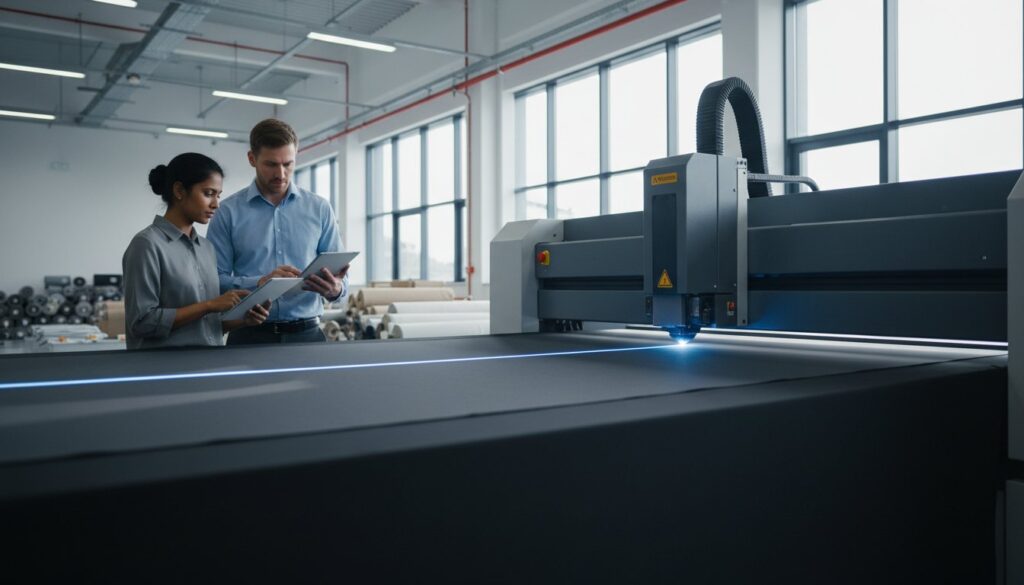
Did you know that laser cutting and engraving of fabrics can be up to 20 times faster than traditional blade methods? If you’ve been managing production for high-performance sportswear or swimwear, you’ve likely seen how much expensive material ends up in the scrap bin because of manual cutting errors. I’ve found that the advantages of laser cutting fabric go far beyond just raw speed; it’s about reclaiming that lost margin and ensuring every single piece matches your digital pattern exactly.
It’s frustrating to deal with fraying edges on synthetic fabrics or inconsistent sizing that forces you to delay a shipment. I’ve been through those production headaches, and I know that in 2026, the margin for error in technical apparel is thinner than ever. I’ll walk you through why laser cutting is the ultimate game-changer for precision and edge-finishing in my factory. We’ll look at how I achieve perfectly sealed edges and reduce lead times for complex designs while maintaining the latest IEC 60825-1 safety benchmarks to ensure a reliable, high-capacity output for every partner.
Key Takeaways
- I’ll show you why I moved away from traditional die-cutting in 2019 and how modern CO2 lasers vaporize fibers to create an edge that’s far superior to manual cuts.
- Explore the core advantages of laser cutting fabric, focusing on how I achieve a “no-fray” finish on complex synthetic materials for sportswear and swimwear.
- I share my personal breakdown of when to choose laser over blade cutting, including my factory’s proven methods for avoiding discoloration on delicate fabrics.
- Learn how I use micro-perforations and bonding techniques to create the breathable, seamless silhouettes that modern activewear brands demand.
- I explain the exact process I use to transition your brand’s tech packs into production-ready prototypes using my high-capacity industrial systems.
Why I Switched to Laser Cutting: More Than Just a Sharp Edge
Back in 2019, I made a decision that fundamentally shifted how my factory operates. We transitioned from traditional die-cutting and manual blade systems to high-tech laser setups. At the time, die-cutting was the industry standard, but I could see the limitations as designs became more intricate. The first time I saw a laser head execute a 0.1mm precision cut on a delicate piece of performance mesh, I knew there was no going back. Manual cutting is essentially becoming obsolete for the complex 2026 apparel designs my clients are bringing to the table. It’s not just about speed; it’s about the ability to execute geometries that a physical blade simply cannot touch.
What is Laser Fabric Cutting Exactly?
In simple terms, I use a concentrated CO2 beam to vaporize fabric fibers along a pre-programmed path. Laser cutting is a technology that allows me to bypass the physical friction and resistance of a blade. Because the beam never actually touches the fabric, there’s no pulling, bunching, or distorting of the material. I take your digital tech pack and translate it directly into laser paths, ensuring that the first unit is identical to the ten-thousandth. One of the main advantages of laser cutting fabric is this digital-to-physical fidelity. I also use these machines for engraving, which lightly marks the surface without cutting through. This is perfect for adding subtle branding or functional alignment marks that don’t compromise the garment’s integrity.
The Shift in Global Apparel Sourcing
I’ve noticed a significant change in what international brands look for when they audit my facility. They aren’t just looking for sewing capacity anymore; they want technical mastery. Many partners are specifically choosing a sportswear factory in Vietnam that can handle complex, bonded, and laser-cut apparel. This technology allows me to maintain the rigorous quality standards required for global OEM contracts. By integrating these systems, I can offer a level of consistency that traditional factories simply can’t match. It’s about being a silent, powerful backbone for brands that need their sportswear, swimwear, or sleepwear to perform under pressure. The advantages of laser cutting fabric in this context are clear: better yield, higher precision, and a much faster transition from prototype to bulk production.
The 5 Biggest Advantages of Laser Cutting for Your Brand
I’ve found that moving to laser technology isn’t just about being modern. It’s about solving the specific production bottlenecks that keep brand owners up at night. When we look at the advantages of laser cutting fabric, we’re really talking about five core pillars that transform a design from a sketch into a high-performance reality. These benefits directly impact your bottom line by improving quality and reducing the time it takes to get to market.
Precision That Scales
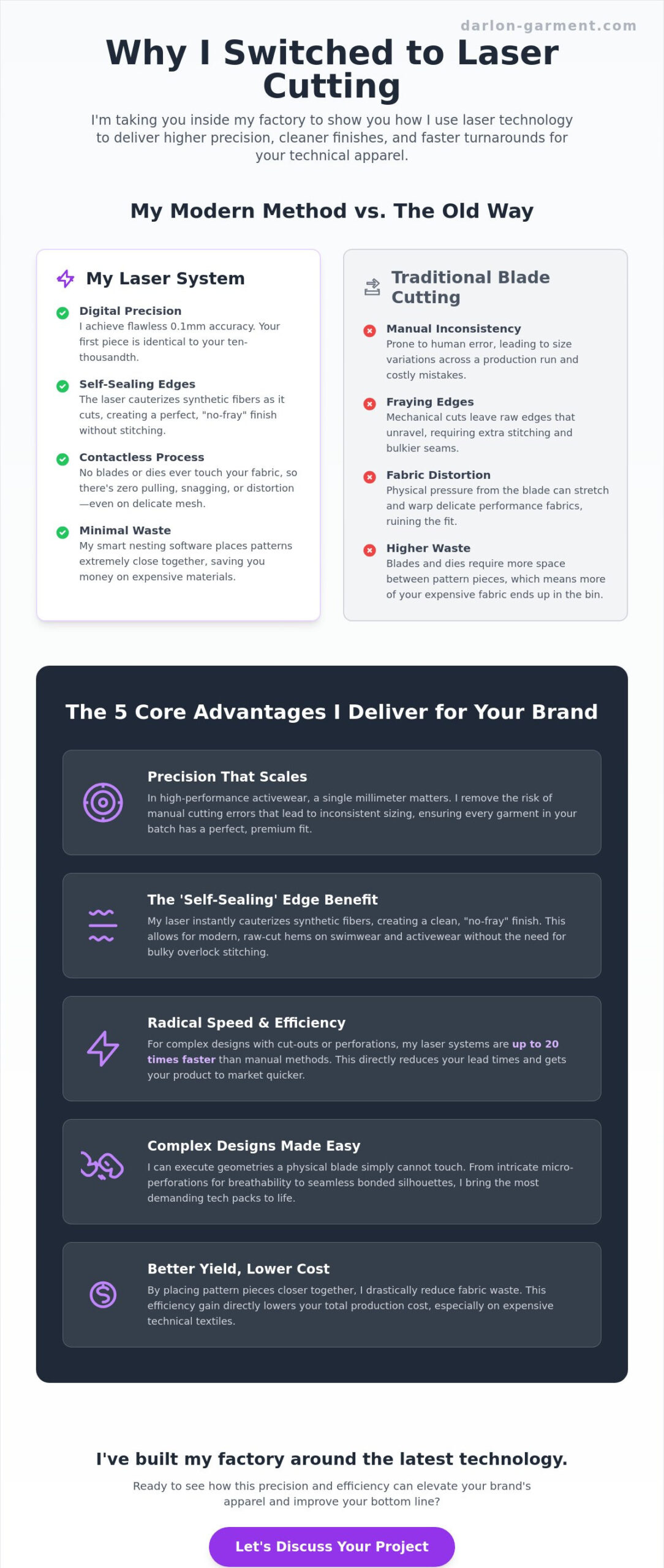
In high-performance activewear, a single millimeter can be the difference between a perfect fit and a returned item. I’ve seen how manual cutting errors pile up during bulk production, leading to inconsistent sizing across a single batch. With my laser systems, I can guarantee that the first unit off the line is identical to the 10,000th. By removing the human error factor, I provide a level of consistency that’s impossible to achieve with a hand-held blade. This precision allows me to produce complex sportswear that looks and feels premium across every size in your grading scale.
The ‘Self-Sealing’ Edge Benefit
One of the most significant advantages of laser cutting fabric is how the beam interacts with synthetic fibers like polyester and nylon. As the laser cuts, it simultaneously cauterizes the edge of the material. This “self-sealing” effect is the secret to creating “no-fray” garments. For swimwear and activewear, this means I can offer raw-cut hems that stay crisp and clean without the need for bulky overlock stitching. It results in a sleeker, more professional finish that consumers in 2026 expect from top-tier brands. If you are interested in exploring these finishes, you can see how I apply them to bonded and laser-cut apparel for my international partners.
Beyond the aesthetic, there’s a major fiscal benefit. I use smart nesting software to arrange pattern pieces with surgical efficiency. Because the laser head is so small, I can place pieces much closer together than a traditional die or blade would allow. This drastically reduces fabric waste, which directly lowers your total production cost. In an era where material costs for performance textiles are rising, this efficiency is a massive competitive advantage.
Speed and material integrity also set this technology apart. For intricate patterns with micro-perforations or complex cut-outs, the laser is up to 20 times faster than manual methods. Plus, it’s a contactless process. Since nothing physical presses down on the fabric, there’s zero distortion or “pulling” during the cut. This ensures that even the most delicate four-way stretch fabrics retain their intended shape and recovery properties throughout the entire manufacturing cycle.
Laser vs. Blade Cutting: My Honest Breakdown
I often have conversations with brand owners who wonder if traditional blade cutting is still a viable option. While mechanical cutting has its place for very simple, high-volume basic items, it’s quickly losing ground in the performance space. One of the biggest myths I hear is that lasers leave “burn marks” or yellowing on fabric. In my facility, I’ve spent years calibrating air-assist systems and power frequencies to ensure that doesn’t happen. By controlling the heat precisely, I get a clean, white edge even on light-colored synthetics. When you weigh the advantages of laser cutting fabric against traditional methods, the consistency of the finish is usually the deciding factor.
The Hidden Costs of Traditional Cutting
Traditional cutting carries several overheads that aren’t always obvious at first glance. Steel rule dies are expensive to manufacture and require significant physical storage space. If a designer makes a 2cm adjustment to a pocket placement, a new die must be cast. This adds weeks to your lead time. In contrast, I can update a digital laser path in minutes. Beyond the hardware, there’s the issue of blade degradation. A dull blade doesn’t just cut poorly; it snags delicate knits and pulls fibers out of alignment. Understanding how garments are made in a modern factory means recognizing that digital agility is now a requirement, not a luxury.
Which Fabrics Win with Laser?
Not every material reacts to a laser beam in the same way. Synthetics like polyester and nylon are the perfect candidates because their plastic-based fibers melt and fuse into a permanent, non-fray edge. I’m much more selective with natural fibers. Cotton and silk don’t melt; they char, which can leave a slight residue if the settings aren’t perfect. I also take extra care with elastane fabric and high-stretch blends. If the laser power is too high, the heat can cause the elastic fibers to snap or shrink back, affecting the final fit. I manage this by using high-speed, low-power passes that protect the fabric’s structural integrity while still delivering a sharp cut. This nuanced approach is why the advantages of laser cutting fabric are most apparent when working with a manufacturer who understands the chemistry of the textiles.
For brands running low MOQ collections, laser cutting is often the only way to stay profitable. You don’t have to sink money into physical tooling before you’ve even sold your first unit. Even for my massive bulk orders, the speed and reduced waste of the laser system provide a cost-benefit that traditional blades just can’t match. It’s a cleaner, faster, and more predictable way to build a premium apparel line.
How Laser Cutting Elevates Activewear and Swimwear
I’ve seen the industry shift toward a minimalist, high-performance aesthetic where traditional bulky seams are no longer acceptable. This is where the advantages of laser cutting fabric really shine for activewear and swimwear. It allows me to create the sleek, seamless look that defines premium 2026 collections. By using a laser to cut components, I can ensure they are perfectly prepped for bonding, which is essential for garments that need to move with the body without chafing. It’s about more than just a cut; it’s about enabling a new category of apparel construction that feels like a second skin.
One of my favorite applications is functional ventilation. Instead of using separate mesh panels that require extra seams and material handling, I use the laser to create micro-perforations directly into the main body fabric. This adds breathability exactly where the athlete needs it most without compromising the garment’s structure. It’s a level of functional design that traditional cutting just can’t achieve. This technical edge is precisely why I’m a preferred partner for brands looking for reliable fitness wear manufacturers who understand the intersection of tech and performance.
Bonding and Laser-Cut Apparel
I use lasers to prep edges specifically for ultrasonic welding or heat-activated bonding tapes. This process removes the need for traditional needle-and-thread seams, resulting in a garment that is lighter and more aerodynamic. Top-tier brands are moving away from traditional seams because bonded edges offer a cleaner aesthetic and superior comfort. If you want to see how these techniques can transform your next collection, you can explore my range of bonded and laser-cut apparel today. The precision I achieve with the laser ensures that the bonding tape has a perfectly uniform surface to adhere to, which prevents delamination later in the garment’s life.
Specialty Materials: Nuyarn and Performance Wool
Cutting high-value materials like Nuyarn performance wool requires a gentle but precise touch. I’ve found that traditional blades can sometimes crush or fray the unique structure of these performance yarns. With a laser, I can maintain the integrity of the wool while adding custom ventilation patterns. The beam vaporizes only what’s necessary, leaving the surrounding fibers untouched. It’s the perfect marriage of aesthetic design and technical function, ensuring your high-end wool pieces perform exactly as promised in the tech pack. The advantages of laser cutting fabric extend to these luxury performance materials by preserving their natural stretch and loft while allowing for intricate, breathable patterns that would be impossible to execute by hand.
Scaling Your Brand with My Technology in 2026
Scaling a brand in 2026 requires a manufacturing partner who handles the technical heavy lifting so you can focus on growth. I’ve built my factory to be a one-stop solution where laser cutting isn’t just a standalone service; it’s a core part of a streamlined production flow. When you look at the advantages of laser cutting fabric in a high-capacity environment, the biggest benefit is predictability. I can take your digital tech pack and move straight into a laser-cut prototype with surgical precision. This eliminates the guesswork that usually happens during the sampling phase, allowing us to hit your launch dates with total confidence.
Vietnam has firmly established itself as the global hub for high-tech apparel innovation. My facility sits at the center of this movement, offering the stability and technical mastery that international brands require for their OEM and ODM contracts. I’ve found that leveraging the advantages of laser cutting fabric is the only way to maintain the speed and quality necessary for the modern global supply chain. It’s about being a silent, powerful backbone for your brand, providing the industrial scale you need to compete at the highest level.
The Dar Lon Advantage
My 2026 facility upgrades have focused on deeper integration between my laser systems and automatic sewing lines. This means that once a piece is laser-cut, it moves through a series of specialized quality control checkpoints designed for technical apparel. I handle everything from sportswear to sleepwear with the same institutional rigor. We don’t just cut fabric; we manage the entire lifecycle of the garment. This includes specialized handling for seamless garments and bonded items, ensuring that the precision of the cut is maintained through the final stitch and packaging.
Getting Started with Your First Order
Starting a partnership with my factory is a straightforward process. I recommend preparing your digital patterns in a high-resolution vector format to get the most out of our laser systems. This allows for the fastest possible transition from design to physical sample. I’ve optimized my workflow to provide rapid sample turnaround times, giving you the agility to test new designs without long delays. If you’re ready to see the difference this technology makes, I invite you to contact me for a tour of my facility or a detailed quote for your next collection. Let’s build something exceptional together.
Elevate Your Production Standards for 2026
I’ve spent years refining my production lines to ensure that every cut serves a specific purpose. We’ve explored how digital precision eliminates human error and how sealed edges create a premium finish for your customers. It’s not just about a single garment; it’s about building a consistent, scalable brand. The advantages of laser cutting fabric give you the freedom to innovate without worrying about production bottlenecks or material waste. When your designs are translated directly from a digital file to a 0.1mm precise cut, you regain control over your margins and your quality.
My facility in Vietnam combines high-volume OEM capacity with specialized expertise in Nuyarn and activewear. I use advanced CO2 laser cutting systems to ensure your technical designs are realized exactly as you intended. I’m here to act as your technical partner and provide the industrial scale you need to compete globally. I’m excited to help you push the boundaries of what’s possible in your next collection. Let’s get started on your next prototype.
Ready to scale? Let’s talk about your laser-cut apparel project today.
Frequently Asked Questions
Does laser cutting leave burnt edges on the fabric?
No, I ensure my machines are calibrated with air-assist systems to blow away smoke and heat during the process. This prevents the yellowing or charring that people often associate with older technology. By matching the laser frequency to the specific material density, I get a clean, white edge even on light-colored synthetics. It’s all about the technical setup and the air pressure I use in the factory.
Is laser cutting more expensive than traditional methods for bulk orders?
Laser cutting is often more cost-effective for bulk orders because it eliminates the need for expensive metal dies. I also use nesting software that places pattern pieces closer together than a physical blade could ever manage. This optimization is one of the key advantages of laser cutting fabric because it significantly lowers your total material spend over thousands of units.
Which fabrics are best suited for laser cutting?
Synthetic fabrics like polyester, nylon, and spandex are the absolute best for this technology. The heat from the beam melts the edge of the fiber, creating a permanent seal that prevents fraying. I also work with performance wool blends, though these require specific power settings to avoid damaging the natural fibers. Synthetics remain the gold standard for a perfect, raw-cut finish that stays crisp.
Can laser cutting handle very thick materials like neoprene or heavy fleece?
Yes, I can cut through thick materials like neoprene or heavy performance fleece by slowing the laser head and increasing the power output. Unlike a traditional blade that might struggle or compress the material, the laser vaporizes the path without any physical pressure. This keeps the edges of thick activewear components crisp and undistorted, which is vital for high-quality garment assembly.
How does laser cutting help with sustainability in fashion?
Sustainability is improved primarily through material yield optimization. My software calculates the most efficient way to lay out your patterns, which reduces the amount of fabric that ends up on the cutting room floor. Since the laser is so precise, I can place pieces within millimeters of each other, helping brands meet their waste reduction goals for 2026 without sacrificing design complexity.
What is the typical lead time for laser-cut garment production?
Lead times are generally shorter because we don’t have to wait for physical cutting dies to be manufactured. Once I have your digital vector files, I can start cutting samples or bulk production almost immediately. This agility is a major part of the advantages of laser cutting fabric, as it allows my factory to respond much faster to design changes or urgent reorders compared to traditional methods.
Do I need a special tech pack for laser cutting?
You don’t need a completely different tech pack, but I do require vector-based patterns like AI or DXF files. These digital files tell the laser exactly where to move with sub-millimeter accuracy. If you only have paper patterns, my team can digitize them for you, but starting with digital vectors is the fastest way to get your production line moving and ensure total precision.
Can you do laser engraving and cutting on the same piece of fabric?
Yes, I can program the laser to perform both engraving and cutting in a single pass. I simply set the machine to a lower power for the engraving areas to mark the surface and a higher power for the cut lines. This is a great way to add functional marking or subtle branding to your sportswear without adding the cost of extra production steps or external vendors.