
If you still think wool is just for heavy winter sweaters, you’re missing out on the biggest technical shift in the $338.97 billion activewear market. I’ve spent years watching brands struggle with the “stink” and environmental baggage of petroleum-based synthetics. We’ve all accepted that gym clothes eventually smell like plastic, but that’s a compromise your customers don’t have to make anymore. I truly believe that performance wool is the future of this industry because it solves the technical gaps that polyester simply can’t bridge.
I understand the pressure to find a reliable OEM partner who understands high-tech fibers. In this article, I’ll show you how performance wool activewear benefits your brand through superior odor control and thermal regulation. We’ll explore why Nuyarn technology is now 5x faster drying than traditional merino and how you can leverage Vietnam’s 0% import duties under the EVFTA to build a high-margin, sustainable product line. I’ll also share my perspective on how to navigate the transition to the new Materials Matter Standard while maintaining a stable, industrial-scale supply chain.
Key Takeaways
- Learn why I see leading 2026 brands moving away from 100% polyester in favor of high-performance natural-synthetic hybrids.
- Understand the molecular science behind performance wool activewear benefits, specifically how it manages moisture and prevents post-workout chills better than plastic-based fabrics.
- Discover how Nuyarn’s “No Twist” spinning method eliminates the itch and durability issues that used to hold wool back in high-intensity sports.
- Get my insights on strategic fiber blending, including when to incorporate Tencel or Elastane to optimize your baselayers and outerwear collections.
- Explore the logistical advantages of partnering with a specialized Vietnam factory to handle the technical requirements of premium, high-margin wool yarns.
What Exactly is Performance Wool for Activewear?
I’ve spent a lot of time on factory floors, and I’ve seen how the definition of wool has shifted from a heavy winter staple to a technical powerhouse. To me, performance wool isn’t just about the raw material; it’s about precision engineering. I define it as ultra-fine Merino fibers that have been specifically selected and spun to handle high-intensity movement. By 2026, I’m seeing a massive shift where brands are moving away from 100% polyester. They’re looking for natural-synthetic hybrids that bridge the gap between luxury feel and athletic utility. This material is the secret to creating a high-margin line that doesn’t just look good but actually performs under pressure.
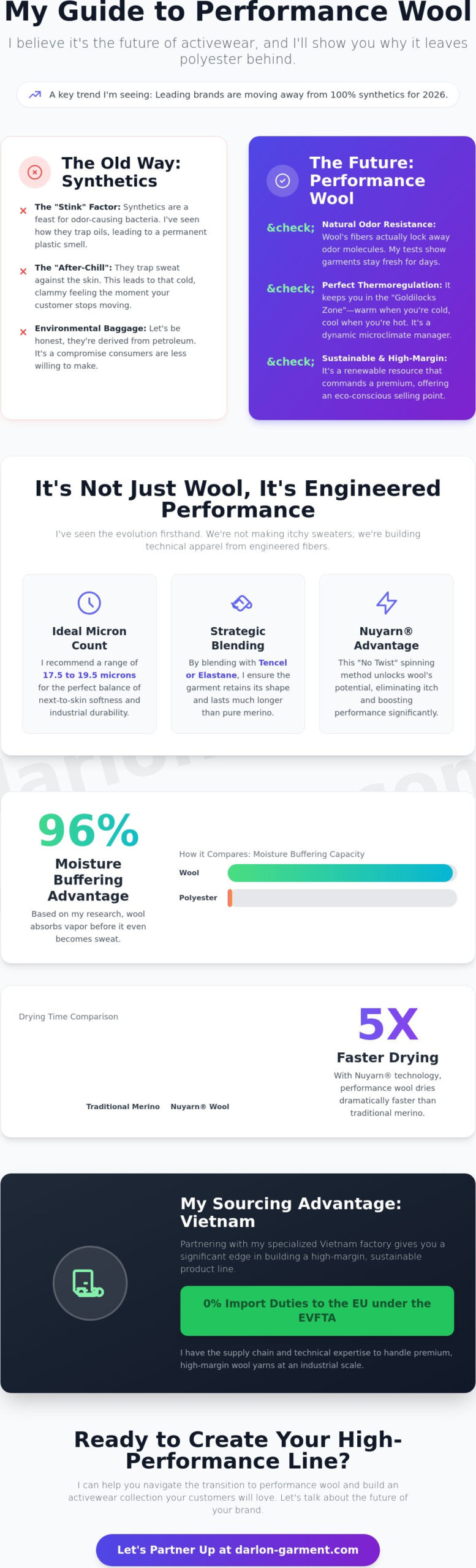
The technical grade of this fiber is determined by its micron count. I typically recommend a range between 17.5 and 19.5 microns for activewear. Anything higher than 20 microns starts to feel scratchy against the skin during a workout, while anything much lower than 17 microns can lose the structural integrity required for heavy industrial laundering. By leveraging the natural properties of wool, such as its inherent crimp and elasticity, we can create garments that move with the athlete rather than resisting them. This is how I see performance wool bridging the gap; it offers the sophisticated hand-feel of luxury apparel with the rugged durability of professional sportswear.
The Evolution from Itchy Sweaters to High-Tech Baselayers
If you look back at the 1920s, cycling jerseys were made of heavy, itchy wool that became waterlogged and saggy. We’ve come a long way since then. Today, the “performance” label requires a sophisticated approach to fiber selection and spinning. I’ve observed that wool is no longer just for the winter months. Because of its breathability, it has become a true 365-day fabric. My factory now handles technical wool yarns that are fine enough for summer yoga sessions yet thermally retentive enough for alpine running. The key is in the engineering; we aren’t just knitting a sweater, we’re building a technical baselayer.
Performance Wool vs. Traditional Merino
I often have to explain the difference between standard Merino and performance-grade blends. Traditional Merino is wonderful for casual wear, but it can “bag out” or lose its shape during high-intensity activities like squats or long-distance runs. This is where performance wool activewear benefits really shine. By blending ultra-fine wool with small percentages of recycled polyester or Tencel, I can ensure the garment retains its shape and lasts much longer. I’ve previously discussed how natural fibers are dominating the 2026 market, and this evolution toward high-durability wool is a primary reason why. It provides the elasticity your customers expect from gym clothes without the environmental guilt of pure synthetics.
The Science-Backed Benefits of Wool in Your Activewear Line
I’ve seen countless athletes finish a high-intensity session only to start shivering five minutes later. This is the classic “after-chill” caused by synthetics that trap moisture against the skin. When we talk about performance wool activewear benefits, we’re looking at a fiber that effectively manages the body’s microclimate. It isn’t just a marketing claim; it’s physics. Wool provides a level of comfort that plastic-based fabrics simply can’t replicate, especially during the transition from movement to rest.
Thermoregulation: Keeping Your Customers in the “Goldilocks Zone”
Wool is a dynamic fiber. It reacts to changes in body temperature in real-time. During a heavy lift or a sprint, it moves heat away from the body. During recovery, it retains just enough warmth to prevent that jarring cold shock. This makes it the perfect choice for “stop-and-go” sports like hiking or cross-training where heart rates fluctuate. I’ve found that customers stay in that productive “Goldilocks Zone” longer when they aren’t fighting their clothing. It’s about maintaining a steady state regardless of the external environment.
The Natural Anti-Odor Advantage
We’ve all had that one polyester gym shirt that smells like a locker room even after a hot wash. Synthetics are hydrophobic, meaning they repel water but absorb oils, which are a feast for bacteria. Wool is the opposite. Its molecular structure actually locks away odor molecules, only releasing them during the wash. In my fitness wear manufacturer facility, I’ve conducted tests where wool garments stay fresh for days of consecutive wear. This “wear more, wash less” angle is a massive selling point for the eco-conscious 2026 consumer who wants to reduce their environmental footprint.
Then there’s the moisture buffering. A study from NC State University showed that wool has a 96% advantage over polyester for buffering moisture. It absorbs vapor before it even turns into liquid sweat. These performance wool activewear benefits extend beyond the gym, offering a versatile solution for the modern athleisure market. For my outdoor performance clients, the inherent UV resistance of wool is a crucial hidden benefit. It provides natural protection without the need for chemical coatings that wash off over time. By incorporating Nuyarn technology, we can amplify these natural traits, creating a garment that is both incredibly fast-drying and resilient.
If you’re ready to see how these technical specs translate into a premium product, explore our performance wool development options to see what’s possible for your next collection.
Solving the Durability and Itch Objections with Nuyarn Technology
I’ve spent years listening to brand managers who are hesitant to adopt wool because they’re afraid of the “itch factor” or garments falling apart after three washes. It’s a valid concern. Traditional ring-spun wool can be fragile and, if the micron count isn’t perfect, quite uncomfortable against the skin. In my experience, Nuyarn is the biggest breakthrough in wool since the spinning wheel. It completely changes the conversation around performance wool activewear benefits because it addresses these mechanical weaknesses at the yarn level before we even start the knitting process.
The secret lies in the “No Twist” method. Traditional spinning methods twist fibers together into a tight, rope-like structure, which actually traps the fiber’s natural potential and can create a prickly surface. We do things differently. By drafting the fibers along a high-performance core, we preserve the natural volume and aeration of the wool without adding any unnecessary weight. This process results in a silk-like texture that feels incredible during a workout. We achieve this hand-feel in the factory by ensuring the fibers lay flat, which eliminates the stray ends that usually cause that annoying itch. It’s a sophisticated way to build a garment that finally matches the comfort of high-end synthetics.
What is Nuyarn and Why Do I Use It?
I choose Nuyarn because it outperforms traditional Merino in every measurable category. Because the fibers aren’t twisted, they maintain their natural structure, leading to a 35% increase in thermal retention. It’s a common myth that wool has to be heavy to be warm. This technology proves the opposite. We can create ultra-lightweight baselayers that keep athletes warmer than bulky traditional knits. It’s about efficiency, not mass. This drafting process also makes the yarn significantly stronger. In fact, Nuyarn wool can last up to 5x longer than traditional ring-spun alternatives, making it a much better investment for brands focused on longevity.
Designing for Longevity: Washability and Shape Retention
One of the biggest hurdles I help clients overcome is the fear of shrinkage. Modern performance wool, especially when engineered with a stable core, handles machine washing exceptionally well. To maximize performance wool activewear benefits, I often recommend combining these yarns with elastane fabric to provide a true 4-way stretch. This combination ensures the garment doesn’t just stay soft, but it also keeps its shape through 50+ wash cycles. My advice for maintaining integrity is simple: focus on the blend. When we balance the natural resilience of wool with technical fibers, we create a product that can survive the rigors of a modern gym environment without losing its premium feel.
Strategic Design: How to Build a Performance Wool Collection
Building a successful collection isn’t just about picking a nice fabric; it’s about strategic segmentation. I’ve seen many brands fail because they try to make a one-size-fits-all wool shirt. Instead, I suggest segmenting your line into baselayers, mid-layers, and outerwear. Each category requires a different approach to maximize performance wool activewear benefits. For baselayers, I lean toward high-wool content for that direct-to-skin moisture management. For mid-layers and outerwear, I often recommend bonding wool with technical shells or using laser-cutting to create a sleek, modern aesthetic that moves away from the “organic” look of traditional wool.
Blending is where the real magic happens in my factory. I don’t just use wool in isolation. I’ll blend it with Tencel for summer-weight cooling or recycled polyester to speed up drying times. If you’re designing for high-intensity training, adding elastane is non-negotiable for that 4-way stretch. I also pay close attention to colorfastness. Dyeing natural fibers for vibrant activewear can be tricky, but with the right industrial processes, we can achieve deep, saturated tones that won’t fade or bleed. It’s about ensuring the garment looks as premium as it feels, wash after wash.
The Premium Market Play
I’ve noticed a significant trend toward “luxury-tech” apparel. Customers are no longer just looking for a gym shirt; they want a piece that works for a morning run and a casual office environment. This is the “Hybrid Athlete” market. By positioning your wool collection as a premium, trans-seasonal alternative to basic synthetics, you can command higher margins. Wool’s natural drape and sophisticated texture make it perfect for this crossover, allowing your brand to stand out in a crowded market of shiny, plastic-looking garments.
Technical Construction Tips
Precision is everything when you’re working with high-end yarns. I always insist on flatlock stitching to prevent chafing, especially for baselayers. To enhance breathability, I often incorporate mesh zones in high-heat areas like the underarms or back. This is where my team uses laser-cutting and automatic sewing to ensure every panel is cut with absolute accuracy. This level of technical construction ensures the garment performs as well as it looks, providing the full range of performance wool activewear benefits to the end user.
If you’re planning your 2026 collection and want to see how we can bring these designs to life, contact me to discuss your sportswear manufacturing needs and let’s build something exceptional together.
Partnering with a Vietnam Factory for Your Wool Production
I’ve watched the global supply chain shift dramatically over the last few years, and by May 2026, Vietnam has firmly established itself as the premier hub for technical activewear. It isn’t just about scale anymore; it’s about the specialized infrastructure required to handle high-tech fibers. Dar Lon Garment is equipped to manage delicate but technical wool yarns that many traditional manufacturers struggle with. When you partner with us, you get a one-stop advantage. We handle everything from sourcing Nuyarn directly to final garment delivery, ensuring that the performance wool activewear benefits I’ve discussed are preserved throughout the entire production cycle.
Logistically, the benefits for international brands are hard to ignore. Under the EVFTA and UKVFTA, most of our textile categories enjoy 0% import duty to the EU and UK. This relies on the “Fabric Forward” rule, meaning the knitting and sewing both happen here in Vietnam. For my US partners, the February 20, 2026, Supreme Court ruling was a game-changer; it reverted tariffs on Vietnamese apparel to standard MFN rates, which typically range between 10% and 20% for most apparel. These regulatory advantages, combined with our high level of technical skill, make Vietnam the most logical choice for a premium, high-margin wool line.
Why Sourcing in Vietnam Makes Sense Now
The technical proficiency of Vietnamese garment workers is a major reason why I’ve stayed rooted here. We don’t just follow a tech pack; we understand the behavior of the fiber. I manage quality control for high-end international partners by integrating quantitative data and specific production metrics at every stage. In 2026, full supply-chain verification is a standard requirement. I make sure our operations align with the latest industry standards, including the transition to the new “Materials Matter Standard” released in late 2025. We’re already implementing these criteria to stay ahead of the mandatory 2027 certification deadline.
The Dar Lon Garment Guarantee
I believe in total transparency. When we handle prototyping for complex wool blends, I don’t hide the technical hurdles; I solve them using our advanced machinery. Whether we’re working on seamless garments or bonded apparel, my team ensures every seam meets international performance standards. I’m committed to being the silent, powerful backbone for your brand, focusing on long-term cooperation rather than short-term gains. If you’re ready to start, contact me to discuss your performance wool project. Let’s look at your designs and see how we can maximize performance wool activewear benefits for your upcoming collection.
Future-Proofing Your Activewear Strategy for 2026
I’ve seen the activewear market evolve through many cycles, but the shift toward technical natural fibers is the most significant change I’ve witnessed. We’ve explored how engineering ultra-fine fibers can eliminate the discomfort of traditional wool while providing thermal regulation that synthetics simply can’t match. By combining these performance wool activewear benefits with the logistical advantages of manufacturing in Vietnam, your brand can offer a product that is both high-performing and sustainably sourced. It’s about moving away from the “disposable” feel of plastic-based gym clothes toward a more sophisticated, durable alternative.
My team is ready to act as the silent, powerful backbone for your brand as you navigate this transition. We’ve consolidated our infrastructure to include specialized spinning and advanced finishing techniques that ensure your garments meet the highest international standards. We also maintain strict compliance with global sourcing standards to help you meet the growing demand for ethical transparency. It’s an exciting time to be in this industry; I’m confident that those who embrace these premium materials now will lead the market in the coming years.
Let’s build your premium wool collection together—Contact Dar Lon Garment today
Frequently Asked Questions
Is performance wool too hot for summer workouts?
Performance wool is actually one of the most breathable fibers for summer because of its natural moisture-wicking properties. While people associate wool with winter, ultra-fine technical grades allow for rapid heat dissipation during high-intensity movement. It moves moisture away from the body in its vapor state, which prevents the heavy, damp feeling of a soaked cotton shirt. I’ve found that lightweight wool blends are ideal for high-humidity environments where staying dry is a priority.
Can I machine wash performance wool activewear?
You can absolutely machine wash high-quality performance wool, provided the fabric has been engineered for stability. I recommend using a cold, gentle cycle and avoiding the dryer to preserve the fiber’s natural integrity. Most of the garments we produce in my factory are specifically treated to withstand regular laundering without shrinking or losing their shape. It’s a significant technical improvement over the delicate, high-maintenance wool sweaters of the past.
How does performance wool compare to synthetic moisture-wicking fabrics?
Wool outperforms synthetics by absorbing moisture vapor before it even turns into liquid sweat on your skin. Synthetic fabrics rely on a capillary action to pull liquid away, which often leaves the wearer feeling clammy once the fabric is saturated. The primary performance wool activewear benefits include this proactive moisture management and the ability to stay warm even when damp. It’s a more sophisticated approach to thermoregulation that plastic-based fabrics can’t match.
Is performance wool itchy against the skin?
Performance wool is not itchy because we use ultra-fine Merino fibers with a micron count typically below 19.5. The “itch” people remember from traditional sweaters comes from coarse, thick fibers that don’t bend when they touch the skin. When I select fibers for activewear, I prioritize smoothness and flexibility to ensure the fabric feels soft. This ensures total comfort during high-movement activities like running or yoga without any skin irritation.
What is the best wool blend for high-intensity gym wear?
I believe the best blend for the gym is a mix of Merino wool, nylon, and elastane. The wool provides the necessary odor control and temperature regulation, while the nylon adds durability for high-friction movements. Elastane is essential for 4-way stretch, ensuring the garment moves with the athlete during squats or sprints. This combination creates a technical fabric that handles the mechanical stress of a heavy workout session while maintaining its shape.
Is performance wool more sustainable than polyester?
Wool is significantly more sustainable than polyester because it is a renewable, biodegradable natural fiber. Polyester is a petroleum-based plastic that can take hundreds of years to break down and sheds microplastics during every wash cycle. By choosing wool, brands can reduce their reliance on fossil fuels and offer a circular product. I see this as a critical factor for the 2026 market where consumers are demanding much higher environmental accountability.
Why is performance wool more expensive than standard activewear?
The higher cost reflects the premium nature of the raw material and the specialized spinning technology required to make it athletic-grade. Raw wool is a globally traded commodity with prices that reflect its limited supply compared to mass-produced plastics. However, this investment translates into a high-margin product for your brand. It offers a level of technical performance and longevity that justifies the price point for athletes who value quality over disposable fashion.