

Selecting the right manufacturing partner is the most critical decision an international sportswear brand can make. A misstep can lead to compromised quality, production delays, and significant financial repercussions, turning a promising venture into a logistical nightmare. The challenge is amplified when sourcing from overseas, where verifying a factory’s true capabilities from afar can feel like a high-stakes gamble, fraught with concerns over communication barriers and compliance.
As Vietnam solidifies its position as a premier global hub for apparel production, the task of identifying a truly capable sportswear manufacturer in Vietnam becomes paramount. Success requires a methodical, evidence-based approach that goes beyond price lists and sample approvals. This definitive 2026 guide is engineered to provide that strategic framework. We will move beyond surface-level checklists to detail the essential criteria for evaluating a factory’s technological integration, quality management systems, and potential for a genuine, long-term partnership.
Our objective is to equip your brand with the knowledge to make an informed, confident decision, establishing a transparent production workflow that consistently delivers excellence and secures your supply chain for the future.
Key Takeaways
- Evaluate potential partners using a structured framework that assesses technological capability, quality assurance systems, and long-term partnership potential.
- Identify the key manufacturing technologies, from automated cutting to seamless knitting, that directly impact the quality and performance of your final product.
- Confidently navigate the production process by understanding the critical steps, from creating a detailed tech pack to final shipment, when engaging a sportswear manufacturer vietnam.
- Discover why Vietnam is a global sportswear hub by looking beyond cost advantages to its skilled workforce and specialized expertise in technical fabrics.
Why Vietnam is a Global Hub for Sportswear Manufacturing
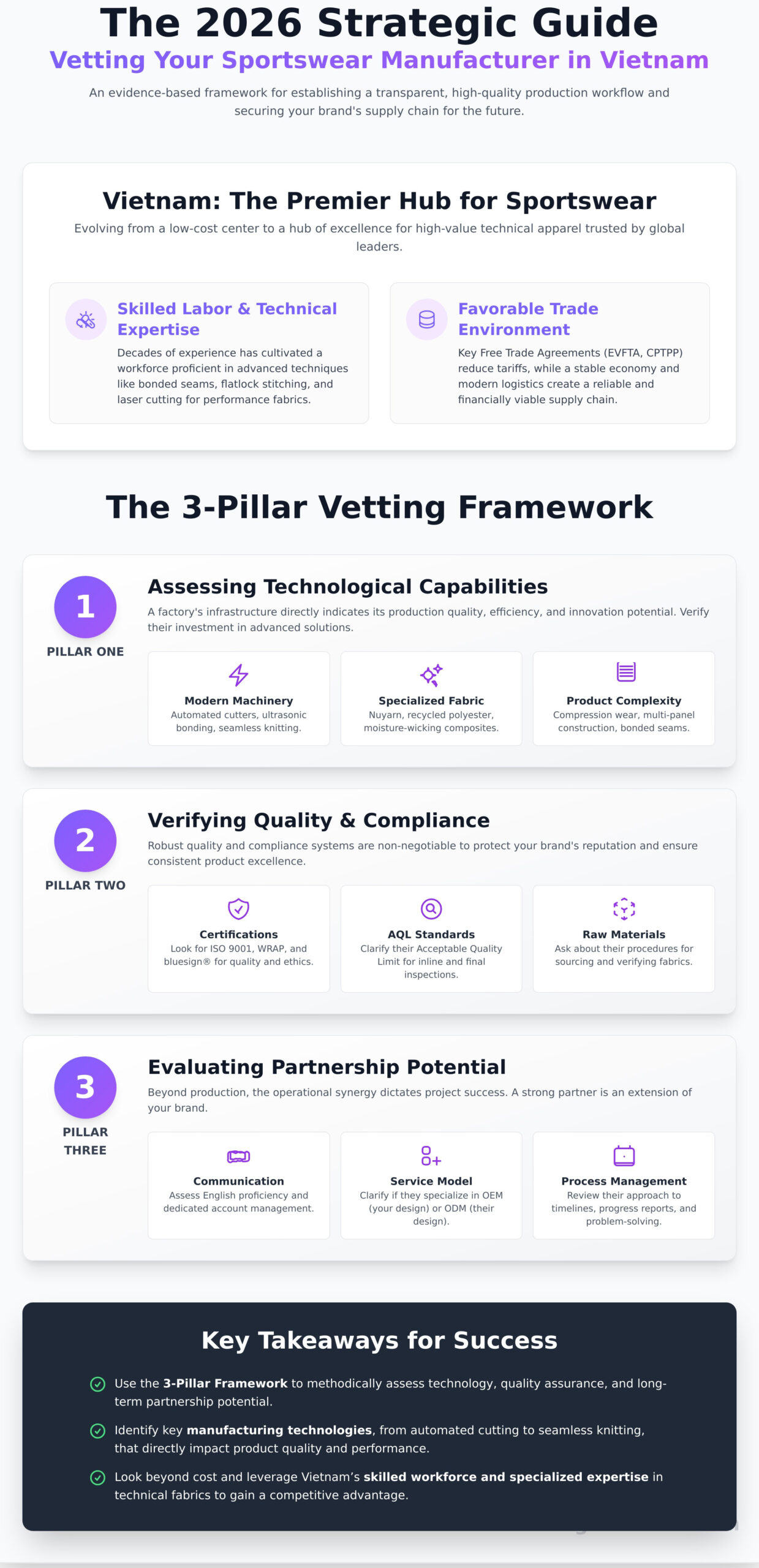
Vietnam has fundamentally transformed its position in the global supply chain, evolving from a low-cost production center into a hub of excellence for high-value technical apparel. This strategic evolution is driven by a convergence of factors that make the nation a preferred partner for leading international sportswear brands. For any company seeking a reliable and proficient manufacturing base, understanding these advantages is critical.
The country offers a unique combination of specialized labor, a supportive economic framework, and modern infrastructure, making it an ideal ecosystem for complex garment production. This environment ensures that brands receive not only competitive pricing but also superior quality and supply chain security.
Skilled Labor & Technical Expertise
Decades of executing production orders for global leaders like Nike, Adidas, and The North Face have cultivated a workforce with unparalleled expertise. Vietnamese technicians possess a deep, institutional knowledge of performance materials, including complex polyesters, nylons, and spandex blends. This proficiency extends to advanced garment construction techniques-such as bonded seams, flatlock stitching, and laser cutting-that are essential for modern activewear meeting exacting global standards.
Favorable Trade & Economic Environment
The country’s integration into the global economy is solidified by key Free Trade Agreements (FTAs). The EVFTA (EU-Vietnam Free Trade Agreement) and CPTPP (Comprehensive and Progressive Agreement for Trans-Pacific Partnership), for instance, offer significant financial advantages by reducing or eliminating tariff burdens for brands exporting to the European Union, Canada, Australia, and other member nations. This commercial benefit is paired with a stable political climate and strong government support for the textile industry. This strategic investment is a cornerstone of Vietnam’s economic growth, which has consistently created a predictable environment for international partners. Furthermore, ongoing modernization of deep-water ports and logistics networks ensures efficient and reliable supply chain operations.
These combined strengths make choosing a sportswear manufacturer vietnam a strategic decision grounded in operational excellence and financial viability. The nation offers not just a factory, but a sophisticated production ecosystem built for the demands of the global sportswear market.
A Framework for Vetting Sportswear Manufacturers in Vietnam
Selecting the right sportswear manufacturer in Vietnam involves a more rigorous evaluation than simply comparing price sheets. A truly strategic partner demonstrates excellence across three foundational pillars: Technological Capability, Quality & Compliance Systems, and Partnership & Communication. Utilizing this framework allows your business to move beyond superficial metrics and assess the capacity of a potential sportswear manufacturer vietnam for long-term, reliable production. This structured methodology is designed to identify a supplier that is not just a vendor, but a vital extension of your brand’s operations.
Pillar 1: Assessing Technological Capabilities
A factory’s technical infrastructure directly indicates its production quality, efficiency, and innovation potential. A forward-thinking sportswear manufacturer vietnam will have invested in advanced manufacturing solutions. Key areas for inquiry include:
- Modern Machinery: Look for evidence of automated fabric cutters, ultrasonic bonding machines, and seamless knitting technology, which ensure precision and consistency.
- Specialized Fabric Experience: Ask about their proficiency with performance textiles, such as merino-based Nuyarn, recycled polyester, or moisture-wicking composites.
- Product Complexity: Request a portfolio or samples of complex garments they have produced, such as multi-panel compression wear or bonded-seam outerwear, to verify their technical skill.
Pillar 2: Verifying Quality and Compliance
Robust quality and compliance systems are non-negotiable for protecting your brand’s reputation. Verification should begin with internationally recognized certifications like ISO 9001 (quality management), WRAP (ethical production), or bluesign® (sustainable textile production). Furthermore, it is critical to understand a manufacturer’s place in the wider industry; as detailed in this global value chain analysis from ERIA, Vietnam’s integration demands strict adherence to global standards. Inquire about their Acceptable Quality Limit (AQL) standards for inline and final inspections and clarify their procedures for sourcing and verifying raw materials.
Pillar 3: Evaluating Partnership Potential
Beyond production, the operational synergy between your brand and the manufacturer dictates project success. A strong partnership is built on clear communication and aligned processes. Assess their English proficiency and the communication protocols of key account managers. It is also vital to discuss their service model-whether they specialize in client-led OEM (Original Equipment Manufacturer) production or offer in-house product development (ODM) services. Finally, clarify their approach to managing timelines, providing progress reports, and executing problem-solving protocols to ensure transparency and accountability.
Key Manufacturing Technologies for Modern Sportswear
The performance of modern activewear is defined not just by its design, but by the technical precision of its construction. A leading sportswear manufacturer in Vietnam differentiates itself through significant investment in advanced production technologies. These capabilities translate directly into superior product benefits, offering brands a distinct competitive advantage in durability, comfort, and function.
Seamless, Bonded, and Laser-Cut Construction
Traditional cut-and-sew methods are often insufficient for high-performance athletic apparel. Advanced construction techniques are required to meet the demands of today’s athletes, delivering tangible improvements in how a garment feels and performs.
- Seamless Knitting: This technology creates garments in a single, continuous process, eliminating the need for most seams. The result is a ‘second skin’ fit that moves with the body, drastically reducing chafing and irritation. This makes it the ideal production method for base layers, yoga wear, and running apparel where comfort is paramount.
- Bonded Seams: For technical outerwear, stitched seams create puncture holes that can compromise waterproofing. Bonding uses heat and adhesive tape to join fabric panels, creating a completely sealed, flat, and durable seam that is both lightweight and impervious to moisture. This method also provides a clean, minimalist aesthetic.
- Laser Cutting: Offering unmatched precision, laser cutting allows for intricate designs and perfectly sealed fabric edges that prevent fraying. It is essential for creating complex ventilation patterns in performance tops and shorts, enhancing breathability without compromising structural integrity.
Specialty Fabric Handling and Sourcing
Advanced construction techniques must be paired with equally advanced materials. The ability to source and expertly handle innovative performance textiles is a critical capability that separates leading manufacturers. This requires an established global network and the technical expertise to work with next-generation fabrics.
For example, Darlon Garment has proven expertise in handling specialized materials like Nuyarn®, a performance merino wool technology offering superior stretch, durability, and faster drying times. Our supply chain is also equipped to source and manage a wide range of recycled and sustainable performance fabrics, enabling brands to build product lines that are both high-performing and environmentally responsible. This holistic approach, a hallmark of an expert sportswear manufacturer in Vietnam, ensures every garment meets the highest global standards.
The Production Process: From Tech Pack to Final Shipment
Transforming a design concept into a market-ready product requires a structured, transparent manufacturing process. For brands partnering with a sportswear manufacturer vietnam, understanding this journey is fundamental to achieving quality, efficiency, and on-time delivery. The process is methodically divided into pre-production, mass production, and logistics, ensuring precision at every stage.
From Design to Pre-Production Sample
The entire production is anchored by the technical package, or ‘tech pack’. This document serves as the master blueprint, containing every critical detail: Bill of Materials (BOM), graded size specifications, construction diagrams, and color standards. The sampling stage is an iterative dialogue between your brand and the factory. Prototypes are created, fit sessions are conducted, and feedback is implemented until a final ‘golden sample’ is approved. This sample becomes the definitive standard against which all bulk production is measured.
Mass Production and Quality Assurance
Upon approval of the golden sample, mass production commences. This includes precise fabric cutting, streamlined sewing on specialized production lines, finishing, and final packing. To ensure fidelity to the approved standard, rigorous quality assurance protocols are implemented. Key quality control steps include:
- In-Line QC: Inspections are conducted at critical points on the production line to identify and correct deviations early, preventing widespread issues.
- Final Inspection: A comprehensive assessment of finished goods is performed before packing to verify compliance with all specifications.
- AQL Standards: Internationally recognized AQL (Acceptable Quality Limit) standards are applied to statistically verify that the entire production run meets your quality threshold.
The final stage involves navigating the logistical framework. Your manufacturer will coordinate packaging, documentation, and handover to freight forwarders. Understanding shipping incoterms like FOB (Free On Board) versus CIF (Cost, Insurance, and Freight) is crucial for defining responsibility and cost. A proficient sportswear manufacturer in Vietnam provides a one-stop service that manages these complexities, ensuring a seamless transition from the factory floor to your final destination.
Why Darlon Garment is Your Premier Sportswear Partner in Vietnam
Navigating the production landscape requires a partner who embodies the key principles of reliability, technological advancement, and uncompromising quality. Darlon Garment is structured to be that partner. We move beyond the traditional vendor relationship to become an integrated part of your supply chain, offering the expertise and infrastructure necessary to elevate your brand. Our operational philosophy is built on a foundation of technical mastery and a client-centric approach, making us the definitive choice for brands seeking a top-tier sportswear manufacturer in Vietnam.
Our commitment is not merely to fulfill orders, but to foster your growth through superior manufacturing. We achieve this by integrating advanced technology with a deeply ingrained culture of excellence, ensuring every garment we produce meets the highest global standards and your specific brand vision.
A Foundation of Technology and Quality
Operating from state-of-the-art facilities in Ho Chi Minh City and Binh Phuoc Province, we leverage advanced manufacturing technologies like automated cutting, bonding, and seamless knitting to produce high-performance sportswear, activewear, and swimwear. Our “Quality First” principle is enforced through a rigorous, multi-stage QC process and adherence to international standards.
- Certifications: ISO 9001, WRAP, and BSCI compliant.
- Internal QC: AQL 2.5 standard inspection from raw materials to final packing.
- Specialization: Expertise in complex constructions for yoga wear, training apparel, and swimwear.
Your One-Stop Manufacturing Solution
Darlon Garment simplifies the entire production lifecycle with our comprehensive OEM/ODM “One-Stop Service.” From material sourcing and sample development to mass production and logistics, we manage every detail. Your project is supported by an experienced, English-speaking team dedicated to ensuring clear communication and seamless execution. We handle the complexities of manufacturing so you can focus on building your brand.
While Darlon handles the complexities of your main product line, building a strong brand often involves other customized items like promotional apparel or corporate gifts. For brands looking for partners in that space, especially within Southeast Asia, resources like corporategift.sg provide a wide range of options.
Ready to transform your designs into high-quality sportswear? Contact our experts to discuss your sportswear production needs.
Partnering for Success: Finalizing Your Choice in Sportswear Manufacturing
Selecting the right manufacturing partner in Vietnam is a critical strategic decision that defines your brand’s trajectory. This guide has underscored the importance of a structured vetting process, focusing on technological adoption, transparent communication, and an unwavering commitment to quality control. These pillars are essential for navigating the dynamic landscape and leveraging Vietnam’s position as a global sportswear production hub.
As a premier sportswear manufacturer vietnam, Dar Lon Garment is engineered to be the operational backbone your brand requires. Our advanced OEM/ODM capabilities and stringent ‘Quality First’ philosophy ensure your technical designs are executed with absolute precision. We deliver a seamless one-stop service model-from our expertise in high-performance technical fabrics to managing logistics for final shipment-providing the reliability and expertise necessary to scale with confidence.
Take the definitive step toward elevating your production standards. Request a Consultation to Build Your Next Sportswear Line and discover how a partnership with Dar Lon Garment can transform your supply chain. Your journey toward manufacturing excellence begins here.
Frequently Asked Questions About Sportswear Manufacturing in Vietnam
What is the typical Minimum Order Quantity (MOQ) for a sportswear manufacturer in Vietnam?
The typical Minimum Order Quantity (MOQ) for a sportswear manufacturer in Vietnam ranges from 500 to 1,000 units per style, per color. This requirement is dictated by fabric mill minimums and the need to achieve production line efficiency. For specialized or custom-developed materials, MOQs may be higher. Reputable manufacturers can sometimes offer flexibility depending on the project’s scope and the potential for a long-term partnership, ensuring a viable production run for both parties.
How much does it cost to manufacture sportswear in Vietnam compared to China?
Vietnam generally offers more competitive pricing for sportswear manufacturing compared to China, primarily due to favorable labor costs and beneficial trade agreements like the EVFTA. While China maintains an advantage in highly specialized textiles and rapid turnaround times, Vietnam provides a superior value proposition for standard to high-performance activewear. The final cost is contingent on garment complexity, fabric composition, and order volume, but Vietnam remains a strategically cost-effective sourcing destination for most brands.
How long does the entire production process take, from sample to shipment?
The end-to-end production timeline, from initial tech pack submission to final shipment, typically spans 14 to 20 weeks. This process includes a development and sampling phase (2-4 weeks), raw material sourcing and approval (3-4 weeks), and bulk manufacturing (8-12 weeks). Timelines are influenced by factors such as design complexity and material availability. A detailed critical path is established at the project’s outset to ensure transparency and manage expectations effectively.
Can Vietnamese manufacturers help with fabric sourcing and product development?
Yes, comprehensive product development and fabric sourcing are core components of the services offered by leading Vietnamese manufacturers. As a one-stop solution provider, we leverage our extensive network of both local and international fabric mills to source high-performance materials. Our in-house development teams assist with pattern making, prototyping, and tech pack refinement, transforming a client’s design concept into a production-ready garment that meets global export standards.
What are the most important questions to ask a potential sportswear manufacturer?
When vetting a potential manufacturer, key questions should address capacity, quality control, and compliance. Inquire about their monthly production capacity and current clients. Ask for details on their quality assurance (QA) process at each production stage. It is also critical to verify their certifications, such as ISO 9001, WRAP, or SA8000, to ensure they meet international standards for quality management and ethical labor practices. Finally, clarify their communication protocols.
How do I protect my intellectual property (designs) when working with an overseas factory?
Protecting your intellectual property is paramount. The standard industry practice is to execute a legally binding Non-Disclosure Agreement (NDA) and a comprehensive Manufacturing Agreement before sharing any proprietary designs. These documents should clearly define ownership of the designs, tooling, and patterns. Partnering with an established factory with a proven track record of working with international brands provides an additional layer of security and professional accountability.
What are the payment terms when working with a Vietnamese garment manufacturer?
Standard payment terms are structured to balance risk for both the buyer and the factory. A typical arrangement requires an upfront deposit of 30-50% via Telegraphic Transfer (T/T) upon confirmation of the purchase order. This initial payment covers the procurement of raw materials. The remaining balance of 50-70% is then due upon completion of production and prior to shipment, often contingent on a successful final quality inspection.
Does Darlon Garment work with startup brands as well as established ones?
Darlon Garment is structured to support the growth of both established international brands and emerging startups. While our infrastructure is built for high-volume production, we offer dedicated support systems and flexible manufacturing solutions for new ventures. We provide expert guidance on product development and sourcing to help startups navigate the complexities of offshore manufacturing, positioning ourselves as a long-term strategic partner committed to mutual growth and success.