
The search for a reliable manufacturing partner can feel like navigating a complex maze. Faced with countless online listings, potential communication barriers, and the persistent risk of quality control failures, many brand owners feel overwhelmed. Selecting the right vietnam clothing factory is more than a logistical step; it is the cornerstone of your brand’s reputation and future scalability. The critical challenge lies not in finding a simple list of suppliers, but in identifying a true partner whose capabilities, quality standards, and operational protocols align perfectly with your vision.
This guide is engineered to provide that clarity. We move beyond directories to deliver a strategic framework for the entire sourcing process—from initial research and technical vetting to final partnership agreements. You will gain a comprehensive understanding of Vietnam’s manufacturing landscape and a practical methodology for evaluating factory specializations, MOQs, and certifications. Our objective is to equip you with the confidence and technical knowledge required to secure a long-term, reliable manufacturing partner that upholds your brand’s commitment to excellence.
Key Takeaways
- Understand the strategic advantages of Vietnamese apparel manufacturing beyond cost, including how trade agreements like the EVFTA and CPTPP impact your bottom line.
- Implement a 5-point framework to systematically evaluate potential partners, moving from a long list to a qualified shortlist based on your brand’s specific needs.
- Utilize a practical due diligence checklist to properly vet any potential vietnam clothing factory, ensuring you select a reliable and capable long-term partner.
- Learn to navigate the production lifecycle with your chosen factory, from tech pack submission and sampling to quality assurance and final shipment.
Why Brands Are Choosing Vietnam for Apparel Manufacturing in 2026
The decision to manufacture in Vietnam has evolved far beyond a simple cost comparison with China. By 2026, global apparel brands are selecting Vietnam for its strategic value, which combines sophisticated production capabilities with robust economic stability. As supply chains continue to diversify, the country has solidified its position not as a low-cost alternative, but as a primary hub for high-quality, value-added garment manufacturing.
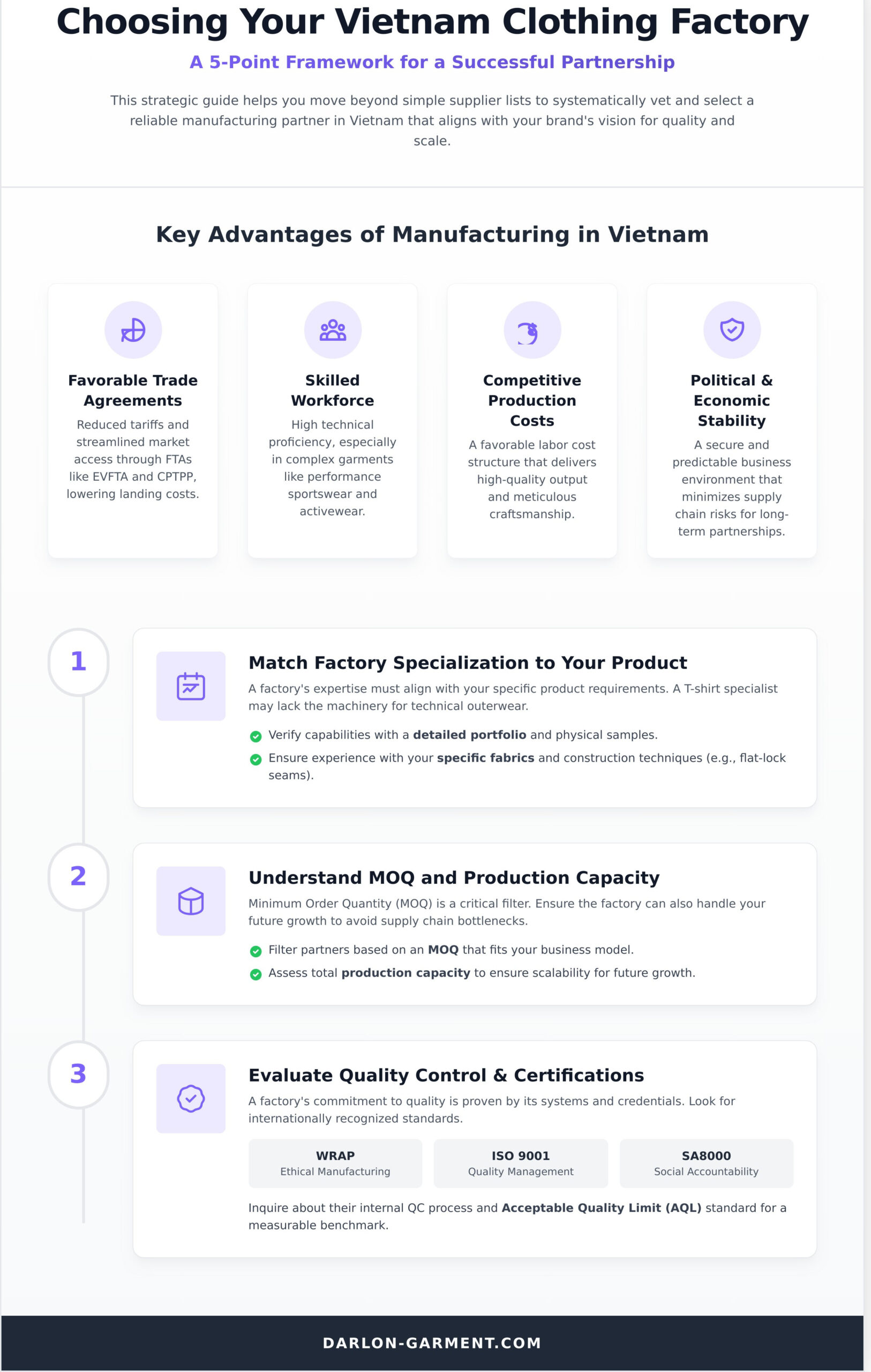
A significant driver of this shift is Vietnam’s strategic integration into the global economy through key free trade agreements (FTAs). The EU-Vietnam Free Trade Agreement (EVFTA) and the Comprehensive and Progressive Agreement for Trans-Pacific Partnership (CPTPP) provide brands with preferential tariff rates and streamlined access to major markets across Europe and the Americas. These agreements reduce landing costs and simplify logistics, offering a distinct competitive advantage.
Vietnam’s manufacturing prowess is anchored by a highly skilled and disciplined workforce, renowned for its technical proficiency in complex garment construction. This expertise is particularly evident in the production of performance sportswear and technical activewear. This skilled labor pool is the result of decades of focused development, supported by industry pillars like the state-owned Vietnam National Textile and Garment Group (Vinatex). This human capital is complemented by continuous investment in modern infrastructure, including deep-water ports and specialized industrial parks, ensuring efficient global export operations.
Vietnam’s Key Manufacturing Advantages
Brands partnering with a vietnam clothing factory gain access to a unique combination of operational benefits:
- Competitive Production Costs: A favorable labor cost structure that does not compromise on high-quality output and meticulous craftsmanship.
- Political and Economic Stability: A secure and predictable business environment that minimizes supply chain risks for long-term partnerships.
- Focus on Ethical Standards: A growing commitment to sustainable materials and socially responsible manufacturing practices, meeting global consumer demands.
Primary Product Categories & Specializations
Vietnam’s manufacturing sector excels in several key areas. The country is a global leader in cut-and-sew knitwear, including T-shirts, polos, and fleece. Its technical expertise has also made it a go-to destination for performance sportswear, activewear, and swimwear requiring complex fabric handling. Furthermore, capabilities are rapidly expanding into higher-value categories like multi-layered outerwear, structured formal wear, and even premium leather goods, with retailers like the Laveri Leather Store showcasing the quality of handcrafted items.
While Vietnam’s factories are scaling up for formal wear, the pinnacle of this category remains bespoke tailoring for special occasions. For readers interested in the craft of personalized suits, it can be insightful to explore Trouwpakken op maat to see what this specialized service entails.
The 5-Point Framework for Choosing the Right Factory Partner
Identifying the ideal manufacturing partner from a long list of candidates requires a systematic evaluation process. Moving beyond basic cost analysis, this framework provides a structured approach to vet potential suppliers, ensuring alignment with your brand’s technical, operational, and ethical standards. This strategic diligence is crucial for navigating the nation’s mature manufacturing sector, a landscape shaped by Vietnam’s role in the global value chain. By focusing on these core pillars, you can confidently select a vietnam clothing factory equipped for a long-term partnership.
1. Matching Factory Specialization to Your Product
A factory’s stated capabilities must align with your specific product needs. A facility that excels in producing high-volume cotton t-shirts may lack the specialized machinery and technical expertise required for complex activewear, such as four-way stretch leggings with flat-lock seams. Request a detailed portfolio or physical samples of past work that closely match your product’s fabric composition, construction techniques, and quality level. This ensures their operational experience is directly relevant to your brand’s requirements.
2. Understanding MOQ and Production Capacity
Minimum Order Quantity (MOQ) is the smallest order a factory will accept and serves as a critical initial filter. For startups, high MOQs can be a significant barrier. However, some factories are willing to negotiate lower MOQs for an initial run, especially if a brand demonstrates strong growth potential. Beyond the MOQ, assess the factory’s total production capacity. A partner must not only meet your current needs but also possess the infrastructure to scale production as your brand grows, preventing future supply chain bottlenecks.
3. Evaluating Quality Control and Certifications
A factory’s commitment to quality is demonstrated through its systems and credentials. Look for internationally recognized certifications which validate their operational and ethical standards. Key credentials include:
- WRAP (Worldwide Responsible Accredited Production): Ensures lawful, humane, and ethical manufacturing.
- ISO 9001: A global standard for quality management systems.
- SA8000: Focuses on social accountability and decent work conditions.
Inquire about their internal quality control (QC) process, from raw material inspection to in-line and final garment checks. Understanding their Acceptable Quality Limit (AQL) standard provides a clear, measurable benchmark for defect tolerance.
Finally, assess the factory’s communication protocols and compliance standards. A responsive, transparent, and English-proficient communication team is non-negotiable for international partnerships. Furthermore, verify their adherence to labor laws, environmental regulations, and your brand’s specific code of conduct. This dual focus on effective collaboration and ethical integrity forms the foundation of a sustainable and trustworthy manufacturing relationship.
Vetting Potential Factories: A Practical Checklist for Brands
Selecting the right manufacturing partner is the most critical decision your brand will make. The due diligence performed during this vetting stage directly mitigates production risks, prevents costly errors, and establishes the foundation for a successful, long-term partnership. A methodical approach to evaluation separates capable suppliers from those that present a liability. This process is not a formality; it is the cornerstone of your supply chain integrity.
Essential Questions to Ask Potential Partners
Initiate dialogue with a structured list of questions designed to assess operational capacity, communication protocols, and technical expertise. The responses will provide a clear, objective measure of a factory’s suitability for your brand’s specific needs.
- Who will be my dedicated point of contact, and what is their technical proficiency?
- What are your standard production lead times, from PO placement to ex-factory date?
- Can you detail your sample development process, timeline, and associated costs?
- What are your Minimum Order Quantities (MOQs) per style, color, and order?
- Can you provide anonymized case studies or references from brands in our market segment?
- Which specific quality assurance (QA) and quality control (QC) systems are integrated into your production line?
- How do you manage raw material sourcing, and what is your supplier verification process?
- What are your standard payment terms and structure?
- Which social, ethical, and environmental compliance certifications do you currently hold (e.g., WRAP, BSCI, ISO 14001)?
- How is our brand’s intellectual property (IP) protected within your facility?
- What is your capacity for scaling production to accommodate our brand’s growth?
The Importance of Factory Audits and Site Visits
While questionnaires provide data, a physical or virtual inspection provides proof. An audit offers invaluable insight into the real-world operations of a potential vietnam clothing factory. During a visit, focus on objective indicators: cleanliness of the facility, organization of production lines, worker conditions and safety protocols, and the condition of the machinery. If an in-person visit is not feasible, request a comprehensive, real-time virtual tour led by the factory manager.
Analyzing Samples: What to Look For
The physical sample is the ultimate testament to a factory’s craftsmanship. Evaluate it with a technical eye, moving beyond simple fit and aesthetics. A rigorous sample analysis should confirm the factory’s ability to execute your tech pack with precision. Key evaluation points include seam integrity, stitch consistency (SPI), fabric and color accuracy against specifications, and the quality of finishing on trims, labels, and hardware.
Understanding the sample stages is crucial for effective communication:
Proto Sample: The first physical interpretation of your design, used to evaluate construction and concept.
Pre-Production (PP) Sample: Made with all final-spec materials and trims. This is the final approval gate before bulk production commences.
Top of Production (TOP) Sample: A unit pulled from the initial production run to verify that bulk quality matches the approved PP sample.
Navigating the Production Process with Your Vietnamese Partner
Once you have selected your manufacturing partner, the focus shifts from evaluation to execution. Navigating the production process with your Vietnam clothing factory is a structured endeavor, not an intimidating one. A systematic approach to communication, financial arrangements, and logistics ensures a predictable and successful outcome. This section demystifies these operational stages, providing a clear framework for managing your offshore production with confidence.
Effective Communication and Tech Pack Management
The cornerstone of successful production is a comprehensive technical package, or “tech pack.” This document serves as the master blueprint for your garment, detailing every specification from stitching and measurements to fabric composition and labeling. A detailed tech pack is the single most effective tool for minimizing errors and aligning expectations. It is crucial to establish clear communication channels and agreed-upon response times with your factory merchandiser. While many professionals speak excellent English, the tech pack provides a universal language of precise technical data.
Understanding Payment Terms and Timelines
Financial clarity is essential for a stable partnership. The industry-standard payment structure requires an upfront deposit, typically 30-50% of the total order value, to procure raw materials. The remaining balance is usually due upon completion and inspection, prior to shipment. Most agreements are based on FOB (Free On Board) Incoterms, where the factory is responsible for delivering the goods to the designated port. A typical production timeline follows this sequence:
- Purchase Order (PO) confirmation and deposit payment.
- Fabric and trim sourcing (2-4 weeks).
- Pre-production sample approval (1-2 weeks).
- Bulk production (4-8 weeks, depending on complexity and volume).
- Quality assurance (QA) and final inspection.
- Final payment and arrangement of shipment.
Logistics and Shipping from Vietnam
Vietnam’s robust export infrastructure is centered around major ports, including Ho Chi Minh City (Cat Lai Port) in the south and Haiphong Port in the north. Brands have two primary shipping options: sea freight, which is highly cost-effective for large volumes, and air freight, which is significantly faster for time-sensitive deliveries or samples. Engaging a reliable freight forwarder is non-negotiable. This logistics partner manages everything from booking cargo space to handling customs clearance and final-mile delivery, simplifying a complex process into a manageable one. For brands seeking a one-stop solution that integrates these complexities, experienced partners like Darlon Garment offer comprehensive services from production to delivery.
How Darlon Garment Excels as a Strategic Manufacturing Partner
Selecting the right manufacturing partner is the critical final step in your sourcing journey. The framework outlined in this guide—prioritizing specialization, quality systems, and streamlined operations—is designed to identify a factory that acts as a true extension of your brand. Darlon Garment was built on these principles, offering a partnership model that transcends the traditional client-vendor relationship and positions us as a leading vietnam clothing factory for global brands.
Specialized Expertise in Sportswear and Activewear
Our core strength lies in deep specialization. We concentrate exclusively on high-performance sportswear and activewear, enabling us to master complex production techniques. Our capabilities include seamless knitting, bonded seams, and precision laser-cutting, allowing us to execute designs that demand technical excellence. We maintain a robust supply chain for advanced materials, including innovative textiles like Nuyarn, ensuring your products achieve superior function and feel.
Advanced Technology and Quality Assurance
A commitment to “Quality First” is embedded in our operations. Our facilities are equipped with modern machinery that guarantees precision, consistency, and efficiency across high-volume production runs. This technological foundation is supported by a rigorous, multi-stage quality control process. From raw material inspection to final garment audit, every step is monitored to meet and exceed global export standards, providing our partners with complete peace of mind.
A One-Stop OEM/ODM Solution for Global Brands
We understand the complexities of global supply chains. Our full-service OEM/ODM model is designed to simplify this process for our partners. We manage everything from material sourcing and sample development to mass production and final delivery. This integrated approach ensures clear communication, streamlined project management, and a single point of accountability, allowing you to focus on building your brand while we handle the manufacturing intricacies.
Choosing Darlon Garment means investing in a long-term partnership dedicated to scalable growth and uncompromising quality. We provide the manufacturing backbone that empowers ambitious brands to succeed in a competitive market. If you are seeking a reliable and technically proficient partner, we invite you to discuss your project with our manufacturing experts.
Securing Your Production Future in Vietnam
As we have detailed, Vietnam’s position as a global apparel manufacturing hub in 2026 is built on a foundation of skill, stability, and strategic advantage. Success in this dynamic landscape hinges on a methodical selection process and a commitment to transparent partnership. Choosing the right vietnam clothing factory is more than a logistical task—it is a critical business decision that defines your brand’s potential for quality and growth.
For brands that demand precision and technical mastery, particularly in high-performance sportswear and activewear, Darlon Garment stands as a premier partner. We integrate advanced manufacturing technology, including laser cutting and bonding, into our comprehensive OEM/ODM one-stop service for leading global brands. Our commitment to “Quality First” ensures your vision is executed flawlessly from concept to completion.
Let our decades of experience and industrial-scale capacity become your competitive advantage. Partner with Darlon Garment for your next collection and build a resilient, world-class supply chain for the future.
Frequently Asked Questions
What is the minimum order quantity (MOQ) for a Vietnam clothing factory?
Minimum Order Quantities (MOQs) in Vietnam typically range from 500 to 2,000 pieces per style/color, contingent upon the factory’s scale and specialization. High-capacity manufacturers may require higher volumes to optimize production efficiency and secure favorable fabric pricing. For complex designs or custom-dyed materials, the MOQ is often dictated by the textile supplier’s minimums. It is crucial to clarify these requirements during the initial vetting process to ensure alignment with your brand’s production scale.
How much does it cost to manufacture clothing in Vietnam?
The cost to manufacture clothing in Vietnam is calculated based on several key variables, including garment complexity, fabric composition, order volume, and finishing details. A simple knitted t-shirt may have a Free On Board (FOB) price of $3-$5, while a technical jacket with multiple components could exceed $20-$30. To receive an accurate quotation, brands must provide a comprehensive tech pack specifying all materials and construction requirements for a precise cost assessment.
Is it cheaper to manufacture clothes in Vietnam or China?
While Vietnam often presents more competitive labor costs, a direct cost comparison with China depends on the product category. For simple, high-volume cut-and-sew garments, Vietnam typically offers a price advantage. However, China’s highly developed textile supply chain can provide cost efficiencies for complex garments requiring specialized fabrics or trims. Brands should also consider factors like import tariffs and trade agreements (e.g., EVFTA), which can significantly impact the final landed cost.
How do I find small clothing manufacturers in Vietnam for a startup?
Startups can identify smaller manufacturers through specialized sourcing agents who maintain curated lists of vetted factories with lower MOQs. Online B2B platforms and local Vietnamese directories are also viable channels, though they require diligent verification. Attending industry trade shows in Ho Chi Minh City or Hanoi provides direct access to a range of suppliers. Engaging with organizations like the Vietnam Textile and Apparel Association (VITAS) can also yield valuable connections with emerging, startup-friendly producers.
What are the main challenges of working with a clothing factory in Vietnam?
Key challenges include navigating supply chain logistics, as many specialized fabrics and trims are still imported, potentially extending lead times. Communication can also present hurdles due to language and cultural differences, necessitating clear technical documentation. Establishing a robust, on-the-ground quality assurance framework is critical to mitigate inconsistencies. A reliable Vietnam clothing factory will have established protocols to manage these operational risks effectively and ensure transparent communication with international partners.
How long does it take to produce and ship clothes from Vietnam?
A standard production timeline, from approved tech pack to ex-factory date, is typically 60 to 120 days. This includes material sourcing (30-60 days), sampling (15-30 days), and bulk production (30-60 days). Ocean freight to North America or Europe adds an additional 25-40 days for transit. Air freight is faster, around 5-10 days, but at a substantially higher cost. These timelines can vary based on order complexity and factory capacity.
Do I need to visit the factory in Vietnam in person?
While not mandatory, an in-person visit is highly recommended, particularly for establishing a long-term partnership. A site visit allows for firsthand verification of production capabilities, quality control systems, and ethical compliance. It fosters a stronger working relationship and clarifies communication. For brands unable to travel, engaging a reputable third-party auditing firm or a local sourcing agent to conduct an inspection is a prudent alternative for due diligence and risk mitigation.
What payment terms are standard for Vietnamese clothing factories?
Standard payment terms for a Vietnam clothing factory typically require a 30-50% deposit upon placement of the purchase order. This initial payment covers the procurement of raw materials. The remaining balance of 50-70% is due either upon completion of production and prior to shipment, or against the presentation of shipping documents (Bill of Lading). For larger, established partnerships, terms such as a Letter of Credit (L/C) may also be negotiated.