
The “cheaper” CMT model might actually be the most expensive mistake your brand makes in 2026. You’ve likely heard that sourcing your own fabric and paying only for labor is the best way to protect your margins. While that sounds logical, the reality of input prices in Vietnam rising at their fastest pace in 15 years means this cmt vs fpp manufacturing explained guide is more critical than ever. I’ve seen brands lose thousands in hidden shipping fees or customs delays because they tried to manage every thread themselves.
I know the pressure you’re under to scale without sacrificing quality or overcomplicating your supply chain. You want a production line that runs like a well-oiled machine, not a series of fires you have to put out. I’ll break down the technical and financial differences between CMT and FPP so you can choose the most profitable manufacturing path for your brand. We’ll examine how each model handles technical expertise, material sourcing, and the new EU Digital Product Passport requirements to give you a clear roadmap for your next sportswear or swimwear collection.
Key Takeaways
- I’ll help you understand why the real difference between these models isn’t just the price tag, but who is responsible for material quality and logistical risks.
- This cmt vs fpp manufacturing explained guide will teach you how to look past the unit price to calculate your Total Cost of Ownership.
- You’ll learn my simple technical bandwidth test to see if your team has the tech packs and expertise required for a successful CMT run.
- I’ll share how choosing the right model can simplify the production of complex items like bonded swimwear or performance sportswear.
- Discover why a full-package partnership might be your best defense against the rising logistics and material costs we’re seeing in 2026.
The Logistics of Fashion: Why the CMT vs. FPP Choice Still Matters in 2026
I’ve talked to many brand owners who get paralyzed by these acronyms. It’s easy to see why. When you’re looking at the global clothing industry, the terminology can feel like a barrier to entry. But here’s the truth: CMT and FPP are just business models. They represent different ways to allocate responsibility and manage your supply chain. They aren’t meant to be confusing; they’re meant to help you define where your brand’s work ends and the factory’s work begins.
The core difference lies in who owns the risk and the raw materials. In 2026, this cmt vs fpp manufacturing explained breakdown is more than just a vocab lesson. It’s a tactical decision that impacts your bottom line. With input prices in Vietnam rising at the fastest pace in 15 years as of April 2026, choosing the wrong model can decimate your margins before a single stitch is sewn. Speed-to-market is everything now. If your fabric is stuck in customs while your competitor is already shipping their new activewear drop, the “cheaper” model just cost you a season. I’ve seen brands try to force a one-size-fits-all approach onto every product line, but that usually leads to wasted money and missed deadlines.
Defining the CMT (Cut, Make, Trim) Model
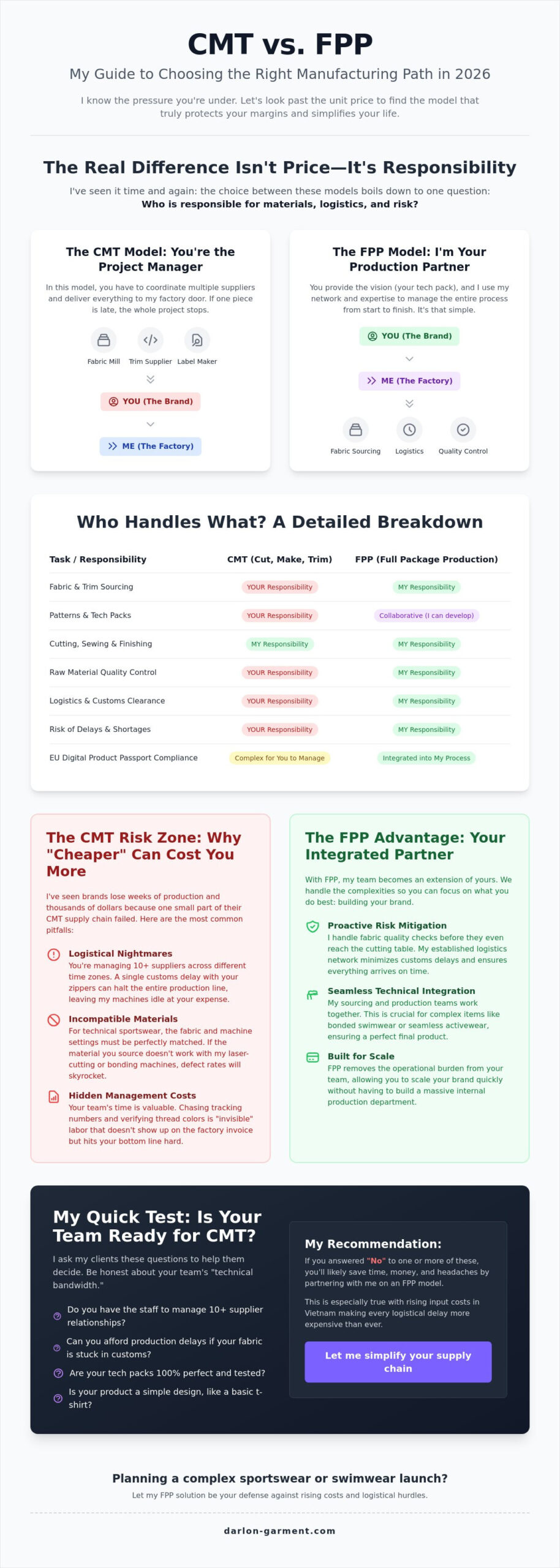
I define CMT as the “labor-only” model where you provide the ingredients and I provide the kitchen. Specifically, CMT is a process where the brand supplies the fabric, patterns, and trims, while the factory only handles the cutting, sewing, and finishing. This model often appeals to designers who want granular control over every thread. If you’ve spent months sourcing a very specific performance wool or a custom-dyed recycled nylon for your swimwear, CMT lets you keep that material under your thumb. However, it means you’re also the one who has to deal with shipping delays, yardage shortages, and quality issues from the textile mill.
Defining FPP (Full Package Production)
I call FPP the “turnkey” solution where the factory manages the entire lifecycle of the garment. In this model, the manufacturer handles everything from sourcing and pattern making to final delivery at your warehouse. By 2026, FPP has evolved to include much more than just procurement. It now incorporates complex compliance like the EU Digital Product Passport (DPP). Under these rules, we track mandatory data like material composition by percentage weight and carbon footprint per unit. For high-tech items like seamless garments or laser-cut apparel, having a single partner manage the technical engineering and the material sourcing together is often the only way to ensure the final product meets international standards.
Deep Dive: How I Manage the Moving Parts of CMT and FPP on the Factory Floor
Let me take you inside my production line to see how these models actually function. When we run a CMT order, my floor manager has to track shipments from multiple vendors just to start a single batch. It’s a logistical dance that can easily trip up even the most organized brand. If the fabric arrives on Monday but the heat-transfer labels are delayed until Friday, my machines sit idle. This cmt vs fpp manufacturing explained deep dive shows that understanding apparel production models is vital for your scheduling and sanity.
Technical sportswear requires a much more integrated approach than basic streetwear. For items like laser-cut apparel or seamless garments, the machinery settings are often specific to the fabric’s weight and stretch. If you source the fabric and I do the sewing (CMT), any mismatch in those technical specs leads to high defect rates. FPP ensures the material and the machine work in harmony from day one. If you’re planning a complex launch, you can contact us at Dar Lon Garment to see how our integrated workflow protects your designs.
The Hidden Complexity of Sourcing in CMT
I’ve watched brands lose weeks because a tiny shipment of waterproof zippers was stuck in customs. In the CMT model, you are essentially the project manager for 10 different suppliers. You’re responsible for the “invisible” labor of chasing down tracking numbers and verifying that the thread color matches the fabric. It’s harder than it looks, especially when coordinating across different time zones. If one supplier fails, the entire production line stops, and those costs fall squarely on your shoulders.
The ‘All-In’ Nature of FPP Services
When I manage an FPP project, the synergy between my sourcing department and the sewing lines is seamless. I use my factory’s established network to find specialized materials like high-performance polyamide that meets specific compression standards. We handle the pattern making and grading in-house, which means the fit is locked in before the fabric is even cut. This integrated approach is the silent backbone for global brands scaling quickly, as it removes the burden of technical engineering from your internal team.
- Risk Mitigation: We handle the fabric quality checks before they reach the cutting table.
- Consistency: Using the same team for patterns and production reduces fit variations.
- Speed: Parallel processing of sourcing and tech pack finalization saves weeks of lead time.
The Total Cost of Ownership: Comparing More Than Just the Unit Price
Don’t get blinded by a low per-unit price in a CMT quote; it’s rarely the final cost you’ll actually pay. When I review budgets with new brands, I always tell my clients to look at the ‘Total Cost of Ownership’ (TCO). In a CMT setup, the price you see on the invoice only covers my labor. It doesn’t account for the freight costs to get your fabric to Vietnam, the import duties, or the storage fees while waiting for trims to arrive. If you don’t have a dedicated production manager to track these variables, the overhead of your own time can quickly eat through any perceived savings.
I find that FPP often ends up being more cost-effective for brands scaling their activewear or swimwear lines. While the unit price is higher, it represents a consolidated expense. You aren’t just paying for a garment; you’re paying for the removal of logistical friction. This cmt vs fpp manufacturing explained analysis shows that the “markup” in FPP is often just the cost of peace of mind. By 2026, with logistics and input prices rising at the fastest pace in 15 years, having a manufacturer manage the entire chain is a strategic hedge against volatility.
Upfront Costs vs. Hidden Logistic Expenses
The “invisible” costs in CMT can be staggering. You have to factor in the local trucking from the port to my warehouse and the inevitable fabric waste that occurs during the cutting process. FPP prices include the factory’s sourcing markup but eliminate shipping risks. I see FPP as a form of insurance. If a fabric shipment is lost or damaged before it reaches me in an FPP agreement, that is my problem to solve. In CMT, that loss is 100% your financial burden, which can be devastating for a small brand’s cash flow.
Quality Control Responsibility: Who Pays for Mistakes?
In a CMT arrangement, if the fabric you sent me is flawed or has inconsistent shrinkage, I can’t be held responsible for the final fit. This often leads to the “Blame Game” between the brand, the fabric mill, and the sewing floor. FPP creates a single point of accountability. Because I sourced the material, I am responsible for its performance. We handle quality control differently in each model, but FPP is the only one where the factory owns the outcome from fiber to finished seam. This model is particularly effective for complex items like bonded apparel or performance wool, where the interaction between fabric and machinery is highly technical.
Assessing Your Technical Bandwidth: A Framework for Choosing Your Model
I’ve developed a simple test to help you decide which path to take. It’s not about how much money you have in the bank, but how much technical bandwidth you have in your office. If you don’t have a professional tech pack, you aren’t ready for CMT. It’s that simple. I’ve seen brands try to “wing it” with sketches and a few emails, only to be shocked when the final activewear sample doesn’t fit or the seams fail under tension. My factory floor operates on data, not guesses. This cmt vs fpp manufacturing explained framework is designed to protect your margins from the technical errors that often kill young brands.
The second part is the “Sourcing Test.” Do you have the contacts to find high-performance yarns like Nuyarn or specialized elastics for swimwear? If your answer is “I’ll find them on Google,” then FPP is your safest bet. In 2026, the supply chain is too volatile for amateur sourcing. Input prices in Vietnam rose at their fastest pace in 15 years this April, and a factory’s established network can often absorb or navigate those spikes better than an individual buyer. Your choice might change as you scale from a startup to a global brand, but you must be honest about your current team’s capabilities.
The Tech Pack Test: Are You Ready for CMT?
I cannot emphasize enough: a bad tech pack equals a bad CMT result. In a CMT model, my factory is a service provider, not a design consultant. We need precise grading, stitch counts, and trim placements. If those details are missing, we have to make assumptions, and assumptions lead to waste. Choosing the right manufacturer depends heavily on your design readiness. If you have a technical designer on staff who can troubleshoot a pattern in real-time, CMT can work. If you don’t, you’re asking for production delays.
Scaling Your Brand: When to Transition Models
I recommend FPP for most startups entering the activewear space. You need to focus on marketing and sales, not whether a shipment of thread is cleared by customs. As you scale, your needs might change. I’ve seen established brands move back to CMT when they’ve secured exclusive fabric rights or developed proprietary textiles they want to keep strictly under their own control. However, the general trend in Vietnam for 2026 is a move toward higher-value FPP models because they offer better speed-to-market. If you’re planning to scale your next collection, review your design readiness with us to see which model fits your current team size.
- Startup Phase: Stick to FPP to leverage the factory’s technical team.
- Growth Phase: Consider CMT only if you hire an in-house production manager.
- Maturity Phase: Use a hybrid approach based on the complexity of the garment.
Why Vietnam and Dar Lon Garment are Redefining the ‘One-Stop’ FPP Experience
I’m proud of how we’ve built Dar Lon to be more than just a sewing floor. Throughout this cmt vs fpp manufacturing explained guide, I’ve highlighted the massive logistical risks of managing multiple vendors on your own. To solve this, I’ve positioned our facility as a high-capacity partner that handles the technical heavy lifting. We aren’t just assemblers; we’re engineers of performance apparel. I’ve seen how Vietnam’s sportswear factories have evolved into global leaders by investing in infrastructure that many brands can no longer maintain in-house. We’ve moved past the era of simple labor toward a model of technical partnership.
The industry is shifting toward higher-value models for a very specific reason. Vietnam aims for an export target of $47–48 billion in 2026, and that growth is driven by factories like ours that provide a complete, integrated solution. My promise is a seamless journey from your first sketch to a retail-ready product. Whether you’re developing high-compression activewear or technical sleepwear, I’ve structured my team to absorb the complexity. This allows you to focus on marketing and scaling while we manage the granular details of the production line.
Advanced Tech in Vietnam: Laser Cutting and Nuyarn
I use automatic sewing and laser cutting to ensure every FPP order is identical. For technical garments like bonded swimwear or laser-cut apparel, the margin for error is zero. If the laser doesn’t cut to the exact millimeter, the bonding tape won’t seal correctly during the assembly phase. This is where the ‘science’ of the fabric comes into play. We specialize in Nuyarn performance wool sourcing, which requires a deep understanding of fiber tension and heat sensitivity. You can’t easily get that level of precision in a standard CMT setup where the factory hasn’t been involved in the fabric selection or testing process.
Partnering with Me for a Seamless Production Cycle
I don’t just want to be your vendor; I want to be your silent partner. Our ‘One-Stop’ service handles the headaches of global logistics and the new 2026 EU Digital Product Passport requirements. We track the material composition and carbon footprint data so you don’t have to hire a separate compliance team. This integrated approach is why Dar Lon Garment reported a net sales revenue increase of 49.99% in 2024. We’ve proven that reliability and technical mastery are the most valuable commodities in the modern supply chain. Ready to start? Let’s talk about your next collection and find the path that protects your margins and your brand’s reputation.
Securing Your Brand’s Future in the 2026 Supply Chain
Choosing between these models determines your brand’s speed, scalability, and long-term profitability. I’ve shown that the labor-only approach of CMT often hides logistical burdens and technical risks that can stall a growing brand in today’s volatile market. Having this cmt vs fpp manufacturing explained helps you realize that FPP isn’t just a service; it’s a strategic partnership that offloads the headaches of sourcing and compliance. This allows you to focus your energy on design and market expansion while I handle the industrial complexities.
In 2026, success in activewear and swimwear requires more than just a sewing floor. It requires a factory that understands the science of the fabric. Whether you’re working with specialized Nuyarn performance wool or complex seamless garments, your manufacturer should be the silent backbone of your operations. I’ve invested in advanced laser-cutting and automatic sewing technology to ensure that every piece we produce meets the highest international standards. My team is ready to provide the one-stop OEM solutions that modern global brands demand.
Let me help you build your next collection—get a custom quote from Dar Lon Garment today.
You have the creative vision for your brand. I have the industrial infrastructure and technical mastery to make it a reality. Let’s work together to build a collection that stands out on the global stage.
Frequently Asked Questions
What is the main difference between CMT and FPP?
The main difference is the scope of responsibility regarding raw materials and development. CMT is a service where you provide the fabric and trims while I provide the labor for cutting, making, and trimming. FPP is a comprehensive solution where I manage the entire lifecycle, from material sourcing and pattern making to the final assembly of your garments.
Is CMT manufacturing cheaper than FPP?
CMT often appears cheaper on a per-unit basis, but it’s frequently more expensive once you calculate the total cost of ownership. When you use CMT, you must pay for fabric shipping, import duties, and the administrative time required to manage multiple suppliers. FPP consolidates these costs into one predictable price, which usually protects your margins better by reducing logistical friction.
Can I switch from CMT to FPP mid-production?
You cannot switch from CMT to FPP once the production cycle has been initiated. These models require entirely different administrative and logistical setups from the start of the project. If you begin with CMT, I’ve already allocated my resources based on you providing the materials. A mid-run change would cause significant delays and likely require an entirely new contract and sourcing phase.
Do I need a tech pack for FPP manufacturing?
Yes, a professional tech pack is still required for FPP manufacturing. While my team can assist with technical refinements and grading, we need a clear blueprint to understand your design intent from the beginning. The difference is that in FPP, we work together to ensure the tech pack aligns perfectly with the specialized fabrics and machinery we’ve selected for your collection.
Which model is better for a startup clothing brand in 2026?
FPP is the superior choice for a startup clothing brand in 2026. As this cmt vs fpp manufacturing explained guide has shown, startups rarely have the technical bandwidth or vendor contacts to manage a complex supply chain. Choosing FPP allows you to leverage my factory’s established network and technical expertise, which reduces the risk of costly production errors during your launch phase.
Who is responsible for fabric quality in a CMT model?
You are entirely responsible for the quality and performance of the fabric in a CMT arrangement. If the material you send is flawed or doesn’t react well to our machines, the financial loss and the burden of replacement fall on your brand. In contrast, an FPP model places that responsibility on me, as I handle the quality control checks before the fabric ever reaches the cutting table.
Does FPP manufacturing include shipping and customs?
FPP typically covers the logistics of sourcing raw materials to the factory, but you must check your specific Incoterms for the final shipment to your warehouse. Most quotes are provided as FOB, meaning I handle everything until the goods are loaded at the port. If you need door-to-door delivery including customs clearance in your country, you should request a DDP quote instead.
Why do many sportswear brands prefer FPP in Vietnam?
Sportswear brands prefer FPP in Vietnam because technical apparel requires a high degree of integration between material and construction. For specialized items like seamless garments or laser-cut apparel, the machinery must be precisely calibrated to the specific properties of the fabric. An FPP partner ensures this technical harmony is maintained throughout the entire manufacturing process, leading to higher quality and fewer defects.