

A garment costing sheet is not just a bill; it’s a strategic blueprint that reveals where your brand can innovate and where it’s losing money. I’ve seen many partners struggle to compare quotes because they’re buried in technical jargon like CMT versus FOB. It’s natural to fear hidden costs appearing after you’ve already paid a deposit, but having a garment costing sheet explained properly changes that dynamic entirely.
I’ll walk you through every line item of a garment costing sheet so you can protect your margins and understand exactly what you are paying for. We’ll look at how the June 2026 cotton price of 76.67 USd/Lbs and shifting tariffs in countries like Vietnam at 46% affect your bottom line. From the technical complexities of seamless garment production to the latest EU packaging regulations, this guide provides the clarity you need to set accurate retail prices and negotiate better with any factory. By the end, you’ll have the data-driven confidence to manage your apparel production costs without the guesswork.
Key Takeaways
- Master the fundamental components of a Bill of Materials to ensure your quotes are transparent and comprehensive from the start.
- See a garment costing sheet explained line-by-line so you can identify exactly where your budget goes, from raw fabrics to the smallest trims.
- Learn how I use your tech pack to source current market rates and build a reliable production budget that avoids expensive surprises.
- Uncover the hidden logistics and compliance fees that often eat into profit margins, including the critical differences between Ex-Works and FOB.
- Discover my strategies for value engineering and volume scaling to help you hit your target price points without sacrificing garment quality.
What is a Garment Costing Sheet? (And Why I Call it the Heartbeat of Production)
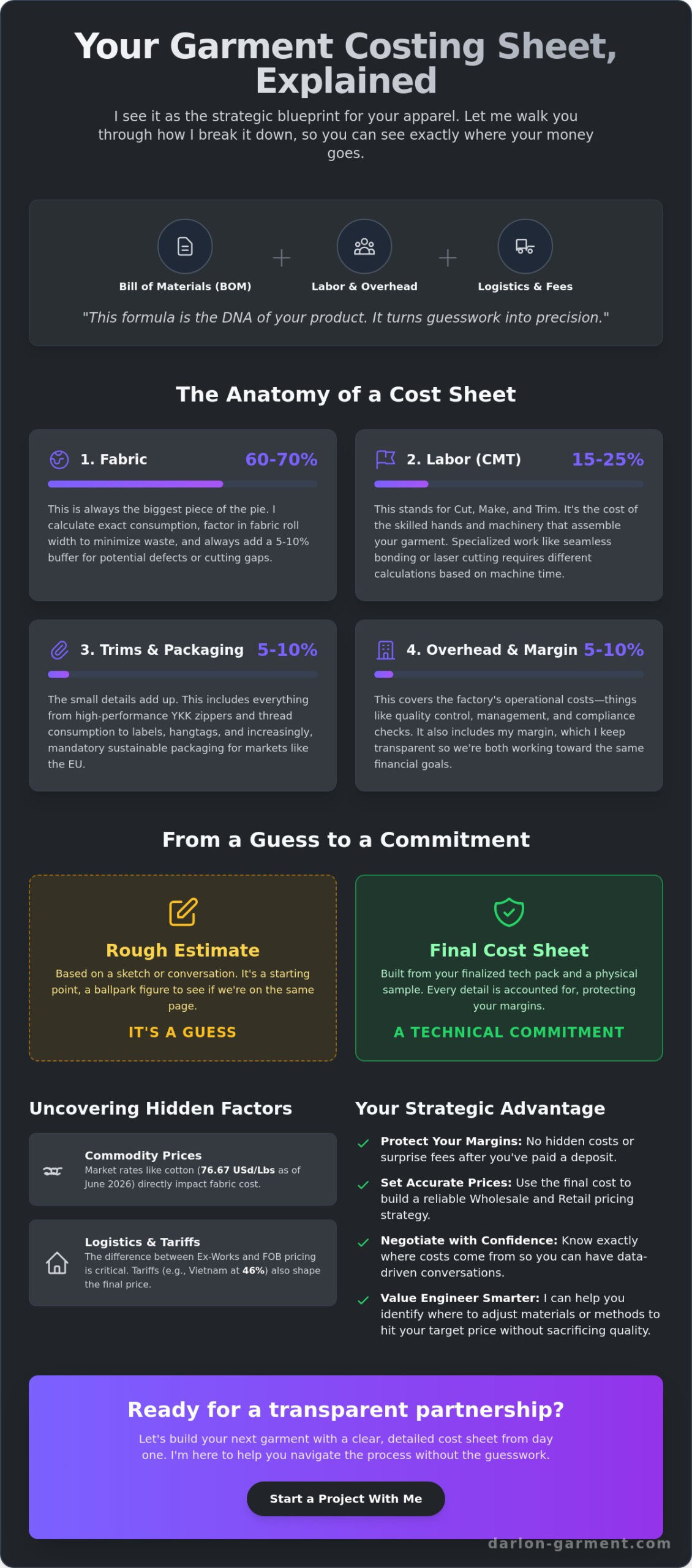
I’ve spent years on factory floors, and I can tell you that a garment costing sheet is much more than a simple spreadsheet. I define it as the Bill of Materials (BOM) combined with labor, overhead, and logistics. It’s essentially the DNA of your product. Having a garment costing sheet explained clearly is vital because it moves our conversation away from guesswork and into the world of industrial precision. It’s the foundation of Cost accounting for any brand, ensuring every cent is accounted for before the first needle moves.
I believe a transparent sheet is the only way to build a long-term partnership. Many manufacturers just give you a flat number and expect you to trust it. I don’t work that way. I want you to see the “why” behind the “what.” This transparency prevents the “price creep” that haunts many startups. When you know exactly what the fabric, trims, and labor cost, you won’t be surprised by a sudden price jump later in the production cycle. It keeps both of us accountable and ensures we’re working toward the same financial goals.
You should also know the difference between a “rough estimate” and a “final cost sheet.” A rough estimate is usually based on a sketch or a verbal description. It’s a starting point, but it’s not a contract. A final cost sheet is based on a finished sample and a finalized tech pack. One is a guess; the other is a technical commitment that protects your margins.
The Role of the Costing Sheet in Your Business Strategy
I use this document to help my clients set their Wholesale and Recommended Retail Price (RRP). If we know the production cost is $15, you can’t sell it for $20 and expect your business to survive. Your tech pack is our primary source of truth here. Every seam, stitch, and fabric weight listed there translates directly to a line on this sheet. Understanding how garments are made helps you see where these costs originate, from the initial laser-cutting of activewear to the final quality control check.
Costing Sheet vs. Price Quotation
A quote tells you “what” you’ll pay, but the costing sheet explains “why” you’re paying it. If you decide to swap a standard nylon for a Nuyarn performance wool, I update the sheet so you see the exact impact on the unit price. I also place a heavy emphasis on “Unit of Measurement” (UOM) clarity. Whether we’re measuring fabric in meters or kilograms, being specific prevents expensive misunderstandings. This level of detail is why having a garment costing sheet explained by a manufacturer is far more valuable than using a generic template you might find online.
The Anatomy of a Costing Sheet: What I Include in Every Quote
When I build a quote for a new partner, I break it down into four primary pillars. Having a garment costing sheet explained this way helps you see exactly where your capital is being deployed. First, we have the fabric, which is consistently the biggest slice of the pie; it usually accounts for 60% to 70% of the total manufacturing budget. Following that are the trims and notions, the labor (often called CMT or Cut, Make, Trim), and any value-added services like specialized laser cutting or embroidery.
I don’t just look at the final price; I look at the technical requirements of the design. A simple sleepwear set has a very different cost structure than a high-performance bonded jacket. By separating these costs, I can show you where we can optimize without compromising the integrity of the garment. If you’re looking for a partner who prioritizes this level of detail, you can view my full production capabilities to see how I handle complex builds.
Fabric Consumption and Wastage
Fabric consumption isn’t just about the dimensions of your garment. I always add a 5% to 10% wastage factor to every calculation. This accounts for the unavoidable gaps between pattern pieces and any minor defects in the fabric roll. The width of the fabric roll is also a critical factor; if the width isn’t optimized for your specific pattern, your costs will rise because we’re paying for material that ends up as scrap. You’ll also see a price difference between basic materials and technical options like elastane fabric, which requires more careful handling during the cutting process.
Trims, Labels, and Packaging
The small details in sportswear often carry significant costs. For example, I frequently recommend YKK water-resistant zippers for high-end activewear. They cost more than standard zippers, but they’re essential for performance. I also calculate “thread consumption” very carefully. High-stretch seams in swimwear or leggings require significantly more thread than a standard t-shirt. Don’t forget the hidden costs of sustainable packaging and hangtags, which are becoming mandatory for brands entering the EU market by late 2026.
Specialized Construction Costs
Specialized garments like seamless or bonded apparel require a different labor calculation entirely. These aren’t just about manual sewing; they rely heavily on machine time and technical calibration. When I’m working with premium materials like Nuyarn performance wool, the labor cost reflects the specialized machinery and skilled technicians needed to handle the yarn’s unique structure. In these cases, another garment costing sheet explained through the lens of machine efficiency is often more accurate than one based purely on man-hours.
Step-by-Step: How I Calculate Your Garment Costs
I don’t believe in pulling numbers out of thin air. To give you a quote that actually holds up during production, I follow a rigorous five-step process. By having a garment costing sheet explained through this technical lens, you can see how I move from your initial design concept to a final, fixed production price. It’s a methodical journey that starts with your tech pack and ends with a healthy contingency buffer to protect us both from market volatility.
- Step 1: Tech Pack Analysis. I examine every design detail, from the number of seams to the specific placement of bonded elements. Every technical requirement has a cost attached to it.
- Step 2: Material Sourcing. I check current market rates for your chosen fabrics. For instance, as of June 1, 2026, the price of cotton sits at 76.67 USd/Lbs. I factor these live costs into your sheet.
- Step 3: SAM Calculation. I determine the Standard Allowed Minutes (SAM) required to assemble the garment. This is where we calculate the actual human and machine time needed for your specific design.
- Step 4: Factory Overheads. I add the fixed costs of running the facility, including electricity, rent, and the management team that keeps your production on schedule.
- Step 5: Profit and Contingency. I apply a standard profit margin and a buffer. This buffer is crucial for absorbing unexpected shipping delays or minor material price fluctuations.
Calculating Labor Using SAM
I use SAM because it’s the fairest way to price labor. It doesn’t matter if we’re in a market like Vietnam, where hourly wages average between $1.50 and $2.50; the time it takes to sew a complex flatlock seam remains a constant technical metric. If your design has a complex pocket or intricate laser-cutting, the SAM increases. I’ve found that labor efficiency also improves with volume. When my team produces 5,000 units instead of 500, they get faster, which is how I can offer better unit pricing on larger orders.
Factory Overheads and Profit
In a Vietnamese factory setting, “overheads” cover everything from the high-tech machinery maintenance to international regulatory compliance. I usually see a 10% to 20% profit margin as the industry standard for a healthy, sustainable manufacturer. This isn’t just “extra money”; it’s what allows me to reinvest in the latest seamless technology and maintain a stable workforce. I also include a “contingency” line. This is my proactive way of handling the garment costing sheet explained to clients who worry about the 0.68% daily price swings we sometimes see in raw material markets.
Hidden Costs and Common Mistakes That Kill Your Profit Margins
I’ve seen many brands fail because they only looked at the unit price on the screen. The reality is that your “landed cost” includes several layers that don’t always appear on the first page of a quote. When you have a garment costing sheet explained by a factory veteran, these “invisible” numbers become visible. For instance, sampling fees often surprise newcomers. I charge more for the first prototype because it requires a dedicated pattern maker and a single machine operator rather than a streamlined production line. It’s manual, high-touch work that ensures the bulk run goes smoothly. Having a garment costing sheet explained with these contingencies included is the only way to ensure your retail price remains profitable.
Currency fluctuations are another silent profit killer. Since I manage operations across global borders, I’ve seen how a shift in the exchange rate can erase a brand’s margin overnight. I protect my partners by locking in rates at the time of the deposit or including a small currency buffer. You also need to account for the evolving regulatory landscape. With the EU Ecodesign for Sustainable Products Regulation (ESPR) taking effect on July 19, 2026, compliance isn’t just a “nice to have” anymore. Testing for REACH or Oeko-Tex certifications carries a cost, but it’s much cheaper than having a shipment seized at customs for non-compliance.
Logistics: FOB vs. CMT Models
I generally prefer the FOB (Free on Board) model for my international partners. In this setup, I take responsibility for the garment until it’s loaded onto the vessel at the port. This includes local transport and export clearances. If you choose an Ex-Works model, you’re responsible for everything from my factory door, which often leads to unexpected port fees you didn’t budget for. I’ve detailed how to navigate these choices in my fitness wear manufacturer guide, which covers sourcing strategies for the current 2026 market.
Quality Control and Inspection
Every production run has a small percentage of “seconds” or defective units. I typically factor in a 2% buffer for this in my internal planning. While I maintain a rigorous in-house QC team, some clients prefer third-party inspections. These inspections add to the initial cost, but they provide an objective validation of quality before the goods leave the factory. Given the 46% US import tariff on Vietnamese apparel as of 2026, you cannot afford to pay duties on defective products. Investing in high-level QC at the source is the most effective way to protect your investment. If you’re ready to build a transparent, risk-mitigated supply chain, get a comprehensive quote for your production needs today.
Beyond the Numbers: How I Help You Optimize Your Production Strategy
I view our relationship as a partnership where your success is tied directly to my factory’s efficiency. Having a garment costing sheet explained is just the first step; the real work begins when we use that data to optimize your production strategy. I don’t just want to build your activewear; I want to help you build a profitable brand. This is where “value engineering” comes into play. By analyzing every stitch and material choice, I can often find ways to reduce costs without compromising the garment’s performance or aesthetic. This proactive approach is what sets a high-capacity manufacturer apart from a simple vendor.
Transparency in the costing sheet is what builds a lasting bond between us. When you see exactly where your money is going, from the 70% spent on premium fabrics to the labor costs in my facility, we can have honest conversations about scaling. I always remind my partners about the power of volume. Doubling your order doesn’t just double your inventory; it can significantly slash your unit cost. Larger runs allow me to optimize machine setup times and negotiate better rates on raw materials, passing those savings directly to you. If you’re still deciding on a production partner, my advice on choosing a sportswear factory in Vietnam provides a roadmap for finding a facility that values this level of technical transparency.
Value Engineering Your Designs
I recently worked with a startup where a small design tweak saved them $0.50 per unit. By slightly adjusting a seam placement on their leggings, we reduced the SAM (Standard Allowed Minutes) and minimized fabric wastage. It didn’t change the look or the fit, but on a 5,000-unit run, that’s $2,500 back in their pocket. I help you find that “sweet spot” where premium materials like Nuyarn performance wool meet production speed. It’s about making smart trade-offs that protect your margins while delivering a high-quality product to your customers.
The Future of Costing: Sustainability and Innovation
As we move through 2026, I’m seeing a massive shift in how sustainability impacts the garment costing sheet explained to global buyers. Recycled fabrics and natural fibers often carry a higher initial material cost, but they reduce the long-term fees associated with new EU waste regulations. To keep labor costs stable despite rising global wages, I am heavily investing in automation and AI-driven pattern nesting. This technology reduces human error and ensures we use every possible inch of fabric. Ultimately, the best costing sheet is one where the brand gets a fair price, the workers earn a fair wage, and the factory remains a stable, powerful backbone for your growth.
Secure Your Margins Through Technical Transparency
I’ve shown you that a costing sheet is far more than a list of prices; it’s a technical roadmap for your brand’s growth. By having a garment costing sheet explained through the lens of a manufacturer, you can now navigate the complexities of SAM calculations, fabric wastage, and the evolving 2026 regulatory landscape with absolute confidence. You’ve learned how value engineering and volume scaling can transform your unit costs while maintaining the high standards required for performance activewear.
My Vietnam-based facility is built to support this level of precision. I specialize in sportswear and activewear, utilizing advanced laser cutting and automatic sewing to ensure every garment meets your exact specifications. This industrial scale, combined with a commitment to transparency, is what makes me a dependable backbone for your business. Ready to see your own costing sheet? Get a transparent quote from Dar Lon Garment today. I’m excited to help you turn these technical insights into a successful, profitable collection.
Common Questions About Apparel Costing
What is the most expensive part of a garment costing sheet?
Fabric typically represents the largest portion of the budget, often accounting for 50% to 70% of the total manufacturing cost. I prioritize sourcing high-quality materials because they dictate the final garment’s performance and durability. In sportswear, technical fabrics with specific GSM or moisture-wicking properties carry higher prices than basic knits. You’ll see this reflected as the primary line item whenever I have a garment costing sheet explained to a new partner.
How do I calculate the fabric consumption for a t-shirt?
I calculate consumption by measuring the body length, sleeve length, and chest width, then adding a specific wastage factor. I usually add 5% to 10% for wastage to account for the unavoidable gaps between pattern pieces on the fabric roll. The fabric’s width is a critical variable in this math; if the roll is too narrow for your pattern, wastage increases. It’s a technical calculation that ensures I order exactly what’s needed for your bulk run without overspending.
What is the difference between CMT and FOB pricing?
CMT stands for “Cut, Make, and Trim,” where you provide the fabric and I only charge for labor, thread, and basic trims. FOB, or “Free on Board,” is a more comprehensive model where I source all materials and handle local logistics until the goods are loaded onto the vessel. I prefer the FOB model for international partners because it gives me full control over the supply chain quality. It simplifies your accounting by bundling materials and labor into a single unit price.
Why do manufacturers charge a sampling fee?
I charge a sampling fee because creating a single prototype requires manual pattern making and a dedicated machine operator. Unlike bulk production, where efficiency is high, sampling is a slow, high-touch process. It involves several rounds of technical adjustments to perfect the fit and construction before we commit to a full run. While it’s a higher upfront cost, it’s the best way to prevent expensive errors during the main production phase.
How much profit margin should a clothing manufacturer charge?
A healthy, sustainable manufacturer typically charges a profit margin between 10% and 20%. This margin allows me to maintain high-capacity machinery and invest in advanced technology like laser-cutting tools and automatic sewing stations. It also ensures I can retain a skilled workforce for the long term. When you have a garment costing sheet explained, you’ll see this margin is what keeps the factory stable and reliable for your future production needs.
Can I negotiate the prices on a garment costing sheet?
You can certainly negotiate, but it’s usually done through design adjustments or volume increases rather than just cutting the price. I look for “value engineering” opportunities, such as simplifying a pocket or changing a specific trim to hit your target price. Increasing your order quantity is the most effective way to lower the unit price. This is because my setup costs and material sourcing rates improve significantly when I’m running larger, more efficient batches.
What are “Standard Allowed Minutes” (SAM) in garment costing?
SAM stands for Standard Allowed Minutes, and it’s the time required for a qualified worker to complete a specific task under standard conditions. I use SAM to price labor accurately across different garment types. A complex bonded jacket has a much higher SAM than a basic pair of sleepwear shorts because it requires more technical steps. It’s a universal metric that ensures you’re paying for the actual human and machine effort involved in your design.
Does the order quantity (MOQ) significantly change the costing sheet?
Order quantity is one of the most influential factors in your final unit price. When I produce at a high capacity, my fixed overhead costs are spread across more units, which lowers the cost per garment. I also secure better pricing from fabric mills when I buy materials in bulk. A low MOQ usually results in higher prices because the setup time for my machines remains the same whether I’m making 100 pieces or 1,000 pieces.