

Most designers treat elastane like a standalone material, but I’ve spent decades on the factory floor learning that it’s actually a high-stakes performance additive. If you’ve ever dealt with leggings that bag out at the knees or swimwear that turns brittle after a few washes, you’ve seen what happens when elastane fabric properties are misunderstood. It’s not just about the stretch. It’s about how the fiber handles the 22,000 to 24,500 yuan per ton price volatility we’re seeing in East China markets and the technical stress of high-speed industrial knitting.
I understand the pressure of maintaining quality while the 15% U.S. import surcharge remains in effect through July 24, 2026. You need a reliable way to source stretch without risking your margins or failing the new EU Digital Product Passport requirements. In this guide, I’ll share my professional blending ratios for activewear and sleepwear, explain the chemical differences between trade names like Lycra and the raw polymer, and provide a clear roadmap for sourcing in a year where the de minimis exemption no longer exists for commercial imports. We’ll also look at how to ensure your 2026 collections meet the updated OEKO-TEX Standard 100 limit values set on June 1, 2026.
Key Takeaways
- I explain why understanding elastane fabric properties like elongation and recovery is vital for preventing garment bagging and ensuring long-term durability.
- You’ll learn how I determine the ideal blending ratios for products like Nuyarn and seamless garments to maximize both performance and comfort.
- I reveal the specific manufacturing techniques I use to manage fiber tension and prevent common production errors like “snap-back” bunching.
- Discover my strategies for sourcing GRS-certified recycled elastane to stay compliant with the latest 2026 EU Ecodesign and traceability requirements.
What is Elastane? My Perspective on the “Invisible” Fiber
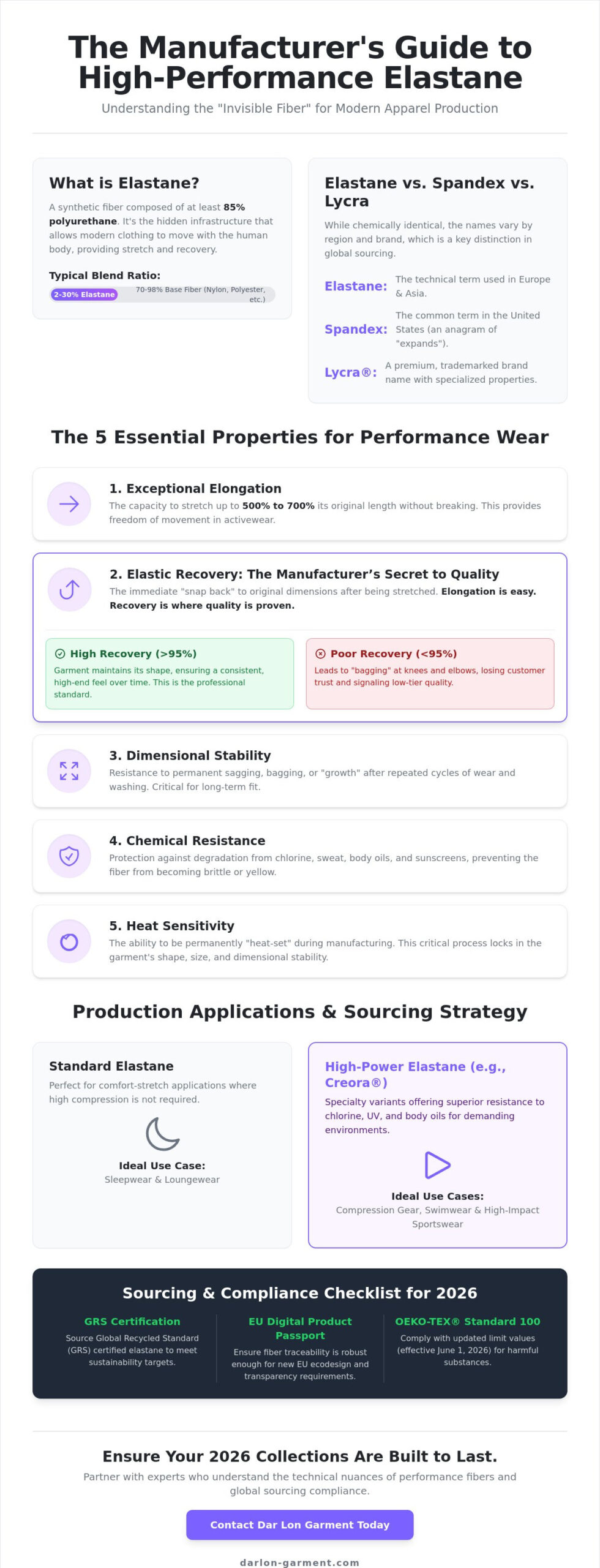
I often tell my clients that if you can see the elastane, the garment is already failing. Technically, it’s a synthetic fiber composed of at least 85% polyurethane by weight. In my world of high-capacity manufacturing, I call it the “invisible” fiber because it’s almost never used alone in 2026 apparel. You’ll find it hidden within the yarn structure of our performance activewear or swimwear, usually making up between 2% and 30% of the total blend. It provides the hidden infrastructure that allows modern clothing to move with the human body.
Understanding What is Elastane? requires looking back to its invention in the late 1950s. It has evolved from a niche laboratory discovery into the functional backbone of a global activewear market valued at over $300 billion. Without it, the modern sportswear industry simply wouldn’t exist. When I’m evaluating elastane fabric properties for a new production run, I’m looking at how this polyether-polyurea copolymer interacts with base fibers like nylon or polyester to create a resilient, multi-directional stretch.
Elastane vs. Spandex vs. Lycra: Is There a Difference?
I spend a lot of time clarifying this terminology maze for my international partners. Chemically, they are identical. Spandex is an anagram of “expands” and is the standard term in the United States. Elastane is the preferred technical name across Europe and Asia. Lycra is a premium brand name owned by The Lycra Company. While the chemical structure is the same, I sometimes recommend paying the premium for the Lycra trademark when a brand needs specific consumer-facing marketing or highly specialized heat-resistance properties for bonded apparel.
How I Categorize Elastane for Sportswear Production
In my factory, we categorize these fibers based on their intended application. Standard elastane works perfectly for comfort-stretch sleepwear. However, for compression gear or high-impact sportswear, I source high-power elastane variants like Creora from my trusted suppliers in Vietnam. These specialty fibers offer superior resistance to chlorine and body oils, which is crucial for the swimwear and activewear we produce as part of our one-stop service. I prioritize fiber purity in my sourcing to ensure consistent dye uptake and long-term elasticity across every batch. These specific elastane fabric properties are what allow a garment to maintain its shape after hundreds of wash cycles.
The 5 Essential Elastane Fabric Properties for Modern Performance Wear
I’ve seen too many brands focus strictly on how far a fabric can pull. While the ability to stretch between 500% and 700% without snapping is impressive, it’s only one part of the elastane fabric properties that actually matter for a successful production run. If a garment doesn’t return to its original state, the stretch is a liability. In my factory, we prioritize dimensional stability to ensure that after 50 cycles of wear, a pair of yoga pants looks exactly like it did on the sample rack. This consistency is what separates professional-grade apparel from low-tier fast fashion.
Moisture and chemical resistance are also non-negotiable for 2026 performance standards. High-quality elastane must withstand body oils, perspiration, and sunscreens without losing its molecular integrity. This is particularly vital for the swimwear and activewear categories we specialize in. I always check how these fibers balance elastane ratios within the knit structure to prevent premature degradation from environmental stressors. If the blend is off, the fabric will lose its snap before it even leaves the retail floor.
- Exceptional Elongation: The capacity to expand up to seven times its length.
- Elastic Recovery: The immediate “snap back” to original dimensions.
- Dimensional Stability: Resistance to sagging or growth after repeated use.
- Chemical Resistance: Protection against chlorine, sweat, and oils.
- Heat Sensitivity: The ability to be heat-set during manufacturing for permanent shape.
Stretch vs. Recovery: The Manufacturer’s Secret to Quality
I always tell designers that elongation is easy. Recovery is where quality is proven. Poor recovery is the direct cause of “bagging” at the knees and elbows, which is the fastest way to lose customer trust. In our Vietnam testing lab, we measure recovery percentages by stretching fabric to a specific limit and recording how quickly it returns. If the recovery rate is below 95% after multiple cycles, we reject the batch. This rigorous testing is why our seamless garments and activewear maintain their high-end feel over time.
Durability and Resistance in Active Environments
Elastane is naturally resistant to the acidic nature of human perspiration, but 2026 environmental factors like increased UV intensity can break down the polymer chains. This degradation leads to “grinning,” where the broken elastane fibers poke through the fabric surface. I select specialty high-chlorine resistant elastane variants for all swimwear production to ensure the material doesn’t turn brittle or yellow after a few swims. By matching the specific grade of fiber to the garment’s end-use, we eliminate the durability issues that plague many brands.
The Art of the Blend: How I Balance Elastane Ratios for Different Garments
In my decades of running production lines, I’ve never once seen a 100% elastane garment. If you tried to make one, it would feel like wearing a massive rubber band. It would lack the structure, breathability, and durability required for daily wear. Instead, I treat elastane as a performance enhancer that we carefully dose into a base material. My goal is always to find the sweet spot where the elastane fabric properties provide maximum mobility without compromising the garment’s integrity. For a deeper dive into the science behind these interactions, you can read this comprehensive review of elastane properties which details how density and heat resistance change during the blending process.
For my sportswear factory Vietnam clients, polyester and polyamide (nylon) are the gold standards for blending. Polyamide provides that buttery-soft hand-feel that high-end yoga brands demand, while polyester is my top recommendation for any brand utilizing heat-transfer printing or sublimation. The choice of companion fiber dictates the final GSM (grams per square meter). A higher GSM doesn’t always mean better quality, but it’s essential for ensuring leggings are “squat-proof” and maintain their opacity under tension. I always adjust the weight based on the specific end-use of your design.
Recommended Ratios by Garment Category
I follow strict internal benchmarks for different product types to ensure consistent performance across production runs. These ratios are the result of years of testing in real-world athletic environments:
- Everyday T-shirts: 2-5% elastane. This is just enough to prevent the neck from stretching out and to keep the fit crisp after washing.
- Performance Leggings: 15-25% elastane. This range provides the high compression needed for athletic support and ensures the fabric remains dense.
- Swimwear: 18-22% elastane. This balance offers the necessary “snap back” while maintaining enough base fiber to resist the harsh effects of salt water.
The Role of the Companion Fiber
The base fiber does the heavy lifting for moisture-wicking and skin comfort. Nylon is incredibly resilient and pairs perfectly with elastane for high-motion activities. If you’re looking for more sustainable options, I often integrate elastane with performance wool or organic cotton. You can explore these combinations in my guide to natural fibers. Mixing these materials requires precise tension control during the knitting phase. I make sure our machines are calibrated for the different shrinkage rates of each fiber so the final fabric doesn’t warp during the finishing process. This technical oversight is a key part of our one-stop service for global brands.
Overcoming Manufacturing Challenges: How I Handle Elastane on the Factory Floor
Managing elastane fabric properties on a high-speed production line is a technical balancing act. Most people don’t realize that elastane is incredibly temperamental during the assembly phase. Tension is my biggest enemy. If the fabric is pulled too tight while it’s being fed into the sewing machine, the finished garment will bunch or shrink as soon as it’s released from the presser foot. I’ve seen production runs where leggings lost several centimeters in length because the tension wasn’t calibrated correctly. To prevent this, I ensure all fabric rolls are relaxed on the cutting table for at least 24 hours before we even touch them with a blade.
Another major challenge involves needle heat. During high-speed production, sewing needles can reach temperatures that actually melt the polyurethane core of the elastane fiber. This creates tiny runs or holes that might not be visible until the customer puts the garment on and stretches it. I use specialized ball-point needles and pneumatic cooling systems on our machines to maintain fiber integrity. In my Vietnam facility, storage is just as critical. High humidity can degrade elastane fabric properties over time, so I keep all raw material rolls in climate-controlled warehouses. This ensures the “snap back” remains perfect from the first yard to the last.
Precision Cutting for High-Stretch Materials
Manual cutting simply doesn’t work for modern 20% elastane blends. The fabric shifts and stretches under the weight of the shears, which leads to inconsistent sizing across a single production run. I’ve invested heavily in laser cutting technology to solve this. The laser seals the edges as it cuts and ensures every panel is perfectly aligned with the grain line. You can learn more about how garments are made in my facility to see how we maintain these tolerances across thousands of units.
Quality Control: The Stretch Test
I implement a 4-stage QC process for every elastane-based production run. First, we check for “grin-through.” This happens when the white elastane core is visible through the dark dye of the companion fiber, usually because the knitting tension was too loose. Second, we verify that the seam elasticity matches the fabric elasticity. If the thread doesn’t stretch as much as the fabric, the seams will pop during a workout. My team performs pull tests on every batch to guarantee that our high-performance activewear meets global export standards for durability and fit. If you’re looking for a partner who understands these technical nuances, I’m ready to help you scale your next collection.
Sourcing Elastane in 2026: Balancing Performance with Sustainability
As we move through 2026, the conversation around sourcing has shifted from pure cost to long-term sustainability and regulatory compliance. The environmental footprint of virgin polyurethane is a concern for many of my partners, especially with the EU Ecodesign for Sustainable Products Regulation (ESPR) now in full effect. Traditional production is energy-intensive, but I am seeing a massive push toward more circular solutions. My goal is to help you maintain the high-performance elastane fabric properties your customers expect while meeting the strict traceability requirements of the new Digital Product Passport.
I am currently sourcing bio-based alternatives, such as corn-derived elastane, which can reduce carbon emissions by up to 30% compared to traditional petroleum-based fibers. While these materials are still scaling, they offer a glimpse into a future where we don’t have to choose between stretch and the planet. I also spend a lot of time exploring mono-material elasticity. By using specialized knitting techniques, we can sometimes achieve the necessary stretch without blending in high percentages of synthetic polymers. This makes the final garment much easier to recycle at the end of its life cycle, which is a key priority for brands looking to avoid the EU ban on destroying unsold goods starting July 19, 2026.
The Move Toward Recycled Stretch
A common question I get is whether recycled elastane holds up as well as virgin fiber. In my testing, Global Recycled Standard (GRS) certified elastane retains about 90% to 95% of the recovery strength of its virgin counterparts. It is a viable solution for most activewear and sleepwear applications. Sourcing these materials in Southeast Asia can be challenging due to fragmented supply chains, but I overcome this by maintaining direct relationships with a few elite yarn mills that guarantee consistency. I prioritize certified suppliers for every fitness wear manufacturer partnership to ensure that every claim your brand makes is backed by verifiable data.
Partnering with Dar Lon Garment for Your Next Collection
Navigating the complexities of elastane fabric selection is a core part of my one-stop solution. I don’t just take an order and start the machines. I work with you from day one to match the right fiber grade to your specific design goals. Whether you need the high-compression power of a 70D spandex or the soft, sustainable stretch of a bio-based blend, my team in Ho Chi Minh City handles the entire process from fabric sourcing to final export. Let me help you build a high-performance collection that lasts and stays ahead of the rapidly changing global regulations. Contact me today to discuss your 2026 production needs.
Master Your Stretch Strategy for 2026
I’ve shared the technical secrets that keep my production lines running smoothly, from the chemistry of the “invisible” fiber to the precise tension settings required on the factory floor. Success in the 2026 market requires more than just choosing a supplier. It’s about mastering elastane fabric properties through intelligent blending and advanced manufacturing techniques. We’ve explored how the right ratios prevent sagging and why laser cutting is the only way to ensure perfect sizing for high-stretch activewear.
Since I established Dar Lon Garment in 2019, I’ve built a one-stop OEM/ODM solution in Vietnam specifically designed for high-performance brands. My facility utilizes advanced laser-cutting technology and specializes in Nuyarn performance wool and seamless garments to give my partners a competitive edge. Ready to source high-quality stretch fabrics? Contact me at Dar Lon Garment today. I’m excited to help you turn these technical insights into your brand’s next best-selling collection.
Frequently Asked Questions
Is elastane fabric breathable for high-intensity sports?
Elastane itself is not a breathable fiber because it is a non-porous synthetic polymer. However, the overall breathability of a garment depends on the companion fiber and the knit structure. I always blend it with moisture-wicking polyester or nylon to ensure airflow. In my experience, a 15% elastane blend with a micro-mesh knit provides excellent ventilation for high-intensity training environments.
Does elastane shrink or lose its stretch in the dryer?
High heat causes elastane to lose its elasticity and potentially shrink the garment permanently. I recommend avoiding the dryer entirely or using the lowest heat setting possible. When the polymer reaches its glass transition temperature, the molecular bonds weaken. This leads to brittle fibers that snap rather than stretch, which ruins the fit of your activewear or swimwear.
What is the best way to wash clothes with high elastane content?
You should wash these garments in cold water on a gentle cycle and avoid fabric softeners at all costs. Fabric softeners leave a waxy coating that clogs the fibers and degrades the elastane fabric properties over time. I suggest air-drying or laying items flat to maintain the original tension and shape of the knit without causing unnecessary mechanical stress.
Can elastane fabric be recycled at the end of its life?
It is technically difficult to recycle elastane when it is blended with other fibers, but new chemical recycling methods are emerging in 2026. Most traditional facilities struggle with multi-material blends. I am currently working with GRS-certified suppliers to incorporate recycled elastane into new production runs. This helps improve the circularity of our performance lines while meeting modern sustainability standards.
Why do some stretchy clothes get “baggy” after a few months?
Bagging occurs when the fiber has poor elastic recovery, meaning it can no longer snap back to its original length. This is usually a result of using low-quality raw materials or incorrect heat-setting during the manufacturing process. In my factory, we perform rigorous stress tests to ensure the recovery rate stays above 95% even after repeated use and multiple wash cycles.
Is there a difference between elastane and Lycra for swimwear?
Lycra is simply a brand name for elastane, but for swimwear, I specifically source Xtra Life Lycra or similar chlorine-resistant variants. These specialized fibers are engineered to resist degradation from pool chemicals and sunscreens. Standard elastane will often turn yellow and lose its stretch 5 to 10 times faster than these premium, treated versions used in professional swimwear.
What happens to elastane properties when exposed to high heat?
High heat permanently damages the molecular structure of the polyurethane, leading to a loss of recovery and eventual fiber breakage. This is why I use specialized cooling systems during the sewing process in my facility. If the needle temperature exceeds 180 degrees Celsius, it can melt the core of the yarn and ruin the elastane fabric properties of the entire seam.
How much elastane is needed for a true compression fit?
You typically need between 15% and 25% elastane content to achieve a functional compression fit that supports muscle recovery. Anything less than 10% provides comfort stretch but won’t offer the technical pressure required for high-performance athletic gear. I always adjust the knitting density and GSM to ensure the compression remains consistent and effective across all garment sizes.