
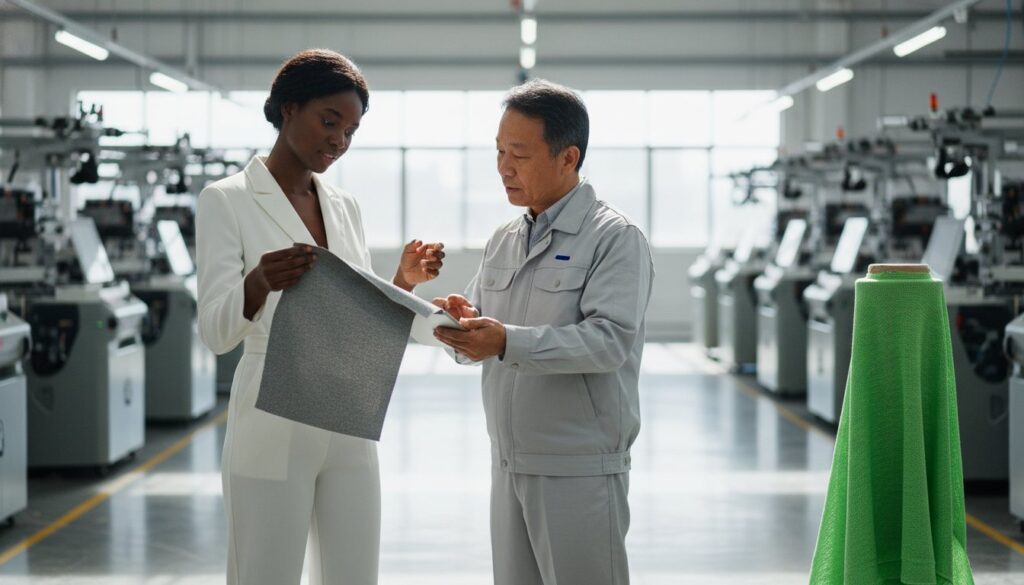
Finding a manufacturer for my clothing brand is less about finding a vendor and more about auditioning a strategic partner who can actually scale with you. I understand the frustration of being ghosted by factories or opening a sample box only to find low-quality activewear that doesn’t meet your standards. Between the new EU Ecodesign regulations taking effect in July 2026 and shifting regional minimum wages in hubs like Vietnam, the margin for error in your supply chain is thinner than ever.
I’ve spent years in the garment industry, and I’ve seen how hidden costs in fabric sourcing or high MOQs can stall a brand before it even launches. I’ll show you exactly how to find, vet, and partner with a world-class manufacturer that acts as a silent backbone for your business. We will break down the production timeline and explore how to secure high-quality sportswear, swimwear, or seamless garments at a fair price without the typical industry headaches.
Key Takeaways
- Understand why global factories are getting pickier in 2026 and how I make sure my brand stays at the top of their priority list.
- Follow my insider process for finding a manufacturer for my clothing brand that specializes in high-tech activewear and performance fabrics.
- Use my vetting checklist to verify a factory’s real capabilities through machinery lists and video tours before you sign any contracts.
- Discover why I look to specialized hubs in Southeast Asia for technical categories like seamless garments, swimwear, and bonded apparel.
- Learn how I use professional tech packs to stop communication errors and keep my production timelines from slipping.
Why Finding a Manufacturer for Your Clothing Brand Feels So Hard Right Now
I’ve spoken to many founders who feel like they’re shouting into a void. You send fifty emails and get three replies; then those three drop off the map the moment you ask about fabric lead times. This “ghosting” isn’t just bad luck or a lack of interest. It’s a symptom of how the global clothing industry has shifted. In 2026, factories are facing higher operational costs and stricter sustainability mandates like the EU’s Ecodesign regulations. They aren’t just looking for orders; they’re looking for professional stability. If your inquiry doesn’t signal that you’re ready for a serious partnership, it gets filtered out.
I believe the biggest reason most brands fail at this stage is the “vendor” mindset. If you treat a factory like a vending machine where you insert money and get clothes, you’ll likely end up with a middleman who marks up prices without adding value. Direct factory partners want to see that you understand the technical side of production. Finding a manufacturer for my clothing brand became a much smoother process once I realized that I wasn’t just buying a service; I was auditioning for a spot on a high-capacity production line.
The ‘Manufacturer Hunt’ Fatigue
I’ve seen hundreds of brands burn out before they even receive a single sample. The fatigue usually sets in after weeks of chasing low prices over reliable communication. It’s a trap. A factory that quotes you the lowest price but takes ten days to answer a simple email will cost you thousands in missed launch dates. I always tell new founders to set realistic expectations. Your first production run is a learning phase for both parties. I suggest prioritizing a partner who offers transparency over one who promises the bottom-dollar price but hides their true machinery capabilities.
Why Your Brand Needs an Insider Strategy
Success in this industry requires a niche-specific approach. I recommend choosing clothing manufacturers based on where the specialized technical infrastructure actually sits. For example, if you are building a line of high-performance sportswear or activewear, you shouldn’t be looking at generalist factories. You need to look at regional hubs like Vietnam, where the expertise in bonded seams and laser-cut apparel is concentrated. Finding a manufacturer for my clothing brand wasn’t just about a Google search; it was about identifying which regions hold the specific machinery needed for my product categories, such as Nuyarn performance wool or seamless garments.
5 Things I Look for Before I Agree to Manufacture a Brand
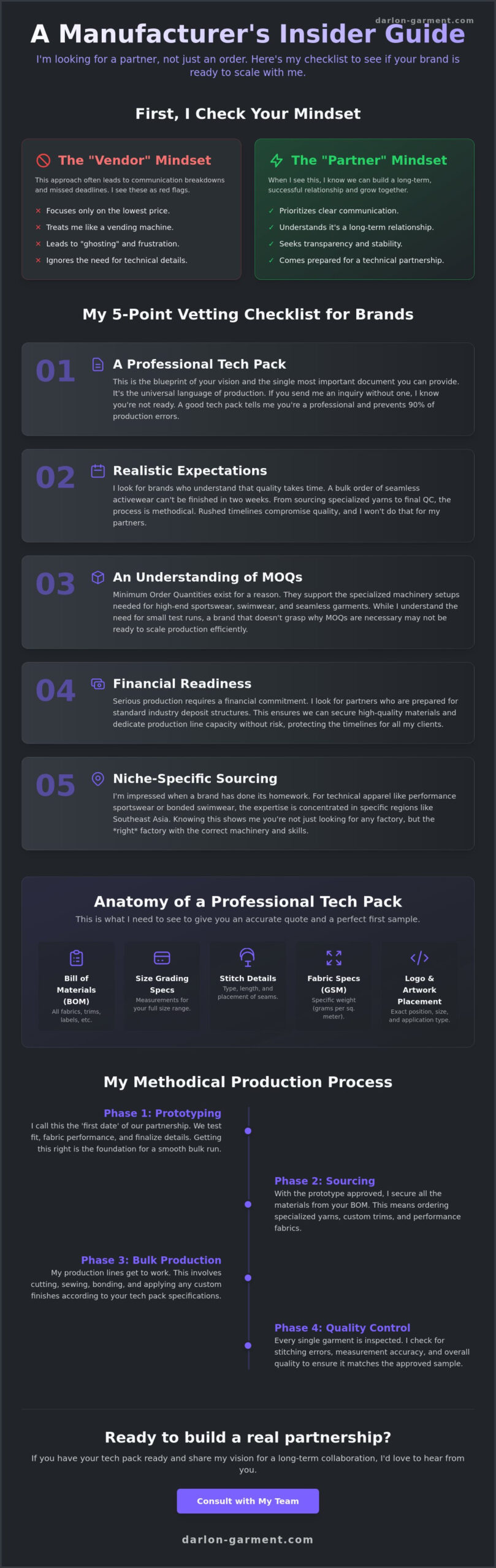
Most guides on the internet focus entirely on what you should demand from a factory. They rarely mention that I, as a manufacturer, am also vetting you. When you’re in the process of finding a manufacturer for my clothing brand, you need to realize that high-capacity facilities look for partners who won’t disrupt their production flow. If I see red flags early on, I’ll likely decline the project to protect my existing clients’ timelines. I want to build a long-term relationship, not just process a one-off order.
The first thing I look for is a professional tech pack. If you don’t have one, we’re both just guessing. A tech pack is the only universal language in this industry. It needs to include a Bill of Materials (BOM), size grading, and specific stitch details. This document prevents 90% of production errors. Without it, your vision is open to interpretation, and that’s where expensive mistakes happen. While finding a clothing manufacturer involves many steps, having your technical data ready is the most important one.
I also look for realistic expectations regarding timelines. I can’t finish a bulk order of seamless garments or activewear in two weeks. Quality takes time. From sourcing specialized yarns to the final quality control check, a standard production cycle has many moving parts. If a brand isn’t financially ready for standard deposit structures or doesn’t understand why Minimum Order Quantities (MOQs) exist, it signals that they might not be ready to scale. Low MOQs are great for testing, but they often don’t support the specialized machine setups required for high-end sportswear or swimwear.
Tech Packs: The Blueprint of Your Business
Think of a tech pack as the architectural blueprint for your house. I need to see exactly what fabric you want, the specific GSM (grams per square meter), and the exact placement of your logos. When I see a detailed tech pack, I know I’m working with a professional. It allows my team to provide an accurate quote and ensures the first sample is as close to perfect as possible. If you need help refining your technical specifications, you can always consult with our team at Darlon Garment for feedback on your designs.
Demystifying the Production Process
The way how garments are made in my facility follows a very methodical sequence. We start with the prototyping phase, which I consider the ‘first date’ of our partnership. This is where we test the fit and the fabric’s performance. I spend the most time here with my clients because a solid prototype is the foundation for a successful bulk run. If we get the sample right, the rest of the line flows smoothly. It’s a collaborative effort that requires clear communication from both sides to succeed.
Navigating the Global Sourcing Map: Why Vietnam Stands Out
In 2026, the map of global apparel production looks very different than it did five years ago. When I talk to founders about finding a manufacturer for my clothing brand, the conversation almost always turns to the shift from China to Southeast Asia. China remains a powerhouse, but rising labor costs and geopolitical trade tensions have made it a risky single-source option. Vietnam has emerged as the primary alternative, not just for basic tees, but for the complex, technical garments that modern activewear brands demand. As of May 2026, ocean freight rates from Vietnam to the U.S. West Coast are holding steady between $1,900 and $2,400 per FEU, making it a logistically sound hub for global distribution.
I’ve positioned my operations in Vietnam because it offers a unique “sweet spot” for international shipping and trade. While reciprocal tariff rates in the region can be high, such as 46% for Vietnam, many brands find the technical mastery and reliability here outweigh the fiscal hurdles. When finding a manufacturer, you have to look at the long-term stability of the region. Vietnam’s minimum wage increase of 7.2% in early 2026 shows a maturing economy that still remains competitive compared to Western manufacturing, with Region 1 wages at approximately USD 204 per month. This stability allows me to maintain high social compliance standards while meeting the strict EU Ecodesign regulations that take effect in July 2026.
The Vietnam Sportswear Hub
If your brand focuses on performance, a sportswear factory in vietnam is often the best strategic choice. The country has invested heavily in specialized machinery that you simply won’t find in generalist facilities. I use laser cutters and seamless knitters to create garments that move with the body, which is essential for high-end activewear and swimwear. We also have incredible access to technical materials like elastane fabric. This proximity to raw material suppliers reduces lead times and allows for more rigorous testing of stretch and recovery before bulk production begins.
Finding the Right Balance of Cost and Quality
I often tell brands that “cheap” is the most expensive choice they can make. A low-cost factory that misses your quality control standards or fails to comply with the new EU Extended Producer Responsibility (EPR) directive will cost you your reputation. I prefer working with FOB (Free on Board) pricing because it provides a clear, transparent breakdown of costs from the factory floor to the port. This transparency is vital as we see a shift toward eco-friendly collections. I’m currently helping many brands source natural fibers to meet consumer demand for circularity, ensuring that finding a manufacturer for my clothing brand leads to a partner who values sustainability as much as you do.
My Checklist for Vetting a Potential Manufacturing Partner
Finding a manufacturer for my clothing brand isn’t just about who can make the product; it’s about who can make it correctly every single time. I’ve seen too many founders rely on digital badges or third-party platform verifications. While those have their place, they don’t replace your own due diligence. You need to look under the hood of the operation. If a factory claims they can produce high-end activewear or Nuyarn performance wool apparel, the first thing I do is ask for their machinery list. If they can’t show me the specific circular knitting machines or bonding equipment they own, they’re likely just a middleman.
I also highly recommend requesting a live video tour. A transparent factory has nothing to hide. I’ll often walk clients through my facility via a video call so they can see the quality control line and the packing area in real-time. This level of transparency builds the trust necessary for a long-term partnership. Pay close attention to their communication speed during this vetting phase. If a factory takes a week to reply to a simple technical question now, imagine how difficult it will be to get an update when your shipment is sitting at the port. I value partners who are as proactive as I am.
Red Flags I Want You to Avoid
One of the biggest red flags is a factory that says “yes” to every single request without asking technical questions. If I don’t ask about your fabric’s GSM or the specific stretch recovery of your elastane, I’m not actually planning your production. Professional manufacturers will push back and ask for details because we want the bulk run to succeed. You should also watch out for vague pricing. If the quote doesn’t explicitly include trims, labels, or sustainable packaging, you’re going to see hidden costs later that kill your cash flow. A lack of formal QC checkpoints in their process is another sign that you’ll end up with inconsistent quality.
The Sampling Phase: Your Real Test
The sampling phase is where the “soul” of the garment is born. I always suggest paying for a high-quality prototype before committing to bulk. This is your chance to see if the factory understands the nuances of your brand. When you receive that sample, don’t just look at the seams. Put it on, wash it, and test the performance of the bonded or laser-cut elements. If you’re looking for a partner who understands these technical complexities, reach out to us at Darlon Garment to discuss your technical requirements.
Remember the difference between an SMS (Salesman Sample) used for your marketing and a PPS (Pre-Production Sample). The PPS is the most important garment you’ll ever hold; it is the exact standard I will use to measure the entire bulk run. If it isn’t perfect, don’t give the green light. Finding a manufacturer for my clothing brand is a marathon, not a sprint, and getting the sampling phase right ensures you don’t trip at the finish line.
How I’ve Built Dar Lon Garment to Help You Scale
I started Dar Lon Garment because I saw how difficult finding a manufacturer for my clothing brand was for founders who wanted to move beyond basic apparel. Most factories are either too small to scale or too large to care about a growing brand’s technical needs. I’ve built this company to be a silent, powerful backbone for global brands. My mission is simple: I provide a one-stop solution where technical mastery meets industrial scale. Whether you are developing high-performance activewear or intricate swimwear, I ensure the process is transparent and methodical.
I’ve invested heavily in specialized infrastructure to handle the most demanding categories. We don’t just sew; we engineer garments using Nuyarn performance wool, seamless technology, and bonded seams. This technical focus is what allows my partners to compete at a world-class level. I keep my clients in the loop from the moment we receive the tech pack until the final shipment leaves the port. This level of transparency is rare in the garment industry, but I believe it’s the only way to build a relationship that lasts for years.
The Dar Lon Difference in Activewear
I’ve worked hard to become the fitness wear manufacturer of choice for brands that prioritize performance over fast-fashion trends. My commitment to precision is visible in every piece of laser-cut apparel we produce. We use automatic sewing machines to maintain consistency across thousands of units, which is a level of detail that manual shops can’t replicate. I also handle the complex sourcing for specialized performance fabrics, so you don’t have to manage multiple vendors for your elastane or recycled polyester needs.
Let’s Start a Conversation About Your Collection
I’m not just looking for a single order; I’m looking for long-term partners who are ready to grow. If you’ve done your homework and have your tech packs ready, I’d love to see what you’re building. Finding a manufacturer for my clothing brand should feel like finding the missing piece of your business puzzle. I enjoy working with brands that are ready to scale—like Adorb Custom Tees, which has carved out a successful niche in themed and matching apparel—and understand the value of technical excellence.
I often point to brands that have successfully mastered their niche as inspiration; you should check out DRIPrDRY if you want to see how a UK brand executes high-quality urban streetwear.
When you’re ready to move from prototyping to bulk production, let’s talk. I can help you understand the complexities of global trade and ensure your sleepwear or sportswear collections meet the highest international standards. Contact Dar Lon Garment today to discuss your production needs and let’s see how we can build your brand’s future together.
Build Your Brand on a Foundation of Technical Excellence
Finding a manufacturer for my clothing brand shouldn’t feel like an impossible puzzle. It’s about moving past the vendor mindset and securing a partner who understands the technical nuances of performance apparel. By focusing on professional tech packs and choosing specialized hubs like Vietnam, you set your brand up for long-term stability and growth. I’ve seen how the right vetting process can turn a stressful launch into a seamless operation.
I’ve built Dar Lon Garment to be that reliable backbone for your business. We provide a one-stop OEM/ODM service for global sportswear brands, specializing in high-performance Nuyarn wool and seamless tech. Our facility in Vietnam features advanced laser-cutting and automatic sewing to ensure every piece meets industrial standards. This technical mastery is the foundation of every successful launch, especially as regulations and consumer expectations evolve in 2026.
If you’re ready to move from a basic sketch to a world-class collection, I’m here to help you navigate the complexities of modern production. Explore Dar Lon Garment’s Manufacturing Solutions and let’s start building your legacy. You’ve got the vision; now it’s time to back it up with the right infrastructure. I look forward to seeing what we can create together.
Frequently Asked Questions
How do I find a clothing manufacturer for my small business with low MOQs?
I recommend focusing your search on factories that specialize in small-batch production or offer flexible “sampling-to-bulk” programs. Many facilities in Southeast Asia now provide tiered Minimum Order Quantities (MOQs) where you pay a higher unit price for smaller runs. This approach allows you to protect your cash flow while testing new activewear or swimwear designs before committing to a full-scale production run.
What is the best country to manufacture clothing in 2026?
Vietnam is currently the leading choice for brands that require a mix of technical expertise and logistical stability. As of May 2026, ocean freight rates from Vietnam to the U.S. West Coast remain competitive, ranging between $1,900 and $2,400 per 40ft container. I’ve found that the country’s advanced infrastructure for specialized categories like seamless garments and performance sportswear makes it more reliable than many emerging markets.
How much does it cost to start a clothing line with a manufacturer?
Costs are determined by your technical specifications and fabric choices rather than a single flat fee. You’ll need to budget for the prototyping phase, raw material sourcing, and bulk production. Most professional factories follow a standard payment structure, often requiring a 30% to 50% deposit before fabric is even ordered. I suggest setting aside a contingency fund for shipping and import duties to avoid surprises.
Do I need a tech pack to talk to a clothing manufacturer?
Yes, you absolutely need a tech pack to have a productive conversation with any high-capacity factory. It acts as the technical blueprint for your garment, detailing the Bill of Materials (BOM), size grading, and specific stitch requirements. Without this document, I can’t provide an accurate quote or ensure that your first sample will meet your quality standards. It is the only way to prevent expensive production errors.
How can I tell if a clothing manufacturer is ethical and sustainable?
I look for transparency in their waste management and labor practices, specifically compliance with the EU’s Ecodesign for Sustainable Products Regulation (ESPR). Starting July 19, 2026, large enterprises are prohibited from destroying unsold textiles; a sustainable factory should already have circularity protocols in place. Ask for a live video tour of the facility and proof of their social compliance certifications to verify their claims about ethical operations.
What is the difference between OEM and ODM manufacturing for clothing?
OEM (Original Equipment Manufacturer) means I produce garments based exactly on your unique designs and tech packs. ODM (Original Design Manufacturer) involves you selecting from my pre-existing library of designs and adding your branding. The process of finding a manufacturer for my clothing brand usually starts with deciding if you want full creative control or a faster, design-ready route to market for your sleepwear or activewear collections.
How long does the clothing manufacturing process take from start to finish?
A typical production cycle takes between three and six months from the initial tech pack submission to final delivery. This timeline includes several weeks for prototyping and fit adjustments, followed by bulk fabric sourcing and the actual sewing phase. I find that brands that rush the sampling stage often face longer delays during the final quality control checks, so it’s better to build a realistic buffer into your launch calendar.
Can a manufacturer help me source fabrics and trims?
Yes, I offer comprehensive sourcing as part of a one-stop manufacturing solution for my clients. This includes leveraging my established relationships with yarn and trim suppliers to find the best performance materials for your collection. This integrated approach simplifies the process of finding a manufacturer for my clothing brand because it keeps the entire supply chain, from raw material to finished bonded apparel, under a single point of contact.