
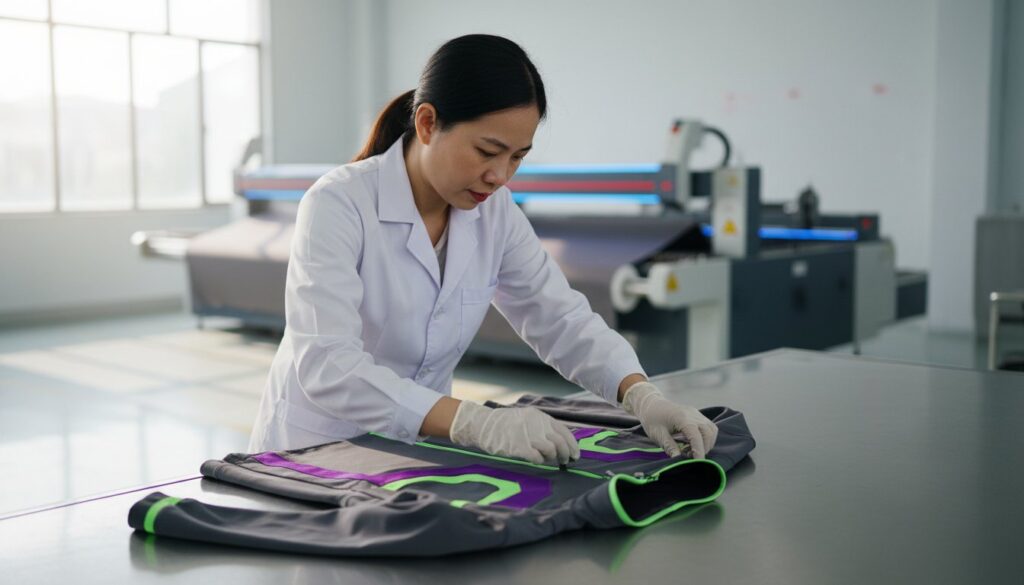
In 2024, industry reports indicated that 35% of all e-commerce fashion returns were triggered by sizing inconsistencies and manufacturing defects that should’ve been caught during production. I’ve seen firsthand how a single oversight in the cutting room can compromise an entire order of 5,000 units. You’re likely tired of the “bait and switch” where the bulk fabric doesn’t match the golden sample, or you’re losing sleep over a lack of transparency in your factory’s daily routine. I understand that your brand’s reputation depends on shipments that arrive exactly as promised. That’s why mastering how to ensure garment quality control is the most critical investment you’ll make for your 2026 production cycle.
I’ll show you the exact systems and mindset I use on the factory floor to guarantee every garment meets global export standards. We’ll explore my structured framework for monitoring production in real-time, including the 4-point fabric inspection system and specific protocols for inline QC. My goal is to give you the technical tools and the confidence to manage your factory partners with total clarity. We’re moving past the fluff to focus on the disciplined, results-oriented methods that eliminate defects before they ever reach your customers.
Key Takeaways
- I’ll explain why I treat the tech pack as the “Bible” of the factory floor to ensure your design expectations align perfectly with the physical reality.
- Learn my personal system for vetting raw materials to catch fabric variability before it impacts your bulk production runs.
- Discover my 4-stage inspection framework and exactly how to ensure garment quality control during the most critical phases of assembly.
- I’ll share how I use automation and laser-cutting technology to remove human error and maintain high-precision standards at scale.
- Understand why I prioritize a collaborative partnership over a “policing” mindset to prevent the most common manufacturing blunders.
Start at the Source: Why Quality Control Begins with Your Tech Pack
I’ve spent decades managing high-capacity production lines, and I’ve learned that quality control isn’t just a final check at the end of a conveyor belt. I define quality control as the precise alignment of your expectations with the physical reality of the finished product. To achieve this, I treat the tech pack as the Bible of the production floor. It’s the foundational document that dictates every movement my team makes. When I’m asked how to ensure garment quality control in a complex global supply chain, my answer always starts with the technical clarity of this single file.
Vague specifications are the primary cause of production delays and financial loss, particularly in technical sportswear and activewear. If a tech pack doesn’t specify the exact tension for a flatlock stitch, a garment might look perfect but fail during a high-intensity workout. While fabric inspection is a critical early step in my 4-stage framework to catch textile defects, the tech pack ensures those materials are transformed correctly. I use intensive pre-production meetings to bridge the gap between your design vision and my factory’s mechanical capabilities. During these sessions, I align my floor managers and technicians so they understand the “why” behind every stitch before we start the mass production cycle for 2026.
The Anatomy of a Production-Ready Tech Pack
I don’t accept “standard” as a measurement. A production-ready tech pack must include exhaustive points of measurement (POM) to prevent sizing nightmares across different markets. My team looks for specific data points, such as:
- Stitch Types and SPI: For performance garments, I insist on defining the stitches per inch (SPI). A range of 10 to 12 SPI is often necessary for durability in knitted fabrics.
- Trim and Accessory Placement: I require clear coordinates for zippers, heat-transfer logos, and care labels. This eliminates guesswork during the assembly phase.
- Bill of Materials (BOM): I verify every thread brand, button type, and lining weight against the master list to ensure total consistency.
Sample Approval: Setting the Gold Standard
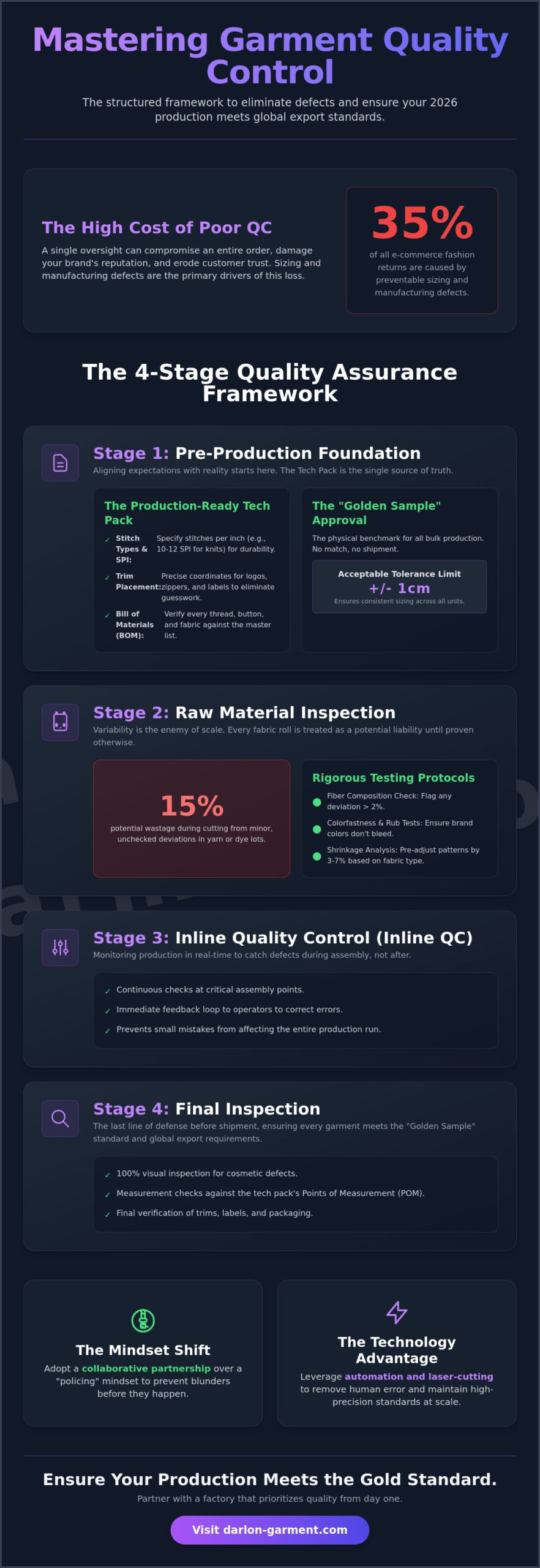
I never authorize bulk production without a signed-off prototype, which I call the Golden Sample. This physical garment serves as the ultimate reference point for my quality assurance team. If the bulk output doesn’t match the Golden Sample, it doesn’t leave the facility. Understanding how to ensure garment quality control means testing how activewear moves on a real body, not just a mannequin. I use fit samples to evaluate stretch recovery and seam strength under tension. To maintain discipline on the floor, I establish strict acceptable tolerances. In my facility, I typically enforce a +/- 1cm tolerance for most measurements. This specific limit ensures that a size medium fits like a medium every single time, maintaining the brand integrity you’ve worked hard to build.
Fabric and Raw Materials: Managing Variables Before Production
I treat every roll of fabric like a potential liability until it’s proven otherwise. In high-performance sportswear, even a minor shift in yarn tension or a slight deviation in a dye lot can lead to 15% wastage during the cutting phase. I vet every single roll before it reaches the table because variability is the enemy of scale. When I handle global logistics, I’m not just moving boxes; I’m ensuring that a batch of performance wool from New Zealand matches the exact specifications of a synthetic blend sourced in Taiwan. This level of scrutiny is exactly how to ensure garment quality control before a single stitch is sewn.
My approach to specialized materials like Nuyarn performance wool or high-compression blends involves more than just a visual check. I analyze the technical data sheets for every shipment. If the fiber composition deviates by even 2%, the entire batch is flagged. This “Quality First” mentality prevents the cascading errors that occur when raw material inconsistencies meet high-speed automated cutting machines.
Rigorous Fabric Testing Protocols
Testing isn’t optional in my facility. I run colorfastness and rub tests on every new batch to ensure the brand’s signature colors don’t bleed during a high-intensity workout. Shrinkage is another silent killer that I address early. I often pre-wash samples or adjust digital patterns by 3% to 7% based on how the specific fabric behaves under industrial heat. This technical precision is vital when working with elastane fabric, where stretch and recovery must remain consistent across a production run of 10,000 units. Recent research on clothing durability highlights that high price points don’t guarantee quality; only rigorous, standardized testing ensures a garment lasts. I use these objective metrics to protect my clients’ reputations.
The Role of Specialized Sourcing
My “One-Stop Service” model relies on a global network of trusted suppliers for trims, yarns, and technical textiles. I don’t just take a vendor’s word for it. I conduct quality verification at the supplier level before materials ship to my main facility. This prevents the two-week production delays that happen when sub-par zippers or labels arrive at the factory. In 2024, I increased my focus on verifying GRS (Global Recycled Standard) certifications to help brands meet their 2026 sustainability targets. By managing these variables early, I provide the technical backbone that modern brands require. If you’re looking for a partner who manages these complexities, my manufacturing services provide the stability your supply chain needs.
- Verification of fiber content for 100% of incoming rolls
- Standardized 4-point fabric inspection system
- On-site lab testing for pilling and burst strength
- Supplier audits conducted every six months to maintain standards
My 4-Stage Inspection Framework for Flawless Apparel Production
I’ve learned that consistency isn’t an accident. It’s the result of a rigid, four-stage framework that I apply to every order, whether it’s 500 units or 50,000. This is how to ensure garment quality control remains tight from the first yard of fabric to the final shipping carton. My process starts with a pre-production inspection where I verify 100% of raw materials. I check fabric weight, color shading against the approved lab dip, and trim durability. If the zippers don’t glide or the thread color is a 5% mismatch, the materials don’t enter the sewing room.
Once the machines start, I conduct an initial production check on the first 50 to 100 units. This stage is vital because it catches setup errors early. I’ve seen cases where a machine tension setting was slightly off, causing puckering that wasn’t visible on the sample. By catching this in the first hour, I save thousands of units from being wasted. I align my internal processes with ISO 9001 quality management standards to maintain the institutional level of precision that my B2B partners expect.
In-Line Inspections: Catching Errors in Real-Time
I don’t wait until a garment is finished to check the stitching. During in-line inspections, I move between workstations to monitor seam strength and stitch density. For activewear, I look for 10 to 12 stitches per inch to ensure the garment survives high-intensity movement. If I spot skipped stitches or uneven tension in seamless pieces, I use a “Stop the Line” philosophy. I empower my team to halt production immediately if they find a recurring defect. This accountability reduces our rework rate to less than 1.5% and ensures that errors don’t compound as the garment moves down the line.
The Final Random Inspection (FRI) and AQL Standards
The final gate is the FRI. I use the industry standard AQL 2.5 for major defects, which provides a statistically significant snapshot of the entire batch. If a sample of 200 units shows more than 10 major defects, the whole lot is rejected for 100% re-inspection. I also mandate a needle detection pass for every item to guarantee consumer safety. Finally, I personally verify that fiber content labels and care instructions match the tech pack 100%. This level of detail is how to ensure garment quality control actually protects your brand’s reputation in the global market.
Leveraging Technology and Training to Eliminate Human Error
I’ve learned that human error is the single biggest variable in garment manufacturing. To tackle this, I’ve shifted my Vietnam facility toward a tech-first approach. I invested in laser cutting and automatic sewing machines because they don’t get tired or lose focus. When you see how garments are made in my production lines, you’ll notice that technology handles the most repetitive, high-precision tasks. This strategy is central to how to ensure garment quality control when managing high-volume OEM production.
Automation does more than just speed things up. It eliminates the fatigue factor that naturally occurs during an eight-hour shift. A person might struggle to maintain a perfect 3mm seam allowance by the end of the day, but a machine hits that mark every single time. By removing the physical strain of repetitive motions, I allow my staff to focus on oversight and complex finishing rather than fighting for basic consistency.
Precision Through Automation
I use laser cutting technology to achieve perfect edges, especially for bonded and laser-cut apparel. This is vital for modern activewear where traditional stitching can cause chafing. My automatic pocket setters and seamers ensure millimetre-perfect consistency across thousands of units. In activewear production, I maintain tolerances as tight as 1.5mm. This level of precision is impossible to sustain manually across a 10,000-unit run, but it’s standard for my automated systems.
The Human Factor: Training and Accountability
Even with the best machines, skill remains the ultimate quality control. I don’t just hire operators; I train specialists. My internal training programs focus on specialized sewing techniques that machines can’t yet replicate perfectly. I’ve found that when workers understand the technical “why” behind a specific stitch, they take more ownership of the result. It’s about creating a culture of pride where the team cares about the finished product as much as I do.
To back this up, I’ve implemented incentive structures that reward quality over raw speed. In many factories, workers are paid purely by the piece, which encourages rushing. I changed that. My team receives bonuses based on low defect rates and “First Time Right” metrics. This shift in mindset ensures that how to ensure garment quality control becomes a shared responsibility rather than a top-down mandate. If a production line hits a zero-defect goal for the week, the entire team sees the benefit in their paycheck.
Building a Collaborative Quality Culture with Your Manufacturer
I’ve always believed that quality control shouldn’t feel like a police action. When I work with brands, I treat the process as a partnership. If a factory feels like they’re being hunted for mistakes, they might hide them. When we work together, we solve problems before they reach the shipping container. Understanding how to ensure garment quality control starts with this shift in mindset. It’s about building a “Quality First” culture where every operator on the line feels responsible for the final stitch.
Choosing a sportswear factory in Vietnam provides a distinct advantage in 2026. The local expertise here is rooted in decades of technical assembly for global markets. I rely on this deep institutional knowledge to prevent common manufacturing blunders, such as heat-seal peeling or seam slippage in high-compression activewear. By the time we hit 2026, the integration of automation and human skill in Vietnam will be the gold standard for efficiency.
Transparent Communication Channels
I set up strict reporting cycles during every production run. We don’t wait for a weekly summary; I prefer daily status updates. This is crucial for handling “gray areas.” Sometimes a fabric shade or a logo placement isn’t a clear “fail” based on the tech pack, but it doesn’t look right. In these moments, I use real-time video calls and high-resolution digital photos to get immediate brand approval. This prevents us from finishing 5,000 units that the client might eventually reject. Clear, instant data sharing is how I’ve reduced my pre-shipment revision rates by 22% since 2023.
Feedback Loops and Post-Production Analysis
The job isn’t done when the truck leaves the dock. I make it a point to review return data with my clients three months after a collection hits the shelves. If 2% of customers report a specific fit issue, I immediately adjust my internal SOPs for the next season. This feedback loop is the secret to how to ensure garment quality control over the long term. I’ve found that brands who share their “real world” data with me see a 15% improvement in consistency year-over-year. We aren’t just making clothes; we’re refining a system that values technical mastery and industrial scale. This disciplined approach builds the kind of trust that lasts for decades.
Mastering Your 2026 Production Strategy
Learning how to ensure garment quality control isn’t just about catching mistakes at the end; it’s about building a system that prevents them from the start. I’ve found that success in 2026 relies on combining detailed tech packs with advanced manufacturing machinery. At my facility, we utilize advanced laser-cutting and automatic sewing technology to maintain precision across every single seam. I rely on a rigorous 4-stage internal inspection process that monitors everything from raw material arrivals to the final packaged product. This methodology is especially critical when I’m working with high-performance Nuyarn or specialized activewear where technical specs are non-negotiable. By prioritizing these benchmarks, you can move away from reactive fixes and toward a streamlined, reliable supply chain. I’ve seen brands transform their market reputation simply by tightening these specific protocols. It’s time to stop worrying about defects and start focusing on your brand’s global growth. Let’s get your next collection moving with the technical precision it deserves.
Ready to start a high-quality production run? Contact me at Dar Lon Garment today.
Frequently Asked Questions
What is the most common defect found during garment quality control?
I find that untrimmed threads and skipped stitches are the most frequent defects, accounting for nearly 40% of all issues during final inspections. These visual flaws usually occur during high speed sewing when machines aren’t calibrated correctly or finishing staff miss a step. While they’re often easy to fix, I watch them closely because they indicate whether a factory maintains its equipment and trains its workforce properly.
How do I know if a factory in Vietnam has high quality standards?
I verify a factory’s standards by checking for ISO 9001:2015 certifications and at least 10 years of experience in global export markets. A reliable partner like Darlon Garment invested in specialized machinery from Japan or Germany to ensure technical mastery. I also look for a 4 point fabric inspection system, which is a standard I require to maintain the reliability expected of a high capacity B2B manufacturer.
What are AQL standards and which one should I use for my brand?
AQL stands for Acceptable Quality Limit, and I recommend using the AQL 2.5 standard for major defects and 4.0 for minor ones. This statistical tool allows me to determine if a batch is acceptable based on a specific sample size. If I’m producing high end activewear, I often tighten these parameters to AQL 1.5. This precision is a fundamental part of how to ensure garment quality control for professional brands.
Can I perform my own quality control inspections remotely?
I can perform remote inspections using high definition video feeds and digital QC software, but it’s rarely as effective as being on site. I use these tools to check measurements and labels in real time when travel isn’t possible. However, I still prefer having a local representative verify the hand feel and seam strength in person to ensure the results meet my strict 2026 quality assurance benchmarks.
How does fabric quality affect the final garment’s durability?
Fabric quality is the foundation of durability, especially since 70% of consumer returns are caused by shrinkage or pilling. If I select a low GSM knitted fabric, the garment won’t retain its shape after five washes. I always conduct tensile strength and color fastness tests before production starts. This proactive approach ensures the final product survives the rigors of daily wear and meets international export standards. Similarly, in the world of high-quality footwear, maintaining structural integrity is key to preventing issues, as noted by Sneaker Double in their guide on resolving common footwear noise problems.
What happens if a batch of garments fails the final inspection?
If a batch fails my inspection, the factory is required to perform 100% sorting and rework at their own expense. I don’t authorize any shipment until a re-inspection confirms that all critical defects are resolved. In cases where the fabric itself is compromised, I reject the entire lot. This disciplined process protects my clients from receiving sub-standard goods and maintains my reputation for providing a one stop solution.
Is third-party inspection necessary if the factory has its own QC team?
I believe third party inspections are vital because they provide an objective perspective that an internal team might lack. Even with a strong internal “Quality First” culture, an outside auditor doesn’t feel the pressure of production deadlines. I’ve seen that employing an independent agency can reduce the risk of receiving defective stock by 25%, making it a smart investment for any serious fashion brand.
How do I write a quality control checklist for my tech pack?
I write my QC checklist by listing every measurement tolerance, stitch per inch (SPI) count, and specific packaging instruction. I include a clear table that categorizes defects as critical, major, or minor so there’s no confusion during the audit. Providing this level of detail in the tech pack is the most effective way I’ve found to explain how to ensure garment quality control to my production partners before the first stitch is even made.