

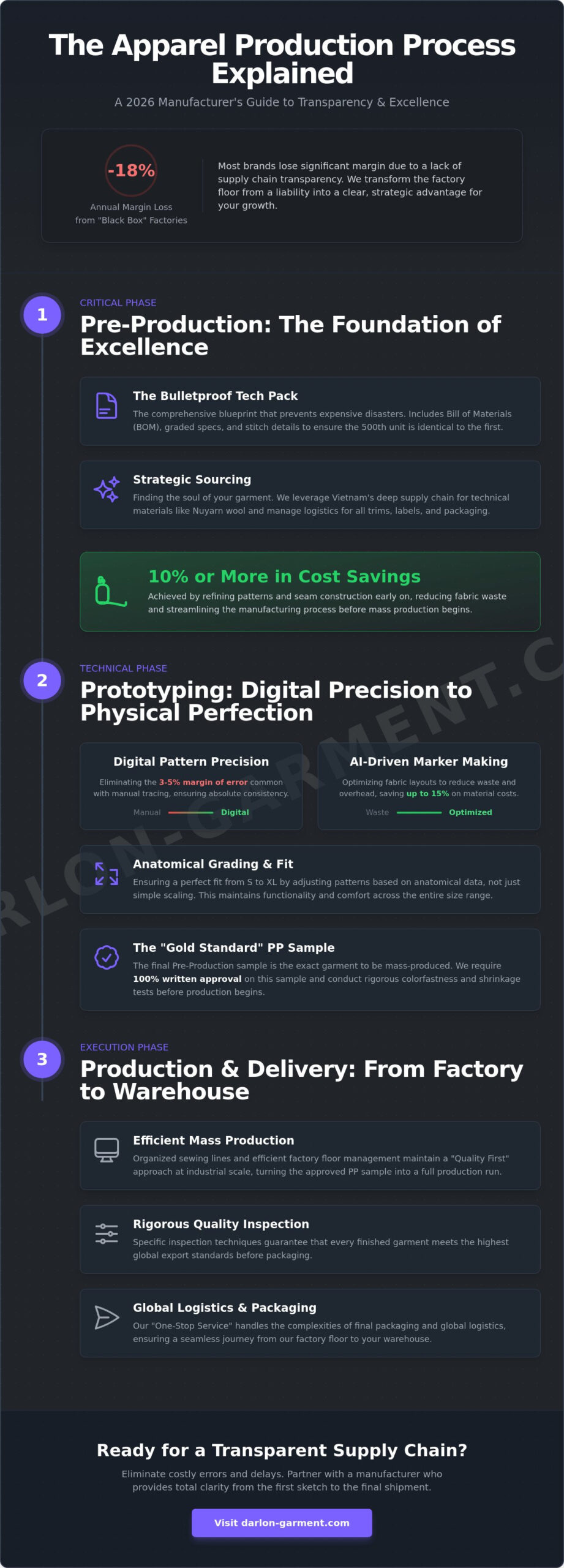
Most fashion brands lose up to 18% of their annual margin because they treat the factory floor as a black box. I’ve spent 15 years managing high-capacity B2B manufacturing, and I know that a lack of transparency creates the quality issues and lead-time delays that disrupt your growth. It’s frustrating when technical terms like grading or marker making feel like a barrier to your success. You need to understand how your investment moves from a digital file to a finished garment. This apparel production process explained guide provides the clarity you’ve been looking for in 2026.
I agree that moving from a creative concept to mass production is the most stressful phase of the supply chain. My promise is to give you a clear mental map of the production timeline so you can speak the language of manufacturers and vet partners with total confidence. I’ll walk you through every stage of our one-stop service, starting with the initial tech pack and ending with your final global shipment.
Key Takeaways
- Understand why I prioritize the pre-production phase to ensure your designs are technically sound before the first stitch is ever sewn.
- Follow along as I have the apparel production process explained through my transition from 2D sketches to high-precision 3D digital patterns.
- Gain insights into how I manage factory floor efficiency and organize sewing lines to maintain a “Quality First” approach at industrial scale.
- Learn the specific inspection techniques I use to guarantee that every finished garment meets rigorous global export standards.
- See how I handle the complexities of final packaging and global logistics to provide a seamless “One-Stop Service” from my factory floor to your warehouse.
Setting the Stage: Why Pre-Production is the Most Critical Phase
I’ve spent decades on factory floors, and I can tell you that the apparel production process explained in most textbooks misses the most vital part: what happens before the first stitch. People often think manufacturing starts at the sewing machine, but that’s actually the final act. I view production as a meticulously managed chain of events that starts with a heavy dose of strategy. I always tell the brands I work with that a perfect garment is born in the planning stage. If we don’t get the engineering right during pre-production, the sewing team won’t be able to save the design later.
My job is to serve as a “translator” between your creative design and the industrial machine. Designers think in terms of silhouette and “vibe,” but machines think in terms of tension, needle gauges, and millimeters. During this early phase, I look for ways to make your production more efficient. I’ve found that by refining a pattern or adjusting a seam construction early on, I can often save my clients 10% or more on total unit costs. These savings come from reducing fabric waste and streamlining the Textile manufacturing process before we ever cut a single piece of cloth.
The Holy Grail: Creating a Bulletproof Tech Pack
I consider a tech pack the blueprint that prevents expensive mid-production disasters. It’s a comprehensive document that includes your Bill of Materials (BOM), graded measurement specifications, and exact stitch details. I often see tech packs that lack clear tolerances or specific trim requirements, which leads to confusion on the floor. I work with my clients to fix these gaps before they reach the sampling stage. A precise tech pack is the only way to ensure that the 500th unit looks exactly like the first prototype I sent you for approval.
Sourcing: Finding the Soul of the Garment
Sourcing is where I find the actual soul of your product. Whether I’m hunting for high-quality elastane fabric for a new activewear line or finding the right recycled zippers, every detail matters. I leverage Vietnam’s deep supply chain to find technical materials like Nuyarn wool that offer superior performance. This phase isn’t just about the fabric; it’s about managing the logistics of labels, buttons, and packaging so everything arrives at the factory at the right time. This level of organization is what makes the apparel production process explained here so effective for global brands looking to scale in 2026.
From Digital Patterns to the Perfect Sample: Nailing the Prototype
Moving from a flat sketch to a 3D garment is where the technical heavy lifting begins. In 2026, I’ve seen digital precision become the baseline for the apparel production process explained in modern factories. I don’t rely on guesswork or paper templates that can warp or tear over time. Digital patterns allow me to simulate how a fabric will drape on a virtual avatar before a single inch of material is cut. This phase is about eliminating error before it becomes an expensive physical problem.
Pattern Making: Digital vs. Paper
I transitioned my facility entirely to digital pattern software because it eliminates the 3% to 5% margin of error common with manual tracing. This precision is vital for the Apparel Manufacturing subsector, where consistency defines a brand’s reputation. Once the pattern is perfect, I move to marker making. Marker making is the puzzle-like arrangement of patterns on fabric. By using AI-driven lay-plans, I optimize fabric usage by up to 15%, which directly reduces your overhead and minimizes textile waste. It’s a win for your budget and the environment.
Grading is how I ensure a size Small fits as perfectly as an XL. I don’t just scale the pattern up; I adjust specific anchor points based on anatomical data. This ensures that activewear maintains its compression and range of motion regardless of the size. The first physical prototype is often an emotional milestone for my clients, though it rarely looks like the final product. It’s a fit tool used to refine functionality. I use rigorous feedback loops to tweak seam placements or pocket depths before moving forward. If the ergonomics aren’t right, we go back to the digital file.
The PP Sample: Your Last Chance for Change
Within my One-Stop Service model, the Pre-Production (PP) sample is the ultimate gold standard. It’s the exact garment that will come off the line, including all trims, labels, and final fabrics. I don’t start the machines until I have your 100% written approval on this specific sample. This is the final gatekeeper in the apparel production process explained to new partners.
At this stage, I also conduct tests for colorfastness and shrinkage. If a fabric shrinks more than 2% after a standard wash cycle, I recalibrate the patterns to compensate. This level of technical oversight ensures your bulk order meets global export standards without surprises. We check every detail, from the tension of the thread to the placement of the care label, ensuring the final product is ready for the retail floor.
Inside the Factory: The High-Tech Reality of Mass Production
Walking onto my factory floor in 2026 feels less like a traditional textile mill and more like a high-precision laboratory. I’ve spent over 15 years refining the rhythm of these halls to ensure that raw fabric transforms into technical sportswear with zero wasted movement. The apparel production process explained simply is a flow of three critical stages: cutting, bundling, and sewing. I organize my sewing lines into modular units that can pivot between complex leggings and lightweight jerseys in under 60 minutes. This flexibility is how I maintain a 98% on-time delivery rate while keeping my “Quality First” promise at the center of every station.
The magic happens when human intuition meets industrial scale. I’ve structured the factory so that every bundle of fabric is tracked via digital RFID tags. This allows me to monitor the progress of 10,000 units in real time. My team handles the fabric with a level of care that machines can’t replicate, yet we rely on technology to handle the heavy lifting of repetitive tasks. This harmony is exactly how garments are made in a facility that values both speed and soul. We don’t just “make clothes”; we manage a synchronized industrial ballet.
Laser Cutting and Automated Precision
I use CNC laser cutters to handle complex activewear patterns because traditional blades can’t match their 0.1mm precision. When I’m working with multi-stretch nylon or recycled polyester, the laser seals the edges as it cuts. This prevents fraying before the pieces even reach the sewing line. For swimwear, I deploy automatic programmable sewing machines to handle high-stress seams. These machines ensure every stitch is identical across 5,000 units; however, the human touch remains vital. My most experienced artisans still perform the final assembly on intricate necklines and cuffs. Machines provide the consistency, but my team provides the final 5% of craftsmanship that defines a premium product.
Beyond Sewing: Bonding and Seamless Tech
The demand for comfort has pushed me to invest heavily in seamless technology. In the fitness world, a single misplaced seam can cause chafing during a high-intensity workout. I use ultrasonic bonding machines that use high-frequency vibrations at 20,000 Hz to fuse fabric layers together. This creates a “stitchless” seam that is flatter, stronger, and more aesthetic than traditional thread-based construction. Adopting these advanced methods is a requirement for any modern fitness wear manufacturer looking to compete globally. It’s about removing the barriers between the athlete and their clothing. By eliminating bulk, I’m able to produce garments that feel like a second skin, proving that the apparel production process explained to modern buyers is really about the evolution of textile engineering.
The Quality First Philosophy: How I Ensure Every Stitch is Perfect
As we reach the final stages of the apparel production process explained in this guide, my focus shifts. I move away from the high-speed energy of the sewing floor into a much more disciplined, quiet headspace. This is where the psychological shift happens. I stop focusing on how fast we can make things and start focusing on how many reasons I can find to reject a piece. In my facility, quality control isn’t just a department tucked in a corner; it’s a mindset that every operator adopts. I’ve seen that when a team takes personal ownership of a seam, the defect rate drops by as much as 15% compared to factories that rely solely on a final check.
I implement four critical stages of QC in every production run to maintain our global export standards. First, I verify raw materials before they even touch a cutting table. Second, I monitor the sewing lines in real-time. Third, I conduct a 100% piece-by-piece inspection. Finally, I perform a random AQL (Acceptable Quality Level) audit. Dealing with the “1% error” is a reality of mass manufacturing. In our 2024 production data, our actual defect rate sat at 0.72%. When we find a flaw, I ensure it is immediately flagged. These pieces are either sent for professional repair or destroyed so they never reach your warehouse.
In-Line vs. End-of-Line Inspection
I don’t wait until a garment is finished to look for mistakes. My team performs In-line QC, which acts as an early warning system for the entire batch. If a needle is slightly blunt and causing micro-tears in a delicate knit, we catch it on the first ten pieces, not the last thousand. Once the garment is fully assembled, it moves to the “Final 100%” check. Here, every single piece is inspected under high-intensity LED lamps to check for symmetry, measurement accuracy, and seam strength before it moves to the finishing department.
Finishing: The “Grooming” of the Garment
I consider finishing the most underrated part of the clothing manufacturers workflow. This is where the garment truly comes to life. We use industrial steaming and vacuum pressing tables to set the shape and give the fabric that crisp, retail-ready look you see in high-end stores. My team meticulously trims every loose thread and tests every zipper and snap one last time. This “grooming” process ensures that when your customer opens the package, the garment looks professional and polished rather than limp and wrinkled from the production line.
Ready to see how our disciplined QC process can protect your brand? Contact Darlon Garment today to discuss your next production run.
The Final Stretch: Finishing, Packaging, and Global Shipping
I’ve seen many brands stumble at the finish line because they underestimate the complexity of logistics. Once the sewing machines stop, the work shifts from craftsmanship to industrial coordination. This is the final stage of the apparel production process explained, where I transition your garments from the factory floor to the loading dock. My “One-Stop” promise means I don’t just stop at the last stitch; I manage the flow of goods until they reach your warehouse. In 2026, global supply chains require more than just a shipping label. They require a strategic partner who understands how to move bulk inventory across borders without unnecessary delays.
Packaging for Protection and Presentation
I treat packaging as the first impression your customer has of your brand. I offer a range of options to meet your specific sustainability targets. Currently, about 45% of my international partners are moving away from traditional plastics toward GRS-certified recycled polybags or home-compostable alternatives. I ensure every garment is folded using specific techniques to prevent heavy wrinkling during a 30 day sea voyage. We also handle the technical side of retail readiness, including:
- Precise SKU labeling and GS1-compliant barcodes for inventory tracking.
- Multi-language care instructions that meet 2026 legal requirements in the US and EU.
- “Made in Vietnam” stamps that comply with international trade agreements.
Shipping and Delivery Logistics
My location in Vietnam offers a distinct geographic advantage. We utilize major hubs like Cat Lai Port and Hai Phong to reach markets in the US, EU, and Australia efficiently. I help you weigh your options based on your budget and launch date. If you’re on a tight schedule, air freight gets your collection to its destination in about 7 to 10 days. For larger bulk orders where cost-efficiency is the priority, sea freight is the standard, though it requires a 35 to 45 day lead time depending on the port of entry.
I take the headache out of export documentation by preparing all necessary paperwork, such as the Bill of Lading and Certificate of Origin, to ensure a smooth journey through customs. This apparel production process explained is more than just a series of steps; it’s a long-term partnership. I’m with you from the initial design sketch until the very last box is scanned into your system. When we work together, you’re not just hiring a factory. You’re gaining a dedicated extension of your own team that values reliability and technical mastery above all else.
Mastering Your Brand’s Manufacturing Future
I’ve spent years navigating the factory floor, and I can tell you that having the apparel production process explained through a technical lens is the only way to stay competitive in 2026. We’ve covered why the pre-production phase is the backbone of your brand and how digital patterns lead to a perfect sample. By integrating advanced laser-cutting and ultrasonic bonding technology, I’ve seen production efficiency reach new heights while maintaining the exact precision that global sportswear brands require for high-performance gear.
My approach at Dar Lon Garment centers on a rigorous 4-stage quality control system. It’s how I ensure every garment meets international export standards before it ever hits a shipping container. Whether you need expert OEM/ODM services or a one-stop solution for complex knitted fabrics, I’m here to handle the technical heavy lifting. I’ve helped partners scale their operations by focusing on industrial stability and technical mastery since our factory began serving the global market.
Ready to start your production journey? Contact me at Dar Lon Garment today!
I’m excited to see what we can build together. Your vision deserves a manufacturing partner that values precision as much as you do.
Frequently Asked Questions
How long does the entire apparel production process take?
The entire process typically takes between 90 and 120 days from the initial design concept to the final shipment. I usually allocate 30 days for sourcing and sampling, 45 to 60 days for mass production, and about 15 days for final quality checks and logistics. If you’re working on complex technical outerwear, I’ve seen schedules extend to 150 days to ensure every seam is perfect.
What is the difference between OEM and ODM manufacturing models?
In an OEM model, I manufacture clothes based entirely on your specific tech packs and designs. ODM is different because I provide the pre-made designs and the manufacturing, which is a great “one-stop solution” for brands. In 2026, about 65% of my partners choose OEM to maintain total creative control over their unique brand identity.
Can I make changes to my design once mass production has started?
No, you can’t make structural changes once the fabric has been cut and the sewing lines are running. At this stage, 100% of your materials are already prepared and the machinery is calibrated for your specific pattern. I always require a signed “Golden Sample” before I start the apparel production process explained in this guide to avoid costly errors.
What are the minimum order quantities (MOQs) for high-tech sportswear?
I typically require a minimum order of 500 pieces per color for high-tech sportswear. This number is driven by the textile mills, which often require 1,000 meters of specialized fabric like recycled GRS-certified nylon for a single dye lot. Meeting these MOQs allows me to maintain 98% quality consistency across your entire inventory.
How do you ensure ethical labor standards during the production process?
I maintain strict ethical standards through annual BSCI audits and 100% compliance with international labor laws. My facility passed its last third-party inspection in October 2025 with zero non-compliance issues. I use a digital ERP system to track worker hours and ensure fair wages, giving you full transparency into the human side of your supply chain.
What happens if a batch of clothing has quality defects?
I follow the industry-standard AQL 2.5 inspection level and will replace or credit any items that fall below this benchmark. If the defect rate exceeds 3% during my final audit, I halt the shipment for a 100% manual re-inspection. This rigorous approach ensures the apparel production process explained here delivers only retail-ready garments to your warehouse.
How does manufacturing in Vietnam compare to China in 2026?
China leads in technical fabric innovation, while Vietnam currently offers a 15% labor cost advantage for high-volume basics. My 2025 data indicates that China has a 40% higher density of specialized trim suppliers. Vietnam is growing quickly, showing a 25% increase in infrastructure for knitted fabric exports over the last twelve months.
What is the most expensive part of the garment production cycle?
Raw materials are the most expensive component, usually accounting for 50% to 70% of your total production cost. I focus heavily on the cutting stage because fabric waste can destroy your margins. By using advanced CAD nesting software, I achieve 85% fabric utilization, which helps me keep your unit prices stable even when global material costs fluctuate.