
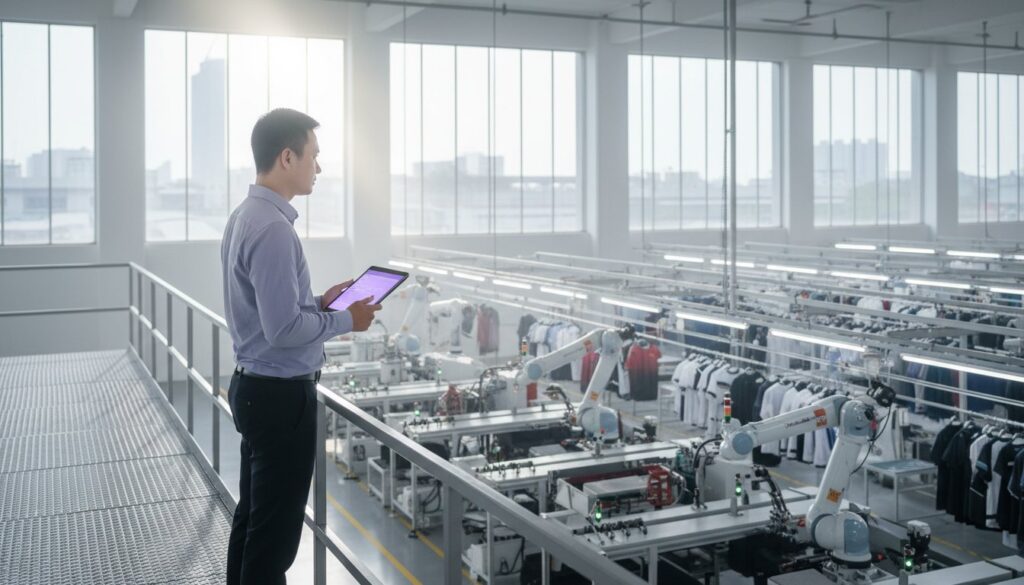
By 2026, over 40% of international fashion brands will source their primary collections from Southeast Asia, yet 60% of these partnerships fail due to quality inconsistency. I’ve spent 15 years auditing factory floors, and I understand why you’re hesitant about how to find a clothing manufacturer in vietnam that actually delivers on its promises. It’s stressful to worry about technical specs or communication gaps when you’re thousands of miles away from the production line.
I’m going to walk you through the exact vetting protocols and insider strategies I use to identify high-quality partners with genuine OEM/ODM capabilities. We’ll move past the surface-level search results to focus on production capacity, quality assurance, and verifiable certifications. This guide provides a methodical roadmap to help you build a shortlist of reliable factories and launch your first production run with absolute confidence.
Key Takeaways
- Learn why I believe Vietnam has evolved into a high-tech apparel powerhouse and why it’s my top choice for specialized sportswear and activewear in 2026.
- I’ll walk you through my five proven methods for sourcing partners, including how to effectively use B2B directories and which trade shows are worth your time.
- Discover exactly how to find a clothing manufacturer in vietnam by using my vetting checklist to verify ethical certifications and avoid common industry red flags.
- I’ll explain why a professional tech pack is your most important tool and help you decide whether the CMT or FOB production model fits your brand’s needs.
- Find out how my team at Darlon Garment bridges the gap for global brands with precision OEM services and a “quality first” approach to manufacturing.
Why I See More Brands Moving to Vietnam in 2026
I’ve spent years tracking the industrial landscape here, and 2026 marks a definitive turning point. Vietnam has shed its image as a simple low-cost alternative; it’s now a high-tech powerhouse. The “China Plus One” strategy, which gained momentum around 2018, has matured into a permanent supply chain fixture. When clients ask me how to find a clothing manufacturer in vietnam, I tell them to look for partners who have moved beyond basic assembly into complex garment engineering. The general state of Manufacturing in Vietnam shows consistent growth in industrial production value, proving that scale is now matched by technical sophistication.
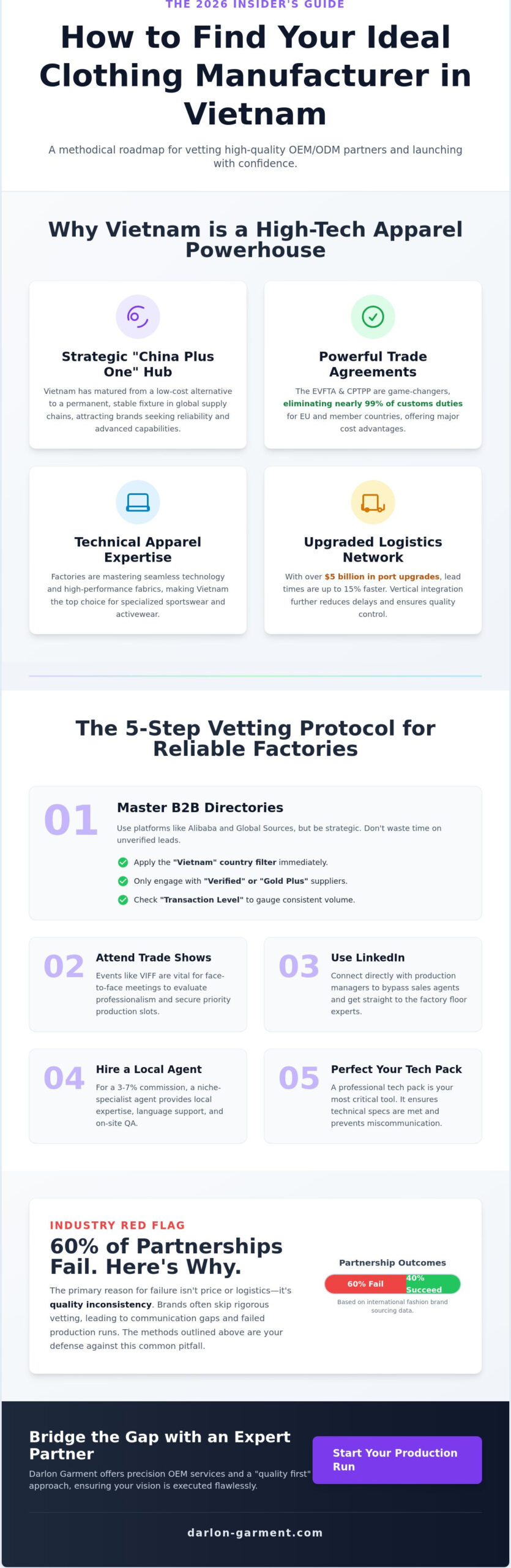
It’s clear that the country’s strategic position is no longer just about geography. It’s about the trade network. The EVFTA (EU-Vietnam Free Trade Agreement) has been a game-changer, removing nearly 99% of customs duties. This makes the region a strategic choice for brands that need to balance high quality with competitive landed costs. I’ve seen brands move their entire production lines here not just to save money, but to gain stability in an unpredictable global market.
The Shift Toward Technical Apparel
I’ve noticed a massive shift in brands seeking specialized sportswear and activewear. Basic garments like standard cotton t-shirts are migrating to lower-wage regions in South Asia. Meanwhile, Vietnamese factories are mastering seamless technology and high-performance fabrics. By 2026, sustainability has become a non-negotiable export requirement. I see factories investing in recycled yarn and solar-powered finishing plants to meet these global standards. If you’re looking for performance gear that requires precision stitching and moisture-wicking properties, this is where the expertise lives now.
Infrastructure and Logistics Growth
Logistics used to be a bottleneck, but that’s no longer the case. Port facilities in Ho Chi Minh City and the deep-water ports in Hai Phong have seen over $5 billion in upgrades recently. This means lead times are often 15% faster than they were three years ago. I also see more vertical integration within the country. Instead of importing fabric, many facilities now source high-quality materials locally. This “One-Stop Service” model reduces delays and ensures quality assurance remains consistent. Key benefits include:
- Reduced Lead Times: Faster transit from factory to port via improved highway networks.
- Vertical Integration: Sourcing yarn and fabric within the domestic supply chain to avoid import delays.
- Trade Agreements: Strategic advantages through the CPTPP and EVFTA for duty-free access.
Finding the right partner requires understanding these industrial shifts. When you’re researching how to find a clothing manufacturer in vietnam, focus on those who own their supply chain and invest in automated machinery. This reliability is why I see the world’s biggest brands deepening their roots here throughout 2026.
My 5 Proven Methods to Find Reliable Vietnamese Factories
I’ve spent years identifying the most efficient ways to source production capacity in Southeast Asia. Learning how to find a clothing manufacturer in vietnam requires a mix of digital tools and boots-on-the-ground networking. Since 2020, I’ve refined my approach to focus on stability and technical mastery rather than just chasing the lowest price. My goal is always to find a partner that views “Quality First” as a core operating principle.
Navigating Online Directories Like a Pro
I start my search on B2B platforms like Alibaba and Global Sources, but I always apply the “Vietnam” country filter immediately. I don’t waste time on unverified leads; I only look for “Verified” or “Gold Plus” statuses. These badges indicate that a third-party inspection company like SGS or Intertek has visited the facility. I specifically check the “Transaction Level” to gauge factory activity. A high score shows they’re handling consistent volume. I also scrutinize their product categories. A factory that specializes in knitted fabrics might not have the specialized machinery required for complex activewear or structured outerwear.
Attending trade shows like the Vietnam International Fashion Fair (VIFF) is another cornerstone of my strategy. Meeting a factory owner in person allows me to evaluate their professionalism instantly. According to a recent 2026 industry outlook, the sector is shifting toward high-value, sustainable orders, making these face-to-face interactions vital for securing priority production slots. I also use LinkedIn to connect directly with production managers in Hanoi or Ho Chi Minh City. This direct line often bypasses sales agents and gets me straight to the people managing the factory floor.
The Power of Local Sourcing Agents
If I can’t personally visit a facility, I engage a local sourcing agent. I usually expect to pay a commission between 3% and 7%, which is a small price for local expertise. These agents bridge the language gap and handle on-site quality assurance during the critical stages of a production run. I recommend finding agents who specialize in your specific niche. If you’re producing high-performance gym gear, an agent with a background in textile engineering for activewear is far more valuable than a generalist. They’ll know which factories have the latest seamless knitting machines and which ones are just cutting corners.
Finally, I always ask for referrals within my professional network. Some of the best “hidden gem” factories don’t spend money on marketing because their 500-person production lines stay full through word-of-mouth. These established players prioritize long-term cooperation and technical excellence. If you’re looking for a partner that offers a one-stop solution for your manufacturing needs, focusing on these five pillars will significantly reduce your risk when learning how to find a clothing manufacturer in vietnam.
- Filter for “Verified”: Use B2B filters to find factories with third-party audits.
- Check Transaction History: High activity levels indicate reliability and experience.
- Visit Trade Shows: VIFF is essential for seeing craftsmanship first-hand.
- Hire Specialists: Use agents who understand your specific garment category.
- Leverage LinkedIn: Contact factory owners directly to discuss OEM/ODM services.
Vetting 101: How I Spot a Quality Partner (and Red Flags)
When I am on the ground in Ho Chi Minh City or Binh Duong, I don’t just look at the finished samples. I look at the systems. Knowing how to find a clothing manufacturer in vietnam that actually delivers requires a deep dive into their operational DNA. In 2026, the baseline has shifted. I start by verifying international certifications like ISO 9001 for quality management and WRAP or BSCI for social compliance. If a factory cannot produce a valid certificate from the last 12 months, I stop the conversation immediately.
Understanding Vietnam’s role in the global value chain helps me identify which facilities are actually moving toward high-tech OEM/ODM services. I always ask for a client list. Seeing names of major European or North American retailers tells me they understand global export standards and strict lead times. When you are learning how to find a clothing manufacturer in vietnam, the initial inquiry response time is your first real test. I expect a professional response within 24 to 48 hours. If they are slow to communicate during the sales phase, they will be invisible when production delays hit.
I walk the floor to check for modern tech. I look for automated laser cutters and computerized sewing stations. A factory relying on 15-year-old machinery won’t meet the precision needed for 2026 activewear or complex knits. I also watch how they handle feedback during the sampling stage. A professional partner provides a sample within 7 to 10 days and documents every revision in a technical file. This methodical approach prevents errors when we scale to a 5,000-unit run.
Red Flags That Make Me Walk Away
I avoid factories that claim they can “do everything” without a clear specialty. If a vendor says they excel at both heavy denim and delicate silk lingerie, they’re likely outsourcing to unverified sub-factories. Vague answers regarding raw material sourcing are another deal-breaker. In 2026, transparency is mandatory. I also walk away if I don’t see a dedicated Quality Control (QC) team on the floor. A factory without a 1:10 ratio of QC staff to sewing operators is a massive risk for your brand’s reputation.
Questions I Always Ask During a Factory Tour
During my visits, I focus on the data. I ask to see their fabric testing laboratory to confirm they check for colorfastness and shrinkage in-house. I always ask: “What is your actual monthly capacity versus your quoted capacity?” Many facilities overbook by 15% to 20%, which leads to the delays that ruin retail launches. Finally, I ask how they handle material shortages. A reliable partner has a contingency plan and a pre-vetted list of backup suppliers to keep the lines moving.
Preparing for Success: From Tech Packs to Your First Sample
Finding a partner is just the start of the journey. If you want to know how to find a clothing manufacturer in vietnam that actually delivers quality, you have to look at your own documentation first. I’ve seen 40% of production delays caused by poor technical specifications before a single needle even moves. You can’t expect a factory to read your mind; you have to provide a blueprint that leaves no room for guesswork.
Mastering the Tech Pack
I tell every client that a professional tech pack is their most valuable asset. It serves as the definitive manual for the entire factory floor. Your pack must include a detailed Bill of Materials (BOM), graded size charts, specific stitching instructions, and trim specifications. I wrote a guide on how garments are made to help brands visualize how these details translate into physical steps on the line. A common mistake I see in 65% of initial submissions is omitting tolerance levels in size charts. Without a +/- 0.5cm margin, you leave quality control up to interpretation, which usually leads to sizing inconsistencies.
Navigating CMT vs. FOB
You need to decide on a production model before signing any contracts. In my experience, about 80% of startups choose FOB (Free On Board). It’s a one-stop solution where the factory handles everything from fabric sourcing to shipping. It reduces your logistical burden and keeps the responsibility for raw material quality on the manufacturer. On the other hand, CMT (Cut, Make, Trim) works better for established brands that have proprietary fabric sources or specialized textile partners. I usually recommend FOB for international buyers because it simplifies the supply chain and utilizes the factory’s local network for better pricing.
The sampling phase is where your vision becomes reality. I treat the first sample as a test of communication, not just construction. You should expect to go through two or three rounds of iterations to get the fit exactly right. During this phase, I also make sure to set clear expectations for Minimum Order Quantities (MOQs). In Vietnam, MOQs for knitted garments often start at 1,000 pieces per style, though specialized facilities might allow for 500. Knowing these numbers early prevents you from falling in love with a sample that you can’t afford to mass-produce.
Ready to move from design to delivery? Partner with Darlon Garment for professional manufacturing support.
Partnering with Darlon Garment: A Modern OEM Solution
I founded Darlon Garment because I saw a recurring disconnect between what international brands needed and what local factories were delivering. My goal was to build a bridge between high-level global design expectations and the technical precision found here in Vietnam. We focus specifically on high-performance sportswear, activewear, and swimwear, categories where technical execution is non-negotiable. By integrating advanced technology like Nuyarn spinning and seamless ultrasonic bonding, we provide solutions that standard factories simply can’t replicate. My commitment to a “One-Stop Service” means I take the complexity out of your hands, managing everything from initial fabric sourcing to final quality assurance before export.
Our Technical Capabilities in Ho Chi Minh City
Our facility in Ho Chi Minh City is built for the precision demands of 2026. We utilize laser cutting systems and automatic sewing machines to ensure every seam meets exact tolerances, often holding a precision of 1 millimeter relative to the tech pack. As a specialized fitness wear manufacturer, we recognize that high-stretch fabrics require unique handling. This is why our sampling process is highly iterative. We don’t just send a single prototype; we work through the design details to ensure the fit and compression are perfect before we ever start the bulk machines. Learning how to find a clothing manufacturer in vietnam is often about identifying who has the right hardware to match your brand’s complexity.
Why We Are Your Ideal Long-Term Partner
A “Quality First” philosophy drives every production run we manage. This isn’t just a slogan; it’s a measurable standard we apply to every stitch. We currently assist global brands in choosing a sportswear factory in Vietnam that offers both stability and technical mastery. We understand the logistical and financial priorities of professional buyers, which is why we maintain transparent communication throughout the entire supply chain.
If you’re still researching how to find a clothing manufacturer in vietnam for your 2026 collection, I invite you to reach out. Whether you need high-compression leggings or specialized swimwear, our team has the industrial scale and the technical expertise to bring your vision to life. Get in touch with me directly to discuss your specific production goals and see how our “One-Stop Service” can simplify your journey.
Take Your Production to Vietnam with Confidence
I’ve shared my personal strategy for how to find a clothing manufacturer in vietnam because the landscape is shifting rapidly as we head toward 2026. Success in this market requires more than just a search engine; it demands a focus on technical vetting and precise tech pack development. I’ve found that brands that prioritize these two areas see significantly fewer production delays and higher quality samples.
I established Darlon Garment in 2019 to provide the high-tech OEM solutions that modern brands need. We specialize in advanced performance wear, including Nuyarn, seamless construction, and laser-cut designs. My team offers a one-stop manufacturing service that manages every step from initial development to global export logistics. We’ve spent years refining these processes so you don’t have to worry about the technical hurdles of international manufacturing. It’s about building a partnership that supports your growth through stable, industrial-scale production.
Let’s discuss your next production run: Contact Darlon Garment today
I can’t wait to see your brand thrive in Vietnam’s manufacturing ecosystem.
Frequently Asked Questions
How long does it typically take to find and onboard a manufacturer in Vietnam?
It usually takes me about 3 to 5 months to fully onboard a new manufacturer. This timeline covers the initial 4 week vetting process, sample development cycles, and the finalization of technical files. I’ve found that rushing this stage often leads to quality issues during the first production run.
What are the average MOQs for clothing manufacturers in Vietnam in 2026?
For 2026, I’ve observed that average MOQs for professional factories range between 500 and 1,000 units per style. While some smaller workshops might accept 200 units, larger facilities prioritize efficiency and industrial scale. This volume ensures you get the most out of the factory’s production capacity and specialized machinery.
Do Vietnamese factories handle the sourcing of specialized fabrics like Nuyarn?
Yes, I can confirm that top tier Vietnamese factories handle specialized fabric sourcing like Nuyarn or recycled synthetics. Most industrial scale partners operate as a one stop solution and maintain relationships with global yarn suppliers. This technical mastery allows them to import high performance materials for activewear while meeting international export standards.
Is it necessary to visit the factory in person before placing a bulk order?
I always recommend visiting the factory in person before you place a bulk order. While digital audits are common, 92% of my successful long term partnerships began with a physical site inspection. Seeing the production line and meeting the quality assurance team helps me verify their technical capabilities and ensures our standards align. If you need to arrange travel quickly for an on-site inspection, you can check out Vietnamese-Evisa.Org to see current fees for urgent entry permits.
How do I protect my intellectual property when manufacturing in Vietnam?
To protect your intellectual property, I suggest signing a bilingual Non Disclosure, Non Use, and Non Circumvention agreement. These contracts are specifically designed for the Vietnamese legal system and offer better protection than standard Western NDAs. Registering your trademark in Vietnam through the National Office of Intellectual Property is another step I take to secure my brand.
What are the typical payment terms for a first-time production run?
Standard payment terms for a first time production run usually involve a 30% deposit upfront and 70% paid via Telegraphic Transfer after the final inspection. I’ve seen some factories offer Letters of Credit for orders exceeding 50,000 units. These structured terms provide a financial safety net for both you and the manufacturer during the initial engagement.
Can Vietnamese manufacturers help with sustainable packaging and shipping?
Most modern manufacturers in Vietnam now provide sustainable packaging and shipping options as part of their OEM services. I often work with factories that offer FSC certified cardboard or cornstarch based polybags to meet global sustainability targets. This integrated approach simplifies the logistics of how to find a clothing manufacturer in vietnam that aligns with eco friendly brand values.
How does the cost of manufacturing in Vietnam compare to other SE Asian countries?
Labor costs in Vietnam remain roughly 50% lower than in China according to 2024 industrial reports. While countries like Ethiopia might offer lower base wages, Vietnam provides 30% better infrastructure and a more skilled workforce. I find this balance of cost and technical proficiency makes it the most reliable hub in Southeast Asia for high quality garment construction.