
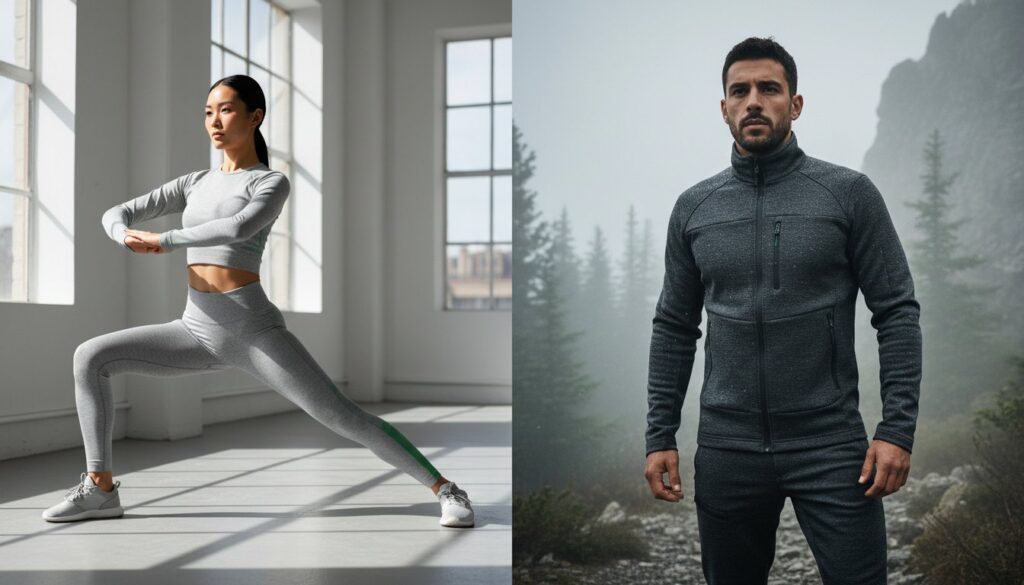
The choice between knit and woven isn’t about which textile is “better,” it’s about the specific movement profile of the athlete you are designing for. I’ve seen brands lose thousands in ROI simply because they chose a high-stretch knit for a garment that required the structural stability of a weave. When you are weighing knit vs woven fabrics for sportswear, you are really deciding between the fluid mobility of a yoga legging and the rugged, wind-resistant durability of a trail jacket.
I understand the stress of choosing a fabric that pills or loses its shape after three washes. It’s a valid concern, especially when you’re also managing manufacturing lead times in Vietnam and the 7.2% minimum wage hike that took effect in January 2026. I’ll show you how to choose between knit and woven fabrics to maximize performance, durability, and cost-efficiency for your sportswear line. This guide provides a clear framework for selection based on sport type, explains the cost implications of current material prices like polyester at $0.51 per pound, and gives you the confidence to finalize your tech pack specifications before the new EU Digital Product Passport regulations go live this July.
Key Takeaways
- Learn why I prioritize interlocking loops for mobility-heavy sports like yoga while reserving 90-degree interlaced wovens for high-stability endurance gear.
- Discover how to balance your production budget by understanding the different MOQ requirements for knit vs woven fabrics for sportswear in Vietnam.
- See my lab findings on which fabric structures pass the “gym floor test” for long-term abrasion resistance and shape retention.
- Use my framework to match specific athlete movement profiles to the correct textile, ensuring your tech packs deliver the performance your customers expect.
- Find out how I help brands leverage local sourcing in Vietnam to offset rising manufacturing costs and the impact of 2026 minimum wage increases.
Understanding the Fundamentals: What Exactly Are Knit and Woven Fabrics?
I’ve sat through countless meetings where brands confuse these two during the initial tech pack stage. It usually happens when a designer wants the specific look of a woven but the performance feel of a knit. Understanding the core difference in knit vs woven fabrics for sportswear is the first step toward a successful production run. If you get this wrong at the start, you’ll likely face fit issues or garment failures during the sampling phase.
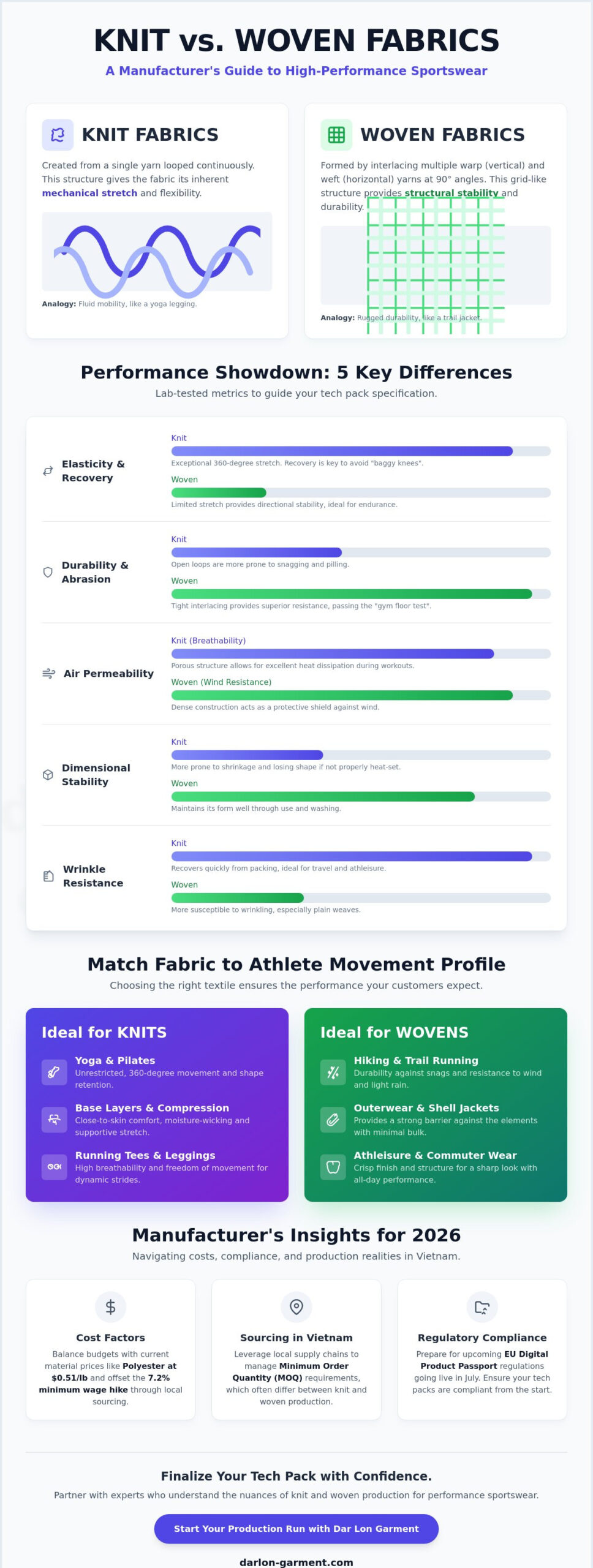
When I define a Knitted fabric, I am referring to a textile created by a series of interlocking loops. This unique structure provides what we call “mechanical stretch.” It allows the fabric to expand and contract even without added spandex. Woven fabrics are fundamentally different. They consist of warp and weft yarns interlaced at 90-degree angles. This grid-like construction provides maximum stability and prevents the fabric from stretching out of shape easily. This structural choice dictates every part of my production line, from the specialized needles we use to the final quality control checks. You can see how we manage these distinct workflows in my behind-the-scenes look at how garments are made in my Vietnam facility.
The Anatomy of a Knit
In my experience, weft knitting is the most common method for activewear. It involves a single yarn that runs horizontally across the fabric, creating loops as it goes. This is what you see in most t-shirts and leggings. Warp knitting is more complex, with yarns running vertically. It’s the go-to for high-performance compression gear because it won’t run or unravel if snagged. Jersey and interlock knits currently dominate the market because they offer a smooth surface for printing. My circular knitting machines are the backbone of this process. They allow us to produce tubes of fabric quickly, which is perfect for seamless garments that reduce chafing during high-intensity workouts.
The Structure of a Woven
Wovens are all about precision and durability. I categorize them into three main types for performance gear: plain, twill, and satin weaves. Plain weaves are durable and simple, while twill weaves, like those found in rugged outdoor pants, offer better drape and wrinkle resistance. For wovens, density or thread count matters much more than it does for knits. A higher density typically means better wind resistance and a crisper finish. In 2026, I have seen a massive shift toward “stretch-wovens.” These fabrics use technical yarns to add a bit of “give” to a traditionally rigid structure. It’s the perfect middle ground for hiking gear or commuter wear that needs to look sharp but still allow for a full range of motion.
The Performance Showdown: 5 Key Differences I See in the Lab
I spend a significant portion of my week in our Vietnam quality control lab, where the data often tells a different story than a marketing brochure. When evaluating knit vs woven fabrics for sportswear, the decision usually comes down to how the material handles stress, moisture, and repeated use. I’ve seen many brands choose a fabric based on hand-feel alone, only to find it fails our “gym floor test” for abrasion resistance. To build a collection that lasts, you have to look past the surface at these five critical performance metrics.
- Elasticity and Recovery: Knits are the undisputed champions for yoga and high-mobility sports because their looped structure offers 360-degree stretch. Wovens, however, provide the directional stability needed for endurance sports like trail running where you don’t want the fabric bouncing with every stride.
- Durability: If your gear involves contact with equipment, wovens are usually the safer bet. Their tight interlacing resists snagging and pilling far better than the open loops of a knit.
- Breathability vs. Wind Resistance: Knits are naturally porous, making them great for heat dissipation. Wovens act like a protective shield, blocking wind while maintaining a lightweight profile.
- Dimensional Stability: In 2026, I’m issuing a specific warning about knit shrinkage. With fluctuating yarn quality in the global market, knits are more prone to losing their shape after a few washes if they aren’t heat-set correctly.
- Wrinkle Resistance: For travel-ready athleisure, knits are my top recommendation. They recover from being stuffed in a gym bag much faster than a standard woven garment.
Stretch vs. Stability
I often use high-quality elastane fabric to enhance the performance of both types. While knits have natural stretch, adding elastane improves the “snap-back” factor. Recovery is actually more important than raw stretch. If a fabric stretches but doesn’t recover, you end up with “baggy knees” in leggings. In my lab, we perform rigorous tensile strength testing to ensure every batch meets global export standards for shape retention. If you’re looking for a partner to help navigate these technical choices, our team at Darlon Garment can provide the data you need to make an informed decision.
Moisture Management and Weight
The weight of your fabric, measured in GSM (Grams per Square Meter), dictates the seasonal utility of the garment. I’ve noticed a major trend in 2026 where ultra-lightweight wovens are making a comeback in marathon apparel. These fabrics don’t hold water weight the way a heavy knit might. Sweat moves through a knit loop via capillary action, but a woven grid can be engineered with specialized channels to push moisture away from the skin even faster. Choosing the right GSM ensures your summer gear stays light and your winter gear provides the necessary thermal barrier without the bulk.
Choosing the Right Fabric for the Right Sport
I often tell my partners that the “best” fabric depends entirely on the athlete’s movement profile. If you are designing for a CrossFit athlete, your technical requirements are worlds apart from someone doing restorative yoga. In my facility, I’ve spent years analyzing how different textiles perform under specific stressors. This experience has taught me that the knit vs woven fabrics for sportswear decision isn’t binary; it’s about matching the material to the mission. If you get the movement profile wrong, the athlete will feel it within the first five minutes of their workout.
For high-impact training like CrossFit or HIIT, I’ve found that a hybrid approach is often the most effective. These athletes need the extreme stretch of a knit for deep squats, but they also require the ruggedness of a woven in high-abrasion zones, such as the shins or thighs where barbells frequently make contact. Yoga and Pilates, however, remain the undisputed territory of the interlock knit. I recommend this specific knit structure because it’s opaque, soft, and offers that “second-skin” feel that practitioners demand. When we move to running and outdoor gear, I almost always suggest woven shells for wind and water protection. A knit simply can’t provide that same level of environmental defense without becoming prohibitively heavy. For compression wear, warp knits are my go-to for muscle support. Their vertical loop structure allows us to build in high tension that stays consistent throughout a workout.
The Rise of Hybrid Sportswear
I am increasingly seeing brands move toward zonal engineering. This involves combining knit panels with woven bodies to create the ultimate track jacket or training pant. By placing breathable knit sections in high-sweat areas and durable woven panels in high-wear spots, we create a superior product. This level of technical sophistication is a key trend for fitness wear manufacturers in 2026. It allows us to offer garments that are both highly functional and aesthetically modern, moving away from the “one fabric fits all” mentality of previous years.
High-Tech Options: Nuyarn and Seamless
I am seeing a significant shift toward Nuyarn performance wool. Its unique structure offers better stretch, loft, and drying speeds than traditional ring-spun wool. It’s a game-changer for brands looking to combine natural fibers with high-performance metrics. Additionally, our seamless knitting technology is redefining expectations. Seamless garments offer zero chafing and produce significantly less waste during production. These advancements change the knit vs woven fabrics for sportswear debate entirely by offering levels of comfort and efficiency that traditional cut-and-sew methods can’t match.
The Manufacturing Perspective: Production Realities in Vietnam
Manufacturing in Vietnam has evolved rapidly, especially with the 7.2% average minimum wage increase that took effect in January 2026. When I discuss knit vs woven fabrics for sportswear with brand owners, the conversation always shifts to the factory floor. Choosing a specific sportswear factory in Vietnam isn’t just about finding a vendor; it’s about understanding how their infrastructure handles different textile structures. I’ve found that sourcing custom knits is often more flexible than wovens. My circular knitting machines allow for smaller Minimum Order Quantities (MOQs) for custom colors or blends. Woven fabrics, by contrast, require complex loom setups that usually push MOQs higher, making them a bigger financial commitment for emerging brands.
Lead times are another critical factor I manage daily. From the moment the yarn is spun to the time the finished garment sits on my warehouse floor, you’re looking at a 60 to 90 day window. Knits often move through the cutting and sewing stages faster because they are more forgiving during assembly. However, sustainability is now a mandatory compliance issue rather than a marketing choice. With the EU ban on destroying unsold textiles starting July 19, 2026, I am helping brands focus on waste reduction. Knits generally offer a better yield during the cutting process, while wovens require more precise marker making to avoid significant fabric scrap.
Cost Implications for Your Brand
The price per yard is influenced by raw material costs, like polyester staple fiber currently at approximately $0.51 per pound, but construction complexity is the true driver. While knits might seem cheaper, the efficiency of the Vietnamese workforce actually favors high-detail woven construction for premium items. My team works to optimize fabric consumption during the design phase, which can lower your unit costs by 5% to 10% without sacrificing quality. It’s about being smart with the layout before the first cut is made.
Quality Control Challenges
I see different technical hurdles for each fabric type. For knits, the primary concern is “running” or snagging during production. For wovens, we watch for “fraying” at the seams. My quality assurance team inspects every fabric roll before it reaches the cutting table. I also insist on rigorous pre-shrinking tests for all knit bulk orders. Without this, a size medium could easily become a small after the first wash, which is a risk no professional brand should take. If you’re ready to start your next production run with a partner who understands these technical nuances, contact Darlon Garment today to discuss your project.
My Recommendation: How I Help Brands Choose the Perfect Textile
I always start my consultations by asking one question: where will this garment actually live? If you’re designing for the gym, your technical requirements for stretch and moisture management are non-negotiable. If you’re designing for the street, the aesthetic and drape take center stage. Making the final call on knit vs woven fabrics for sportswear requires a clear understanding of this end-use case. I’ve seen brands over-engineer a simple lifestyle hoodie with high-compression warp knits, which only serves to drive up the unit cost without adding value for the casual wearer.
I also encourage my partners to lean into the “Vietnam Advantage.” Since the 7.2% minimum wage increase in January 2026, I’ve focused on helping brands source high-quality textiles locally within Vietnam. This strategy avoids the unpredictability of international shipping and potential 10-15% global tariffs that have fluctuated throughout the year. By sourcing locally, we keep your supply chain resilient and your landed costs predictable. Additionally, don’t underestimate the power of “Hand-Feel.” In 2026, consumers are more tactile than ever. They want fabrics that feel luxurious against the skin while still performing under pressure. This is why I believe physical swatches are better than any tech pack. I never move to bulk production until my clients have felt the fabric, stretched it, and approved the recovery in person.
Building Your Fabric Strategy
For new activewear brands, I typically suggest a 70/30 knit-to-woven split. This ratio allows you to capture the massive demand for comfortable, high-stretch leggings and tops while offering structured woven pieces like windbreakers or trail shorts to round out the collection. Developing a signature fabric profile is what sets a brand apart in a crowded market. I am seeing a massive shift toward incorporating natural fibers into these profiles. Blending technical synthetics with performance wool or organic cotton provides the sustainability and comfort that 2026 buyers demand.
Partnering for Success
My one-stop manufacturing service is designed to take the guesswork out of the knit vs woven fabrics for sportswear dilemma. I provide the technical data from our lab, but I also provide the industrial experience to know what works on the sewing line. Transparency between the designer and the factory is my #1 rule. When we share information openly, we catch potential pilling or shrinkage issues before they become expensive mistakes. As we move through 2026, textile innovation is only accelerating. Whether it’s seamless technology or bio-based synthetics, I am here to ensure your brand stays at the forefront of these advancements while maintaining the stability and quality your customers expect.
Mastering Your Textile Strategy for the Year Ahead
Choosing between knit vs woven fabrics for sportswear is a strategic business decision that impacts both athlete performance and your bottom line. I’ve spent over 10 years in Vietnam garment manufacturing helping brands navigate these technical trade-offs. We’ve explored how specific movement profiles dictate the choice between the fluid stretch of a knit and the structural stability of a weave. I also highlighted how local sourcing in Vietnam helps you manage the 2026 minimum wage increases while keeping your supply chain resilient.
I believe the future of activewear depends on specialized technologies like Nuyarn and seamless production. These innovations allow us to create high-performance gear that meets the rigorous demands of the modern market. At my facility, I ensure every batch meets global export standards through a rigorous 4-stage quality control process. Let me help you source the perfect fabric for your next collection. Whether you’re scaling a proven bestseller or launching a new hybrid line, I’m ready to help you build a collection that stands the test of time.
Frequently Asked Questions
Which is better for leggings: knit or woven?
Knits are the superior choice for leggings because their looped structure provides the 360-degree stretch necessary for a full range of motion. Woven fabrics lack the natural elasticity required for high-mobility lower-body movements. I almost always recommend high-gauge interlock knits for leggings to ensure the fabric remains opaque and comfortable during deep squats or yoga poses.
Does knit fabric shrink more than woven fabric?
Yes, knit fabrics typically experience more shrinkage than wovens because their loops are more prone to contracting when exposed to heat and moisture. In my Vietnam facility, I perform rigorous pre-shrinking tests on every bulk order to establish a stable baseline. Wovens are far more dimensionally stable because their interlaced yarns are held tightly in a fixed grid.
Can I use woven fabric for compression gear?
I don’t recommend using standard woven fabrics for compression gear because they don’t offer the uniform recovery needed to support muscles effectively. Warp knits are the industry standard for compression because they provide high tension without losing their shape over time. A woven fabric would likely feel too restrictive and wouldn’t “snap back” after being stretched during a workout.
What is the difference in cost between knit and woven production?
Knit production generally offers lower Minimum Order Quantities (MOQs) because circular knitting machines are faster to set up for custom colors. When comparing knit vs woven fabrics for sportswear, wovens often carry a higher price per yard for small batches due to the complex loom setup required. I help brands mitigate these costs by sourcing raw materials like polyester at current rates of $0.51 per pound locally in Vietnam.
How can I tell if a fabric is knit or woven just by looking at it?
You can identify a knit by looking for rows of tiny “V” shaped loops on the fabric surface. Woven fabrics look like a miniature basketweave or a fine grid where yarns cross over and under each other at 90-degree angles. If you pull the fabric and it stretches easily in multiple directions before bouncing back, you’re almost certainly holding a knit.
Is woven fabric more sustainable than knit fabric?
Sustainability is driven more by fiber choice than construction, but wovens often last longer due to their superior abrasion resistance. However, knits typically produce less waste during the cutting phase because the fabric yield is higher. I am currently helping brands prepare for the July 2026 EU Digital Product Passport by ensuring both fabric types meet new transparency and circularity standards.
Why do most hoodies use knit fabric instead of woven?
Hoodies use knit fabrics because they provide the soft hand-feel and flexibility required for comfort and easy layering. Using knit vs woven fabrics for sportswear like hoodies ensures the garment can stretch as it’s pulled over the head. A woven hoodie would feel stiff and wouldn’t provide the cozy, breathable environment that consumers expect from their favorite athleisure pieces.
What is the best fabric for moisture-wicking in high-intensity sports?
Synthetic knits with moisture-wicking finishes are usually the best for high-intensity sports because their porous structure allows sweat to evaporate quickly. I’ve found that these knits move moisture via capillary action better than most dense wovens. However, for sports like trail running, I might suggest a lightweight woven shell to provide wind protection while the base layer handles the sweat.