
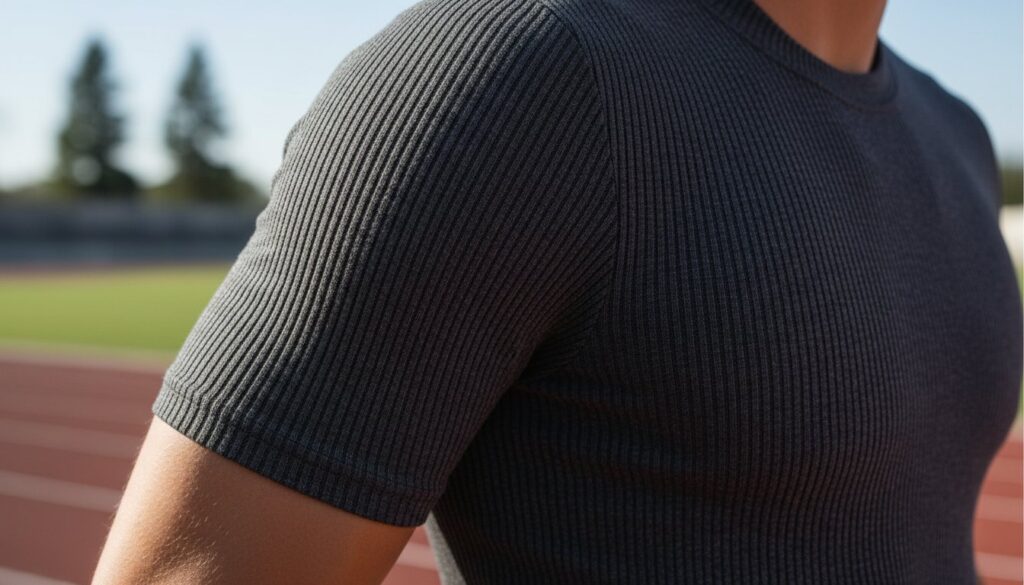
Most designers treat ribbing as a secondary trim, but if you’re building a high-end activewear brand in 2026, that mindset will destroy your garment’s silhouette. I’ve seen too many brands struggle with samples that “bag out” or lose their recovery because they didn’t fully grasp what is rib knit fabric at a structural level. It’s frustrating to decipher technical specs like 1×1 versus 2×2 while also trying to manage the logistics of a 46% reciprocal tariff on imports from Vietnam. You need a partner who understands the mechanics of the knit, not just the aesthetic.
I’ve spent years on the factory floor perfecting these structures, and I’m going to show you why ribbing is actually a structural powerhouse for modern apparel. I’ll share my process for creating high-performance sportswear that maintains its integrity through hundreds of wash cycles. We’ll also cover the latest fiber innovations, including organic cotton options that use 91% less water and performance wool blends like Nuyarn. This guide will give you the technical confidence to select fabrics for bulk production and the clarity needed to navigate the current global supply chain with ease.
Key Takeaways
- Learn how to select specific rib ratios, from sleek 1×1 base layers to heavy 3×3 outerwear, to achieve the exact drape your collection requires.
- Understand exactly what is rib knit fabric in a performance context, specifically how its “valleys” provide natural breathability and supportive compression.
- Identify the critical quality markers I use to vet suppliers, such as wale consistency and torque prevention, to ensure your garments don’t twist after the first wash.
- Discover my proactive approach to wear testing ribbed prototypes, which helps you eliminate the risk of fabric bagging out before you commit to bulk production.
Understanding Rib Knit: More Than Just Your Average Stretch Fabric
I often talk to designers who think ribbing is just a secondary detail for necklines or cuffs. That’s a huge missed opportunity. When you ask what is rib knit fabric, you aren’t just asking about a visual pattern; you’re looking at a structural solution for fit and performance. Unlike a standard knitted fabric that lays flat, ribbing uses alternating knit and purl stitches to create raised vertical ridges. This creates a texture that is functional, durable, and significantly more elastic than a basic jersey.
Think of it as the accordion of the textile world. The fabric expands and contracts with the wearer’s movement, providing a level of crosswise stretch that a jersey knit simply cannot match. While jersey tends to curl at the edges and lose its shape over time, rib knit maintains its structural integrity. This makes it my go-to choice for high-performance activewear and seamless garments where the fabric needs to stay put during high-intensity movement. I’ve found that using ribbing as a primary body fabric, rather than just a trim, gives garments a premium, sculpted look that lasts.
One of the things I love most about high-quality ribbing is its reversibility. Because the pattern of ridges is identical on both sides, it’s incredibly versatile for industrial production. It allows for cleaner finishes in sleepwear or sportswear where the interior of the garment might be visible. This symmetry is a technical advantage that simplifies the cutting and sewing process while ensuring the final product looks polished from every angle.
The Anatomy of a Rib: Knit vs. Purl
These raised columns are formed by interlocking loops that pull the fabric together. This construction does more than just look good; those vertical “valleys” between the ridges trap air. This creates a natural layer of insulation, providing slightly more warmth than a flat knit without adding unnecessary bulk. In my experience with high-end production, the technical face and the back of the fabric are often indistinguishable. This level of consistency is exactly what I look for when vetting materials for global brands.
Why “Recovery” is My Favorite Word
In my world, “recovery” is the ultimate measure of quality. It’s the fabric’s ability to snap back to its original width after being stretched to its limit. The rib structure provides natural recovery because the vertical ridges act like tiny springs. Even if we reduce the elastane content to make a garment more breathable, the knit itself does the heavy lifting to prevent bagging. For 2026 apparel standards, fabric recovery is defined as the percentage of dimensional return within sixty seconds of stress release.
The Technical Side: Rib Structures, Ratios, and Fiber Blends
When I sit down with a brand to plan a 2026 collection, the first technical hurdle is always the ratio. While basic guides often suggest that 1×1 is the only standard, modern activewear requires much more nuance. If you’re trying to understand what is rib knit fabric from a production standpoint, you have to look at the math behind the wales. The ratio defines the garment’s visual texture, its weight, and how it behaves on the human body.
I also pay close attention to the GSM (Grams per Square Meter). For high-performance leggings, a “squat-proof” finish usually requires a rib with a GSM of at least 280 to 300. If the weight is too low, the fabric becomes translucent when stretched. To prevent the ribs from “smiling”—which is when the ridges open up too far and reveal the yarn underneath—I often integrate a high-quality elastane fabric. This ensures the garment maintains its opaque, premium look even during deep lunges or yoga poses.
Common Rib Ratios I Use in the Factory
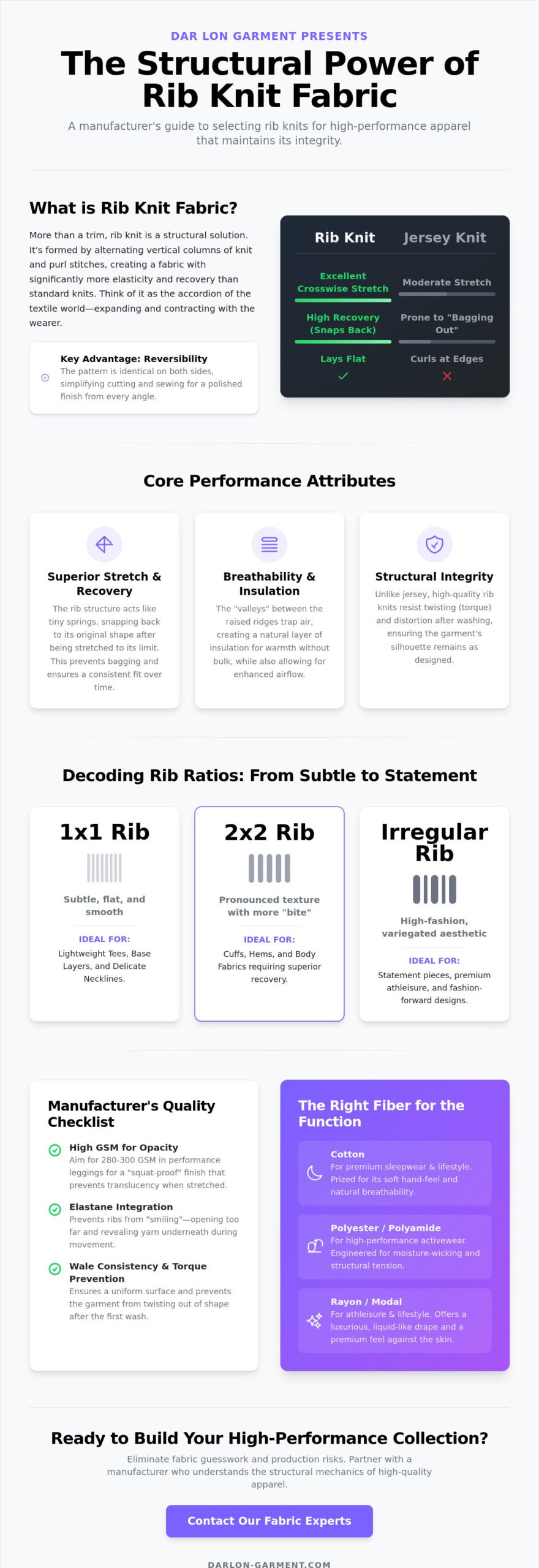
- 1×1 Rib: This is my go-to for lightweight tees and delicate necklines. It’s subtle, flat, and provides a smooth surface for printing or embroidery.
- 2×2 Rib: I recommend this for cuffs and hems that need more “bite.” It has a more pronounced texture and superior recovery compared to 1×1.
- Irregular Ribs: For a high-fashion aesthetic, I use 4×2 or 6×2 ratios. When working with these variegated patterns, I stay updated on the latest innovation on shrinkage control to ensure the irregular columns don’t distort after the first wash.
Fiber Blends: Cotton, Polyester, and Performance Synthetics
The fiber choice is the soul of the fabric. Cotton rib remains a staple for natural fibers and premium sleepwear because of its hand-feel and breathability. However, for moisture-wicking activewear, I prefer polyamide or polyester blends. These synthetics are engineered to move sweat away from the skin while maintaining the rib’s structural tension. If your collection focuses on lifestyle or “athleisure” pieces, Rayon or Modal ribs offer a liquid-like drape that feels incredibly luxurious against the skin.
I’ve found that the right blend can make or break a brand’s reputation for quality. If you are unsure which ratio or fiber mix fits your specific design goals, I can help you navigate these technical choices at darlon-garment.com to ensure your production is both efficient and high-performing.
Why Rib Knit Dominates Activewear and Sportswear Production
I’ve found that when brands ask what is rib knit fabric in the context of performance, they’re usually looking for a balance between aesthetics and high-level functionality. Ribbing provides a natural compression effect that feels supportive but doesn’t restrict breathing or movement like some heavy-duty compression panels. It’s a structural advantage; the fabric moves with the athlete, expanding during a deep squat and snapping back instantly without losing its shape. This mechanical stretch, combined with synthetic fiber memory, offers a level of recovery that flat knits simply can’t replicate over long-term use.
The vertical channels or “valleys” are essential for thermal regulation. They create a micro-climate between the skin and the fabric, allowing air to circulate even during high-intensity training. This focus on textile geometry is a concept often explored at research centers like the Wilson College of Textiles, where the science of how fabric structures impact moisture and heat transfer is a primary focus. By choosing a rib, you’re essentially building a cooling system directly into the garment’s architecture.
One practical reason I push for ribbed textures is their ability to mask sweat. On a flat jersey surface, moisture spreads in a visible, dark circle. On a rib, the light hits the ridges and creates shadows in the valleys, making moisture far less obvious to the naked eye. These garments are also industrial workhorses. Because the knit is already “pre-stretched” in its relaxed state, it doesn’t suffer from the same fiber fatigue as flat knits. I’ve seen ribbed sportswear maintain its integrity after fifty or more wash cycles, while flat-knit equivalents begin to pill or sag.
Ribbed Leggings and Sports Bras
In 2026, I’m seeing a massive shift toward “micro-rib” textures for gym wear. These are very fine ribs that look smooth from a distance but provide that signature supportive feel. To avoid sheerness, I ensure the yarn density is high enough so that when the rib expands, the “grin-through” of the base yarn is minimal. Seam placement is also vital; I always align seams within the valleys of the rib to keep the silhouette sleek and reduce friction against the skin.
Swimwear: The Ribbed Revolution
Swimwear is undergoing a major transition. I see more brands switching to synthetic rib blends because they offer a sophisticated, vintage aesthetic with modern durability. I make sure these blends are treated for chlorine and salt-water resistance to prevent the elastane from breaking down. The result is a suit that looks like a luxury lifestyle piece but performs like professional gear, holding its shape even when wet.
Sourcing and Manufacturing Rib Knit in 2026
If you’re sourcing for a global brand, you’ve probably realized that most online resources focus on DIY sewing rather than industrial scale. When I’m vetting a new supplier for bulk production, the first thing I examine isn’t the color; it’s the consistency of the “wale.” These are the vertical rows of stitches that define the fabric’s structure. If the wales aren’t perfectly parallel, you’ll encounter the “Torque” problem. This is when a garment twists around the wearer’s body after the first wash because the internal tension of the knit was never properly balanced. I prevent this in my facility by strictly controlling the yarn feed tension and using specific heat-setting processes for synthetic blends.
Managing shrinkage is another critical hurdle. Because of its “accordion” nature, rib knit is prone to significant dimensional change. I implement a mandatory pre-shrinkage protocol during the finishing stage to ensure that the medium you see in the sample room is the same medium the customer receives. Sourcing through a high-capacity sportswear factory in Vietnam has become a primary strategy for many of my partners. Despite the 46% reciprocal tariff rate for apparel imports into the U.S. as of February 2026, the technical mastery and vertical integration found here often outweigh the duty costs for premium brands.
Technical Specifications for Your Tech Pack
When you’re building your tech pack, you need to go beyond just saying you want a “rib.” You must specify the rib width and depth in millimeters to ensure the factory matches your vision. I also require brands to define the required stretch percentage for both width and length. Most importantly, your QC team must track the “recovery rate.” This is the metric that determines if a sports bra will still fit correctly after six months of heavy use. If you need help refining these technical details, you can contact my team at Darlon Garment to review your current specifications.
The Vietnam Advantage: Scale and Quality
My factory in Vietnam provides a strategic edge because we have established access to high-quality yarns from across Asia. We offer a comprehensive service model where we handle everything from yarn selection to the final stitch. You can see a detailed breakdown of how garments are made in my facility to understand how we maintain these standards at scale. For 2026, we’ve also expanded our sustainable options, specifically sourcing recycled polyester ribs that meet the strict ESG requirements currently dominating the market.
Bringing Your Ribbed Designs to Life: My Proactive Approach
When a brand brings me a sketch, the first step is always evaluating how the rib’s structure will interact with the intended seams. Because of its inherent elasticity, ribbing can pull or distort seams if they aren’t engineered with precision. I’ve found that a partnership model is the only way to succeed in this industry. A standard vendor just takes an order. A partner helps you understand what is rib knit fabric in the context of your specific garment’s geometry, ensuring the final product looks as good on the body as it does on the page.
I believe that the transition from a design concept to a production-ready sample is where the most critical decisions are made. It’s not just about picking a fabric from a swatch book; it’s about engineering a textile that supports your brand’s reputation for quality. In 2026, with the global market for rib knit fabrics projected to grow by over 6% annually, standing out requires more than just a standard 1×1 or 2×2 structure. It requires a proactive approach to prototyping and testing that accounts for both aesthetics and long-term durability.
Prototyping with Rib Knits
Prototyping is where we solve the “bagging” problem. I insist on rigorous wear testing for every new ribbed design. If a prototype loses its shape after a few hours of movement, we immediately adjust the yarn tension or the fiber blend. We also perform “wash and wear” cycles in our facility to check for torque and shrinkage. My team at Dar Lon Garment handles complex rib alignments with care. We make sure the vertical columns meet perfectly at the seams; this is a detail that separates premium sportswear from fast-fashion alternatives.
Scaling Your Production in 2026
Scaling in the current climate requires a firm grasp on global logistics and production metrics. With the U.S. government applying a 10% import surcharge as of February 2026, and reciprocal tariffs for Vietnam at 46%, every meter of fabric must be utilized efficiently. I manage bulk runs by tiers, ensuring that color consistency remains perfect across different batches. This is particularly challenging with ribs because the depth of the “valleys” can create shadows that alter the perceived color. We use digital spectrophotometers to maintain a delta-E value that meets international retail standards. If you’re ready to move beyond the theory and start building your line, reach out to me for a consultation on your next collection.
My final tip for brands is to select a rib that aligns with your core DNA. If you’re focused on high-performance activewear, prioritize synthetic blends with high recovery rates. If your brand values sustainability, consider organic cotton ribs that use 91% less water than conventional options. Understanding what is rib knit fabric at this level allows you to create garments that don’t just look great but actually perform for the end user.
Building Your 2026 Performance Collection
I’ve covered a lot of ground, from technical specifics to the complex logistics of industrial manufacturing. You now understand that what is rib knit fabric is defined by its structural integrity and its ability to provide natural compression and breathability. Whether you’re engineering a micro-rib legging or a textured swimwear line, the right ratio and fiber blend will determine your garment’s longevity and market success.
Since 2019, I’ve used my global OEM/ODM expertise to help brands navigate these technical waters. My facility is specialized in activewear and sportswear, utilizing advanced laser-cutting technology to ensure every piece meets the highest standards. I’m ready to help you manage current 46% reciprocal tariff challenges while meeting the rising demand for sustainable, recycled polyester ribs that meet modern ESG requirements.
Success in the 2026 market requires a partner who understands the machinery as well as the design. I’m here to act as that silent, powerful backbone for your brand. Partner with me for your 2026 rib knit production in Vietnam. I’m excited to see your next collection come to life on the production line.
Frequently Asked Questions
Is rib knit fabric good for summer or winter?
Rib knit works for both seasons depending on the fiber weight and density you choose. Understanding what is rib knit fabric in terms of seasonal versatility depends on the GSM; for summer, I recommend lightweight micro-ribs made from rayon or cotton that offer high breathability. In winter, heavier gauge ribs or performance wool blends trap air in the ridges to provide natural insulation for the wearer.
Does rib knit fabric shrink more than other knits?
It can shrink more than flat knits due to its unique accordion-like structure. Because the stitches are more open, they have more room to contract during the washing process. I always implement a rigorous pre-shrinkage protocol in my facility to ensure the final garment maintains its specified dimensions after the consumer washes it for the first time.
What is the difference between 1×1 and 2×2 rib knit?
The main difference lies in the width of the vertical ridges and the level of stretch. A 1×1 rib alternates single stitches for a finer, flatter appearance that’s perfect for lightweight tees. A 2×2 rib uses double stitches, creating a more pronounced texture and a higher degree of elasticity. I usually suggest 2×2 for cuffs and neckbands that need to hold their shape under more tension.
Can I use rib knit for an entire garment or just for cuffs?
You can definitely use rib knit for the entire garment, and it’s a major trend for 2026 activewear collections. While it was traditionally used for trims, its natural compression makes it an excellent primary body fabric for leggings and sports bras. I’ve helped many brands transition from using it as a small detail to making it the structural foundation of their whole collection.
How do I prevent my ribbed clothes from stretching out?
Preventing bagging out starts with choosing a high-quality fiber blend with good recovery metrics. I always suggest adding a percentage of elastane to the knit, but the technical construction of the rib itself also helps. Testing the recovery rate during the prototyping phase is my standard practice to ensure the garment snaps back to its original width even after hours of wear.
Is rib knit fabric difficult to cut and sew in bulk production?
It is more challenging than flat knits because the vertical wales must be perfectly aligned during the cutting process. If the fabric isn’t handled with proper tension, the seams can become wavy or distorted. In my factory, we use specialized equipment and careful tension control to ensure that every ribbed panel is cut and sewn with industrial precision.
What is the best fiber content for a performance rib knit?
For high-performance gear, I believe a blend of polyamide and elastane is the gold standard. This combination provides excellent moisture-wicking properties and the necessary snap-back for intense workouts. If you’re looking for a premium natural option, Nuyarn performance wool is a fantastic choice that offers the benefits of wool with the durability of a synthetic.
How does rib knit compare to interlock knit?
Rib knit is significantly more elastic than interlock knit and has a visible vertical texture on both sides. Interlock is essentially a double-knit fabric that looks like jersey on both faces; it’s thicker, more stable, and doesn’t stretch nearly as much as a rib. When you’re deciding what is rib knit fabric versus interlock for your line, choose rib for fit and interlock for structure.