
For global apparel brands, the decision to move production overseas is fraught with uncertainty. Verifying factory claims from a distance, mitigating the risks of inconsistent quality, and navigating complex communication barriers can seem like insurmountable challenges. These operational hurdles often stand between a brand’s vision and its successful execution on a global scale. As Vietnam solidifies its position as a manufacturing powerhouse, achieving success in oem apparel manufacturing vietnam has become less about chance and more about strategic selection.
This definitive guide for 2026 provides the strategic framework necessary to move forward with confidence. We will detail a comprehensive methodology for evaluating and selecting the right manufacturing partner, ensuring your decision is grounded in proven capability and operational excellence. By following this guide, you will gain the clarity needed to forge a reliable, high-quality, and scalable partnership that serves as the backbone for your brand’s long-term growth.
Key Takeaways
- Understand the critical difference between a simple vendor and a strategic OEM partner to build a resilient and scalable supply chain.
- Learn to evaluate potential manufacturers beyond their quoted price by using a structured vetting checklist designed for international brands.
- Navigate the complete production process for oem apparel manufacturing vietnam, from initial tech pack submission to final global shipment.
- Identify key indicators of technical expertise and technological investment that signal a factory’s commitment to quality and innovation.
Understanding OEM Manufacturing in Vietnam’s Apparel Landscape
Original Equipment Manufacturer (OEM) in the apparel industry refers to a partnership model where a manufacturing facility produces garments based on the client’s exclusive designs, specifications, and technical packages. This approach grants brands complete creative control over their product while leveraging the industrial capacity, technical expertise, and production efficiency of a specialized factory. For global brands seeking this level of control and quality, Vietnam has solidified its position as a premier manufacturing destination.
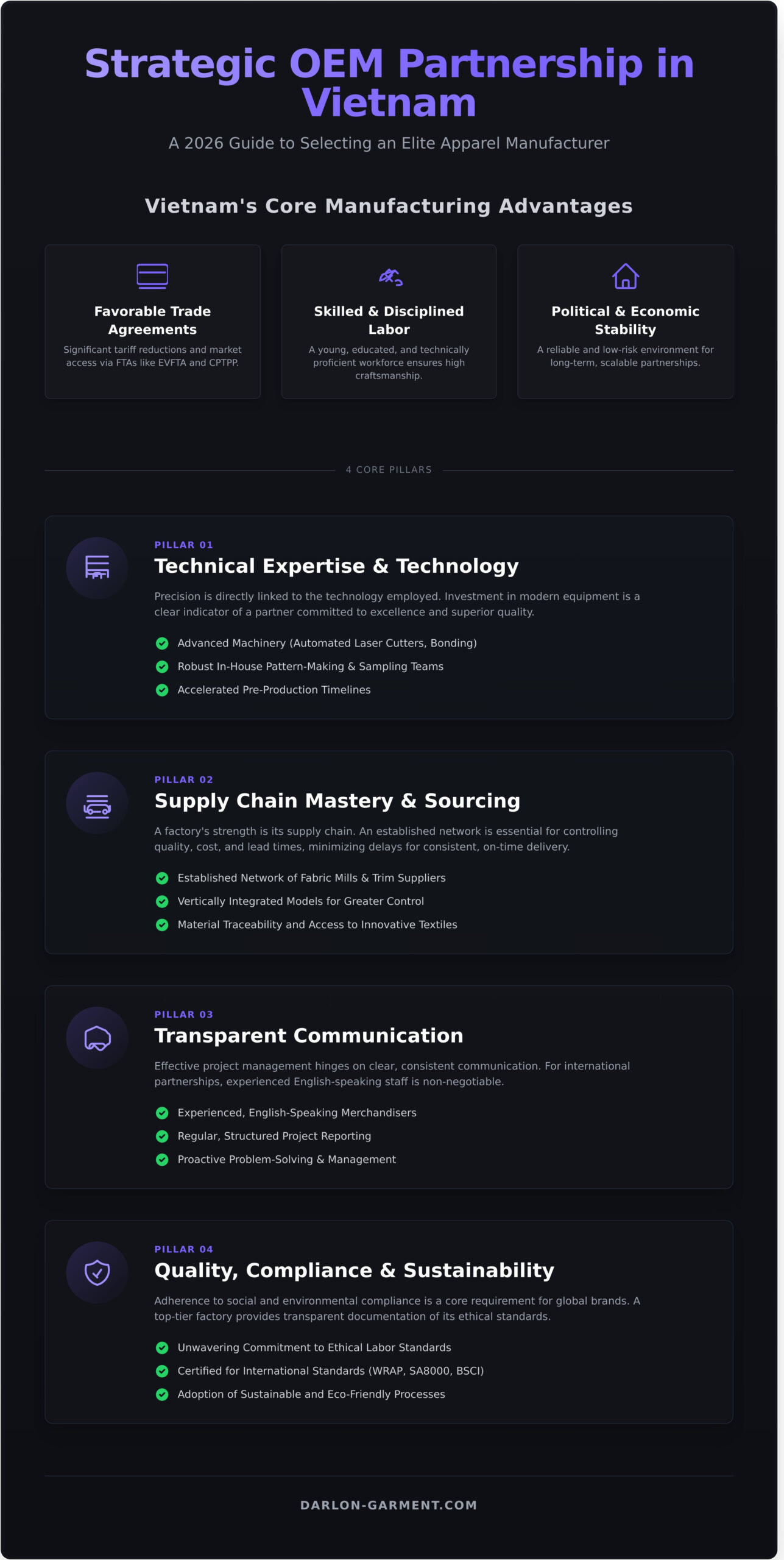
The nation’s ascent in the global textile supply chain is no accident. Decades of strategic policy have fueled this growth, with Vietnam’s economic transformation opening its doors to international trade and investment. This has created a stable and highly competitive environment for oem apparel manufacturing vietnam. Key strategic advantages that attract global partners include:
- Favorable Trade Agreements: Comprehensive FTAs like the EVFTA (EU-Vietnam Free Trade Agreement) and the CPTPP (Comprehensive and Progressive Agreement for Trans-Pacific Partnership) provide significant tariff reductions and preferential market access.
- Skilled and Disciplined Labor: A young, educated, and technically proficient workforce ensures high standards of craftsmanship and productivity.
- Political and Economic Stability: A stable government and consistent economic policies provide a reliable and low-risk operational environment for long-term partnerships.
To clarify the service scope, it is essential to distinguish OEM from other common models. An OEM partnership is ideal for brands with established design capabilities. In contrast, an ODM (Original Design Manufacturer) service involves the factory providing pre-developed designs for the client to brand. CMT (Cut, Make, Trim) is the most basic model, where the factory only handles assembly using client-sourced materials.
Vietnam’s Key Manufacturing Hubs
The epicenter of Vietnam’s garment industry is Ho Chi Minh City and its surrounding industrial provinces, including Binh Duong and Dong Nai. This southern hub boasts a dense network of suppliers and is supported by world-class logistics infrastructure and major seaports. Concurrently, northern regions around Hanoi and Hai Phong are historically strong in textile production and raw material sourcing, creating a comprehensive and vertically integrated national supply chain.
Specializations within Vietnamese Apparel Production
Vietnamese factories are renowned for producing complex, high-value garments that demand technical precision. The country is a global leader in sophisticated categories like technical sportswear, functional activewear, and multi-layered outerwear, demonstrating advanced capabilities in both knit and woven fabrics. Increasingly, there is a significant commitment to sustainable and eco-friendly manufacturing, with top-tier facilities adopting green certifications and processes to meet the demands of the conscious global consumer.
Beyond Capacity: The Core Pillars of a Strategic OEM Partnership
While production capacity is a fundamental metric, seasoned brands understand that a successful manufacturing relationship transcends mere volume. The distinction between a transactional vendor and a strategic partner is defined by a manufacturer’s ability to provide integrated value. When evaluating partners for oem apparel manufacturing vietnam, look beyond the production line to assess the foundational pillars that ensure quality, efficiency, and long-term growth.
A truly capable partner is built upon four core principles:
- Technical Expertise & Technological Investment
- Supply Chain Mastery & Material Sourcing
- Transparent Communication & Project Management
- Commitment to Quality, Compliance & Sustainability
Technical Expertise and Modern Machinery
Precision in garment construction is directly linked to the technology employed. Factories equipped with advanced machinery-such as automated laser cutters for accuracy, bonding machines for seamless finishes, and advanced sewing automation-consistently deliver superior quality. Furthermore, a robust in-house pattern-making and sample development team is critical. This internal capability accelerates the pre-production timeline and ensures your technical designs are executed flawlessly. Investment in technology is a clear indicator of a forward-thinking, reliable partner committed to excellence.
Supply Chain and Sourcing Capabilities
A factory’s strength is intrinsically tied to its supply chain. An established network of reliable fabric mills and trim suppliers is essential for controlling quality and lead times. A vertically integrated model or a meticulously managed supply chain offers significant advantages, including cost efficiencies, greater material traceability, and access to innovative textiles. This mastery over sourcing minimizes delays and provides the stability required for consistent, on-time delivery, a critical factor in the competitive landscape of apparel manufacturing.
Communication and Compliance Standards
Effective project management hinges on clear, consistent communication. The presence of experienced, English-speaking merchandisers who provide regular reporting is non-negotiable for international partnerships. Equally important is an unwavering commitment to ethical standards. A top-tier factory must provide transparent documentation of its compliance with international labor certifications like WRAP, SA8000, or BSCI. For global brands, this adherence to social and environmental compliance is not just a preference; it is a core requirement for protecting brand reputation and ensuring responsible production.
A Brand’s Vetting Checklist: How to Qualify a Vietnamese Factory
Selecting the right partner is the most critical decision in establishing a successful supply chain for oem apparel manufacturing vietnam. A systematic vetting process moves beyond price-per-unit, focusing instead on long-term reliability, technical capability, and operational transparency. This due diligence protects your brand’s reputation and ensures consistent product quality.
The qualification process begins with initial online research and the submission of a detailed Request for Quotation (RFQ), complete with your technical pack. A factory’s response time and the clarity of its quotation are the first indicators of its professionalism. The subsequent sampling and prototyping stage is even more revealing. Evaluate not only the quality of the submitted samples but also the manufacturer’s ability to interpret feedback and execute revisions efficiently.
Once initial samples are approved, a factory audit-conducted either virtually or in-person-is essential. This step verifies production capacity, machinery, and working conditions. Finally, assess communication and cultural fit. A responsive, transparent, and English-proficient team is fundamental for navigating the complexities of production schedules, material sourcing, and quality assurance without friction.
Key Questions to Ask Potential Manufacturers
To formalize your evaluation, secure direct answers to the following operational questions:
- What are your primary product specializations and what specific machinery supports them?
- What is your MOQ (Minimum Order Quantity) per style and per color?
- Can you provide references from current clients in non-competing markets?
- How is your quality control process structured, and what are the key inspection points?
Red Flags to Watch For
Conversely, certain behaviors should be considered immediate warnings. Be cautious of partners who exhibit the following:
- Vague or evasive answers regarding their production facility or use of subcontractors.
- Consistently poor-quality samples or a disorganized, slow prototyping process.
- An inability to provide internationally recognized compliance certifications (e.g., ISO 9001, WRAP, or OEKO-TEX).
A thorough vetting process mitigates risk and builds a foundation for a successful partnership. Download our detailed factory vetting checklist for a deeper analysis.
The OEM Production Journey: From Tech Pack to Global Shipment
Understanding the end-to-end production cycle is fundamental for any brand engaging in oem apparel manufacturing vietnam. This structured process, from initial design specifications to final delivery, is a collaborative effort where your brand’s input is critical at every milestone. The journey is methodically divided into three primary phases: Pre-Production, Mass Production, and Post-Production.
The process begins with Stage 1: Pre-Production, where your vision is translated into a viable manufacturing plan. This involves submitting a detailed tech pack, sourcing the specified fabrics and trims, and approving a series of samples (prototype, fit, and pre-production). Your timely feedback and approval at this stage are paramount to maintaining the production schedule.
Once samples are approved, Stage 2: Mass Production commences. This is where industrial-scale operations take over, beginning with precision fabric cutting, followed by systematic sewing on production lines. Throughout this phase, in-line quality checks are conducted to identify and rectify any deviations from the approved standard, ensuring consistency across the entire order.
The final phase, Stage 3: Post-Production, involves final quality control inspections, meticulous garment pressing, folding, and packing according to your brand’s specifications. This culminates in logistics management and global shipment, delivering the finished product to your designated port or warehouse.
The Critical Role of the Tech Pack
The tech pack is the single most important document in apparel manufacturing; it is the definitive blueprint for your product. A comprehensive tech pack eliminates ambiguity and minimizes costly errors. It must contain precise details, including:
- Technical sketches (flats) of the garment
- A Bill of Materials (BOM) listing all fabrics, trims, and accessories
- A complete garment measurement and grade rule sheet
- Construction details and stitch specifications
- Labeling and packing instructions
For a deeper dive into creating an effective document, see our guide on What is a Tech Pack?
Navigating Quality Control and Logistics
Quality assurance is governed by international standards, primarily the Acceptable Quality Limit (AQL). This statistical tool determines the maximum number of defective units permissible in a batch before it is rejected. Your brand will agree on an AQL level (e.g., AQL 2.5) with the manufacturer before production. For ultimate peace of mind, many brands conduct a final inspection, either in-person or via a third-party service, before the goods are shipped. Understanding shipping incoterms is also vital. FOB (Free On Board) means your responsibility begins once goods are loaded onto the vessel, while CIF (Cost, Insurance, and Freight) means the manufacturer covers costs until the goods arrive at your destination port.
Partnering with a seasoned manufacturer in the oem apparel manufacturing vietnam sector ensures meticulous management of each stage. Darlon Garment provides the one-stop solution and technical mastery required to navigate this journey successfully.
Partnering with Dar Lon Garment: Your Strategic OEM Manufacturer in Vietnam
Selecting the right manufacturing partner is the most critical decision for scaling your apparel brand. A strategic partnership must be built on pillars of technical expertise, transparent communication, advanced technological capacity, and unwavering quality control. At Dar Lon Garment, we have engineered our entire operation to embody these principles, establishing ourselves as a premier partner for oem apparel manufacturing vietnam.
Our specialization lies in high-performance garments, including technically demanding sportswear, activewear, and swimwear. We integrate advanced manufacturing technologies like precision laser cutting and seamless bonding to achieve superior construction and finish. This technical mastery is delivered through our comprehensive One-Stop Service model, which manages the entire production lifecycle-from material sourcing and sample development to bulk manufacturing, quality assurance, and final logistics. This streamlined process provides our clients with efficiency, cost-effectiveness, and a single point of accountability.
Our Commitment to Quality and Innovation
Quality is not a final check; it is a protocol embedded in every stage of our production. Our multi-stage quality control process includes raw material inspection, in-line production monitoring, and a final, rigorous audit of every finished garment. We extend this commitment to innovation by investing in specialized capabilities, such as becoming a certified manufacturer of Nuyarn® performance wool. Our objective is to build long-term, collaborative relationships, serving as a silent, powerful backbone for your brand’s success.
Begin Your Production Journey with Dar Lon Garment
Initiating your production with Dar Lon Garment is a straightforward and transparent process designed for clarity and efficiency. The journey begins with an initial consultation to understand your brand’s vision and technical requirements. From there, our team collaborates with you on tech pack refinement, material sourcing, and prototype sampling. We position ourselves as more than a vendor; we are your reliable, high-quality partner for growth, dedicated to bringing your designs to life with precision and scale.
Ready to elevate your production capabilities? Request a Consultation to Discuss Your Production Needs.
Finalizing Your Strategy for OEM Apparel Manufacturing in Vietnam
As this guide has detailed, Vietnam’s apparel sector presents a strategic opportunity defined by skilled craftsmanship, robust infrastructure, and proven economic stability. Successfully leveraging this landscape requires more than just finding a factory; it demands a true partnership. The key to long-term success lies in identifying an OEM partner whose technical capabilities, quality control systems, and communication protocols align precisely with your brand’s vision and standards. A meticulous vetting process is the critical first step in building a resilient and profitable global supply chain.
At Darlon Garment, we are engineered to be that strategic partner. Specializing in high-performance sportswear and activewear, we integrate advanced manufacturing technology like laser cutting and bonding to achieve unparalleled precision. Our comprehensive ‘One-Stop Service’ manages every stage, from technical development to global shipment, providing the reliability your brand requires. We are not just a vendor; we are the operational backbone for your growth. Let us help you build a powerful production foundation for 2026 and beyond.
Contact Our Team to Start Your OEM Production Journey.
Frequently Asked Questions About OEM Apparel Manufacturing in Vietnam
What is the typical MOQ for OEM apparel manufacturing in Vietnam?
The typical Minimum Order Quantity (MOQ) for OEM apparel manufacturing in Vietnam generally ranges from 500 to 1,000 units per style and colorway. This figure is contingent upon factors such as fabric sourcing requirements, garment complexity, and the factory’s production capacity. For highly specialized materials or intricate designs, the MOQ may be adjusted. It is crucial for buyers to discuss these parameters directly with their manufacturing partner to align on production viability and achieve competitive pricing.
How do I protect my designs and intellectual property when working with a Vietnamese factory?
Protecting your intellectual property is paramount. It is standard industry practice to execute a legally binding Non-Disclosure Agreement (NDA) before sharing any proprietary designs or tech packs. Furthermore, a comprehensive Manufacturing Agreement should be established, clearly outlining ownership of designs and tooling. Partnering with established manufacturers who have a proven track record of working with international brands provides an additional layer of security and professional accountability for your IP portfolio.
Is Vietnam a more cost-effective manufacturing location than China?
Vietnam often presents a more cost-effective solution than China, primarily due to competitive labor costs and benefits from free trade agreements like the EVFTA. However, the final cost is contingent on order volume, garment complexity, and fabric sourcing. While Vietnam excels in cut-and-sew manufacturing, China’s highly developed supply chain may offer advantages for intricate trims or specialized textiles. A thorough cost analysis based on your specific tech pack is recommended for an accurate comparison.
What are the average lead times for an OEM apparel order from Vietnam?
Average lead times for an OEM apparel order from Vietnam typically range from 90 to 120 days. This timeline commences after the confirmation of the tech pack and prototype sample. The process includes approximately 30-45 days for fabric sourcing and lab dips, 30-60 days for bulk production, and a final 1-2 weeks for quality assurance and packing. Timelines can fluctuate based on material availability and the intricacy of the production requirements.
How are payments typically structured with Vietnamese garment manufacturers?
The standard payment structure is designed to mitigate risk for both parties. A deposit of 30-50% is typically required via Telegraphic Transfer (T/T) upon placement of the purchase order to initiate production. The remaining balance of 50-70% is due upon completion of production, often after a successful final quality inspection and before the goods are shipped. For larger, ongoing contracts, a Letter of Credit (L/C) may also be utilized as a secure payment instrument.
Can Vietnamese factories source sustainable and recycled fabrics?
Yes, Vietnamese factories are increasingly equipped to source a wide array of sustainable and recycled fabrics. Manufacturers can procure materials such as GOTS-certified organic cotton, recycled polyester (rPET), and lyocell (Tencel™). Buyers must clearly specify their sustainability requirements in the tech pack. Requesting material certifications like the Global Recycled Standard (GRS) or OEKO-TEX® Standard 100 ensures transparency and compliance with global environmental standards for responsible sourcing.
What certifications should I look for in a Vietnamese apparel manufacturer?
When vetting a Vietnamese apparel manufacturer, look for internationally recognized certifications that validate their operational standards. Key credentials include WRAP (Worldwide Responsible Accredited Production) for ethical manufacturing, SA8000 for social accountability, and ISO 9001 for quality management systems. Additionally, certifications like OEKO-TEX® confirm that textiles are free from harmful substances, a critical standard for market access in Europe and North America.
What is the difference between OEM and ODM services?
The distinction between OEM and ODM services lies in the origin of the design. OEM (Original Equipment Manufacturer) involves producing garments based entirely on the client’s unique designs, specifications, and tech packs; the client retains full intellectual property. In contrast, ODM (Original Design Manufacturer) is when a client selects a pre-existing design from the manufacturer’s catalog and applies their own branding. ODM offers a faster route to market with lower development costs.