
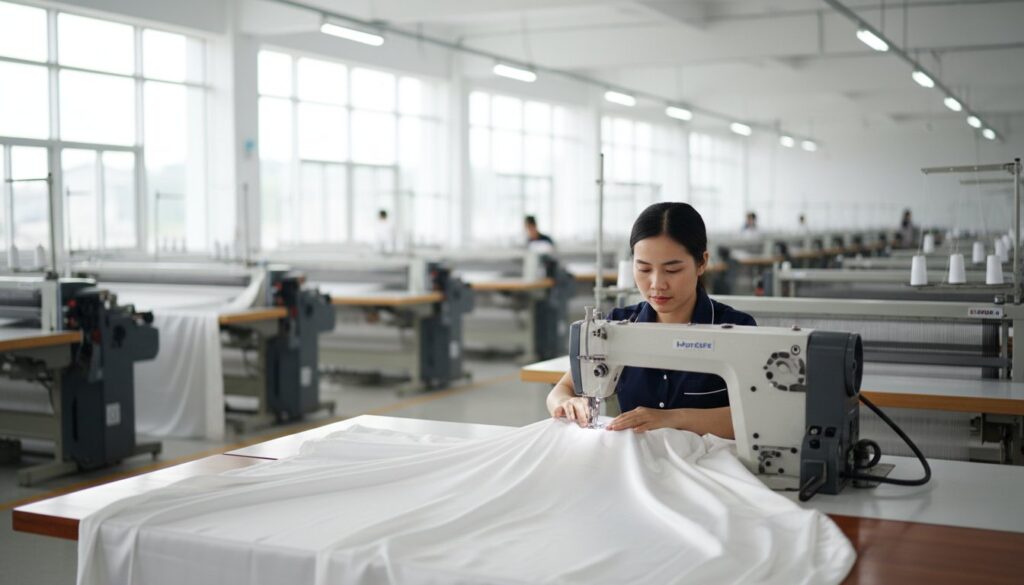
The search for a high-quality sleepwear factory in Vietnam presents both immense opportunity and significant risk. For global brands, the potential for competitive pricing and skilled craftsmanship is often offset by the challenges of ensuring consistent quality, navigating complex communication, and verifying ethical compliance. A single misstep in partner selection can jeopardize an entire production run, leading to financial loss and damaging your brand’s hard-won reputation.
This comprehensive 2026 guide provides the strategic framework necessary to eliminate that uncertainty. We will detail the critical criteria for vetting and selecting a manufacturing partner, covering everything from technical capabilities and quality assurance protocols to social compliance and transparent communication. Our objective is to equip your brand with the operational intelligence required to forge a reliable, long-term partnership that guarantees production excellence and protects your investment.
Key Takeaways
- Understand the strategic advantages of Vietnam’s skilled workforce and established textile industry for high-quality sleepwear production.
- Implement a proven framework to evaluate any potential sleepwear factory vietnam, assessing critical areas like production capacity, quality systems, and compliance.
- Master the essential due diligence process with a checklist of seven critical questions to ask potential manufacturing partners before committing.
- Gain a clear understanding of the end-to-end production journey, from submitting a technical pack to final product delivery.
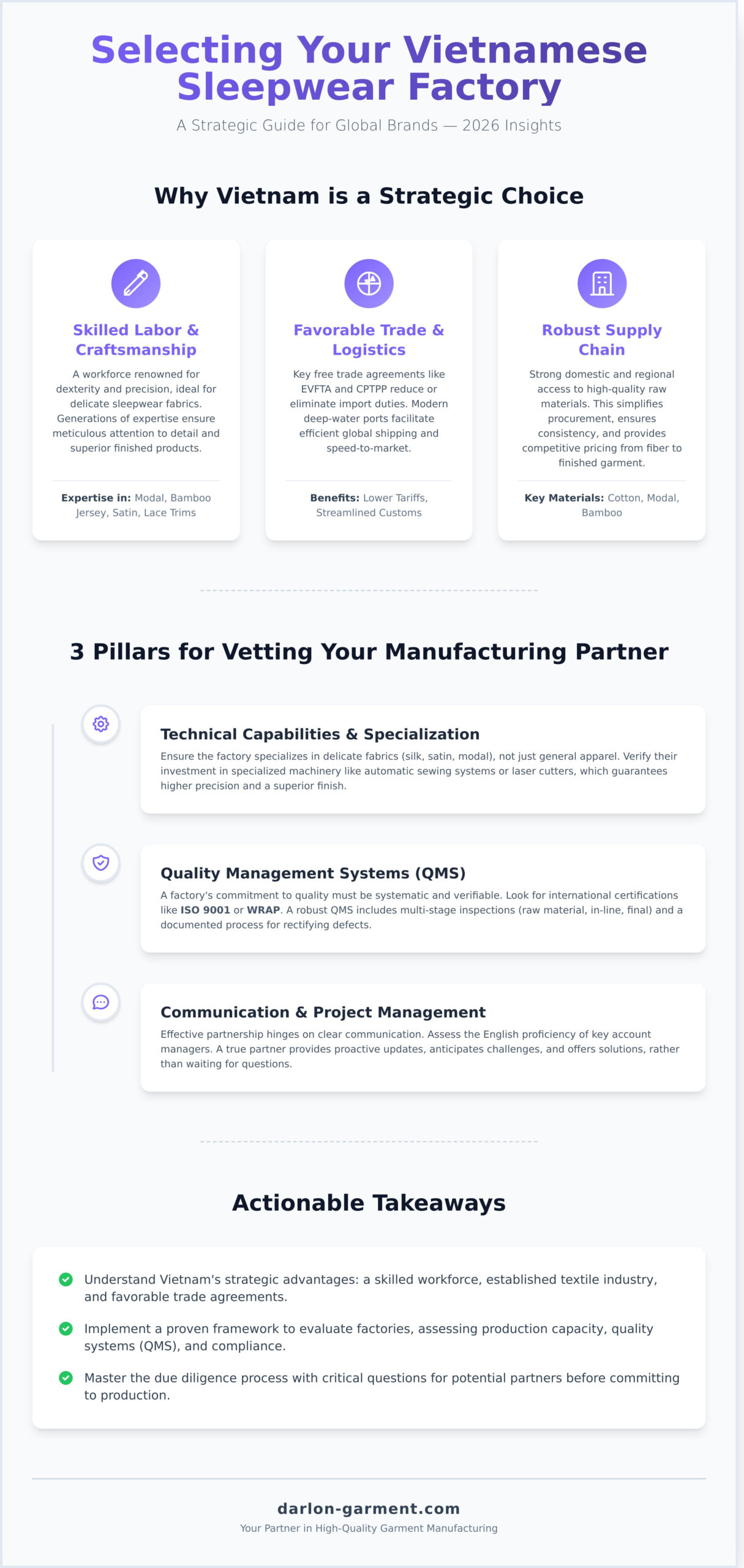
Why Vietnam is a Strategic Choice for Sleepwear Manufacturing in 2026
Vietnam has solidified its position as a global leader in textile and garment manufacturing, built upon decades of industrial development and technical mastery. For international brands seeking reliable production partners, the country offers a compelling combination of stability, skill, and strategic advantage. The evolution of Vietnam’s economic landscape has been marked by a strong focus on export-oriented industries, creating a mature ecosystem perfectly suited for high-volume apparel production. This long history has cultivated a deep-seated expertise that is particularly valuable for intricate product categories like sleepwear.
The nation’s robust supply chain for popular sleepwear fabrics-including cotton, modal, and bamboo-further enhances its appeal, providing brands with access to high-quality raw materials at competitive price points. This vertical integration potential simplifies procurement and ensures consistency from fiber to finished garment.
Skilled Labor and Craftsmanship
The Vietnamese workforce is renowned for its dexterity and precision, skills honed over generations of garment production. This craftsmanship is critical for sleepwear, which often utilizes delicate and challenging materials such as modal, bamboo jersey, and satin blends. Unlike regions that focus primarily on heavy-duty apparel, Vietnamese artisans excel at the complex sewing techniques required for lightweight fabrics, intricate lace trims, and stretch-sensitive seams. This institutional commitment to quality and attention to detail ensures that finished products meet the exacting standards of global brands.
Favorable Trade Agreements & Logistics
Vietnam’s integration into the global economy is accelerated by its participation in key free trade agreements (FTAs). The EU-Vietnam Free Trade Agreement (EVFTA) and the Comprehensive and Progressive Agreement for Trans-Pacific Partnership (CPTPP) provide significant competitive advantages, including:
- Reduced or eliminated import duties for brands in member countries.
- Streamlined customs procedures, improving speed-to-market.
- Enhanced market access to major consumer regions across Europe and the Americas.
Logistically, Vietnam’s strategic coastal location, coupled with modern deep-water ports in cities like Ho Chi Minh and Hai Phong, facilitates efficient global shipping. The nation’s proximity to major fabric and trim suppliers across Asia ensures a resilient supply chain, making the search for a dependable sleepwear factory vietnam a sound strategic decision.
Key Criteria for Evaluating a Vietnamese Sleepwear Factory
Selecting the right manufacturing facility is the single most critical decision for your brand’s supply chain. The objective is to secure a strategic partner, not merely a transactional vendor. A vendor fulfills purchase orders; a partner invests in your quality standards, brand growth, and long-term success. This distinction mitigates risk and transforms your production process from a liability into a competitive advantage. A comprehensive evaluation framework should assess a factory’s technical prowess, quality control infrastructure, communication protocols, and ethical compliance.
Technical Capabilities & Specializations
A factory’s specialization directly impacts product quality. A general apparel manufacturer may not possess the nuanced expertise required for delicate sleepwear fabrics like silk, satin, modal, or flannel. Inquire specifically about their experience with these materials. Furthermore, ask about their investment in specialized machinery, such as automatic sewing systems or laser cutters, as this technology ensures a higher degree of precision, consistency, and a superior finish on every garment.
Quality Management Systems (QMS)
A factory’s commitment to quality must be verifiable and systematic. Look for internationally recognized certifications like ISO 9001 for process management or WRAP for ethical production standards. A robust QMS includes multi-stage inspections, from raw material verification to in-line and final product checks. This focus on process excellence is vital as Vietnam’s textile and garment industry continues its strategic shift toward higher-value growth. Critically, you must clarify their documented process for identifying and rectifying defects to ensure production errors are managed transparently.
Communication & Project Management
Effective collaboration hinges on clear, consistent communication. Assess the English proficiency of the key personnel who will manage your account, as this is fundamental for avoiding costly misunderstandings. A true manufacturing partner provides proactive updates, anticipates potential challenges, and offers solutions-they do not simply wait for your questions. Inquire about their standard communication channels (e.g., email, video calls) and their expected response times to ensure alignment with your operational tempo. Ultimately, the ideal sleepwear factory vietnam for your brand is one whose operational standards and growth ambitions mirror your own.
Your Vetting Checklist: 7 Questions to Ask Potential Factories
Selecting a manufacturing partner is the most critical decision in your production journey. A thorough vetting process is not merely a formality; it is an essential due diligence measure that safeguards your brand’s quality, reputation, and financial investment. Before committing to a partnership, arm yourself with precise questions that reveal a factory’s true capabilities. This structured inquiry will help you identify the ideal sleepwear factory vietnam for your specific needs, especially as the Vietnam’s garment industry outlook for 2026 indicates a shift toward higher-value export orders that demand proven expertise.
Questions About Production & Capacity
These inquiries focus on the operational realities of production. The answers will determine if a factory’s scale, speed, and technical skills align with your business model and product specifications.
- What is your Minimum Order Quantity (MOQ) for sleepwear? This is a foundational question. A factory’s MOQ must align with your sales projections and inventory capacity, whether you are a startup launching a small collection or an established brand placing a large-volume order.
- What are your average lead times for samples and bulk production? Understanding timelines is crucial for supply chain management. Clarify the duration for both initial sample creation and the full production run to accurately plan your launch calendar and marketing efforts.
- Can you share examples of similar sleepwear you have produced? Requesting a portfolio or physical samples allows you to assess their craftsmanship firsthand. Evaluate the stitching, fabric handling (especially for delicate materials like silk or modal), and overall finishing quality.
Questions About Compliance & Sourcing
Beyond production, a factory’s integrity is defined by its ethical standards and supply chain transparency. These questions address crucial business and compliance aspects of a potential partnership.
- Can you provide your social compliance audit reports (e.g., BSCI, WRAP)? Verifiable certifications are non-negotiable for responsible brands. These documents confirm that the factory adheres to ethical labor practices and international standards.
- How do you ensure the traceability and quality of your sourced fabrics? A reliable partner will have a robust system for quality assurance that begins with raw materials. Inquire about their fabric sourcing process and any certifications they hold, such as OEKO-TEX®.
- What are your payment terms and process? Clear financial terms prevent future misunderstandings. Typically, terms involve an initial deposit (e.g., 30-50%) with the balance due upon completion or shipment. Confirm these details upfront.
- Do you offer OEM and/or ODM services? Clarify if the factory can execute your custom designs (Original Equipment Manufacturer – OEM) or if they provide their own pre-developed designs for you to brand (Original Design Manufacturer – ODM). This determines the level of creative control and development support available.
The Production Journey: From Tech Pack to Final Delivery
Transforming a design concept into a market-ready product follows a structured and highly controlled pathway. For brands new to overseas manufacturing, this process can seem complex. However, a professional sleepwear factory vietnam operates with a methodical system designed for clarity, efficiency, and quality assurance at every turn. Understanding this journey builds confidence and ensures a successful partnership.
The entire manufacturing cycle is a collaborative effort, guided by technical specifications and rigorous checkpoints to guarantee the final product aligns perfectly with your brand’s vision.
Stage 1: Design, Prototyping, and Sampling
This initial phase translates your creative vision into a tangible product blueprint. Your tech pack is the most critical document, containing all technical details: measurements, fabric type, color codes, stitching instructions, and trim placements. Based on this, the factory sources appropriate materials and creates a pre-production sample (PPS). Your approval of the PPS is the final checkpoint before committing to a full production run, ensuring every detail is correct.
Stage 2: Bulk Production and Quality Assurance
Once the sample is approved, bulk production commences. This involves precise fabric cutting, often using automated machinery for consistency, followed by assembly line sewing. Quality is not an afterthought; it is integrated throughout the process. Key checkpoints include:
- In-line quality control: Supervisors inspect garments at various stages of the sewing line to catch and correct deviations early.
- End-of-line inspection: Every finished garment is checked for defects in stitching, sizing, and overall construction.
For added security, brands can also engage a third-party inspection agency to verify the shipment before it leaves the factory.
Stage 3: Finishing, Packing, and Logistics
In the final stage, garments undergo finishing touches like pressing, trimming loose threads, and attaching brand tags and care labels. Each item is then carefully folded and packed into polybags according to your specifications. Your chosen sleepwear factory vietnam will also coordinate the logistics, preparing all necessary export documentation. Understanding shipping terms like FOB (Free On Board) or CIF (Cost, Insurance, and Freight) is essential here, as it defines where the financial responsibility shifts from the manufacturer to you. A full-service partner like Darlon Garment can expertly guide you through these logistical requirements, ensuring a smooth final delivery.
Why Darlon Garment is Your Ideal Sleepwear Production Partner
Selecting the right manufacturing partner is the most critical decision for your brand’s success. After evaluating the essential criteria for technical capability, quality assurance, and communication, it becomes clear why Dar Lon Garment stands as a premier choice. We have structured our operations to directly address the challenges brands face when sourcing production, making us the ideal partner for your next sleepwear collection.
Our expertise extends beyond sportswear and activewear into the nuanced requirements of sleepwear, where comfort, fabric hand-feel, and precise construction are paramount. We combine this specialized knowledge with industrial-scale capacity to deliver exceptional value.
Advanced Technology & Quality Commitment
Our commitment to “Quality First” is embedded in our production floor. We leverage advanced technology, including precision laser cutting and automated sewing machines, to ensure consistent seam quality and perfect fits-critical for high-end sleepwear. Our quality assurance is a multi-stage process, with rigorous inspections at every step: from fabric arrival and cutting to sewing and final packaging. This meticulous approach has enabled us to consistently meet and exceed the demanding export standards of major international brands for decades.
A Seamless One-Stop Manufacturing Solution
As a leading sleepwear factory vietnam, we understand that streamlined logistics are as important as production quality. Dar Lon Garment offers a comprehensive ‘One-Stop Service’ through our robust OEM/ODM framework. This integrated solution manages every aspect of your production cycle, from innovative fabric sourcing and sample development to full-scale manufacturing and final delivery. Our experienced, English-speaking project managers ensure clear communication and transparent oversight, transforming a complex international supply chain into a seamless, efficient process.
By partnering with Dar Lon, you gain more than a supplier; you secure a dedicated production backbone for your brand. Let’s discuss your sleepwear project. Contact our production experts today.
Secure Your Production Partner for Success in Vietnam
Selecting the right manufacturing partner is the most critical decision for your brand’s success in the competitive 2026 market. As this guide has outlined, the process demands a strategic approach: understanding Vietnam’s manufacturing landscape and applying rigorous evaluation criteria. Your success ultimately depends on finding a sleepwear factory vietnam that is not just a supplier, but a true operational partner committed to your brand’s quality and compliance standards.
At Darlon Garment, we are structured to be that partner. Our advanced facility, equipped with precision laser cutting and automatic sewing technology, delivers consistent, high-quality output at scale. With proven experience meeting diverse international quality and compliance standards, we provide a comprehensive OEM/ODM ‘One-Stop Service’ that manages every detail from tech pack to final delivery, ensuring a seamless and efficient production journey for our global clients.
Take the definitive step toward securing a reliable and technologically advanced supply chain. Request a consultation to discuss your sleepwear production needs and let our team demonstrate how our capabilities can elevate your brand.
Frequently Asked Questions About Manufacturing Sleepwear in Vietnam
What is a typical MOQ for a sleepwear factory in Vietnam?
Minimum Order Quantities (MOQs) for sleepwear production in Vietnam typically range from 500 to 2,000 pieces per style, per color. This figure is influenced by factors such as fabric sourcing requirements, custom dyeing processes, and production line efficiency. For highly specialized materials or complex designs, the MOQ may be higher to ensure cost-effective procurement and manufacturing. Established factories often provide some flexibility for long-term partners, aligning production minimums with a brand’s strategic goals.
How much does it cost to manufacture sleepwear in Vietnam?
The final cost per unit is determined by several key variables: fabric composition (e.g., cotton vs. modal), garment construction complexity, print or embroidery details, and total order volume. A basic cotton pajama set may range from $5-$10 USD, while a more intricate design using premium fabric could be $15-$25+ USD. Providing a detailed technical pack (tech pack) is essential for receiving an accurate, transparent quotation that accounts for all specifications.
What are the average lead times for sample and bulk production?
Sample development typically requires 7 to 14 days, contingent upon design intricacy and the availability of specified materials. Following the approval of the final sample, bulk production lead times average between 45 and 90 days. This comprehensive timeline covers fabric sourcing, cutting, sewing, stringent quality assurance checks, and final packaging. Peak seasons or complex logistics can affect this schedule, making advanced planning with your manufacturing partner critical.
How can I protect my intellectual property (designs) when working with a Vietnamese factory?
Protecting your intellectual property (IP) is paramount for brand integrity. The most effective initial step is to execute a legally binding Non-Disclosure Agreement (NDA) before sharing any proprietary designs or tech packs. Partnering with a reputable factory that demonstrates a strong ethical track record is crucial. For enhanced legal protection, consider registering your trademarks and core designs in Vietnam. A trustworthy manufacturing partner will respect your IP as the foundation of a long-term business relationship.
Do I need to visit the factory in person before placing an order?
While an in-person visit is highly recommended for assessing infrastructure, quality control systems, and ethical compliance, it is not always mandatory. Many international brands successfully partner with a sleepwear factory in Vietnam remotely. This is accomplished through detailed virtual tours, independent third-party audits (such as BSCI or WRAP), and transparent communication. A reliable manufacturer will readily provide certifications and video conferencing to build confidence and ensure full alignment before production begins.
What is the difference between OEM and ODM manufacturing services?
OEM (Original Equipment Manufacturer) is a service where the factory produces garments based entirely on your brand’s unique designs and detailed technical specifications. In contrast, ODM (Original Design Manufacturer) is a service where the factory provides its own portfolio of pre-developed designs that your brand can select, modify, and label as its own. ODM can accelerate time-to-market, while OEM offers complete creative control and product exclusivity for your brand.
What fabrics are best for high-quality sleepwear production?
The selection of fabric is critical to the final quality and comfort of the garment. For premium sleepwear, superior options include Pima or Supima cotton for their exceptional softness and durability. Modal and Tencel™ are favored for their silky feel, moisture-wicking properties, and sustainable credentials. For luxury collections, silk and satin blends offer unparalleled drape and breathability. An experienced sleepwear factory in Vietnam will have robust supply chains for sourcing these high-grade textiles.