

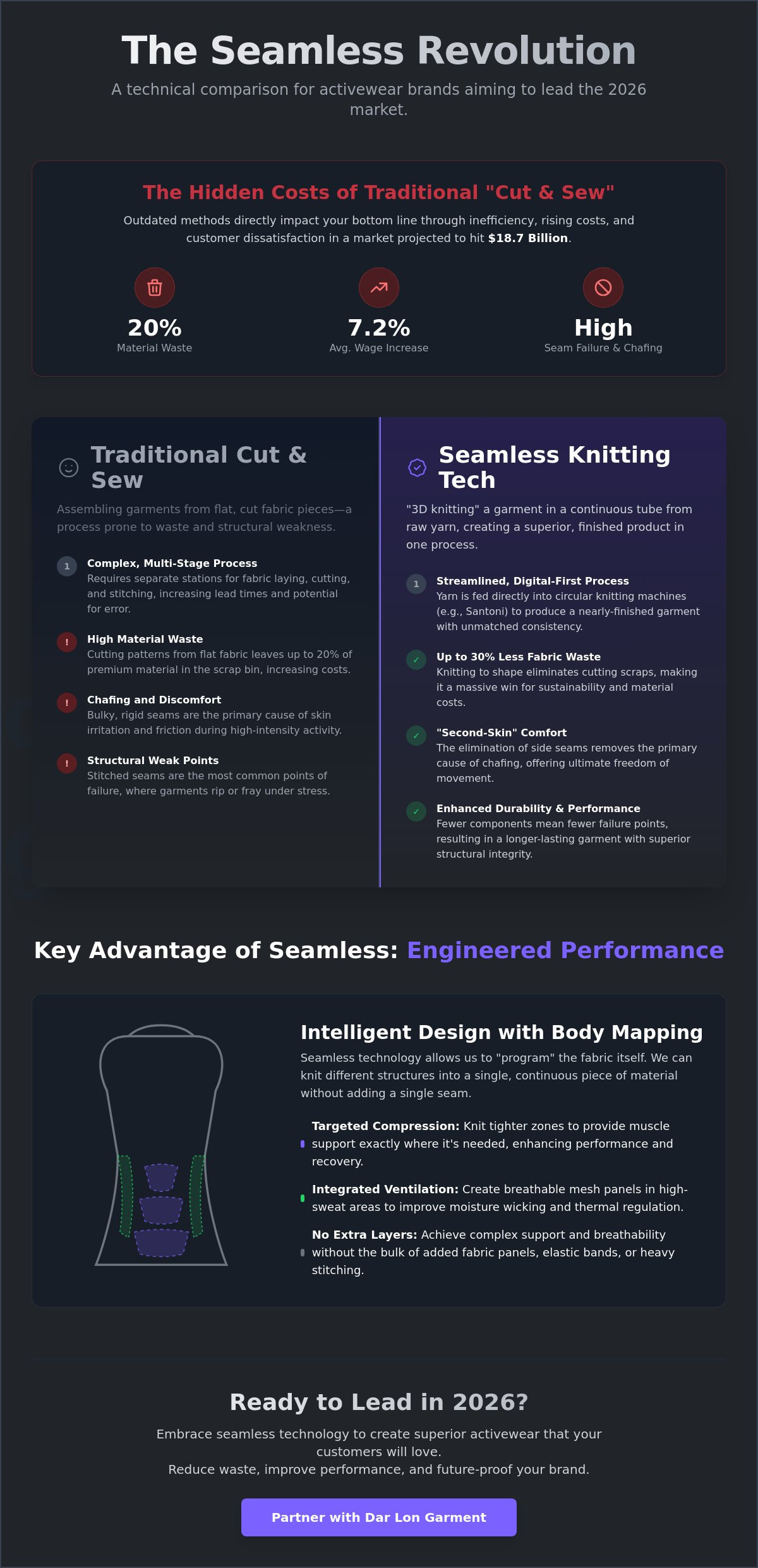
If you are still relying on traditional cut-and-sew methods, you are likely losing up to 20% of your raw materials to the scrap bin. In a year where Vietnam’s regional minimum wage has increased by an average of 7.2% as of January 2026, these production inefficiencies aren’t just annoying; they are a direct hit to your bottom line. I have talked with many brand owners who are frustrated by slow lead times and constant customer complaints about seams that chafe or fail during high-intensity workouts. Understanding the benefits of seamless knitting technology is no longer a luxury for brands that want to lead in a U.S. market projected to hit $18.7 billion this year.
I know you want to deliver high-performance apparel that feels like a second skin without the logistical headaches of complex assembly. I’ve spent my career in industrial manufacturing, and I’m convinced that seamless tech is the most strategic upgrade for any activewear brand looking to balance performance with production speed. In this article, I will show you how this technology slashes waste by up to 30% and simplifies your supply chain. We will look at the technical advantages of body mapping and why this specific manufacturing shift is the key to attracting premium customers in 2026.
Key Takeaways
- I’ll explain how circular knitting machines eliminate side seams entirely to create a more durable, “second-skin” fit for your customers.
- Discover how removing traditional seams allows me to effectively eliminate the primary cause of skin chafing in high-performance activewear.
- Learn why the benefits of seamless knitting technology include a 20% to 30% reduction in fabric waste, making it a massive win for your sustainability goals.
- I’ll show you how body mapping lets us knit mesh vents and compression zones exactly where they are needed without any extra stitching or assembly.
- Get my insider advice on sourcing in Vietnam and how to identify a factory partner with the technical mastery required for complex 2026 designs.
What Exactly is Seamless Knitting Technology? (My View from the Factory)
When I walk through our production facility and look at our circular knitting machines, I don’t just see hardware. I see the future of apparel. For decades, the garment industry relied on flat fabric that we had to cut and stitch together. Seamless technology changes that entire dynamic. Instead of building a garment from flat parts, we create it in a continuous tube. This removes traditional side seams and results in a piece of clothing that feels fundamentally different on the body. It’s a shift from assembly to creation.
I often describe this process as a “3D printing” approach for the clothing world. We aren’t cutting away from a larger block of fabric; we’re building the shape stitch by stitch from the ground up. This method relies on highly computerized programming to dictate every single loop, tension level, and yarn transition. One of the primary benefits of seamless knitting technology is this level of precision. I can program a single machine to change its knit pattern mid-row, creating support zones or breathable areas without ever stopping the production line.
The Machinery Behind the Magic
I always tell my clients that Santoni machines are the gold standard for this work. These machines use hundreds of precision needles to knit complex patterns simultaneously. It’s a marvel of engineering. Because the process is digital, we’ve replaced the need for manual fabric laying and cutting. The Circular knitting process allows us to feed yarn directly into the machine and receive a nearly finished garment on the other side. This digital-first approach ensures that the tenth garment is identical to the ten-thousandth, providing a level of consistency that manual cutting simply cannot match.
Seamless vs. Traditional Cut-and-Sew
In traditional manufacturing, I see so much fabric left on the cutting room floor. It’s frustrating to watch premium textiles go to waste because of the “puzzle piece” approach. Traditional methods require joining flat fabric panels, which naturally creates scrap. Seamless eliminates that entirely. The transition from raw yarn to a finished garment happens in a single, streamlined process. By removing the need for heavy side seams, we’re also removing the weak points where garments usually fail. I believe it’s a cleaner, more efficient way to build high-performance activewear that meets the demands of 2026 consumers.
Why Seamless is a Game-Changer for Performance and Comfort
The “second-skin” feel is the number one reason my clients choose this technology. When I’m overseeing production, I see how the absence of seams changes the garment’s behavior. By removing those bulky lines, I am effectively removing the primary cause of skin chafing. Traditional activewear often fails at the seams because that’s where the most friction occurs. One of the main benefits of seamless knitting technology is that it allows for a much higher degree of elasticity and freedom of movement. Because the fabric isn’t restricted by rigid thread lines, it moves with the body rather than against it.
Eliminating the Friction Point
I’ve noticed that athletes, particularly those in high-intensity sports like running or yoga, specifically seek out seamless options. In my experience, traditional seams often interfere with moisture-wicking properties by trapping sweat in the raised ridges of the thread. Seamless garments stay flatter against the skin, allowing moisture to move efficiently away from the body. There’s also a significant psychological benefit; when a garment “disappears” during a workout, the athlete can focus entirely on their performance.
Engineered Compression and Support
What I find most exciting is the ability to program specific zones of compression directly into the knit structure. This allows us to provide muscle support without the bulk of extra fabric layers or heavy elastic bands. It’s the difference between “all-over” tightness and targeted, functional support. This level of customization is one of the standout benefits of seamless knitting technology for high-end performance brands. Research into innovative design applications shows how these technical zones can be mapped to human anatomy. If you are looking to develop a line that combines these performance features, I recommend exploring our seamless sportswear manufacturing capabilities.
Durability is another factor that shouldn’t be overlooked. I have found that seamless garments typically last longer because there are fewer seams that can potentially rip or fray over time. When you reduce the number of components, you reduce the number of potential failure points. This reliability is why I believe seamless is the logical choice for brands aiming for the premium tier in 2026. Traditional garments often fail at the gusset or the waistband where four different fabrics might meet. In a seamless piece, those areas are knitted as one continuous unit, which creates a structural integrity that is hard to match with a sewing machine.
The Business Case: Sustainability and Production Efficiency
I’ve noticed a significant pivot in how my partners approach their 2026 collections. It’s no longer just about the look of the garment; it’s about the math behind it. One of the most compelling business benefits of seamless knitting technology is its alignment with modern sustainability mandates. In our facility, we typically see a 20% to 30% reduction in fabric waste compared to traditional cut-and-sew methods. When you consider that traditional cutting can leave up to 20% of fabric as scrap, the fiscal and environmental savings are impossible to ignore. I believe that in an era of rising material costs, efficiency is your strongest hedge against margin erosion.
Reducing the Environmental Footprint
Minimizing fabric offcuts is the most direct way to improve your brand’s sustainability profile. I’ve found that using seamless machines allows for a much tighter control over yarn consumption. This precision is particularly valuable when working with premium natural fibers or recycled synthetics. New regulations, such as the EU’s Empowering Consumers for the Green Transition Directive, will require verifiable data starting in September 2026. Seamless production provides that transparency. I’ve also seen brands use on-demand knitting to prevent overstocking, which solves the “deadstock” problem before it even begins. It’s a cleaner way to do business.
Streamlining the Supply Chain
I frequently recommend seamless for brands looking to simplify their production process. By reducing the number of components needed for a single garment, we cut down on logistical complexity. Fewer production steps mean I can often offer faster lead times. This speed is critical for staying ahead of 2026 market trends. The process also minimizes the labor-intensive sewing phase. With Vietnam’s regional minimum wage increasing by an average of 7.2% as of January 2026, reducing the reliance on manual assembly is a smart move. Digital tech packs for seamless are incredibly precise. This precision significantly lowers the risk of human error during the manufacturing cycle, ensuring your bulk order matches your sample exactly.
Design Freedom: Body Mapping and Aesthetic Innovation
I love showing designers how they can mix textures within a single piece. When we sit down with a digital tech pack, I see the lightbulb go off. They realize they aren’t limited by what a sewing machine can join; they are only limited by what a needle can knit. One of the most visible benefits of seamless knitting technology is the ability to create intricate patterns and logos directly into the fabric structure. We aren’t using heat-press prints that might peel or crack after ten washes. We are knitting the brand identity into the very DNA of the garment. This creates a sleek, modern aesthetic that is perfect for premium brands looking to justify a higher price point in 2026.
The Power of Body Mapping
I often help brands place specific breathability zones exactly where they are needed. Think about the heat mapping of a runner. We can program mesh vents under the arms or behind the knees without adding a single seam. I can transition the machine from a tight, supportive knit to a loose, breathable rib in one continuous tube. This level of customization is simply impossible with traditional flat fabrics. If you want a ventilation panel in a cut-and-sew garment, you have to cut a hole and sew in a different fabric. That adds weight, cost, and a potential failure point. Seamless does it all in one pass.
Body mapping allows me to offer several advantages that traditional sewing can’t touch:
- Zonal Ventilation: Mesh structures are knitted into high-sweat areas like the center back.
- Variable Compression: We can increase tension around muscle groups for better support.
- Texture Transitions: Smooth panels can bleed into ribbed cuffs without a single stitch.
Integrating Advanced Materials
My experience has shown that the choice of yarn is just as important as the knit pattern. We often combine elastane fabric with high-tenacity nylon to achieve the perfect balance of stretch and recovery. I’ve also had great success using Nuyarn and other performance wools in our seamless setups. These materials allow us to create garments that perform in extreme conditions while maintaining a luxury feel. We can even use jacquard knitting to create subtle, tonal patterns that look far more sophisticated than traditional solid colors. This technical depth is why the benefits of seamless knitting technology extend far beyond just comfort.
If you are ready to push the boundaries of what your activewear can do, I suggest you explore our design and development services to see these innovations in person. We don’t just manufacture; we help you engineer a better product.
Sourcing Seamless Apparel: Finding the Right Partner in Vietnam
Vietnam has become a global powerhouse for seamless technology in recent years. In the first quarter of 2026 alone, the country’s textile and garment export turnover exceeded $8.8 billion. This growth isn’t just about volume; it’s about technical maturity. When you are looking to capitalize on the benefits of seamless knitting technology, I suggest looking for a sportswear factory in Vietnam that consistently invests in the latest circular knitting machinery. The hardware is only half the battle. Technical expertise in software programming is what actually determines the quality of your finished product. Seamless programming is a highly specialized skill set; it’s essentially digital architecture for clothing.
I always remind my partners that quality control in a seamless environment looks different than in a cut-and-sew facility. You must ask about their specific standards for tension and shrinkage. Because the garment is knitted as a finished shape, any variation in yarn tension can lead to inconsistent sizing across a bulk order. A reliable partner will have rigorous testing protocols to ensure that every piece maintains its structural integrity after multiple wash cycles. This is how you protect your brand reputation and minimize returns.
What to Ask Your Potential Manufacturer
I always tell clients to ask about machine gauge and the specific yarn types the factory can handle. If they only work with basic nylon, they might not be able to execute the complex body-mapping designs we discussed earlier. Why you should request a prototype is simple: you need to test the “recovery” of the knit. A high-quality seamless piece should stretch significantly but return to its original shape instantly. I also recommend choosing a partner who understands both OEM and ODM models. This flexibility means they can either follow your exact tech pack or help you develop a design from scratch based on 2026 market trends.
The Dar Lon Advantage
My team at Dar Lon Garment focuses on providing a silent, powerful backbone for international brands. We don’t just stop at knitting. We integrate the benefits of seamless knitting technology with other advanced techniques like laser-cutting and bonding. This allows us to create hybrid garments that offer the comfort of seamless with the sharp, technical finish of bonded edges. Our commitment to one-stop manufacturing solutions means we handle everything from yarn sourcing to final quality inspection. I believe our location in Vietnam’s southern manufacturing hub offers the best balance of cost-efficiency and technical mastery available today. We are prepared to meet the strict international regulatory standards that professional buyers demand in this competitive landscape.
Building Your Brand’s Future with Seamless Innovation
Moving into 2026, the shift toward smarter manufacturing isn’t just a trend; it’s a necessity for survival. I’ve seen firsthand how the benefits of seamless knitting technology transform a basic activewear line into a high-performance collection that commands premium prices. By eliminating unnecessary seams, we aren’t just improving comfort for the athlete. We are also cutting production waste by over 20%, which is a massive win for your sustainability metrics and your bottom line.
I believe that the right partnership is the foundation of any successful apparel brand. At Dar Lon Garment, we provide a one-stop OEM/ODM solution right here in Vietnam. We’ve invested in advanced Santoni circular knitting machinery to ensure that every technical detail, from compression zones to mesh vents, is executed with industrial precision. If you are ready to streamline your production and elevate your garment quality, I invite you to partner with Dar Lon Garment for your next seamless collection. Let’s work together to build something that truly stands out in the 2026 market. I’m excited to see what we can create.
Frequently Asked Questions
Is seamless knitting more expensive than traditional manufacturing?
Upfront costs for digital programming and machine setup are typically higher than traditional pattern making. However, I’ve found that the reduction in assembly labor and material waste makes the total landed cost competitive for high-volume orders. You aren’t just paying for a garment; you’re investing in a more efficient production cycle that requires fewer manual touches and less fabric scrap.
Can any design be made using seamless technology?
Not every design is suitable for this method because the machines knit in a continuous tube. While we can create incredible body-mapped textures, garments that require sharp, architectural structures or specific non-stretch elements might still need traditional cut-and-sew or bonding. I usually review a brand’s sketches early to determine if the benefits of seamless knitting technology align with their specific design goals.
What are the best fabrics for seamless activewear?
I’ve had the most success using high-performance synthetic blends like nylon and elastane for maximum stretch and recovery. These fibers allow me to create apparel that handles moisture and temperature regulation much better than basic cotton. I also frequently use performance wools like Nuyarn in seamless setups to provide a premium, natural feel that still offers technical durability.
How does seamless technology help with sustainability?
Sustainability in my factory comes down to material efficiency and product longevity. Beyond the significant reduction in fabric waste, seamless garments are inherently more durable because they don’t have seams that fray or fail over time. This means the end consumer keeps the product longer. I also use this tech to help clients produce exactly what’s needed, which prevents the environmental cost of unsold deadstock.
What is the difference between circular knit and seamless?
Circular knitting is the foundational process of knitting in the round, while seamless is the specific application used to create nearly finished garments. Think of circular knitting as the broad category of machinery. Seamless is the sophisticated programming of those machines to create graduated tension and anatomical shaping without needing to cut the tube into flat panels for assembly.
Do seamless garments lose their shape over time?
High-quality seamless garments are engineered to retain their shape through hundreds of wear cycles. I ensure this by using high-grade elastane and specific stitch densities that provide “memory” to the fabric. If a garment loses its shape, it’s usually due to poor yarn quality or incorrect tension settings during the initial knitting phase rather than a flaw in the technology itself.
Can I use seamless technology for swimwear or sleepwear?
Yes, I frequently produce both swimwear and sleepwear using these methods. For swimwear, the lack of seams reduces drag and prevents the uncomfortable “digging in” feel of traditional elastic bands. For sleepwear, the smooth fit provides a level of comfort that is hard to achieve with stitched hems. It’s an ideal solution for any apparel category where constant skin contact is a priority.
How do I start a seamless production run with a factory?
You start by providing a digital tech pack that outlines your desired compression zones, textures, and measurements. I always recommend starting with a prototype to dial in the fit and stretch before moving to bulk. Once we’ve perfected the digital program for the machines, we can begin production with a high degree of confidence that every piece in the order will be identical.