
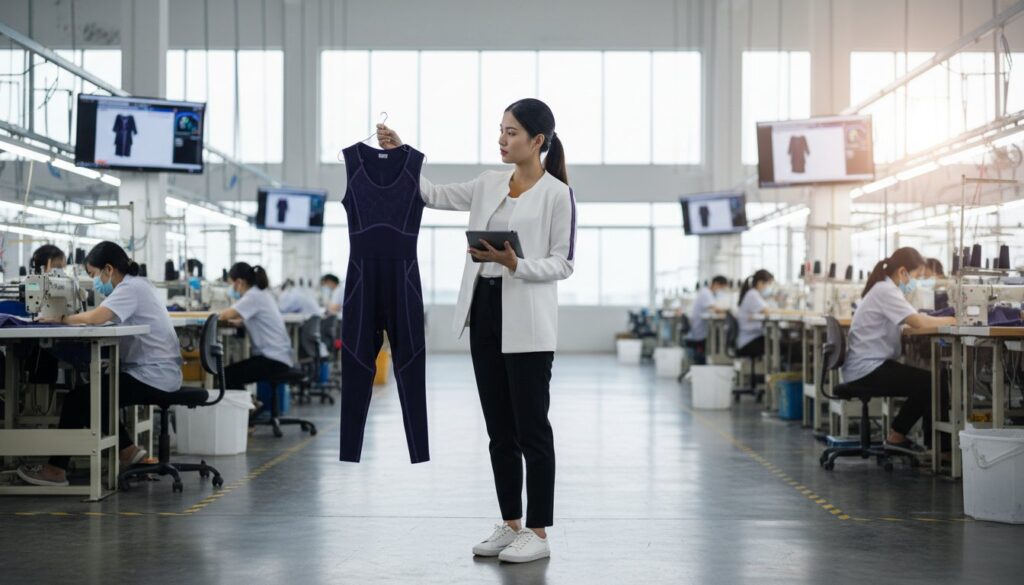
In 2024, a boutique owner I consulted lost $12,000 on a single production run because they didn’t clarify the factory’s internal quality control protocols before the fabric was cut. Choosing the wrong partner isn’t just a minor headache; it’s a significant financial risk that can sink a brand before it even launches. I’ve seen firsthand how the right set of questions to ask a garment factory can be the difference between a seamless delivery and a warehouse full of defective activewear.
I understand that you’re likely feeling anxious about potential communication barriers or hidden costs that might disrupt your 2026 collection. It’s natural to worry about unethical labor practices or confusion over complex MOQ structures when you’re looking for a long-term partner. I will walk you through the exact questions I recommend asking to vet a clothing manufacturer, ensuring your brand avoids costly production mistakes and builds a stable supply chain. We’re going to dive into a comprehensive 21-point checklist that covers technical capacity and my “Quality First” philosophy, providing you with a “One-Stop Service” roadmap for a smooth transition from your initial design to the final delivery.
Key Takeaways
- I’ll show you how to make a professional first impression and why checking a factory’s current capacity is the first step to a successful partnership.
- You’ll learn why a detailed tech pack is your most important tool and how to vet a manufacturer’s true in-house technical capabilities.
- I have outlined the essential questions to ask a garment factory regarding MOQs and pricing to ensure you get a fair deal without overcommitting.
- Discover how to look past vague sustainability buzzwords and secure your supply chain against risky, unauthorized subcontracting.
- I’ll walk you through my final selection checklist, including the non-negotiable “wear test” and the benefits of a one-stop service model.
The “First Date” Questions: Establishing Basic Compatibility
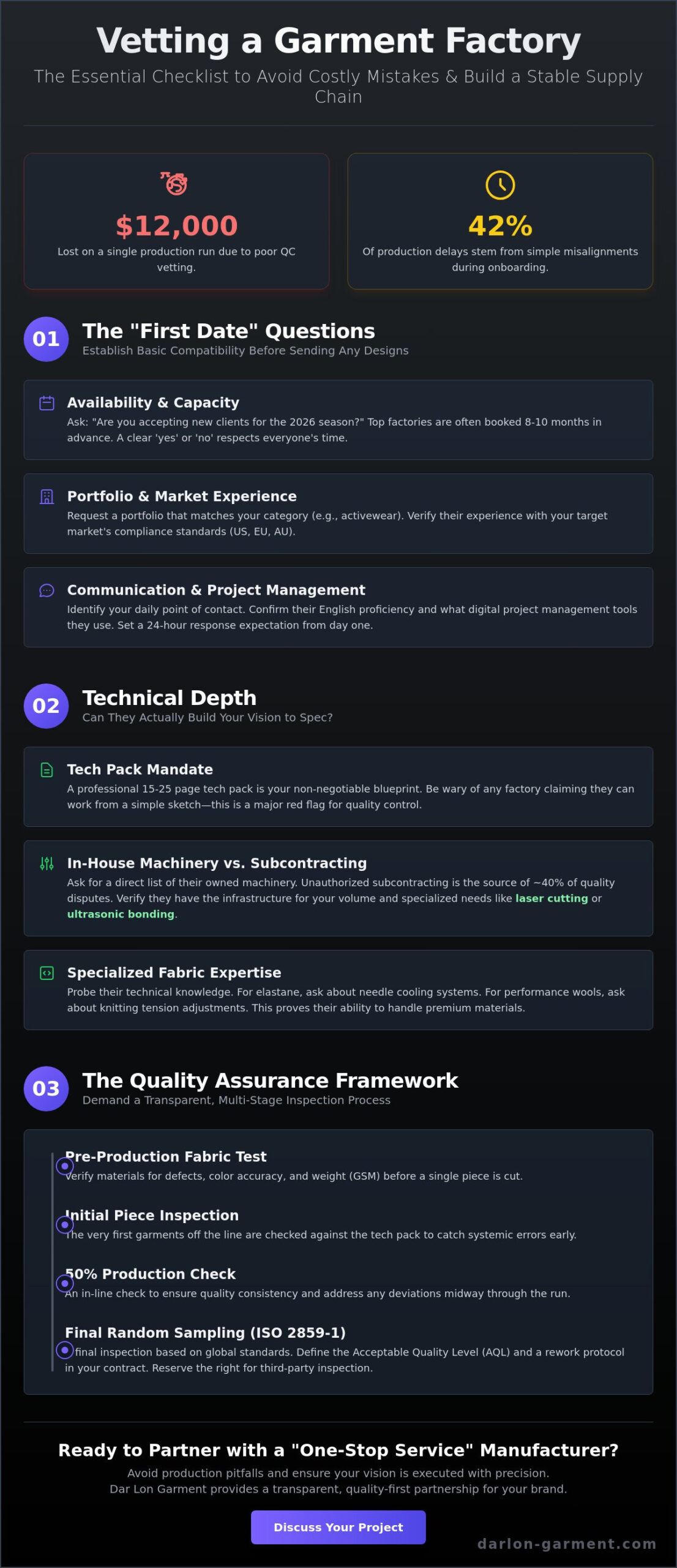
I’ve learned that your first email to a manufacturer is more than a simple inquiry; it’s a professional audition. If you want to be taken seriously by a high-capacity facility, you need to lead with the right questions to ask a garment factory. I always tell my partners to establish basic compatibility before they ever send a design file. In 2025, industry data showed that 42% of production delays stemmed from simple misalignments during the onboarding phase. By asking the right questions early, you save months of back-and-forth and avoid the frustration of a mismatched partnership.
I treat this stage like a filter. I’m not just looking for a vendor; I’m looking for a silent, powerful backbone for my brand. If a factory can’t answer basic logistical questions with precision, they won’t be able to handle a complex production run when deadlines are tight. I focus on technical mastery and industrial scale from the very first sentence. This sets a standard of professional accountability that carries through the entire contract.
Availability and Brand Portfolio
I never start a conversation without asking: “Are you currently accepting new clients for the 2026 season?” Many top-tier factories are already booked 8 to 10 months in advance. I also insist on seeing a portfolio that matches my specific category. If I’m building an activewear line, a factory’s history with formal silk gowns doesn’t help me. I look for technical mastery in specific areas like knitted fabrics or seamless construction. It’s also vital to verify their experience with your target market. A factory that understands US, EU, or AU compliance standards is worth more than one that only handles local distribution. Part of this vetting process involves understanding sweatshop conditions to ensure the facility meets global ethical benchmarks. I don’t just look at brand names in their deck. Big names can be misleading if the factory only did a small, one-off run for them. I look for evidence of long-term partnerships that prove consistent quality over several years.
Communication and Project Management
I need to know exactly who will be my daily point of contact. If their English proficiency isn’t high enough to discuss technical fabric compositions or GSM weights, the project will fail. I also ask what project management tools they use to track production milestones. Professional shops in 2026 should use digital systems rather than just messy email chains. I establish a 24-hour rule for response expectations early on. If a factory takes 3 days to answer a simple question about capacity, they’ll likely take 3 weeks to solve a crisis on the production line. I value a “One-Stop Service” approach, but that only works if the communication is transparent, methodical, and disciplined.
Technical Depth: Can They Actually Build Your Vision?
I firmly believe that a tech pack is the only blueprint that matters in this industry. Before you dive into technical questions to ask a garment factory, you must ensure your own documentation is airtight. A professional tech pack usually spans 15 to 25 pages; it details everything from Points of Measure (POMs) to specific thread weights. If a factory claims they can work off a simple sketch or a physical sample alone, I see it as a red flag. You need a partner that speaks the language of data and precision.
You also need to verify exactly what stays in-house. I have observed that roughly 40% of quality disputes in global trade arise because a primary factory outsourced a complex component to an unvetted workshop. I always ask for a direct list of their owned machinery to confirm they have the physical infrastructure to handle my volume. It is wise to consult these questions to ask potential manufacturers to ensure you are vetting their actual factory floor rather than just a beautiful showroom.
Specialized Machinery and Fabric Expertise
Precision in 2026 requires more than just standard lockstitch machines. I look for facilities utilizing laser cutting and ultrasonic bonding to create the seamless finishes expected in modern activewear. These tools eliminate bulky seams and improve garment aerodynamics. I also prioritize a factory’s technical grasp of stretch materials. For instance, mastering elastane fabric requires specific needle cooling systems to prevent heat damage during high-speed production. If you are using specialized yarns like Nuyarn performance wool, ask if they have adjusted their knitting tensions to account for its unique structure. I’ve found that specialized fabric knowledge is a non-negotiable requirement for any brand aiming for the premium market.
The Quality Assurance (QA) Framework
I never settle for a simple final inspection. I demand a transparent, four-stage in-line quality control process. This includes a pre-production fabric test, an initial piece inspection at the start of the line, a 50% production check, and a final random sampling based on ISO 2859-1 standards. If the defect rate exceeds the agreed Acceptable Quality Level (AQL), the factory must have a documented rework protocol. I always reserve the right to hire a third-party inspection agency to visit the floor 72 hours before the ship date. This level of transparency is exactly why experienced buyers often seek out a reliable one-stop manufacturing partner that prioritizes technical mastery over quick turnarounds.
The Business Side: Navigating MOQs, Lead Times, and Pricing
I’ve found that the financial and logistical framework of a manufacturing partnership is where most brands either thrive or hit a wall. It’s not just about finding a factory that can sew; it’s about finding a partner whose business model aligns with your cash flow and delivery schedule. When I evaluate a new facility, I focus on the hard numbers that drive the production line. To get an accurate price estimate without sounding like a “tire kicker,” I always provide a complete Tech Pack before asking for quotes. This shows the factory that I understand the technical requirements and am ready for a professional B2B relationship. I also look out for hidden costs that most brands overlook, such as specialized packaging, trim sourcing fees, and local logistics, which can quietly add 12% to your total production cost.
Understanding Minimum Order Quantities (MOQs)
I always start by asking: what is the MOQ per style and per color for my specific fabric choice? This is crucial because a factory might have a low sewing minimum, but the fabric mill might require 1,000 meters for a custom dye. I need to know how fabric mill minimums affect the factory’s ability to scale down for smaller collections. I also ask if they are willing to offer lower MOQs for a higher unit price during a launch phase. In my experience, paying a 25% premium on a smaller run is often better than sitting on 500 units of unsold inventory.
Lead Times and Production Schedules
Reliability is the primary currency in this industry. One of the most important questions to ask a garment factory is what the standard lead time is from sample approval to bulk delivery. In 2026, I expect a clear timeline that accounts for fabric procurement and quality control phases. I ask how they manage peak seasons, like the pre-holiday rush in October, to prevent delays that could ruin a retail launch. I also require a clear process for handling unexpected supply chain disruptions. If a factory can’t explain how they handle a 10% delay in raw material arrival, they aren’t prepared for the realities of global trade. I also recommend asking about payment terms early in the negotiation. Most established partners require a 30% deposit, and knowing this helps me manage my capital before production even begins.
Ethics and Transparency: Vetting for Sustainability and Compliance
I’ve seen “sustainability” transform from a niche interest into a marketing shield that many factories use to hide behind. In 2026, you can’t afford to accept vague promises. I believe transparency is the most critical trait in a manufacturing partner because it’s the only way to verify that your brand isn’t being exposed to legal or reputational ruin. When I evaluate a facility, I look for data over adjectives. If a factory claims to be “eco-friendly” but cannot produce a water usage report from 2025, they’re likely greenwashing.
The biggest risk you’ll face is unauthorized subcontracting. This happens when a factory accepts an order they can’t handle and quietly passes it to a smaller, unvetted workshop. This is where child labor and safety violations usually hide. To prevent this, your questions to ask a garment factory must focus on their actual physical capacity versus their order volume. I always insist on seeing the production schedule to ensure my goods are actually being made on the machines I inspected.
Certifications and Labor Standards
Don’t just look for logos like WRAP, BSCI, or ISO 9001 on a website. I’ve found that these certificates are often expired or belong to a different facility. Ask for the full audit report from the last 12 months. A 2025 BSCI report with an “A” or “B” rating tells me the factory is serious about fair wages and safe conditions. I also check if they comply with the EU Strategy for Sustainable and Circular Textiles, which has become a global benchmark for import regulations. You need to know: what specific steps do you take to ensure fair wages and safe working conditions? If they can’t explain their payroll verification process, walk away.
Subcontracting and Supply Chain Visibility
I always ask if the factory performs all cutting, sewing, and finishing in-house at their Vietnam facility. If they use subcontractors for specialized trims or embroidery, I demand to know how they vet those partners’ ethics. Total visibility is the goal. You should be able to track your order from the raw yarn to the final polybag. I recommend asking: how much of the production process can I see during a factory tour? A transparent partner will let you see every corner of the floor, from the breakrooms to the chemical storage areas. These are the essential questions to ask a garment factory to ensure your supply chain is clean.
Moving from Inquiry to Partnership: My Final Selection Checklist
I’ve spent years vetting manufacturing partners, and I can tell you that the final selection phase is where the real work begins. You’ve prepared the right questions to ask a garment factory, but now you need to see those answers reflected in physical results. I never sign a contract until I’ve conducted a rigorous “wear test” on a final prototype. If a performance legging loses its compression or shows seam slippage after five heavy wash cycles, the factory’s technical mastery isn’t where it needs to be for a 2026 market. I also look for a “One-Stop Service” model. Managing five different vendors for fabric, zippers, and sewing creates too many points of failure. I prefer a single point of accountability where the factory handles everything from sourcing to final quality assurance.
The Sample and Prototyping Phase
I always clarify the exact timeline for a proto-sample versus a salesman sample; a 14-day window is the industry standard for technical knits. I also confirm whether the development fee covers at least two rounds of revisions to perfect the fit. Most importantly, I ask if the samples are made by the same production team handling the bulk order. This prevents a common issue where a master tailor creates a perfect sample, but the actual assembly line lacks the specialized training to replicate it at scale.
Why Vietnam is Your Strategic Advantage
I’ve observed a 15% annual shift of high-end activewear production toward Southeast Asia. Choosing a sportswear factory vietnam location offers deep expertise in synthetic fibers and bonded seams. Beyond the craftsmanship, Vietnam’s participation in trade agreements like the CPTPP and EVFTA can reduce your landed costs by 10% to 12% through tariff eliminations. This is a massive financial win for brands scaling in 2026. Contact me at Dar Lon Garment for a consultation to discuss your specific production needs.
Before committing to a long-term contract, I always recommend a trial run. This is a smaller “test” order, typically around 500 to 1,000 units, designed to stress-test the factory’s communication and lead times. It’s the most effective way to verify the answers you received when you first started listing your questions to ask a garment factory. If the factory delivers on time and maintains a 99% quality control pass rate during this run, I know I’ve found a partner I can trust. I look for consistency in the stitch count and the placement of heat-transfer logos. A successful trial run is the final green light I need to move from a simple inquiry to a profitable, multi-year partnership.
Build Your Manufacturing Foundation
I’ve learned that the success of a fashion brand often relies on the strength of its silent partners. When you finalize your list of questions to ask a garment factory, these 21 points will help you secure a contract that protects your interests through 2026. I always look for facilities that invest in the future. For instance, look for those using laser cutting and automatic sewing machines to maintain tight tolerances and reduce waste. Since 2019, Darlon Garment has provided one-stop OEM solutions that handle everything from sourcing to final export. If you’re developing specialized products like Nuyarn performance wool or seamless garments, you need a partner with the specific machinery to execute those designs. I’ve seen how much smoother things go when you choose a disciplined, high-capacity manufacturer that values technical mastery. It’s time to move past the inquiry phase and start building a reliable supply chain. Partner with a leading garment manufacturer in Vietnam today to secure your production slots. I’m excited to see your vision come to life with the right technical support behind you.
Frequently Asked Questions
What is the most important question to ask a clothing manufacturer first?
I always start by asking about their specialized production capacity for my specific product category. It’s vital to know if they have the right machinery for activewear or complex knits. For instance, a factory with 500 specialized sewing machines handles bulk orders differently than a boutique shop. I look for a one-stop service provider that manages everything from fabric sourcing to final quality assurance.
How do I know if a garment factory is being honest about their MOQs?
I ask for a detailed breakdown of the raw material minimums from their fabric suppliers. Usually, 95% of MOQ constraints come from the textile mills rather than the sewing lines. If a factory claims they need 1,000 pieces per color, I verify if that matches standard 3,000 yard fabric rolls. This clarity helps me understand if the factory is being transparent about their logistical limits.
Should I ask about their other clients by name?
I ask about their client portfolio to gauge their experience with global export standards. While 80% of high-end partnerships are protected by NDAs, a reputable manufacturer can still discuss the regions they serve. I want to know if they’ve shipped to the US or EU in the last 12 months. This confirms they understand the specific compliance and labeling laws required for my target market.
What happens if the bulk production doesn’t match the sample?
I ensure the contract includes a remediation clause defining an acceptable 2% variance in measurements. If the bulk production falls outside these parameters, the factory should offer a discount or a remake. I’ve found that using a “Quality First” approach involves comparing the gold seal sample directly against the first 50 pieces of the production run. This prevents large scale errors before the entire order is finished.
How do I ask for a discount on manufacturing fees without offending the factory?
I suggest a long-term volume commitment to secure better rates. Proposing a 12-month production schedule often leads to a 5% or 10% reduction in manufacturing fees. I also ask about technical ways to lower costs, such as optimizing fabric yield by 3%. This shows I value their expertise while looking for a competitive pricing structure that benefits both of our businesses.
Is it okay to ask to visit the factory in person before placing an order?
I believe an on-site visit is essential to verify their physical infrastructure and workforce. Statistics show that 90% of professional buyers perform a site audit before signing a contract. I check the 2024 maintenance logs on their machinery and observe the working conditions. Seeing the production line in motion gives me the confidence that they can actually deliver the one-stop solution they promised.
What technical certifications should a high-quality sportswear factory have in 2026?
I prioritize factories holding ISO 9001:2015 and the Oeko-Tex Standard 100 certification. These are essential questions to ask a garment factory to ensure they meet 2026 global export standards. I also check for the GRS (Global Recycled Standard) if I’m using sustainable fabrics. These documents prove the facility undergoes regular third-party audits, which is the backbone of any reliable B2B manufacturing partnership.
How can I tell if a factory is actually doing the work or just acting as a middleman?
I request a live video walk-through of the production floor to see the workers in real-time. A genuine manufacturer typically maintains a 1:10 ratio of office staff to floor workers. I also verify their business license and 2025 tax records to ensure the entity I’m paying is the one actually sewing the garments. This transparency is a key part of the questions to ask a garment factory to avoid hidden sub-contracting.