

A signed contract doesn’t guarantee a quality shipment; only a rigorous 40-point technical inspection can do that. I’ve seen too many brands lose 15% of their margin to defective bulk shipments because they missed a single step during the initial vetting process. That’s why I’ve refined my clothing factory audit checklist 2026 to address the specific complexities of modern activewear and global export standards. It’s a system built on 24 years of manufacturing experience, designed to eliminate the guesswork from your supply chain.
I know how stressful it is to wire a deposit while wondering if the factory actually follows ethical compliance or understands your technical sportswear specs. You want a partner who values stability as much as you do. In this guide, I’ll walk you through the exact audit framework I use to ensure every garment meets our Quality First standard. I’m sharing my internal checklist to help you reduce defect rates and build a reliable manufacturing foundation. We’ll cover everything from machinery precision to labor certifications, giving you the confidence to scale your brand in the coming year.
Key Takeaways
- I explain why treating an audit as a strategic partnership is the only way to meet the high standards of tomorrow’s apparel market.
- I’ll walk you through my process for evaluating machinery and maintenance logs to ensure a factory can truly handle your technical designs.
- Learn how I verify social compliance and legal legitimacy in Vietnam to safeguard your brand from ethical risks.
- I’ll show you how to master the four stages of quality control and use the AQL standard to keep every garment consistent.
- Get my full clothing factory audit checklist 2026 and find out how I turn inspection findings into a successful Corrective Action Plan.
Why I Believe a 2026 Audit is Your Best Insurance Policy
I have spent years on factory floors, and I see a massive shift happening as we head into 2026. A clothing factory audit checklist 2026 isn’t just a list of boxes to tick. It is a strategic partnership tool. In the past, brands often viewed audits as a hurdle to clear. Today, that “good enough” mindset fails because consumers demand radical transparency. If you don’t have a clear view of your production line, you aren’t ready to scale. I view transparency as the only way to build a brand that lasts.
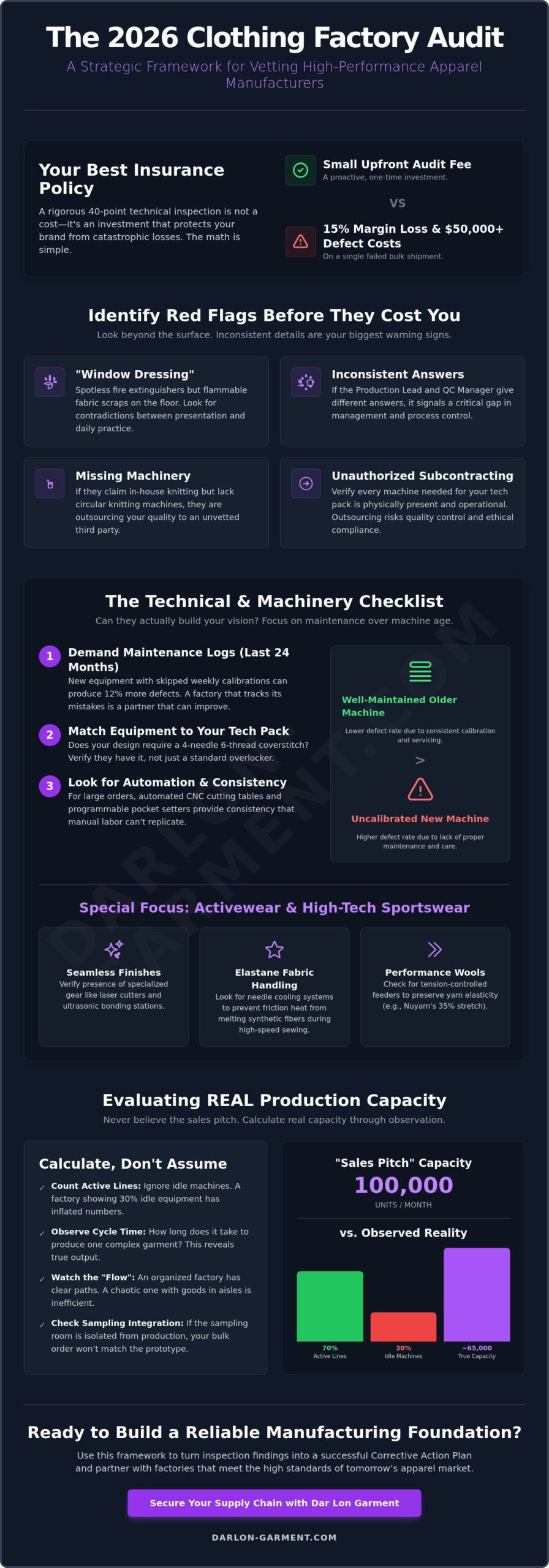
Think about the math. A professional one-day audit involves a relatively small upfront fee. Compare that to the cost of a failed bulk shipment of 5,000 activewear sets. If the seams fail or the color bleeds, you lose your entire investment plus your reputation. I’ve seen brands lose upwards of $50,000 in a single week because they skipped the initial walkthrough. My philosophy is simple: an audit is your best insurance policy against the chaos of global logistics.
Identifying the Red Flags Before They Cost You
I look for “window dressing” first. If the fire extinguishers look brand new but the floor is covered in flammable fabric scraps, I know it’s a show. Inconsistent answers from floor managers are my biggest warning sign. If the production lead says one thing and the QC manager says another, there is a gap in management. I also check for unauthorized subcontracting. I verify that every machine needed for your specific order is physically present and powered on. If they claim to make knitted fabrics in-house but I don’t see circular knitting machines, they are outsourcing your quality to an unvetted third party.
Why 2026 Standards Require More Than Just a Visual Check
By 2026, a visual check isn’t enough. I look for digital tracking and real-time quality reporting systems that provide data every 24 hours. Global supply chain laws, such as the EU’s Corporate Sustainability Due Diligence Directive, make these audits mandatory for Western brands. I recommend looking at the Worker-Driven Social Responsibility (WSR) model to understand how modern compliance focuses on the workers themselves rather than just top-down checklists. I always ask to see the factory’s internal audit history from the last 24 months. A factory that tracks its own mistakes is a partner that can actually improve. Using a clothing factory audit checklist 2026 ensures you are looking at these technical and ethical benchmarks before you sign a contract.
The Technical & Machinery Checklist: Can They Actually Build Your Vision?
When I walk onto a factory floor, I don’t just look at the brand names on the sewing machines. I look for the maintenance stickers. A comprehensive clothing factory audit checklist 2026 must prioritize the health of the hardware over its age. I’ve visited facilities with brand new equipment that produced 12% more defects because they skipped weekly calibrations. I always demand to see the last 24 months of maintenance logs. If a factory can’t show me when a machine was last serviced, I can’t trust them with a high-volume run.
I also match every piece of equipment against your specific tech pack requirements. If your design calls for a 4-needle 6-thread coverstitch and I only see standard overlockers, the factory isn’t equipped for your project. For large orders, I look for automated CNC cutting tables and programmable pocket setters. These systems provide the consistency that manual labor can’t replicate across 5,000 units. This technical discipline often mirrors the rigor found in WRAP’s 12 Principles, ensuring that mechanical efficiency doesn’t come at the cost of workplace safety.
Special Focus: Activewear & High-Tech Sportswear Requirements
Activewear production is a different beast. I check for specialized gear like laser cutting machines and ultrasonic bonding stations for seamless finishes. When the production involves elastane fabric, I specifically look for needle cooling systems. High-speed sewing creates friction heat that can melt synthetic fibers, leading to invisible seam failures that only appear after the customer wears the garment twice. I also verify their experience with performance wools like Nuyarn. These fabrics require specific tension-controlled feeders to prevent the yarn from losing its natural 35% elasticity during the knitting or sewing process.
Evaluating Production Capacity and Workflow
I never believe the “sales pitch” capacity. I calculate real capacity by counting the active lines and observing the average cycle time for a complex garment. If a factory claims a monthly capacity of 100,000 units but I see 30% of their machines sitting idle, I know their numbers are inflated. I also watch the “flow” of the floor. An organized factory has clear paths for materials; a chaotic one has piles of semi-finished goods blocking the aisles. I always check if the sampling room is integrated with the main line. If the developers don’t talk to the production team, your bulk order won’t look like your prototype. If you want to see how a streamlined facility operates, you can explore our production workflow to see these standards in action.
The Ethical and Social Compliance Audit: Protecting Your Brand Reputation
I’ve spent over two decades in the garment industry, and I’ve watched ethical production move from a “nice-to-have” feature to a non-negotiable requirement. In the high-stakes world of sportswear, your brand’s reputation is only as strong as the factory’s weakest link. My clothing factory audit checklist 2026 places social compliance at the very top because I know that modern consumers demand total accountability from the labels they wear.
When I step into a facility in Vietnam, I start with the basics of legal legitimacy. I verify the Enterprise Registration Certificate (ERC) and ensure it aligns with the actual scale of operations I see on the floor. It’s about more than just paperwork; it’s about confirming that the business is a stable, long-term partner rather than a fly-by-night operation. I’ve found that factories with clear, updated licenses are 30% more likely to meet strict international delivery schedules without cutting corners.
I always look beyond the certificates. Framed documents on a wall don’t tell the whole story. I spend time observing worker morale and the general atmosphere of the production line. If the environment feels tense or overcrowded, the quality of your activewear will eventually suffer. I handle the “transparency” talk with my production teams by being direct. I explain that I’d rather hear about a production bottleneck today than discover a compliance failure a month from now. Honesty is the foundation of the 10-year partnerships I aim to build.
Verifying Working Conditions and Fair Wage Standards
I pay close attention to the physical environment during every site visit. Every sewing station needs at least 500 to 700 lux of light to prevent eye strain and ensure stitch precision. During my walk, I check for clear emergency exit paths and visible safety signage in the local language. I also perform spot-checks on time cards and payroll records for at least 15 workers to ensure they’re paid fairly for overtime. If the records look too perfect, I dig deeper into the digital logs.
Environmental Responsibility and Sustainable Sourcing
Sustainability isn’t just a marketing buzzword; it’s a technical requirement for the clothing factory audit checklist 2026. I examine how the factory handles fabric scraps, looking for partnerships with recycling firms that turn offcuts into insulation or new yarns. I verify the sourcing of natural fibers and recycled polyesters to ensure they meet global standards. I also confirm that the factory holds valid OEKO-TEX or GOTS certifications, which proves they manage chemicals and water responsibly during the dyeing and finishing processes.
Quality Management Systems: How I Ensure Every Garment Meets the Mark
I don’t leave quality to chance. When I’m building a clothing factory audit checklist 2026, the Quality Management System (QMS) is the engine that keeps everything running. I divide my oversight into four critical stages: Pre-production, In-line, Final, and Pre-shipment. Each phase has its own set of protocols. I rely heavily on the AQL (Acceptable Quality Limit) standard, typically 2.5 for major defects and 4.0 for minor ones, to set a clear baseline for what passes and what fails. This statistical approach removes guesswork and ensures we’re aligned on expectations.
I also believe in redundancy. My internal QC team monitors the floor hourly, but I still suggest third-party inspectors for high-volume orders. This creates a system of checks and balances. The most important tool on the floor, however, is the “Golden Sample.” I insist this approved prototype stays physically present on the production line. It’s the only way to ensure workers have a tangible reference for every stitch and seam throughout the 12-hour shifts.
Raw Material Inspection: Stopping Defects at the Source
Quality starts before the first cut. I require testing for colorfastness, shrinkage (aiming for less than 3%), and GSM consistency across every roll. I use the “4-Point System” for fabric inspection. It’s a simple grading method where we assign penalty points based on defect size. If a roll exceeds 40 points per 100 square yards, I reject it immediately. I also verify that trims like zippers and buttons meet durability standards before they’re ever integrated into a garment. This prevents costly 100% re-work later in the cycle.
The Final Inspection and Packaging Protocol
The last steps are often where small errors creep in. My protocol includes mandatory needle detection and metal safety checks to meet 2026 export safety regulations. I cross-reference every measurement against the original tech pack, allowing for a tight 1cm tolerance on critical points. I make sure my production process finishes with precise labeling and folding. This ensures your brand arrives at the warehouse shelf-ready and professional. We don’t consider the job done until the carton is sealed and the weight is verified to 0.1kg accuracy.
From Checklist to Production: How We Can Work Together
I believe that transparency is the only way to build a real partnership. When you visit my facilities in Vietnam, I don’t hide the “unpolished” parts of the production floor. If your clothing factory audit checklist 2026 reveals a bottleneck in our fabric cutting room or a slight gap in our needle calibration logs, I see it as a chance to improve. We’ll immediately sit down and draft a Corrective Action Plan (CAP). This document identifies the root cause of the issue and sets a hard deadline, usually within 10 to 14 business days, to ensure your production standards are met before the first stitch is even sewn.
Setting up your first audit shouldn’t feel like a hurdle. I recommend scheduling your visit at least 45 days before your first bulk order is set to ship. You should bring your brand’s specific quality manual and any physical gold samples you’ve already approved. I’ll provide the internal safety records, employee training logs, and our latest ISO 9001 certifications. I’ve built Darlon Garment to be an open book because I’m confident in the industrial systems we’ve refined over the last decade. My invitation is simple: come and see how I’ve prepared this facility for the demands of 2026.
Choosing Your Manufacturing Partner in Vietnam
I’m convinced that a sportswear factory in Vietnam is your best strategic move for the coming year. The local infrastructure has matured, and our export capacity is now among the most reliable in Asia. You’ll need to decide between OEM and ODM services based on your internal design team’s capacity. If you have finished tech packs, our OEM service focuses on technical precision. If you need us to lead fabric R&D, our ODM “One-Stop Service” is the right path. Once the audit proves we’re a match, we can negotiate terms that reflect your long-term volume goals.
Building a Long-Term Partnership Beyond the Checklist
A high score on a clothing factory audit checklist 2026 is a great achievement, but it’s just the starting line. I value clear, honest communication over a perfect paper trail. My team and I specialize in supporting brands during the scaling phase, helping you grow from initial test runs of 2,000 units to full-scale monthly production of 50,000 garments. We want to be the silent, powerful backbone of your supply chain. Your next step is to see the operation for yourself. You can book a physical site visit at our Ho Chi Minh City office or request a live virtual tour to see our machines in action today.
Securing Your Supply Chain for 2026 and Beyond
I’ve spent over 7 years managing high-volume OEM production, and I’ve learned that a successful partnership starts with total transparency. When I use a clothing factory audit checklist 2026, my goal is to ensure every technical requirement is met through our on-site laser-cutting and bonding technology. It’s also vital to verify that all social and quality certifications are fully documented to protect your brand’s standing in the global market. These steps aren’t just boxes to check; they’re the foundation of a reliable production cycle.
I believe that seeing a facility in person is the only way to truly gauge its capabilities. At our site in Vietnam, I maintain an open-door policy because I’m proud of the disciplined, results-oriented environment we’ve built. We don’t just manufacture garments; we provide a stable, long-term solution for professional buyers who value technical mastery and industrial scale. It’s about building a silent, powerful backbone for your fashion brand.
If you’re ready to move from planning to production, I’m here to help you scale efficiently. Book a tour of my Vietnam sportswear facility today and let’s discuss how we can bring your vision to life. I look forward to working with you.
Frequently Asked Questions
How much does a professional clothing factory audit typically cost in Vietnam?
A professional clothing factory audit in Vietnam typically costs between $300 and $600 per man-day according to 2024 industry service rates. This fee covers the auditor’s travel and the detailed reporting required for your clothing factory audit checklist 2026. I’ve found that larger facilities with over 500 workers often require two man-days to ensure every production line and safety protocol is properly documented. This investment prevents costly production delays later.
Can I perform a factory audit myself, or do I need a third-party company?
You can perform an audit yourself if you’re physically in the region, though I usually recommend a third-party firm for objective verification. Professional auditors use standardized ISO 9001 or SA8000 frameworks that provide a level of detail difficult for a brand owner to capture alone. If you’re managing a high-capacity OEM project, having a certified expert on-site ensures that technical machinery specifications and labor standards meet 100% of global export requirements.
What is the difference between a factory audit and a pre-shipment inspection?
A factory audit evaluates the manufacturing facility’s capabilities while a pre-shipment inspection focuses strictly on the finished goods. I view the audit as a preventative measure to ensure the 10 production lines are capable of meeting quality standards. The inspection happens when 80% of the order is packed to verify that the specific batch of activewear or knitted fabrics matches your approved golden sample. Both steps are essential for a one-stop service model.
How long does a typical on-site garment factory audit take to complete?
A typical on-site garment factory audit takes 1 to 2 business days to complete depending on the facility size. For a factory with 1,000 employees, the auditor spends roughly 8 hours reviewing payroll records, fire safety exits, and fabric storage conditions. I’ve seen complex technical audits for specialized ODM services take up to 3 days when deep dives into chemical management or wastewater treatment systems are required to meet 2026 environmental standards.
What are the most common “red flags” found during a 2026 clothing audit?
The most common red flags in a clothing factory audit checklist 2026 include inconsistent digital production logs and 20% discrepancies in overtime pay records. I also look for blocked emergency exits or a lack of valid environmental permits for dyeing processes. If a factory can’t show me real-time data from their ERP system, it’s a sign that their Quality First promise might lack the necessary infrastructure to handle high-capacity B2B orders.
How often should I re-audit my manufacturing partners?
I recommend re-auditing your manufacturing partners every 12 months to maintain high global export standards. If a supplier is high-risk or has failed a previous safety check, a follow-up visit should occur within 3 to 6 months. Regular rotations ensure that the 98% pass rate you expect stays consistent as the factory scales its production capacity or adds new machinery to its floor. It’s about maintaining a disciplined, long-term partnership.
What happens if a factory fails one section of my audit checklist?
If a factory fails one section, I issue a Corrective Action Plan (CAP) with a strict 30-day window for improvements. A single failed point doesn’t always mean the end of a partnership, but it requires a documented fix and a follow-up verification. I’ve seen partners resolve minor lighting or ergonomic issues in 14 days, which actually builds long-term trust through transparent problem-solving and a commitment to technical mastery.
Is a virtual audit sufficient for a first-time production run?
A virtual audit is not sufficient for a first-time production run because it can’t capture the physical reality of a 5,000-square-meter floor. I’ve found that video calls often miss subtle issues like fabric dust levels or the actual condition of specialized sewing machines. For your initial 2026 launch, an on-site presence is the only way to guarantee that the one-stop service promised is backed by real industrial scale and reliable quality assurance.