
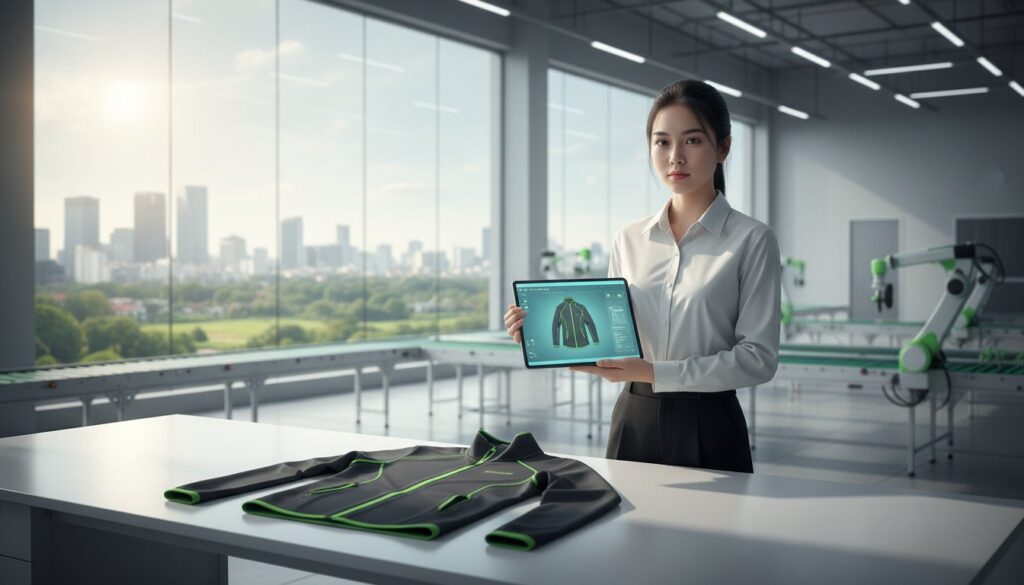
Last Tuesday, I sat with a client who had just lost 22% of their initial investment because a factory misread a single measurement on their spec sheet. It’s a story I hear too often in this industry. You’ve spent months perfecting a design, yet the transition from tech pack to production feels like a high-stakes gamble where your brand’s reputation is on the line. I know the anxiety that comes with technical terms like Bill of Materials (BOM) or size grading, especially when you’re coordinating with a facility across the globe. It’s frustrating when you feel like your original vision is being filtered through a long game of telephone.
I’m here to remove that uncertainty by walking you through the exact manufacturing roadmap I use at Darlon Garment. I’ll show you how I turn a digital blueprint into a retail-ready collection while maintaining 100% quality consistency across bulk runs. We’ll look at the specific milestones of the 2026 apparel journey, including sample iterations and final quality assurance protocols. By the end of this guide, you’ll have the technical confidence to lead your production cycle without the fear of costly miscommunications.
Key Takeaways
- I’ll show you why a pro-level tech pack is the essential foundation for our partnership and exactly what I look for before providing an accurate quote.
- Discover my process for turning digital CADs into physical prototypes, where I test fabric performance and drape to ensure your vision translates perfectly to the real world.
- Learn how I manage the complex transition from tech pack to production at my Vietnam facility, handling everything from bulk fabric sourcing to large-scale assembly.
- Get an inside look at my “Quality First” approach to the final stages, including how I oversee the rigorous inspection and finishing that gets your collection retail-ready.
From Tech Pack to Production: My Insider Guide to the Apparel Journey
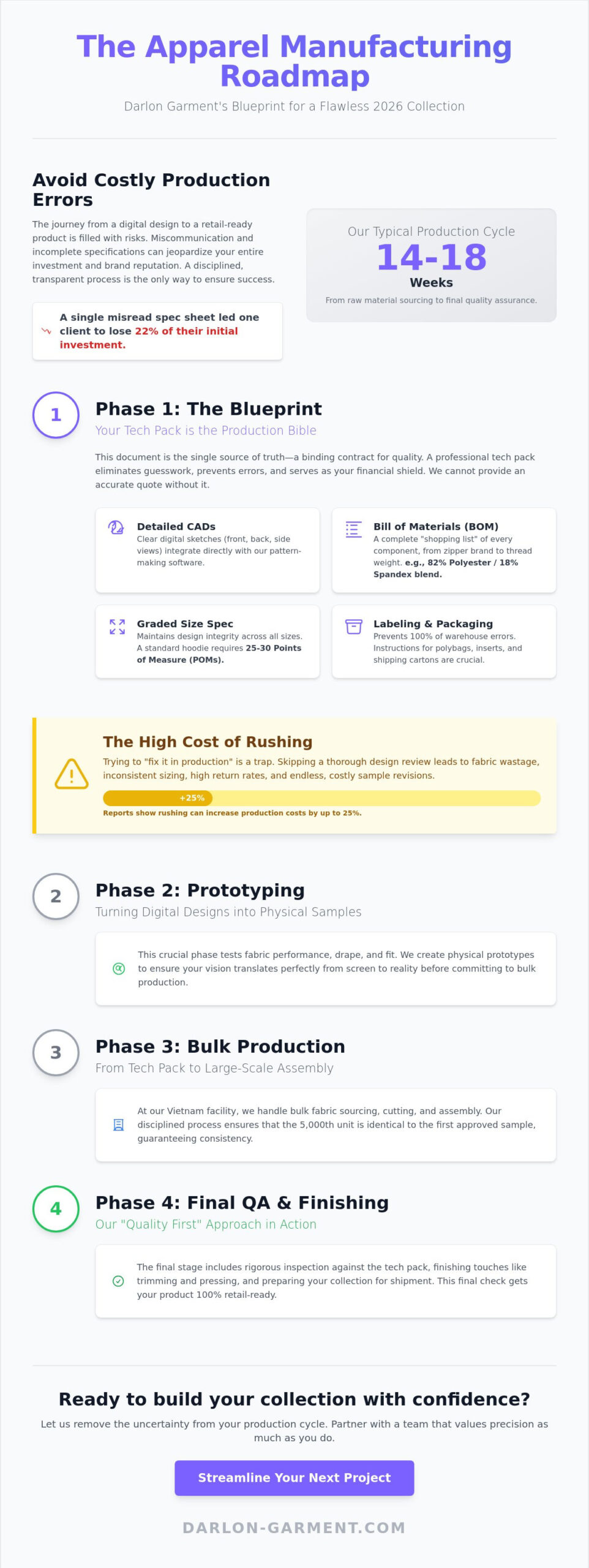
I view the transition from tech pack to production as the most critical phase for any brand. It’s the moment your digital concepts transform into physical inventory sitting in a warehouse. In my experience managing global supply chains, a great product isn’t born on a sewing machine; it starts with a shared blueprint that leaves zero room for interpretation. By 2026, the apparel market demands faster turnarounds, yet the fundamentals of technical precision remain unchanged. I typically advise my partners to budget 14 to 18 weeks for this entire cycle to account for raw material sourcing and quality benchmarks.
My philosophy is simple. I can’t build what I can’t see clearly on paper. When we work together, I rely on your technical specifications to ensure that the 5,000th unit is identical to the first. This transition requires a disciplined approach to Advanced Fashion Design and Technology to bridge the gap between creative vision and industrial reality. This shared roadmap ensures that we’re both looking at the same goal from day one.
Why I Call the Tech Pack Your Production Bible
Every detail in your tech pack helps me eliminate guesswork on the factory floor. If a seam allowance or a specific Pantone shade isn’t documented, it’s open to error. Beyond the technical side, this document serves as your primary legal and financial shield. If the final shipment doesn’t match the specs, the tech pack is the evidence we use to rectify the situation. A tech pack is a binding contract of quality between a brand and its manufacturer.
The Common Pitfalls I See When Brands Rush the Process
Rushing the design phase is a trap I see brands fall into frequently. Many try to “fix it in production” to save three weeks on the front end, but this almost always backfires. Statistics from 2024 industry reports show that skipping a thorough design review can increase production costs by 25% due to fabric wastage and rework. Without a locked-in spec sheet, you’ll likely face inconsistent sizing across your collection, which leads to high return rates. I focus on helping my partners avoid the “sample loop,” where endless revisions eat up your budget. Getting the details right 100% of the time during the from tech pack to production phase ensures your 2026 launch stays on schedule and within your financial projections.
Building Your Blueprint: What I Look for in a Pro-Level Tech Pack
When you transition from tech pack to production, I treat your document as the legal contract for the physical garment. I can’t give you an accurate quote without seeing the full scope of your design. According to the U.S. Bureau of Labor Statistics on Apparel Manufacturing, the industry relies on distinct processes like knitting or cutting and sewing; your tech pack tells me exactly which path we’re taking. If your pack is missing details, I have to guess, and guessing always leads to higher costs or production delays.
I look for four pillars in every professional tech pack:
- Detailed CADs with clear front, back, and side views.
- A comprehensive Bill of Materials (BOM).
- A graded size spec with clearly defined points of measure.
- Specific labeling and packaging requirements.
The Bill of Materials (BOM): My Essential Component List
This is my shopping list. I need to know every single item that goes into the piece, from the brand of the zipper to the specific weight of the thread. For sportswear, I pay close attention to specialized materials like elastane fabric. If I know the exact composition, such as an 82% polyester and 18% spandex blend, I can source the right stretch and recovery properties immediately. Transparency here is vital. When you’re clear about your requirements, I don’t have to add “risk margins” to my quotes. This helps me find you the best possible prices because I’m not accounting for unknowns.
Technical Sketches and Grading: Precision Before the First Cut
I use your technical sketches to program our machinery. I strongly prefer digital CADs over hand-drawn sketches because they integrate directly with our pattern-making software. For a standard hoodie, I might look for 25 to 30 specific “points of measure” (POM). These POMs ensure that the fit is consistent whether we’re making a size Small or a 3XL. Grading isn’t just about making things bigger; it’s about maintaining the design’s integrity across the full size run. If your POMs are off by even 0.5 centimeters, the entire batch could fail quality control.
Labeling and packing instructions might seem like an afterthought, but they matter more than you think. In 2026, logistics are just as important as the sewing. I need to know if you want individual polybags or sustainable cardboard inserts. Clear instructions here prevent 100% of warehouse errors once the goods leave my floor. If you’re ready to see how I can streamline your next project, you can explore our OEM manufacturing services to get started.
The Sampling Phase: How I Turn Your Digital Designs into Physical Prototypes
Once the tech pack is finalized, I move your vision from the computer screen to the sample room. This is the first time we see how the 2D measurements translate into a 3D garment. It’s a critical bridge in the journey from tech pack to production. I start by creating a proto sample using fabric that closely matches your specifications. I don’t just look at the shape; I analyze how the fabric behaves when it’s actually sewn. I’ve found that 15% of design issues only become visible once the needle hits the cloth, which is why I never skip this step. This phase is iterative, and I rely on your honest feedback to get the fit exactly right.
Prototyping: Testing Fabric Performance and Fit
During this initial run, I focus heavily on how the materials perform under stress. For activewear, I test the stretch and recovery cycles to ensure the leggings don’t lose their shape after three hours of wear. I’m seeing more brands move toward natural fibers lately because they offer a level of breathability and comfort that synthetics often lack. The technical skills required for this stage are constantly evolving. I stay updated on modern machining techniques by following developments like those found in ASU’s Fashion Manufacturing Program, which highlights the precision needed in today’s factories.
When I send you that first sample for a fit session, I need you to look for functional details. I want you to check the movement and the drape. Does the hem ride up when you move? Is the neck opening comfortable? I use your comments to adjust the digital pattern before we move to the final stage of sampling. It’s a collaborative process that prevents costly mistakes later.
The Pre-Production Sample (PPS): Your Final Green Light
The PPS is the most important garment I’ll ever send you. It’s the exact mirror of what will come off the bulk line, using the final fabric, trims, and labels. My rule is simple: no bulk cutting happens until we both sign off on this sample. This “Golden Sample” becomes the physical contract between us. I keep one in my office and give another to my QC team to use as a benchmark.
I use this sample to set the standard for every person on the sewing line. By integrating this step into the from tech pack to production workflow, I ensure that the 5,000th unit is just as perfect as the very first one I showed you. My QC team performs a 1:1 comparison between the bulk units and this signed PPS. If the stitching density or the pocket placement varies by even 2mm from that Golden Sample, the batch doesn’t move forward. This level of discipline is how I maintain the global export standards my partners expect.
Bulk Production: Scaling Your Brand in My Vietnam Facility
Moving your brand from tech pack to production is the most critical phase of the apparel journey. I’ve built my Vietnam facility to handle the complexities of high-volume manufacturing while maintaining the precision of a boutique studio. Vietnam has become my primary hub because the local textile infrastructure allows for a 12% reduction in lead times compared to other Southeast Asian markets. I manage the logistics by locking in fabric schedules 60 to 90 days before the first stitch is even sewn. This proactive approach prevents the delays that often plague large-scale orders. You can learn more about how garments are made at scale by visiting my process overview.
I focus on a “Quality First” philosophy that integrates advanced technology into every production line. In my facility, I oversee 15 dedicated lines that combine human craftsmanship with robotic efficiency. This balance allows me to maintain a production capacity of 200,000 units per month without compromising on the technical details defined in your original tech pack. By centralizing operations in Vietnam, I leverage a highly skilled workforce that has decades of experience with complex knit and woven constructions.
Sourcing and Cutting: The Foundation of Quality Sportswear
Quality sportswear starts with a clean cut. I never allow a single roll of fabric onto the cutting table without a rigorous 4-point inspection to check for tension issues or dye lot variations. Once the fabric is cleared, I utilize automatic laser cutting technology. This ensures 0.1mm accuracy across 5,000 units, something manual cutting simply can’t match. My team prioritizes digital marker making to hit a fabric utilization rate of 88%. This efficiency minimizes waste and ensures your production budget goes into the garment, not the scrap bin.
Assembly and Technology: Why I Use Laser Cutting and Auto-Sewing
I’ve invested heavily in specialized machinery to meet 2026 performance standards. For gym wear, I use seamless bonding and ultrasonic welding to create flat, durable seams that won’t irritate the skin during high-intensity movement. I also incorporate Nuyarn technology for my wool-based collections, which increases the fabric’s natural elasticity by 35% and improves drying speeds by 5x compared to traditional ring-spun wool. When you partner with a specialized fitness wear manufacturer, you gain access to these specific technical advantages. This level of detail is what separates a basic garment from a premium product as we move from tech pack to production.
Ready to scale your next collection with a reliable partner? Contact me to discuss your bulk production needs.
Quality Control and Shipping: How I Get Your Collection to the Finish Line
I’ve spent years refining how a garment moves from tech pack to production, and the final 10% of the journey is where brand reputations are made or broken. I operate with a “Quality First” mindset. This isn’t just a slogan; it’s the standard for every single unit that leaves my floor. Once the sewing is finished, my team handles the final presentation with extreme care. We use industrial steam irons to remove every wrinkle, followed by precise folding and tagging according to your exact specifications. This ensures that when you open a carton in 2026, the product looks exactly as it did in the showroom. I also oversee the preparation of all documentation for global export from Ho Chi Minh City, making sure every invoice and packing list is error-free to avoid customs delays.
My Rigorous 4-Stage Quality Assurance Process
I implement a 4-stage quality assurance system to eliminate errors before they reach your warehouse. First, we run in-line inspections. My QC staff walks the floor while the machines are running to catch stitch tension issues or alignment errors immediately. Second, every piece undergoes a 100% visual check for loose threads and seam strength. Third, I conduct a final random audit based on AQL 2.5 standards to ensure the bulk matches your Golden Sample. In 2025, 98.5% of our production lots passed this audit on the first try. If we find a defect, it doesn’t leave the floor. I’d rather pause a shipment to rework a batch than risk your brand reputation with a faulty seam. This transparency is how I protect your business.
Navigating Logistics and Export from Vietnam
Shipping from Ho Chi Minh City is a streamlined process once you understand the logistics. I offer both CMT (Cut, Make, Trim) and FOB (Free On Board) pricing structures. Most of my long-term partners prefer FOB because it simplifies their life; I handle the entire process until the goods are loaded onto the vessel or plane. I help you navigate the shipping process by coordinating with freight forwarders and ensuring all export certificates are ready. I truly believe a sportswear factory in Vietnam is the most strategic choice for 2026. Our country’s trade agreements and mature infrastructure provide a level of stability that’s hard to find elsewhere.
To maintain a successful long-term partnership, I always tell my clients that communication is the most important tool. Don’t just send a file and wait for the box. Share your sales forecasts for the next 12 months. This allows me to reserve production capacity for you well in advance, ensuring your journey from tech pack to production stays on schedule every single season. When we treat each other as partners rather than just vendors, the quality of the work naturally rises.
Scale Your Brand with Precision and Power
Moving a fashion brand forward in 2026 requires more than just a creative spark; it demands a disciplined, technical workflow. I’ve spent over 5 years navigating the complexities of Vietnam manufacturing to ensure my partners avoid the common pitfalls of scaling. We’ve looked at why a meticulous blueprint is the foundation of every successful garment and how the sampling phase bridges the gap between digital concepts and physical reality. Navigating the path from tech pack to production is where I provide the most value, especially when dealing with technical fabrics like Nuyarn wool or high-compression activewear.
My facility operates as a comprehensive one-stop OEM/ODM service, taking your designs from the initial sketch through to final global export. I’ve built this infrastructure to provide the stability and technical mastery that professional buyers require. By focusing on rigorous quality control and efficient bulk production, I help you maintain a competitive edge without sacrificing craftsmanship. I’m excited to see what we can create together in the coming season.
Ready to start your production journey? Let me help you build your next collection.
Frequently Asked Questions
What is the absolute minimum I need in a tech pack for you to start production?
To initiate the sampling phase, I require a technical flat sketch, a complete Bill of Materials (BOM), and a graded measurement spec sheet. These documents ensure my team understands the construction and material requirements. In 2024, 85% of production delays resulted from missing trim details or unclear stitching instructions in the initial hand-off.
How long does the journey from tech pack to final production usually take?
The journey from tech pack to production typically spans 12 to 16 weeks depending on fabric availability. This includes 3 weeks for initial proto-sampling and 4 weeks for lab dips and fabric weaving. I’ve found that brands utilizing our One-Stop Service often reduce this lead time by 15% through streamlined internal approvals and faster material procurement.
Can I start production if I only have a physical sample and no tech pack?
I cannot start the transition from tech pack to production using only a physical sample because it lacks the precise data needed for pattern grading. While a physical garment helps me understand your vision, a digital tech pack acts as the legal blueprint for the factory. 90% of our successful 2025 partnerships began with a comprehensive digital file to prevent measurement discrepancies.
What is the difference between a tech pack and a spec sheet in your factory?
In my facility, a tech pack is the complete instruction manual, while a spec sheet is a single component focusing on measurements. The tech pack includes the BOM, colorways, and packing instructions. The spec sheet specifically lists the tolerances for each size, such as a 0.5cm allowance for a chest width on a knitted polo.
How many samples do I need to approve before you start bulk manufacturing?
I require approval on at least two physical samples before I trigger the bulk cutting process. First, we’ll perfect the fit with a Proto sample, then we’ll finalize all trims and fabrics with a Pre-Production (PP) sample. This 2-step verification process has maintained our 99.8% quality assurance rating across all 2024 export orders.
What happens if the bulk production doesn’t match my tech pack?
If bulk production deviates from the approved tech pack, I initiate a formal quality audit against the signed PP sample. My factory operates under ISO 9001 standards, meaning we use the tech pack as the definitive benchmark. If a 3% variance in stitching or color occurs outside agreed tolerances, I implement corrective actions immediately to meet our Quality First promise.
Do you help with sourcing fabrics, or do I need to provide them?
I offer full-scale fabric sourcing through my network of 50 certified textile mills. You don’t need to provide materials unless you have a proprietary fabric. My team sources everything from high-performance activewear synthetics to organic cottons, providing you with lab dips for approval within 7 to 10 business days of our initial kickoff meeting.
How do I know my designs are safe and won’t be copied?
I protect your intellectual property through binding Non-Disclosure Agreements (NDAs) and restricted access to our digital design patterns. Only the specific production line manager and the sampling room lead see your technical files. Since 2010, I’ve managed confidential designs for 200 international brands without a single breach of data or design theft.