
If you think a generic polyester blend will cut it in 2026, you’re already behind a $458.7 billion market that now demands absolute digital traceability and zero PFAS. I’ve seen too many brands struggle with choosing fabric for activewear, only to end up with leggings that pill or lose their shape before the first month is over. It’s frustrating to balance technical specs with the new EU Green Claims Directive, especially when your reputation is on the line.
I’ve spent years in the manufacturing trenches, and I’m here to help you solve those textile headaches. I’ll show you exactly how to find the perfect match for your brand’s line, ensuring your materials meet the July 19, 2026, ESPR standards without sacrificing performance. We’ll look at why certain blends work for HIIT while others are better for yoga. I’ll also cover the 2026 shift toward “bluepass” certified materials and give you the specific vocabulary needed to lead professional conversations with your production partners.
Key Takeaways
- I’ll explain why I prioritize capillary action over simple moisture absorption to ensure your garments maintain thermal regulation during high-intensity training.
- You’ll get my professional perspective on choosing fabric for activewear by comparing the cost-efficiency of polyester with the premium, soft compression of polyamide.
- I’ll show you why I move away from 100% cotton in favor of technical natural blends and how seamless construction significantly improves the end-user experience.
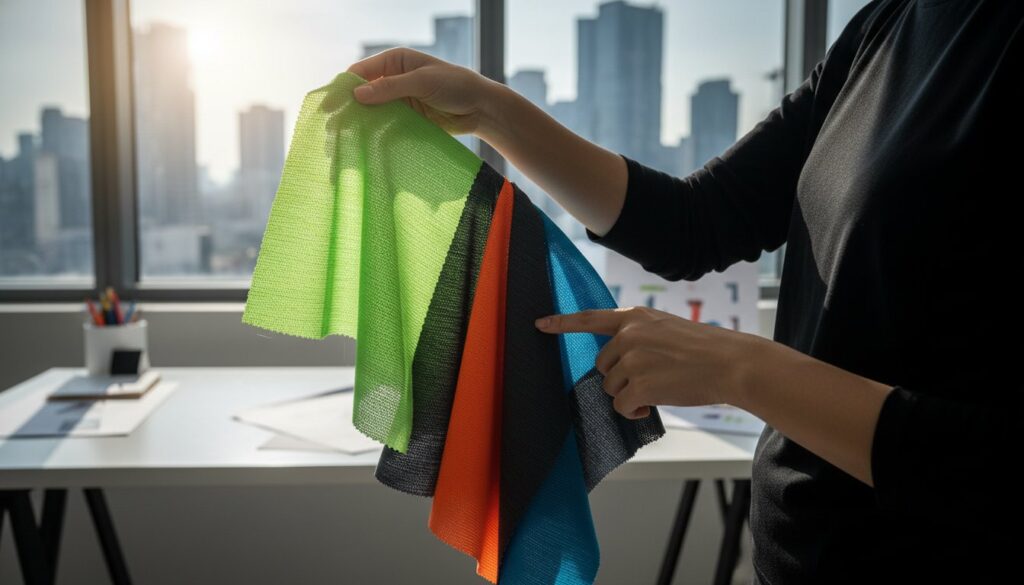
- I’ll share my 5-step framework for sourcing, including the specific way I evaluate swatch cards and “hang-type” samples from my production floor.
The Three Pillars of Performance: Why I Start Every Fabric Search Here
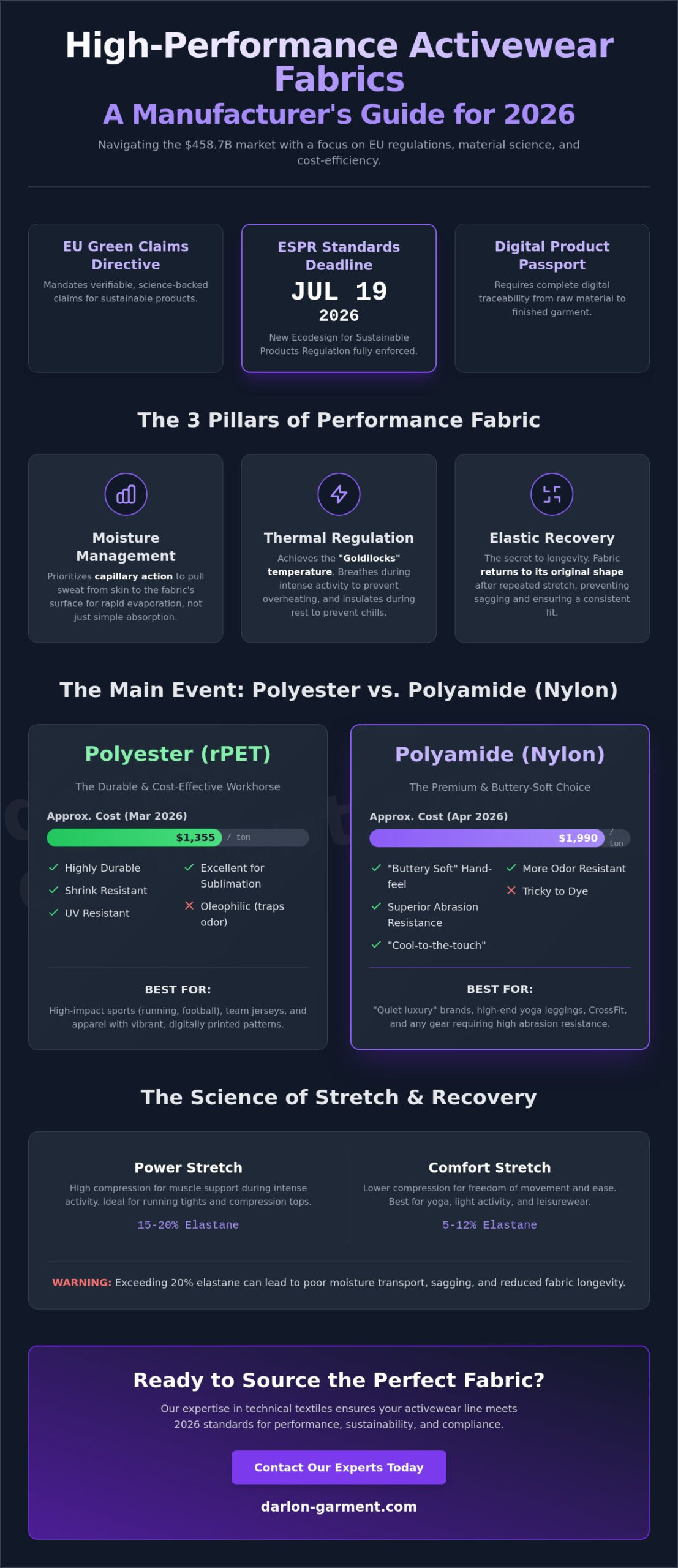
I’ve found that choosing fabric for activewear isn’t just about picking a color or a soft handfeel; it’s about precise engineering. A high-performance fabric is a textile engineered to support physiological needs during physical exertion. When I evaluate a new material for a client’s sportswear line, I look at how it handles the body’s reaction to stress. I focus on three pillars: moisture management, thermal regulation, and elastic recovery. These are the core textile performance criteria I use to separate high-quality gear from low-tier alternatives.
Moisture management is often misunderstood. I don’t just look for absorption. I look for capillary action. This is the fabric’s ability to pull liquid through the micro-channels in the yarns to the surface where it can evaporate quickly. For thermal regulation, the goal is what I call the “Goldilocks” temperature. During a HIIT session, your body heat spikes. If the fabric doesn’t breathe, you overheat. If it doesn’t insulate during rest, you chill. Finally, elastic recovery is the secret to longevity. It’s the difference between a fabric that simply stretches and one that actually returns to its original shape after a 10 hour day of movement. My framework for choosing fabric for activewear relies on these metrics to ensure the final garment doesn’t sag or fail after three washes.
Moisture-Wicking vs. Breathability
I often see brands confuse these two concepts. A fabric can be highly breathable but still leave the wearer soaked if it doesn’t wick. To fix this, I check the denier and gauge in my lab. A higher gauge knit provides a denser, more durable surface, but I must balance the denier of the yarn to ensure air can move through the loops. I prefer using a mix of hydrophobic and hydrophilic fibers in a single knit. The hydrophilic side sits against the skin to pull sweat away, while the hydrophobic side pushes it to the exterior for evaporation.
The Science of Stretch and Recovery
Regarding stretch, more isn’t always better. I never recommend more than 20% spandex for high-impact gear. While elastane fabric is essential for that “second skin” feel, too much of it can lead to sagging and poor moisture transport. I distinguish between “power stretch” and “comfort stretch” during my testing phase. Power stretch is what I use for compression leggings that need to hold muscles in place during a run. Comfort stretch is better suited for sleepwear or light yoga, where the goal is easy movement rather than intense support.
Polyester vs. Polyamide: Which Synthetic Powerhouse Should You Choose?
When I’m helping a brand with choosing fabric for activewear, the debate usually centers on polyester versus polyamide. Both are synthetic workhorses, but they serve very different masters. As of March 2026, recycled polyester (rPET) in China is priced at approximately $1,355 USD per metric ton, making it a highly cost-effective choice for brands looking to scale quickly. I’ve found it to be the king of durability. It doesn’t shrink, it resists UV rays, and it’s the only real option for vibrant digital sublimation printing. If your line features bold patterns or team jerseys, polyester is my go-to recommendation.
Polyamide, which you likely know as nylon, is the premium alternative. In April 2026, Nylon 6 prices in Northeast Asia sat at $1.99 USD per kilogram. It’s more expensive than polyester, but the hand-feel is incomparable. I use polyamide for those “buttery soft” leggings that high-end yoga brands demand. It also boasts superior abrasion resistance. For CrossFit gear or outdoor training apparel where the fabric constantly rubs against barbells or pavement, nylon wins every time. However, dyeing nylon is tricky and requires expert handling to ensure color fastness across different batches.
One issue I always address with clients is the “stink factor.” Polyester is oleophilic, meaning it loves oil. It traps body oils and bacteria, which leads to that persistent gym bag smell. I fix this by specifying antibacterial finishes or silver-ion treatments during the finishing stage. Nylon is naturally more resistant to odors, though it’s not immune. In 2026, I’ve shifted most of my production toward recycled synthetics like Econyl and rPET to comply with the EU Digital Product Passport requirements. If you’re unsure which blend fits your specific price point, you can view our full range of technical textiles to see how these fibers perform in finished garments.
When to Choose Polyester for Your Line
I recommend polyester for high-sweat, high-impact sports like running or football. Its low moisture regain means it doesn’t get heavy when wet. Since the bio-based elastic core-spun yarn market hit $191 million this year, I’ve been blending rPET with these sustainable stretch fibers to create eco-friendly kits that don’t lose their shape. It’s the most reliable way to maintain competitive pricing while meeting the new EU Green Claims Directive.
Why Polyamide is the Premium Choice
The global bio-based nylon market is projected to reach $1.69 billion this year, reflecting a massive shift toward premium, sustainable performance. I choose polyamide when a client wants to compete with “quiet luxury” athletic brands. It has a higher “cool-to-the-touch” property than polyester, which is essential for thermal regulation during intense sessions. While it takes more skill to manage the supply chain for high-quality nylon, the result is a garment that feels significantly more expensive to the end consumer.
The Rise of Performance Naturals: Beyond the ‘Plastic’ Feel
I often hear from brand owners that their customers are tired of the “plastic” feel of traditional synthetics. While I understand the desire for a more organic touch, I always warn my partners that 100% cotton is a total nightmare for high-intensity movement. It can absorb up to 27 times its own weight in water and dries incredibly slowly. This leads to heavy, sagging garments and skin chafing. When I’m helping a client with choosing fabric for activewear, I suggest a hybrid approach instead. The real magic happens when we integrate natural fibers with technical yarns to get the best of both worlds.
In 2026, the market has shifted toward “Performance Naturals.” These are blends that maintain the soft hand-feel of organic materials but utilize the moisture-wicking power of synthetics. I’ve seen a massive surge in the use of Bamboo and Lyocell for recovery wear and light athleisure. These fibers are naturally bacteriostatic, which helps manage odor without the need for heavy chemical coatings. By using these materials, I help brands meet the stricter OEKO-TEX 2026 standards that took effect on June 1, while providing a product that feels premium against the skin.
Nuyarn: Why This Isn’t Your Grandmother’s Wool
Nuyarn is my secret weapon for endurance gear. Unlike traditional ring-spun wool, Nuyarn drafts fibers onto a high-performance core. I use it because it’s 35% more elastic and 5 times faster at drying than standard merino. It provides incredible warmth-to-weight ratios for high-altitude training. Plus, the natural odor resistance is a huge selling point. I make sure all the wool I source is non-mulesed to stay ahead of the GOTS 8.0 due diligence requirements released in March 2026.
Cellulosic Fibers: Modal and Lyocell in Activewear
Lyocell is my top recommendation for eco-conscious luxury lines. With market prices ranging from $4.50 to $6.00 per kg in 2026, it’s a solid investment for brands that want to market sustainability. I often blend Tencel Lyocell with recycled polyester to create a “soft-tech” fabric. To solve the common “wet-cling” issue where natural fibers stick to the skin when sweaty, I specify strategic knitting patterns like micro-waffles or bird’s-eye meshes. These structures create a physical gap between the skin and the fabric, ensuring the wearer stays comfortable even during a heavy session.
Choosing fabric for activewear in this category requires a deep understanding of how these fibers behave when wet. I always test these blends in my lab to ensure they don’t lose their dimensional stability after the first wash. This level of technical oversight is what keeps my partners’ return rates low and their customer loyalty high.
Construction Matters: How We Turn Fabric into High-Performance Gear
I’ve found that even the most expensive fiber will fail your customer if the construction method is mismatched. Construction is where the technical specs of a yarn meet the physical reality of the gym. When I’m helping a partner with choosing fabric for activewear, I always explain the difference between circular and warp knitting. Circular knitting is my preferred method for seamless garments because it allows for 360 degree stretch. Warp knitting, on the other hand, is what I use when a brand needs maximum compression and “ladder-proof” durability for high-intensity training. It’s more stable and provides better muscle support than standard weft knits.
The modern aesthetic of 2026 focuses on a “clean” look. I achieve this through bonded seams and laser-cutting. Instead of traditional stitching, which can add bulk and cause irritation, I use heat-activated adhesives to join panels. This creates a flat, weightless finish that is essential for premium swimwear and high-end yoga lines. Laser-cutting allows me to create intricate ventilation patterns that won’t fray, removing the need for heavy hems. If you want to see how this works in a factory setting, you can read about my production process to understand the machinery involved.
The Power of Seamless Technology
I strongly suggest seamless construction for high-friction activities like cycling or long-distance running. By eliminating side seams, I significantly reduce the risk of chafing. One of the biggest advantages I’ve found is the ability to knit in “ventilation zones” directly. I can program the machine to change the stitch density in high-heat areas like the back or underarms. From a sustainability standpoint, seamless is a winner for 2026. It reduces fabric waste by approximately 25% compared to traditional cut-and-sew methods, helping you align with the latest EU ESPR mandates.
GSM and Opacity: The ‘Squat Test’ Standard
In my lab, I use GSM (Grams per Square Metre) to determine the weight and “honesty” of a fabric. For leggings, 280 to 320 GSM is my sweet spot. Anything lower risks being see-through during a deep squat. I always recommend interlock knits over single jersey for bottoms. Interlock is essentially two layers of fabric knitted together, which provides double the security and better shape retention. I perform a physical stretch test on every batch to verify opacity before it hits the sewing line. If you’re ready to start building your next collection with these technical standards, get a quote for our professional manufacturing services today.
My 5-Step Framework for Sourcing Activewear Fabrics in 2026
I’ve spent years refining a systematic approach to choosing fabric for activewear to help my partners avoid costly production errors. It starts with Step 1: Define the primary activity. You can’t use the same base for high-intensity training and restorative yoga. Step 2 involves requesting “hang-type” samples and swatch cards from the factory. I never approve a bulk order based on a digital image. In Step 3, I perform a “Three-Wash Test” on every sample. I look for shrinkage over 5% or signs of pilling. Step 4 requires verifying the tech pack specs against the physical sample. Finally, Step 5 is checking for global compliance. With the OEKO-TEX 2026 update taking effect on June 1, 2026, I ensure all my suppliers provide updated certifications to meet the latest biodegradability and chemical limits.
Sourcing in Vietnam: What I’ve Learned
Vietnam has emerged as the global leader for fitness wear manufacturing in 2026. I’ve found that the infrastructure here is perfectly suited for high-tech textiles. However, navigating Minimum Order Quantities (MOQs) can be tricky. Most high-performance mills require at least 1,000 meters per color. I manage quality control during the dyeing process by requesting “lab dips” for every single batch. This ensures the neon pink you see in the sample is exactly what arrives in the shipping container. My presence on the ground allows me to verify these standards before the fabric even reaches the cutting table.
Testing Your Fabric Like a Pro
I rely on the “Burst Strength” test for any compression gear I produce. This measures the amount of pressure, usually in PSI, a fabric can handle before it tears. It’s a critical metric for power-stretch leggings. I also check for “crocking,” which is color rub-off. This is a common issue with bright synthetics that haven’t been properly set. I recommend every brand creates a “Fabric Library.” I use mine to track how different blends perform over multiple seasons. This allows me to standardize quality and ensure that a 2026 production run feels identical to the one from 2025. By following this structured framework, I take the guesswork out of technical sourcing. Choosing fabric for activewear becomes a data-driven process rather than a gamble.
Ready to Lead the Activewear Market in 2026?
Choosing fabric for activewear is a technical challenge that requires balancing physiological needs with the latest global regulations. I’ve shown you that success in this $458.7 billion industry depends on more than just aesthetics. It’s about selecting the right GSM for opacity, mastering moisture management through capillary action, and staying ahead of the 2026 GOTS and OEKO-TEX updates. By moving toward hybrid blends and seamless technology, you can create a product that stands out for its performance and its sustainability profile.
I specialize in turning these complex textile choices into high-quality finished goods. My facility in Vietnam offers full-service OEM/ODM solutions, utilizing advanced laser-cutting and automatic sewing technology to ensure precision in every batch. As a specialized Nuyarn performance wool partner, I can help you integrate high-altitude endurance materials that your competitors simply can’t match. Ready to build your activewear line? Let’s talk about your fabric needs today! I’m excited to see what we can create together to push the boundaries of modern sportswear.
Frequently Asked Questions
What is the best fabric for high-waisted gym leggings?
I recommend a high-gauge polyamide blend with 15% to 20% elastane for high-waisted gym leggings. This specific combination provides the high tensile strength needed for a supportive, non-slip waistband. I’ve found that nylon is much more resistant to pilling than polyester in high-friction areas. It’s the standard choice for brands looking to offer a premium, “buttery” feel to their customers.
Is 100% polyester good for activewear, or should I avoid it?
You should avoid 100% polyester if your design requires stretch, but it’s perfect for loose-fitting team jerseys. Polyester is incredibly durable and is the only fiber that handles high-resolution digital sublimation printing effectively. For most activewear, I blend it with at least 10% spandex to give it the flexibility required for exercise. It’s a reliable, cost-efficient workhorse for high-volume production.
How do I know if a fabric is truly moisture-wicking?
I verify moisture-wicking by checking the yarn’s physical structure for capillary action. A high-performance fabric uses micro-channels to pull sweat to the surface for evaporation. I avoid materials that rely only on chemical coatings because those finishes typically fail after 20 laundry cycles. Instead, I specify fibers with inherent wicking properties that last for the entire life of the garment.
What is the difference between Spandex, Lycra, and Elastane?
Spandex and elastane are the exact same generic fiber; Lycra is just a brand name. I use the term elastane in my technical specs because it’s the standard in global trade. These fibers provide the 4-way stretch essential for choosing fabric for activewear that needs to maintain its shape after hundreds of gym sessions. They are chemically identical but marketed differently across various regions.
Should I use natural or synthetic fibers for my yoga brand?
I suggest a blend of 70% Tencel Lyocell and 30% recycled polyamide for most yoga collections. This mix offers the soft, breathable feel that practitioners want while the synthetic portion ensures the leggings don’t sag mid-pose. While pure natural fibers are comfortable, they don’t have the recovery needed for athletic use. A technical blend is the most reliable way to ensure a long-lasting product.
How can I tell if a fabric will be ‘squat-proof’ before ordering bulk?
I determine if a fabric is squat-proof by verifying it has a minimum weight of 280 GSM and an interlock knit construction. Interlock is a double-knit structure that is much more opaque than a standard single jersey. When I’m choosing fabric for activewear, I always perform a physical stretch test in the lab to confirm that the material remains non-transparent under maximum tension.
What is the most sustainable fabric for activewear in 2026?
Recycled polyester (rPET) and bio-based nylons are the leading sustainable options as we move through 2026. With rPET prices in China sitting at $1,355 per metric ton in March 2026, it’s a cost-effective way to comply with the new EU Digital Product Passport requirements. I recommend using GRS-certified sources to ensure your brand can legally substantiate its environmental claims under the new Green Claims Directive.
How does fabric GSM affect the performance of my sportswear?
GSM, or grams per square meter, directly impacts the weight and opacity of your apparel. I specify low weights of 120 to 150 GSM for high-ventilation running tops. For leggings, I never go below 280 GSM to ensure the garment provides enough “hold” and coverage. Getting the GSM right ensures the piece performs as intended without being unnecessarily bulky or dangerously thin.