
If you are still relying on traditional needles and thread to hold your high-performance activewear together, are you building gear for the modern athlete or just assembling fabric? Understanding exactly what is bonded seam clothing is no longer a luxury for premium brands. It’s a technical requirement in 2026. I know how frustrating it is to design a sleek, high-end legging only to have the aesthetic ruined by bulky, chafing seams that make the final product look cheap. You need a finish that matches your brand’s performance promises.
I’ll explain the mechanics of stitchless construction, why it’s the gold standard for high-output gear, and how I manage the complex bonding and laser-cutting processes at my factory in Vietnam. We’ll also cover the critical shift toward PFAS-free adhesives required by new 2026 regulations and how to determine when bonding is the superior choice over traditional sewing. This is your insider look at how I help international partners transition from basic apparel to engineered equipment.
Key Takeaways
- Learn exactly what is bonded seam clothing and how this stitchless technology eliminates the bulk and discomfort of traditional thread-based seams.
- I’ll walk you through the technical methods I use in my Vietnam facility to create durable, high-performance bonds that won’t fail under pressure.
- See why removing thread and seam allowances allows me to produce significantly lighter garments that offer a zero-chafing experience for athletes.
- Identify the specific design trade-offs and cost factors you need to consider before choosing bonding over traditional sewing for your next collection.
- Follow my 4-stage quality control protocol to ensure every stitchless bond meets the rigorous durability standards required for 2026 performance wear.
What is Bonded Seam Clothing? Defining the Stitchless Revolution
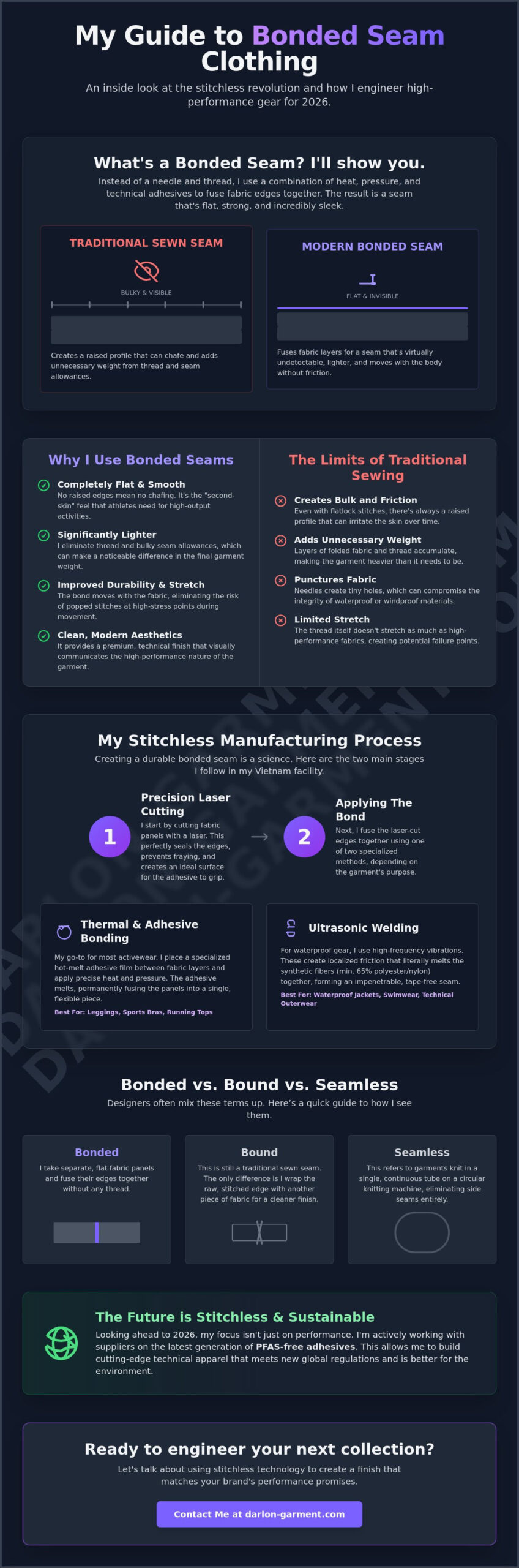
I often get asked by brand owners, “what is bonded seam clothing exactly, and why should I pay more for it?” It’s a fair question. To put it simply, bonded seams are created by joining fabric edges using a combination of heat, pressure, and technical adhesives rather than a needle and thread. This is what I call the stitchless revolution. It’s the primary reason high-end activewear looks so sleek and feels like a second skin. By 2026, as global markets move toward higher-value products, this technology is no longer just for Olympic athletes. It’s becoming the baseline for any brand that wants to be taken seriously in the performance space.
People often mix up bonded apparel with seamless or bound construction. Seamless garments are usually circular-knitted as a single tube. Bonded apparel, however, starts as flat fabric panels that I fuse together at the seams. I consider bonding the gold standard for 2026 because it offers a level of streamlined engineering that traditional sewing simply can’t match. It allows for a clean, aerodynamic finish that is essential for modern sportswear and swimwear.
Bonded vs. Sewn: A Quick Comparison
Traditional seams rely on thread to mechanically lock two pieces of fabric together. Bonding uses chemical or thermal fusion. Visually, the difference is night and day. A flatlock stitch, while functional, still leaves a raised profile on the skin. A bonded seam is virtually invisible and sits completely flat. This isn’t just about looks; it’s about physics. Removing the thread reduces the weight of the garment and eliminates the friction points that cause skin irritation. I often suggest a hybrid approach for my clients. We might use bonding for the visible, high-friction areas like waistbands and traditional sewing for high-stress structural points to balance cost and durability effectively.
The “Bound Seam” Confusion
This is where many designers and buyers get tripped up. A bound seam is just a standard sewn seam that has been encased in a piece of bias tape or fabric. It still uses thread. It still creates bulk. Technical bonding is an entirely different beast. The Science Behind the Bond often involves ultrasonic welding, where high-frequency acoustic vibrations create a molecular-level friction that fuses fabrics. If you want to spot a true bonded seam in the wild, look for the total absence of needle puncture holes. In my Vietnam facility, I use this technology to ensure the connection is as strong as the fabric itself. It’s a precise industrial process that separates premium gear from mass-market apparel.
The Science Behind the Bond: How I Create Stitchless Seams
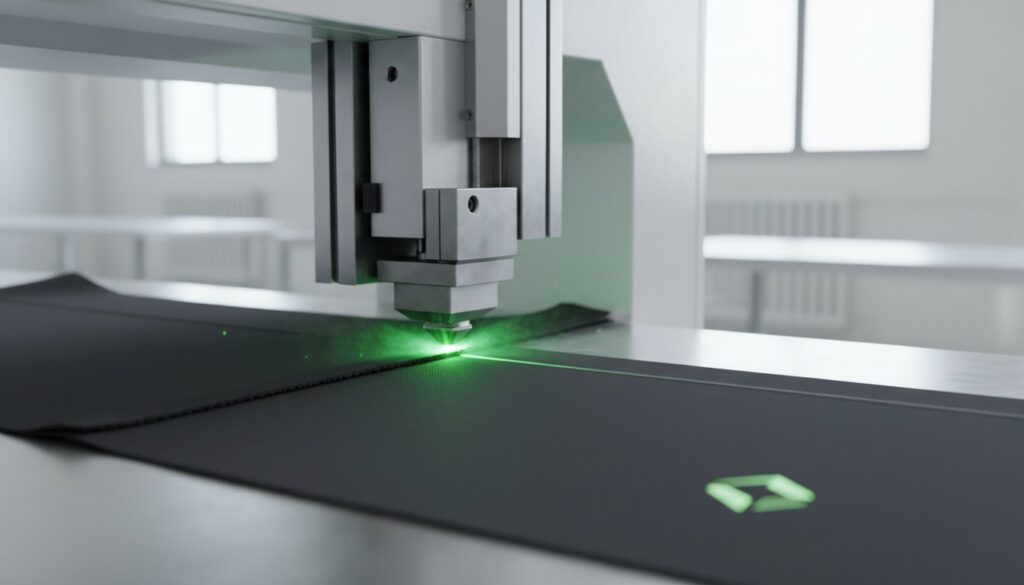
Creating high-performance gear requires more than just high-end fabric. It demands precision at the molecular level. Before I even think about joining panels, I use laser cutting to prepare the edges. Unlike traditional shears, a laser cauterizes the edge of synthetic fabrics as it cuts. This prevents fraying and creates a perfectly flat surface for the bond to grip. When clients ask me what is bonded seam clothing, I explain it’s as much about chemistry as it is about tailoring. If the edge isn’t perfectly clean, the bond will eventually peel under stress.
I focus on three primary methods to join fabrics in my factory. Each serves a specific purpose depending on the garment’s end use. Whether I am building a compression legging or a lightweight running jacket, the goal is always the same: a seam that is stronger than the fabric itself. It is the essential first step in understanding what is bonded seam clothing from a manufacturing perspective. By 2026, the demand for this level of precision has grown as brands move away from generic mass production.
Thermal and Adhesive Bonding
For most activewear, I rely on thermal and adhesive bonding. This involves placing a specialized hot-melt adhesive film between two layers of fabric. It’s a literal sandwich of material. I then use pressure-sensitive machines to apply consistent heat and force. This triggers a curing process where the adhesive penetrates the fibers and becomes a permanent part of the garment. Understanding how adhesives are used in textile manufacturing is vital because the chemistry must match the fabric’s elasticity. If the adhesive is too rigid, the seam will crack when the athlete moves. If it’s too soft, it won’t survive a standard wash cycle. You can see how I manage these technical stages in my production process.
Ultrasonic Welding
When I manufacture waterproof gear or swimwear, I often turn to ultrasonic welding. This method doesn’t use tape or film. Instead, high-frequency vibrations create localized friction that melts the synthetic fibers together. It’s an incredibly strong, waterproof connection that’s perfect for the high-chlorine environments of competitive swimming. It is important to remember that this only works if the fabric has a high enough synthetic content, usually at least 65 percent polyester or nylon.
Temperature control is the most critical variable on my factory floor. If the heat is off by even a few degrees, the bond fails. I calibrate my machines daily to ensure every garment maintains its structural integrity. My goal is always to create a seam that’s as flexible as the fabric itself. If you’re looking for a partner to help scale your next technical apparel project, feel free to explore my manufacturing capabilities.
Why Performance Brands Love Bonded Construction
When I talk to technical apparel designers, they aren’t just looking for a new visual style. They’re looking for a competitive edge. If you’ve ever wondered what is bonded seam clothing to a professional athlete, the answer is simple: it’s the difference between a successful race and a painful one. Traditional seams, even high-quality flatlock stitches, involve thousands of tiny thread loops. Under the conditions of heat, sweat, and repetitive motion, those threads act like sandpaper against the skin. By removing the thread entirely, I eliminate the primary cause of chafing in high-performance activewear.
Weight reduction is another critical factor that I prioritize in my factory. When you remove the thread and the extra fabric required for seam allowances, the garment becomes significantly lighter. In professional cycling or long-distance running, every gram matters. Beyond weight, bonded construction offers superior aerodynamics. Air flows smoothly over a flat, bonded surface without hitting the ridges created by traditional stitching. This is why triathlon and cycling brands insist on stitchless finishes for their elite gear. Plus, for products like rain jackets or swimwear, bonding provides an inherent advantage. Sewn seams are literally full of holes from the needle. Bonded seams are naturally airtight and watertight from the moment they’re fused.
Enhanced Durability and Recovery
There’s a common misconception that “glue” is weaker than thread. In my experience, the opposite is true when the process is handled correctly. Stitches concentrate tension on individual points where the needle punctured the fabric. Bonding distributes that tension evenly across the entire surface area of the seam. This makes the garment less likely to “pop” or tear during extreme stretching or high-intensity gym sessions. I verify this durability through a rigorous 50-cycle industrial wash test. If a bond can’t maintain its structural integrity after dozens of high-temperature washes, it doesn’t meet my production standards for 2026.
The Aesthetic Advantage
Beyond performance, bonding creates a “luxury” feel that’s impossible to replicate with a sewing machine. It allows for minimalist, clean lines that define high-end sportswear and sleepwear. I often use this technology to create hidden hems and internal pockets that look like they’re part of the fabric itself. This design freedom is one of my favorite parts of the manufacturing process. Bonding allows me to execute complex curves and sharp angles that a standard sewing machine arm simply can’t navigate. It transforms a basic piece of clothing into a highly engineered piece of equipment.
Is Bonding Right for Your Collection? Key Design Trade-offs
While I am a big advocate for stitchless tech, I always tell my clients that bonding isn’t a universal solution for every garment. If you’re building a high-volume, low-cost collection, traditional sewing is still your best friend. Bonding is a premium process. The machinery costs more to run, the adhesives are specialized, and the labor requires a higher level of technical training. When you ask what is bonded seam clothing from a budget perspective, you have to view it as an investment in performance rather than a way to save money. It is a strategic choice for brands aiming for the top tier of the market.
Fabric choice is the biggest gatekeeper. Natural fibers like 100% cotton or heavy wool are notoriously difficult to bond because they lack the thermoplastic properties of synthetics. The adhesive has nothing to “melt” into at a molecular level. If you try to bond a heavy cotton hoodie, the seam will likely peel after a few washes. Synthetics are where this tech shines. You should also consider repairability. If a thread snaps on a pair of leggings, I can simply restitch it. If a bond fails because of improper heat calibration or poor fabric choice, the garment is usually a total loss. There’s no way to re-glue a failed seam in a way that looks professional or maintains its integrity.
Fabric Compatibility
High-polyester and nylon blends are the ideal candidates for my bonding machines. These fibers respond beautifully to heat and create a permanent fusion. However, I usually advise against using highly textured fabrics like deep-ribbed knits or heavy fleece. The adhesive needs a smooth, consistent surface to create a reliable seal. When I work with elastane fabric, I have to be extremely careful with temperature. Too much heat can damage the elastic core, causing the seam to lose its recovery. I use specific low-temperature adhesive films to ensure the garment stays stretchy without compromising the bond strength. This level of detail is what defines what is bonded seam clothing in a professional production environment.
The MOQ and Production Lead Times
Manufacturing bonded apparel isn’t as simple as swapping out a sewing machine. It requires entirely different tech packs that specify adhesive widths, heat settings, and dwell times. My setup times in the Vietnam facility are longer for bonded items because every machine must be calibrated to the specific fabric weight of that production run. This usually results in higher Minimum Order Quantities (MOQs) compared to standard sewn items. My factory workers also undergo months of specialized training to operate the laser cutters and bonding presses. It’s a precision-heavy environment that doesn’t allow for the same speed-to-market as basic cut-and-sew operations. If you’re ready to see if your designs are a fit for this technology, you can contact me to discuss your project requirements.
Manufacturing Bonded Apparel in My Vietnam Facility
I’ve spent years refining my operations in Vietnam because the region has transformed into a global hub for high-tech apparel construction. When brands ask me what is bonded seam clothing, I don’t just show them a finished legging; I show them the infrastructure required to build it. With Vietnam’s garment exports forecast to reach between $48 billion and $50 billion in 2026, the industry here has moved far beyond basic sewing. We’ve pivoted toward high-value models that prioritize technical mastery over mass-market volume. This shift allows me to offer the precision that high-performance brands demand.
To ensure every bond is permanent, I implement a strict 4-stage inspection process. First, I test the fabric’s compatibility with our specific adhesive films. Second, I calibrate the laser cutters to ensure a cauterized, clean edge. Third, I perform a pull test on the first production samples to check for delamination. Finally, I conduct random industrial wash tests to simulate long-term wear. This methodical approach is why my partners trust me to handle their most complex activewear and swimwear projects without worrying about seam failure in the field.
Our Advanced Machinery
I’ve invested heavily in the latest European and Asian bonding technologies to stay ahead of rising labor costs and increasing technical requirements. My facility uses automatic bonding machines that provide consistent pressure and heat, which is impossible to achieve with manual pressing. We don’t just guess if a bond is strong enough. We measure bond strength in Newtons per centimeter. If a seam doesn’t meet our specific tension threshold during the testing phase, we recalibrate the entire production line before mass assembly begins.
Partnering for Success
Choosing the right fitness wear manufacturer is the most important decision you’ll make for your technical collection. My approach starts with detailed prototyping because getting the bond right at the sample stage prevents costly mistakes later. I need your tech pack to include specific fabric compositions and your desired seam widths so I can provide an accurate quote. If you’re ready to innovate and move away from traditional stitching to embrace what is bonded seam clothing in its most durable form, contact me at Dar Lon Garment to discuss how we can bring your next collection to life.
Elevate Your Performance Apparel for 2026 and Beyond
Transitioning to stitchless construction is a major step for any brand. It moves your collection from simple apparel into the world of high-performance equipment. We’ve explored exactly what is bonded seam clothing and why factors like laser-cutting precision and adhesive chemistry are non-negotiable for a durable finish. My Vietnam-based facility is equipped with advanced automatic bonding machinery specifically to meet these rigorous standards for global brands. I prioritize a 4-stage quality control process to ensure every garment I produce meets the zero-chafing, lightweight promises your athletes expect.
Success in this space requires a partner who understands the technical nuances of synthetic fibers and heat-sensitive films. I’ve built my factory to serve as the silent backbone for international partners who refuse to compromise on quality. If you’re ready to move past traditional needles and thread, let me help you build your next high-tech activewear collection. We can work together to refine your tech packs and choose the right synthetic blends for a flawless bond. I look forward to seeing how your brand pushes the boundaries of performance design.
Frequently Asked Questions
Will bonded seams fall apart in the wash?
Bonded seams won’t fall apart in the wash if the adhesive was cured at the correct temperature during production. When explaining what is bonded seam clothing to new clients, I emphasize that I run every design through a 50-cycle industrial wash test to ensure the bond holds up. You should advise your customers to avoid high-heat dryers. Excessive heat can reactivate the adhesive and cause the layers to separate over time.
Are bonded seams as strong as sewn seams?
Bonded seams are often stronger than sewn seams because they distribute tension across the entire surface area of the joint. Traditional needles create thousands of tiny puncture holes that can act as fail points under extreme stress. By removing these holes, I create a more resilient structure that won’t pop when an athlete moves through a full range of motion.
Can you use bonded seams on 100% cotton fabric?
I don’t recommend using bonded seams on 100% cotton fabrics. Natural fibers don’t have the thermoplastic properties required for a molecular-level fuse. The adhesive has nothing to melt into, which usually leads to the seam peeling after just a few laundry cycles. For the best results, I suggest sticking to synthetic blends with high polyester or nylon content.
Why is bonded clothing more expensive than regular clothing?
Bonded apparel carries a higher price point because the manufacturing process is significantly more complex than standard sewing. It requires specialized machinery like laser cutters and ultrasonic welders that are expensive to maintain. Additionally, the setup time for each production run is longer. My team has to calibrate heat and pressure settings for every specific fabric weight to ensure a perfect bond.
Is bonding the same as “seamless” technology?
No, bonding is different from seamless technology. Seamless garments are typically created on a circular knitting machine to produce a tube of fabric with no side seams. When I talk about what is bonded seam clothing, I’m referring to flat fabric panels that are joined together using adhesives. Bonding gives you more design flexibility for complex shapes that circular knitting can’t achieve.
Can I use bonded seams for swimwear?
Yes, bonding is an excellent choice for swimwear. Since there are no needle holes, the seams are naturally more water-resistant and provide a sleeker, more aerodynamic profile in the water. I use specialized adhesives designed to withstand constant exposure to chlorine and salt water. It’s a great way to give your swim collection a premium, high-performance feel.
What kind of adhesive is used in clothing bonding?
I primarily use thermoplastic polyurethane (TPU) films and hot-melt adhesives. These materials are chosen based on the stretch and weight of your fabric. For 2026, I make sure all adhesives are free of intentionally added PFAS to comply with new regulations in Maine and California. Using the right chemical composition is crucial for both safety and durability.
Do bonded seams lose their stretch over time?
Bonded seams won’t lose their stretch if the adhesive film is correctly matched to the fabric’s elasticity. I use high-recovery films for activewear that contains a lot of elastane. If a manufacturer uses a rigid film on a stretchy fabric, the seam will eventually crack. By selecting the right technical components, I ensure the seam moves and recovers exactly like the rest of the garment.